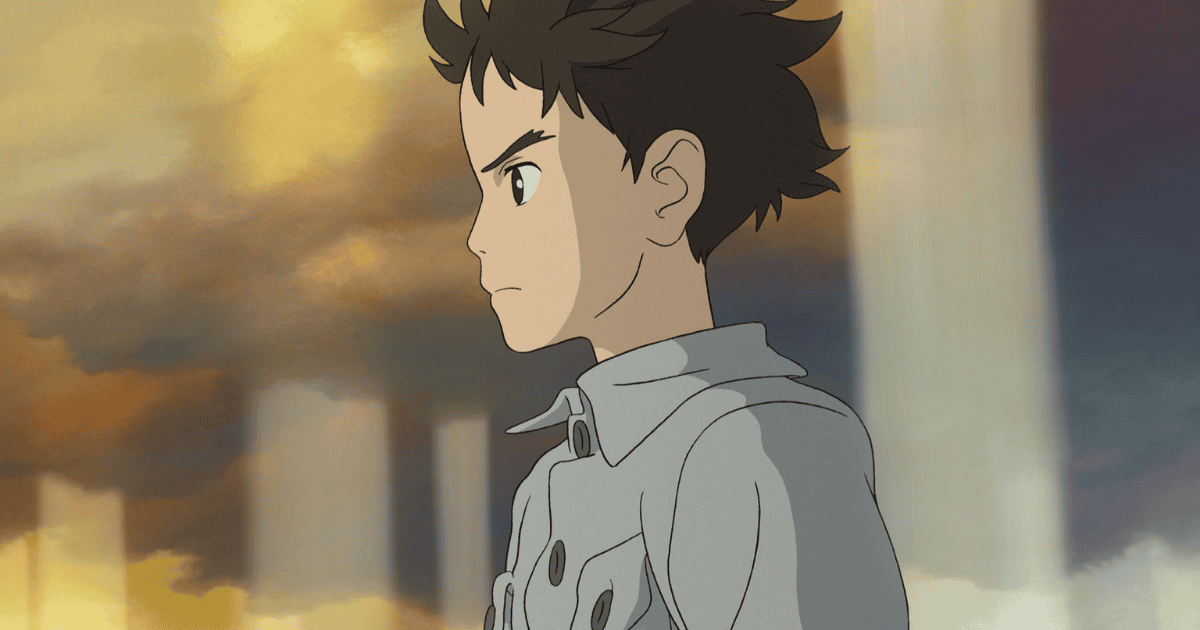
Just when the world was convinced Hayao Miyazaki had permanently retired following The Wind Rises, the legendary director orchestrated the ultimate sleight of hand. He returned to deliver a deeply personal, psychological labyrinth. The Boy and the Heron (Studio Ghibli Official), released in Japan on July 14, 2023, is far more than a stunning fantasy; it is a profound reflection on grief, legacy, and creation itself, grossing a massive 9.4 billion yen at the box office (Reference: Motion Picture Producers Association of Japan, Inc. ‘2023 National Film Industry Overview’, in Japanese).
While the Japanese title borrows from Genzaburō Yoshino’s classic novel (How Do You Live?), the film is not a direct adaptation. Instead, the physical book appears as an emotional anchor—a parting gift left by the protagonist Mahito’s mother. Reading it serves as a massive psychological turning point in the boy’s journey.
I was entirely fooled by Miyazaki’s retirement announcement, so the revelation of this new masterpiece filled me with absolute joy.
But this begs the question: “Why did he decide to make one last film?” The answer lies in the narrative framing. Crucially, the movie begins with Mahito’s monologue and ends with Mahito’s monologue.
In other words, the entire film is framed as a memory recalled by an older Mahito, making it an intensely subjective, deeply personal tale of survival.
Today, we are going to break down the sprawling plot of The Boy and the Heron and explore its most fascinating hidden themes. What kind of cinematic confession did Miyazaki really leave us?
*The following comprehensive guide contains major plot spoilers. If you haven’t seen the film, please bookmark this page, experience the magic for yourself, and return when you are ready.
*This is a translated version. The original (Japanese) is available here.
- Detailed Synopsis
At its core, the film follows an 11-year-old boy named Mahito Maki grappling with the traumatic loss of his mother during the Pacific War. Evacuated to the countryside, he struggles to accept his pregnant stepmother. A mysterious, crumbling tower and a deceptive gray heron force Mahito into a surreal underworld. Through his treacherous adventure, Mahito confronts his grief, rediscovers the bonds of family, and faces a universe-altering choice. This article provides a meticulous scene-by-scene breakdown and character map. - Deep Dive Analysis Points
We will serve as your hub to explore the film’s most staggering mysteries: “the fierce father figure,” “the mother of flames,” “the cosmic meteorite,” “the dark metaphor of the parakeets and pelicans,” “the encrypted 8 and 13 stones,” and “Toshio Suzuki as the model for the Gray Heron.” Links to our dedicated deep-dive articles are provided below.
On this pageContents
The Boy and the Heron (2023) Full Synopsis and Character Guide (Spoilers Ahead)
Quick Summary: A Journey Through Grief
If you need a rapid refresher, here are the crucial milestones that define The Boy and the Heron:
-
The Tragedy and Evacuation
The story follows 11-year-old Mahito. After his mother perishes in a horrifying hospital fire during the Pacific War, Mahito and his wealthy father, Shoichi, evacuate Tokyo for the countryside estate of his mother’s family. -
The Unwanted Stepmother
Upon arriving, Mahito discovers his father has married Natsuko—his late mother’s younger sister—who is already pregnant. Paralyzed by grief, Mahito fiercely resists accepting her as his new mother. -
The Gray Heron’s Whisper
Isolated and depressed, Mahito is lured by a grotesque gray heron toward an abandoned, sealed tower on the estate. The bird torments him with a chilling whisper: “Your mother is waiting.” -
Into the Abyss
When the pregnant Natsuko mysteriously vanishes into the forest, Mahito and a superstitious housemaid named Kiriko track her to the forbidden tower and cross the threshold. -
The Master of the Tower
Inside, they encounter a powerful, enigmatic old man who forcibly sucks them into the surreal “world below.” -
The World of the Parakeets
This bizarre underworld operates on entirely different laws of nature and is ruthlessly policed by hordes of giant, man-eating parakeets. -
The Fire Maiden and the Truth
Mahito forms an uneasy alliance with the Gray Heron and a powerful fire-wielding girl named Himi. He soon realizes that Himi is actually his own mother, existing in this realm as a child who was “spirited away” decades ago. -
The Architect
The mysterious old man ruling the tower is revealed to be Mahito’s Granduncle—a brilliant but mad architect desperately holding the crumbling dimension together. -
The Ultimate Choice
The Granduncle begs Mahito to inherit his god-like power and rebuild a pure world. Mahito boldly refuses, accepting his own flaws and choosing to return to his flawed, painful reality. -
Moving Forward
The tower collapses. Two years after the war concludes, a healed Mahito leaves the countryside with his father, Natsuko, and his new baby brother, finally ready to live his life.
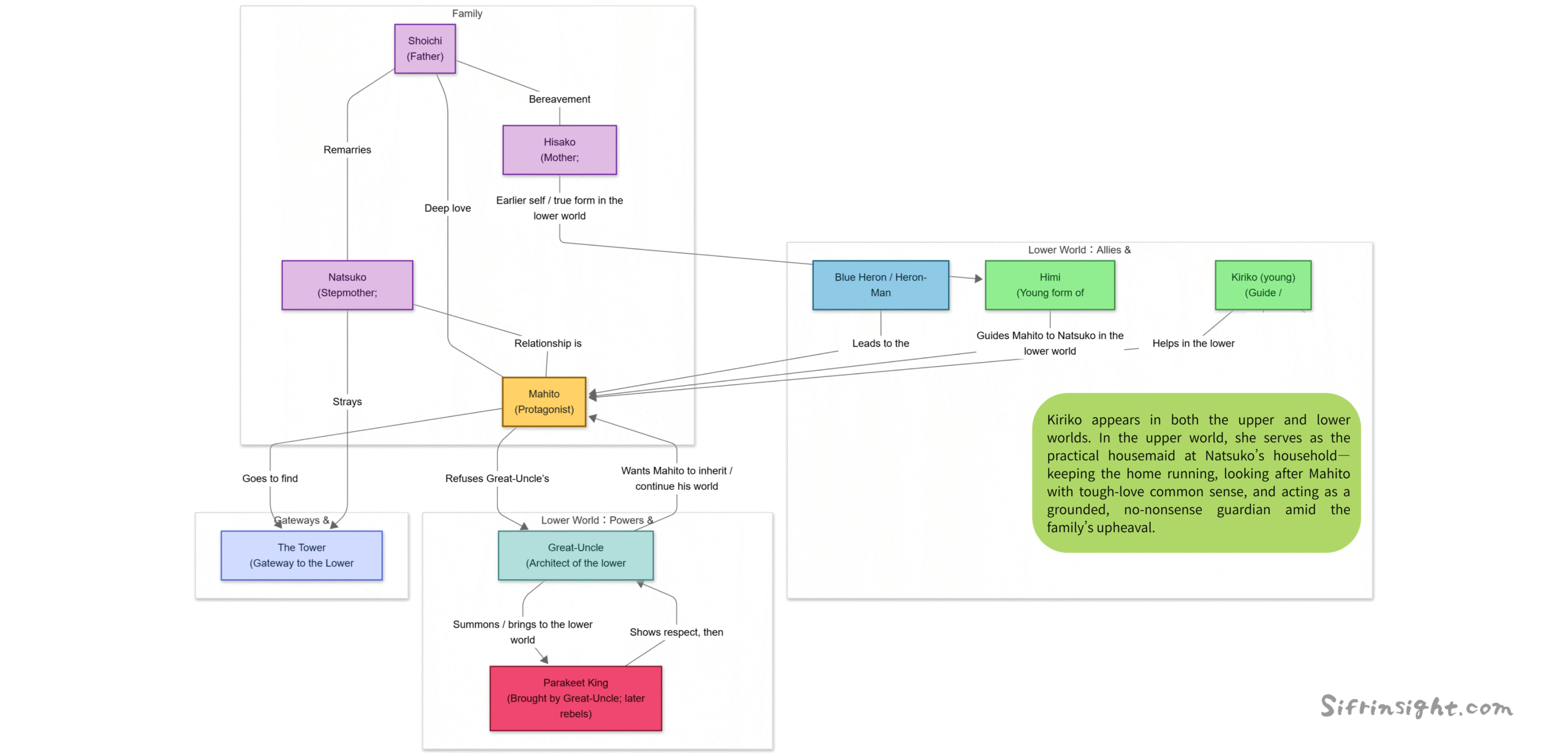
Character Map: The Inhabitants of the Tower
Thematic Foundation: Healing and Metaphor
On the surface, the central narrative thrust of The Boy and the Heron is simple: a traumatized boy, Mahito, must navigate the agonizing stages of grief to finally accept his mother’s death and embrace his stepmother, Natsuko, as his true family.
However, the surreal “world below”—a pocket dimension constructed by the obsessively brilliant Granduncle—acts as a powerful, multi-layered metaphor for Hayao Miyazaki’s own creative universe. It is a psychological landscape where memories, magic, and trauma collide.
The time-bending reunion between Mahito and his biological mother, Hisako (existing in the underworld as the fierce fire-maiden Himi), provides absolute emotional closure. Her mastery over fire poetically reclaims the very element that claimed her life in the hospital bombing.
To complicate this masterpiece further, Miyazaki deliberately fragments his own psyche across the cast. Elements of the master director are subtly projected onto Mahito, his father Shoichi, and the god-like Granduncle, demanding that the audience actively participate in deciphering the film.
Detailed Synopsis: The Descent into the Underworld
The Boy of Loss and the Mysterious Tower
The nightmare begins in the fiery ruins of Tokyo. Eleven-year-old Mahito Maki races through the burning streets, helplessly watching the hospital housing his mother collapse in a sea of flames. A year later, deep into the Pacific War, Mahito and his wealthy industrialist father, Shoichi, evacuate the devastated city for the lush, rural estate of his late mother’s family.
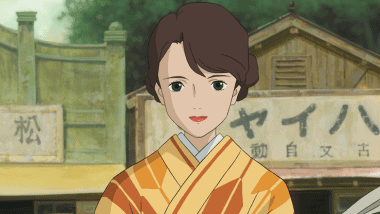
Upon arriving, Mahito faces a jarring new reality: his father has already married Natsuko, his late mother’s younger sister. She is pregnant and eager to welcome him. Suffocating under the weight of unresolved grief, Mahito silently rejects her affection, retreating inward.
Wandering the sprawling, overgrown estate, Mahito is relentlessly stalked by a menacing gray heron. The bird leads him to a decaying, sealed tower hidden deep in the woods. When Mahito attempts to pry open the barricaded entrance, he finds it impossible to breach.
Natsuko later warns him about the tower’s dark history. It was erected around a fallen meteorite by her eccentric Granduncle, a brilliant man who “went mad” from reading too many books before vanishing entirely inside the structure.
Despite the warm, bustling environment provided by the estate’s elderly maids and Natsuko, Mahito’s depression deepens, and the hypnotic pull of the forbidden tower grows stronger.
The Gray Heron’s Attack
Mahito’s first day at the local rural school is a disaster. Driven to class in a flashy Datsun by his fiercely protective father, Mahito instantly becomes a target for the local boys. After a brutal fistfight on the way home, a bloodied Mahito makes a shocking, desperate decision: he picks up a jagged rock and violently smashes it into the side of his own head.
Returning to the estate with a massive, self-inflicted head wound, Mahito secures an excuse to isolate himself in his room. His furious father threatens to tear the school apart, completely unaware of his son’s dark manipulation.
While bedridden and feverish, the gray heron invades Mahito’s bedroom window. The beast horrifies the boy by speaking with a raspy, human voice, mocking him with a sinister plea: “Mahito, help me.” It then drops a psychological bomb: “I will guide you to your mother… she is waiting for help.”
Realizing the bird is a genuine threat, Mahito methodically carves a deadly bow and arrow, fletched with the heron’s own discarded feathers, preparing for war.
Inside the Tower
During his recovery, Mahito discovers a copy of the novel How Do You Live? left specifically for him by his late mother. Reading her heartfelt dedication breaks down his emotional walls, allowing him to finally process her love and begin accepting her death.
At that exact moment, panic erupts across the estate. A visibly ill Natsuko has wandered off into the woods.
Armed with his bow, Mahito plunges into the forest, shadowed by Kiriko, one of the brave, superstitious elderly maids. They arrive at the tower to find its massive stone doors ominously wide open.
The heron’s voice echoes from the darkness: “I have been waiting for you.” Mahito steps into the abyss. Kiriko, terrified but fiercely protective, refuses to let him go alone.
Inside an illusionary library, the heron presents the figure of Mahito’s mother sleeping on a couch. But as Mahito touches her, she violently melts into a puddle of viscous liquid. The heron cackles, “What a shame. It was a good creation, too.”
Boiling with rage, Mahito fires his custom arrow. Guided by the heron’s own feather, it strikes perfectly, piercing the bird’s beak. The majestic heron deflates, grotesquely revealing its true form: a bald, big-nosed, cynical little man trapped in a bird suit.
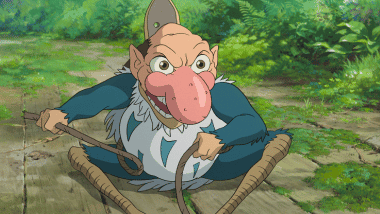
Mahito holds the Heron Man at arrow-point, demanding to be taken to Natsuko.
Before the Heron Man can refuse, the disembodied voice of the Granduncle booms from the heavens, commanding the bird to act as Mahito’s guide. The floor instantly liquefies, and Mahito, Kiriko, and the Heron Man are violently sucked into the underworld.
The World Below
Mahito awakens on the shores of an impossible ocean, surrounded by ancient sailing ships drifting on the horizon.
Here, he encounters a tough, magical fisherwoman who effortlessly cuts through giant fish. Recognizing her fierce spirit, Mahito realizes this young warrior is actually the elderly maid, Kiriko, existing in her prime.
That night, Mahito witnesses a breathtaking spectacle: thousands of pure white, bubble-like spirits called “Warawara” float toward the sky. Kiriko explains they are ascending to the “world above” to be born as human souls.
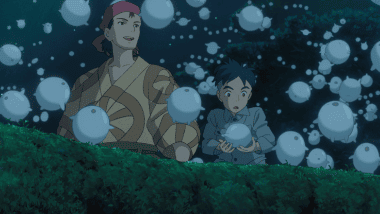
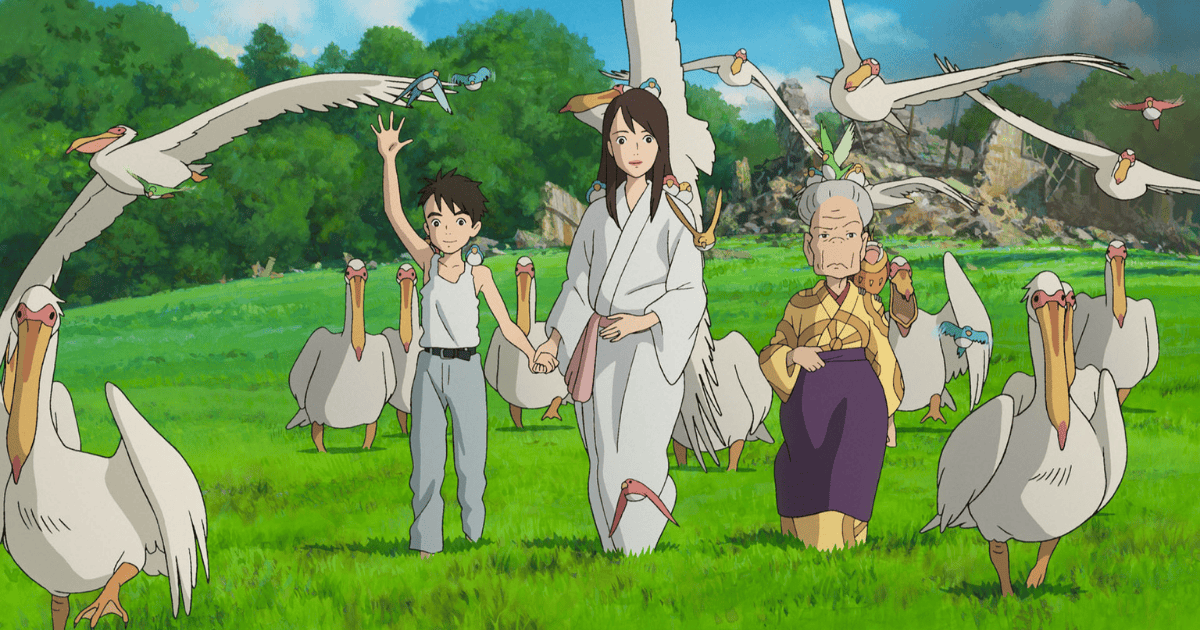
The beauty is shattered when a starving flock of giant pelicans descends, brutally devouring the helpless Warawara. Suddenly, a brilliant explosion of fireworks lights up the dark. Lady Himi, a powerful fire-maiden, obliterates the pelicans with magical flames, though some Warawara perish in the crossfire.
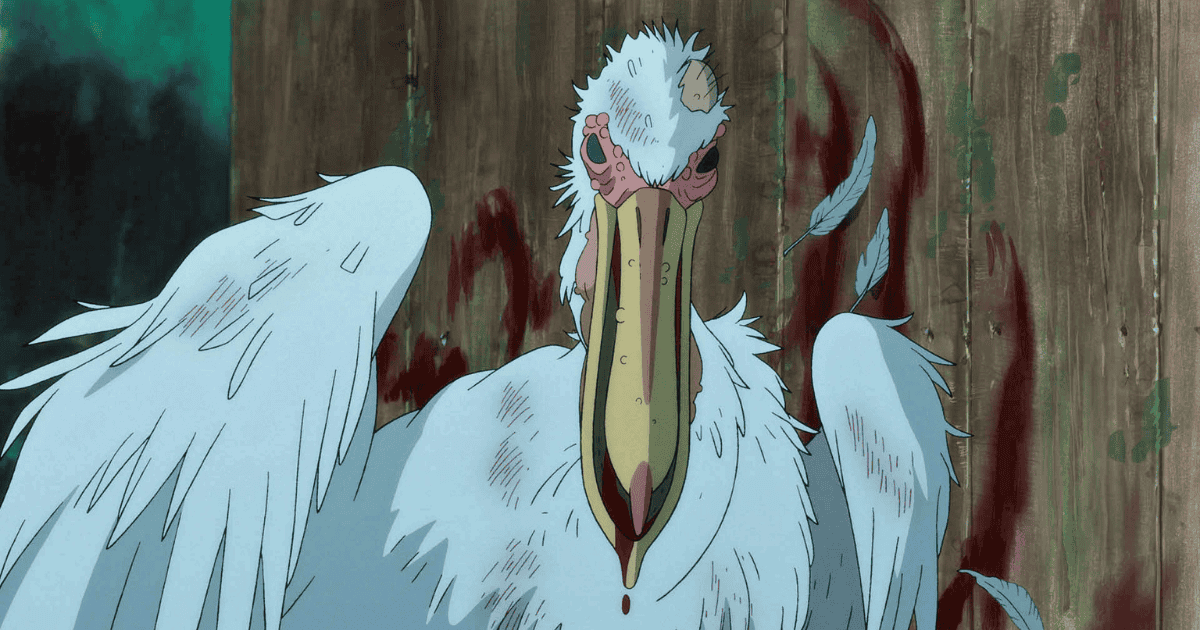
Later, Mahito finds a dying pelican. The bird confesses that his kind were trapped in this cursed realm by the Granduncle, forced to eat the Warawara simply to survive. Understanding the tragic, inescapable cycle of this ecosystem, Mahito respectfully buries the beast.
The Heron Man finally catches up. Reluctantly following Kiriko’s advice, Mahito accepts the deceitful bird as his guide. Armed with a protective wooden talisman carved in the shape of the elderly Kiriko, Mahito marches deeper into the realm to find Natsuko.
Meanwhile, in the real world, a frantic Shoichi arms himself with a sword and searches the estate. He uncovers the tower’s true, alien origin: it was built to conceal a cosmic meteorite. He also learns the chilling fact that Mahito’s mother, Hisako, disappeared into this exact dimension for an entire year when she was a child.
Natsuko’s Rejection
Mahito and the Heron navigate a perilous landscape dominated by massive, carnivorous parakeets. During a stealth mission gone wrong, Mahito is rescued by the fiery Lady Himi.
When Mahito reveals he is hunting for a woman named Natsuko, Himi instantly recognizes the name: “My sister!” Himi is, in fact, Mahito’s mother, Hisako, existing in this dimension as a young girl.
Himi leads Mahito to the “Corridor of Time,” a metaphysical hallway lined with doors leading to different eras and realities. She opens the door to Mahito’s present day, urging him to escape. Mahito refuses, absolutely determined to bring Natsuko back.
Himi warns him that Natsuko ventured to this realm intentionally to give birth in the spiritual delivery room. When Mahito finally breaches the sacred delivery chamber, the paper wards attack him.
Awakening in agony, Natsuko screams at Mahito: “I hate you! Go away!” It is a brutal, heart-wrenching moment. Mahito realizes the immense psychological pressure Natsuko has been burying. Instead of running, Mahito finally shatters his own emotional barrier, screaming back, “Mother! Let’s go home!”
Before they can embrace, the magic of the chamber forcibly expels them.
The Granduncle’s World
Mahito regains consciousness bound and gagged in the parakeets’ chaotic kitchen, mere moments from being butchered. The Heron Man stages a frantic, clumsy rescue, and the two rush to find Himi.
The realm is collapsing into political chaos. The fascist Parakeet King has captured Himi. He plans to leverage her—and the fact that Mahito committed heresy by entering the delivery room—to overthrow the Granduncle and seize absolute control of the dimension.
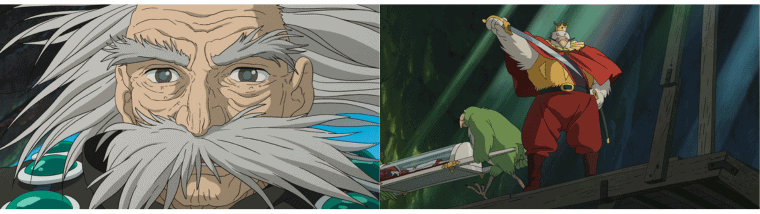
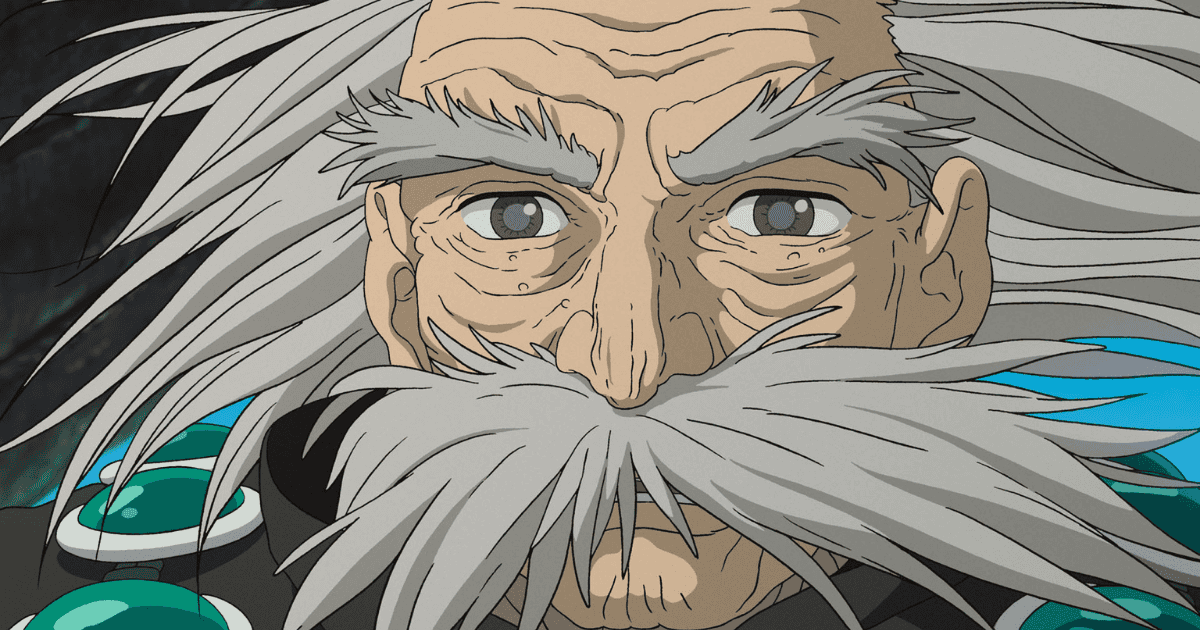
Evading the parakeet army, Mahito and the Heron finally breach the celestial floating garden. There, Mahito stands face-to-face with the architect of the universe: the Granduncle.
“Isn’t it wonderful!”
The Granduncle reveals that his magical universe is rotting from the inside out. He desperately pleads with Mahito—the only living blood relative possessing the purity to wield the magic—to inherit his throne. He offers Mahito 13 untainted, celestial stones to build a new, perfect world free of malice.
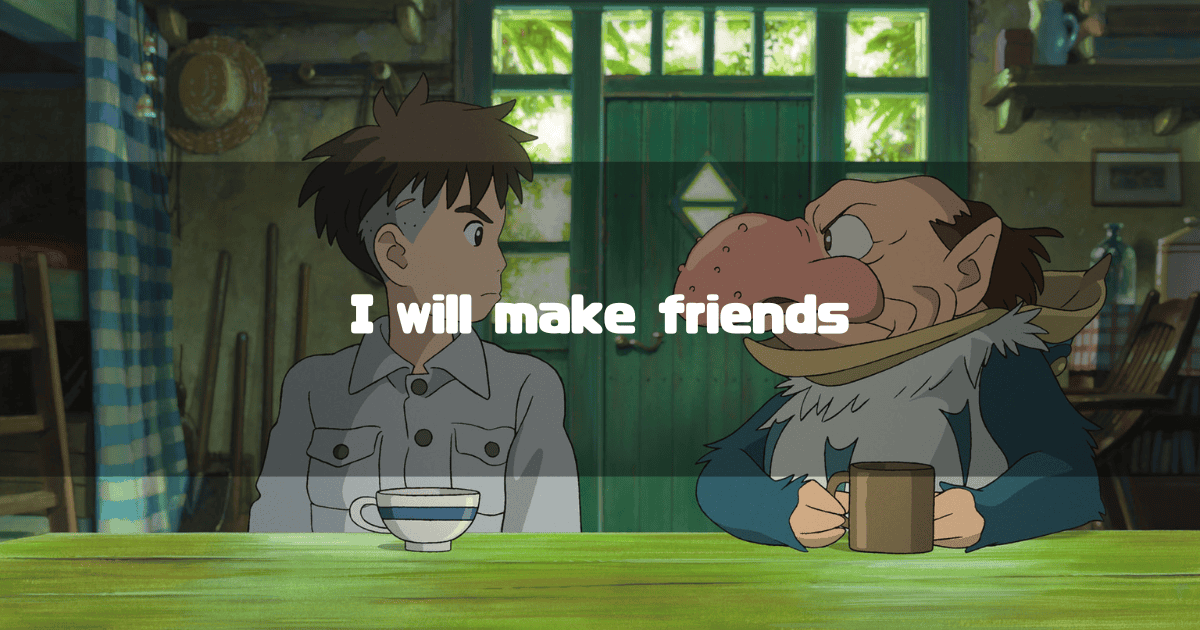
Mahito looks at the scar on his own head. He confesses his own capacity for malice and rejects the stones. He chooses to return to his flawed, painful, but beautiful reality to live alongside his new friends, like the Heron.
Mahito expresses both sides of this choice directly in the film’s dialogue: he acknowledges his own “malice,” then chooses to make friends instead. I examine those lines in The Boy and the Heron quotes in Japanese and English.
Outraged by the rejection, the Parakeet King storms the garden, screaming, “I will be the one to build the empire!” He frantically stacks the stones himself, but his inherent greed shatters the delicate balance. The universe instantly begins to tear itself apart.
Accepting the inevitable end of his creation, the Granduncle urges Mahito and Himi to flee to the Corridor of Time.
As reality crumbles, they reunite with Natsuko and Kiriko at the dimensional doors. Himi prepares to enter the door leading to the past. Mahito begs her to stop, warning her that returning to that timeline means she will eventually burn to death in the hospital.
Himi smiles radiantly, completely devoid of fear. “Isn’t it wonderful? To give birth to you, Mahito.”
With tears of acceptance, Mahito, Natsuko, and Kiriko step through the door to the present, while Himi embraces her fiery destiny. The tower collapses into rubble.
Two years later, the war has ended. Mahito, fully healed and smiling, packs his bags. He leaves the countryside estate with his father, his mother Natsuko, and his new baby brother, stepping confidently into the future.
The Boy and the Heron (2023) Deep Analysis: Unlocking the Mysteries
The Father, the Flame, and the Meteorite
As noted earlier, framing the entire film through Mahito’s retrospective monologue was a brilliant, unprecedented directorial choice by Miyazaki. But equally groundbreaking is the film’s fierce, proactive portrayal of a father unapologetically loving and protecting his son.
While a father figure technically exists in Ponyo, he is almost entirely absent. In The Boy and the Heron, we see Shoichi wielding a sword, aggressively defending Mahito. Why did Miyazaki suddenly feel compelled to highlight this dynamic?
Simultaneously, the film is an exhaustive exploration of “motherhood.” While echoes of Miyazaki’s real-life mother permeate his entire filmography, she has never been the absolute focal point like this.
Miyazaki presents us with four distinct manifestations of the mother figure: the tragic biological mother, the haunting water-illusion, the vibrant fire-maiden (Himi), and the struggling stepmother (Natsuko). This intense fracturing is entirely deliberate.
And then, we have the cosmic elements: the omnipotent Granduncle and the mesmerizing meteorite that triggered his madness.
While official documentaries confirm the Granduncle was heavily modeled after Miyazaki’s late mentor, Isao Takahata, the character onscreen feels far more complex. He doesn’t act strictly like Takahata.
So, who does the Granduncle truly represent? And what does the meteorite symbolize in the real world?
I have compiled a massive, philosophical breakdown of these exact questions. Dive into our comprehensive breakdown here: The Three Miyazakis: Decoding the Granduncle and the Meteorite.
The Devouring Flocks: Parakeets and Pelicans
The sheer volume of birds in The Boy and the Heron is overwhelming.
While you can certainly enjoy the film without overthinking them, the aggressive, predatory nature of the pelicans and parakeets practically begs for psychoanalysis.
The critical clue is understanding that the Granduncle represents both Isao Takahata and aspects of Hayao Miyazaki himself. With that established, the fact that both bird species are depicted as insatiable “devourers” takes on a dark, meta-textual meaning.
These flocks are a brilliant, agonizing metaphor for the guilt of “devouring the talent of young animators” to feed the Ghibli machine. Read the full psychological deep dive here: Devouring Talent: The Dark Metaphor of the Parakeets and Pelicans.
The Cipher of the “8” and “13” Stones
During the climax, the Granduncle presents Mahito with exactly 13 pure stones to balance the universe. It is widely accepted by film critics that these stones represent Hayao Miyazaki’s directorial filmography. However, if you count only his official Ghibli features, the math doesn’t quite equal 13.
While it is easy to dismiss the number as arbitrary, a closer, rigorous examination of his career reveals that the number “13” aligns perfectly with his true output.
To crack this code, we must also identify the significance of the number “8”—the exact number of crumbling stones the Granduncle had already stacked before Mahito’s arrival.
By factoring in Isao Takahata’s foundational role in Miyazaki’s career, the cipher opens up beautifully. Uncover the secret timeline in our dedicated article: Cracking the Code: The True Meaning of the 8 and 13 Malice-Filled Stones.
Toshio Suzuki: The Real-Life Gray Heron
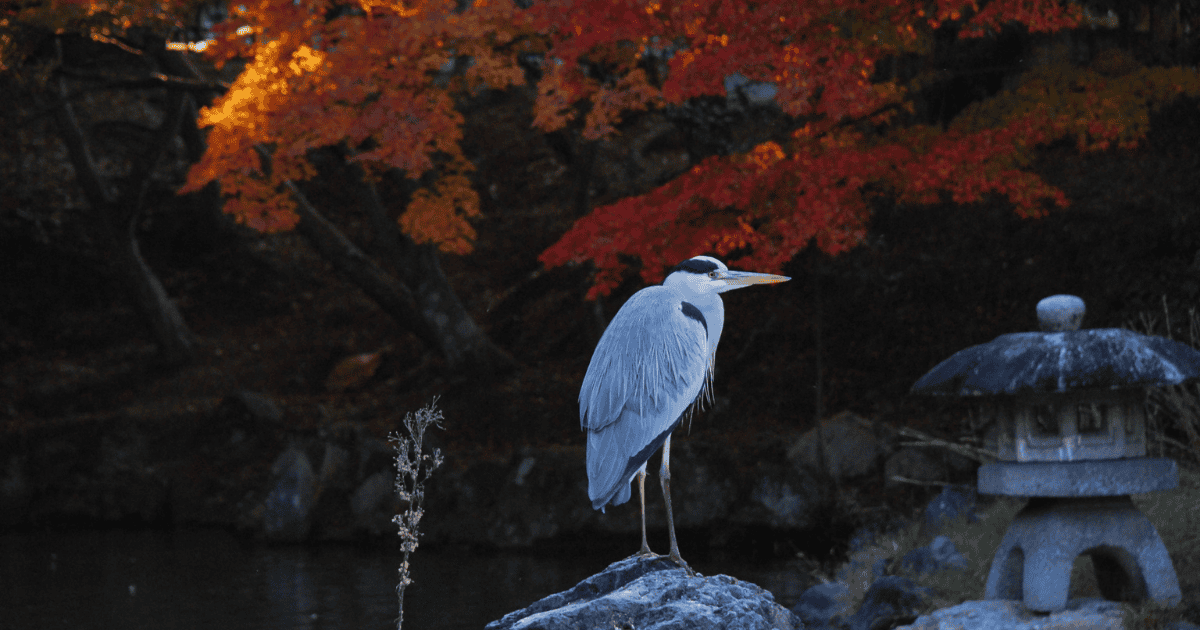
It is an open secret that the deceitful, aggravating, yet ultimately fiercely loyal Gray Heron (Heron Man) is modeled directly after Studio Ghibli’s legendary producer, Toshio Suzuki.
This has been confirmed across numerous interviews and documentaries. But why did Miyazaki choose to portray his lifelong partner as a sagi (a Japanese word meaning both “heron” and “fraud/swindler”)?
When you look back at the chaotic, high-stakes history of Studio Ghibli, and the aggressive, brilliantly manipulative tactics Suzuki employed to keep Miyazaki and Takahata afloat, the nickname makes perfect, hilarious sense.
Explore these jaw-dropping corporate bluffs here: The Masterful ‘Frauds’ of Toshio Suzuki That Built Studio Ghibli.
Without Suzuki’s cunning “fraudulent” skills, Studio Ghibli would have crumbled decades ago, and the world would have been robbed of cinematic history. He is the ultimate wingman.
Can you name the movie before the scene comes into focus?
Put your visual memory to the test with a blurred Studio Ghibli scene.

Reader Comments