
Makoto Shinkai’s Your Name (Official) isn’t just a beautifully animated romance; it’s a desperate fight against an inescapable tragedy. When it hit theaters in 2016, following the massive success of The Garden of Words, audiences were completely swept away by its visual splendor.
I actually missed the opening day, and before I knew it, the film had exploded into a cultural phenomenon. A bit of a contrarian at heart, I waited over a month before finally stepping into the theater. I strictly avoided all spoilers during that time, which allowed me to experience the sheer emotional weight of the story completely blind.
Today, let’s dive into one of the film’s most glaring mysteries: why did Mitsuha’s father, the mayor of Itomori, finally issue the evacuation order at the climax? Personally, I never fully bought the surface-level explanation for his sudden change of heart. I suspect many fans share this exact frustration.
To truly understand this pivotal moment, we need to unearth the hidden narrative running beneath the surface of Your Name.
But before we crack open that theory, let’s review the standard interpretation of the climax.
*This is a translated version. The original (Japanese) is available here.
- The True Catalyst for the Evacuation Order
Surface-level logic implies the mayor yielded to his family’s pleas. In reality, the mayor—while actively body-swapped with his late wife, Futaba—likely made the call after hearing Mitsuha’s desperate warnings about the comet. - The Dark Past Hidden in the Mayor’s Words
When he scoffs, “Are delusions the Miyawizu bloodline?” and confesses, “I couldn’t save her,” the film hints that the mayor previously witnessed his wife’s future-sight “delusions” and still carries the guilt of failing to prevent her tragic fate. - The Miraculous Reunion of Four Generations
The climactic office scene is much more than a political debate. It secretly unites four generations of Miyamizu women in one room: Mitsuha, Yotsuha, Grandmother Hitoha, and Mother Futaba (operating inside the mayor’s body). This is the true emotional core of Your Name. - The Bicycle Anomaly and Shifting Worldlines
Teshigawara’s complete amnesia regarding the ruined bicycle proves a crucial sci-fi concept: Taki and Mitsuha didn’t simply “rewrite the future.” They jumped into an entirely different, parallel “worldline.” - Honoring Real-Life Tragedy
Deeply influenced by the Great East Japan Earthquake, Your Name grants its heroes a miracle without erasing the emotional weight of the disaster. By using branching worldlines, the film avoids the disrespectful trope of pretending the original tragedy “never happened.”
On this pageContents
Your Name (2016) Analysis: The Surface-Level Truth Behind the Mayor’s Order
If you take the film at face value, you can map out the mayor’s decision to evacuate the town through this sequence of events:
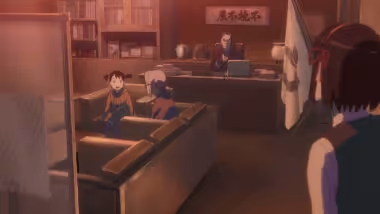
The sequence essentially breaks down like this:
- Mitsuha (while swapped with Taki) storms in to persuade the mayor.
- Hitoha and Yotsuha, despite initially doubting the comet strike, eventually pressure the mayor to sound the alarm.
- Mitsuha (now back in her own body, armed with Taki’s warning) confronts her father one last time.
- The mayor, worn down by these four consecutive appeals from his estranged family, finally issues the evacuation order.
This is the standard read. The scene where Mitsuha bursts into the office is framed as a triumphant “feel-good” moment, symbolizing a fractured family finally uniting to save their town.
But does that actually make sense for his stubborn character? Frankly, it didn’t convince me.
To reach a genuinely satisfying conclusion, we have to decode the cryptic remarks the mayor drops throughout the film. Once you understand the true meaning behind his dialogue, an entirely different version of Your Name emerges.
Your Name (2016) Deep Dive: The Mayor’s Cryptic Words and the ‘Hidden’ Storyline
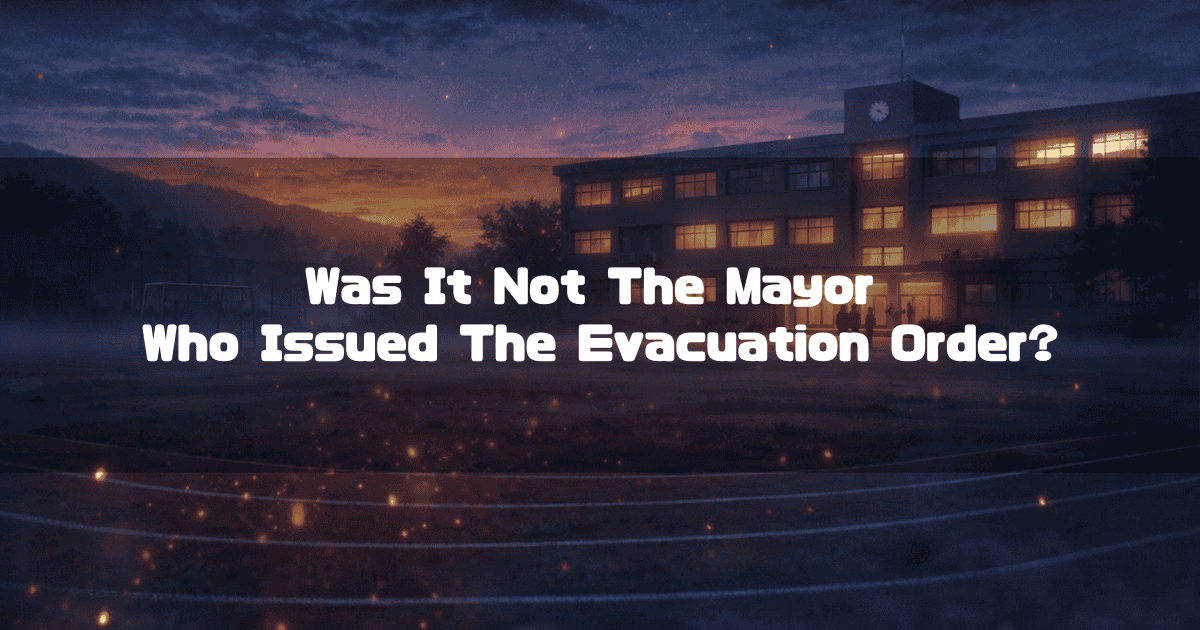
Clue #1: “Are Delusions the Miyamizu Bloodline?”
When Mitsuha (possessed by Taki) tries to warn the mayor, he fiercely rejects her, spitting out the line: “Are delusions the Miyamizu bloodline?”
Think about the implications here. The mayor must have witnessed another Miyamizu woman suffer from “delusions” long before Taki showed up. Who was it, and what did they say? He immediately follows this up by asking, “Who are you?”
The phrase “Who are you?” is Taki’s signature line. The fact that the mayor uses it signals that he is intimately familiar with the concept of body-swapping.
This repetition is especially striking because the same question appears at multiple turning points in the film. I examine Toshiki’s “Who are you?” alongside the other memorable dialogue in my guide to Your Name. quotes in Japanese and English.
Naturally, fans assume that the mayor himself had swapped bodies with someone in the past. However, I believe that theory only tells half the story. To clarify this, we need to examine his second cryptic line.
Clue #2: The Tragedy of “I Couldn’t Save Her”
When Taki drinks the sacred Kuchikamizake to force a final connection with Mitsuha, he plummets through the ancestral memories of the Miyamizu bloodline. During this sequence, we see the mayor—then a young Shinto priest—grieving right after his wife, Futaba, passes away.
In that flashback, the heartbroken mayor mutters a devastating confession: “I couldn’t save her.“
On the surface, it sounds like standard grief. But logically, it’s a very strange choice of words. As a Shinto priest rather than a medical doctor, he literally lacked the means to cure her of a fatal illness.
Here is where we need to read between the lines.
Could his intense regret stem from the feeling that “I failed to do what I was supposed to do“?
Imagine this scenario: Shortly before her death, Futaba swapped bodies with the future version of her husband (the mayor). The younger mayor from the past would have been entirely overwhelmed by Futaba’s sudden, bizarre predictions and behavior. Before they could make sense of her “delusions,” her illness worsened, and she passed away.
Looking back at how he dismissed her prophetic visions as mere madness, his lingering guilt transforms his grief into: “I couldn’t save her.“
The Breakthrough: Why the Order Was Actually Given
If we accept this theory, the dynamic of the climactic scene completely shifts.
The sequence essentially breaks down like this:
In this exact moment, the mayor is actively body-swapped with Mother Futaba. When Mitsuha barges in, she doesn’t just yell about a comet. She likely explains that she discovered this future by swapping bodies with a boy whose name she can’t remember. Recognizing this exact supernatural phenomenon from her own life, Futaba (inside the mayor’s body) instantly understands the gravity of the situation and initiates the evacuation.
Therefore, this isn’t merely a political victory or a standard family reconciliation. It is a profoundly moving scene where four generations of Miyamizu women are gathered in one room to save their town.
This brings us to the first major conclusion of this deep dive:
“The evacuation order was issued because the mayor had swapped bodies with Futaba.“
But we can’t stop the analysis here.
A much darker, more philosophical question remains: “Did the evacuation order actually save the people of Itomori?”
To answer this, we have to look at the “meta-structure” of Your Name, a detail crucial to unlocking Makoto Shinkai’s true message.
The key to this puzzle lies in Teshigawara’s baffling reaction to the bicycle incident.
Your Name (2016) Theory: Shifting Worldlines, Not Just the Future

The Bicycle Anomaly: Proof of a Timeline Shift
Near the end of the film, Taki (in Mitsuha’s body) fails to convince the mayor. Desperate, he borrows Teshigawara’s bicycle to race up the mountain to the shrine. He wrecks the bike along the way but manages to reach the summit during twilight (Katawaredoki) and reunites with the real Mitsuha. After exchanging vital information, they snap back to their own bodies. When Mitsuha later runs into Teshigawara and apologizes for destroying his bike, Teshigawara—who is calmly riding a moped—has absolutely no idea what she’s talking about. Why?
When dealing with time-travel narratives, science fiction usually gives us two models. Model A is the Back to the Future approach: changing the past literally rewrites a single linear future. Model B is the Steins;Gate approach: changing the past shifts the protagonist to an entirely new, parallel “worldline.”
If Your Name followed Model A, Teshigawara’s amnesia makes zero sense.
The definitive “change” in the story happens when Mitsuha and Taki reunite at the summit—an event that takes place after the bicycle was borrowed. Therefore, if they merely “rewrote the future,” Teshigawara should still remember lending out his bike. (Honestly, it’s also a mystery why the restored Mitsuha retained the memory of borrowing it in the first place). The only logical conclusion is that Your Name doesn’t feature a “changed future,” but rather a “jump to a new worldline.”
You could argue this is just Director Shinkai leaning into his sci-fi preferences (he heavily explored parallel worlds in The Place Promised in Our Early Days).
However, within the context of Your Name, this creative choice carries a heavy, real-world significance.
The Ethical Core: Why Real Tragedies Can’t Be Erased
The desire to “go back in time and fix the past” is a universal human fantasy, born directly from our helplessness in the face of sudden tragedy.
At its core, Your Name is undeniably shaped by the collective trauma of the Great East Japan Earthquake.
The miracle Taki and Mitsuha pull off resonates so deeply with audiences precisely because it fulfills our desperate wish to undo real-world disasters. This emotional catharsis is a huge reason why the film became a masterpiece.
But Shinkai knows that the miracle on screen is ultimately a fiction.
In our waking world, devastating tragedies happen. Lives are permanently lost. We cannot bend time to fix it, which is exactly why human life is so precious and must be protected in the present. The internal logic of Your Name respects this harsh reality.
In the original timeline of the film, the comet struck Itomori, and hundreds of people died. That horrific event is an undeniable fact.
Movies and anime offer us an escape, a temporary sanctuary from a painful reality.
But creators constantly wrestle with a moral dilemma: “How much of a lie is acceptable to feed the audience?” In animation, you can draw whatever happy ending you want. You can magically resurrect the dead to give the audience a sweet dream.
Instead, Your Name strikes a masterfully respectful balance. By utilizing “branching worldlines” instead of just “magically erasing the past,” the film acknowledges a bitter truth.
Yes, Taki and Mitsuha forced a miracle into existence. But in that original timeline, those lost lives never came back.
If we cannot treat real-world tragedies “as if they never happened,” a responsible storyteller shouldn’t treat fictional tragedies “as if they never happened” either.
This is the true brilliance of Makoto Shinkai’s Your Name: it delivers blockbuster entertainment while actively fighting against the disrespectful erasure of grief.
Your Name (2016): Final Thoughts and Timelines
We’ve gone down quite a rabbit hole, but let’s summarize the core takeaways of this analysis:
While the mayor’s sudden decision to evacuate Itomori feels slightly unearned on a surface level, decoding his cryptic dialogue reveals a brilliant twist: Mother Futaba likely hijacked the mayor’s body in the final act, making the evacuation order a beautifully poetic, unified family effort.
Furthermore, the paradox of Teshigawara’s bicycle proves that Taki and Mitsuha didn’t just alter their timeline; they leaped into a new worldline. This structural choice is Director Shinkai’s profound way of honoring disaster victims—refusing to let the audience lazily believe that tragedy can just be magically “undone.”
It’s a testament to the immense respect and ethical weight the creators poured into a medium that is so often dismissed as mere escapist fiction.
And there you have it. (If you want to dive deeper into other massive mysteries?like a full breakdown of the plot and exactly how the two protagonists managed to find each other in Tokyo?check out our Deep Dive Plot Summary and Character Analysis for Your Name).

Reader Comments