Charlie and the Chocolate Factory (Official Website) is a spectacular, visually eccentric fantasy film directed by Tim Burton, released in the United States on July 15, 2005. Based on the beloved 1964 children’s novel by Roald Dahl, the film operates as a dark comedy exploring family, trauma, and the psychological regeneration of an “adult who refuses to grow up.” The narrative unfolds through a bizarre, highly dangerous factory tour involving Charlie, a boy living in extreme poverty, and the enigmatic, deeply troubled factory owner, Willy Wonka.
In this article, we will provide a detailed chronological synopsis of the story before diving into a comprehensive psychological analysis. We will unpack the “cruel punishments inflicted on the children,” explore “Wonka’s paralyzing childhood trauma,” and explain why the entire tour is essentially an act of “revenge against his father.” But first, let’s review the basic production information.
*This is a translated version. The original (Japanese) is available here.
On this pageContents
Charlie and the Chocolate Factory (2005): Basic Information
Film Overview
| Release Date | July 15, 2005 (US) |
|---|---|
| Director | Tim Burton |
| Music | Danny Elfman |
| Original Work | Roald Dahl, Charlie and the Chocolate Factory |
| Production | Warner Bros. |
| Runtime | 115 minutes |
Main Characters and Cast
| Character | Actor | Character Overview |
|---|---|---|
| Willy Wonka | Johnny Depp | The eccentric, reclusive genius behind the world’s greatest chocolate factory. Beneath his flamboyant exterior, he hides severe childhood trauma and a deep-seated hatred for the concept of “family.” |
| Charlie Bucket | Freddie Highmore | A profoundly kind, humble boy living in extreme poverty near the factory. His absolute devotion to his impoverished family acts as the emotional anchor of the film. |
| Grandpa Joe | David Kelly | Charlie’s optimistic grandfather. He previously worked for Wonka before the factory was shuttered to human workers, and he serves as Charlie’s enthusiastic chaperone. |
| Augustus Gloop | Philip Wiegratz | An obese, gluttonous German boy. His entire existence is governed by an insatiable appetite for chocolate and sweets. |
| Veruca Salt | Julia Winter | The viciously spoiled daughter of a wealthy British nut mogul. She operates under the assumption that she can possess anything she demands. |
| Violet Beauregarde | AnnaSophia Robb | A hyper-competitive, arrogant American girl. She is obsessed with breaking records, winning trophies, and endlessly chewing gum. |
| Mike Teavee | Jordan Fry | A cynical, violent American boy obsessed with television and video games. He harbors a deep intellectual arrogance and despises candy. |
| Oompa-Loompas | Deep Roy | The diminutive, highly synchronized workers imported from Loompaland to run the factory. They serve as a Greek chorus, brutally satirizing the fallen children through elaborate musical numbers. |
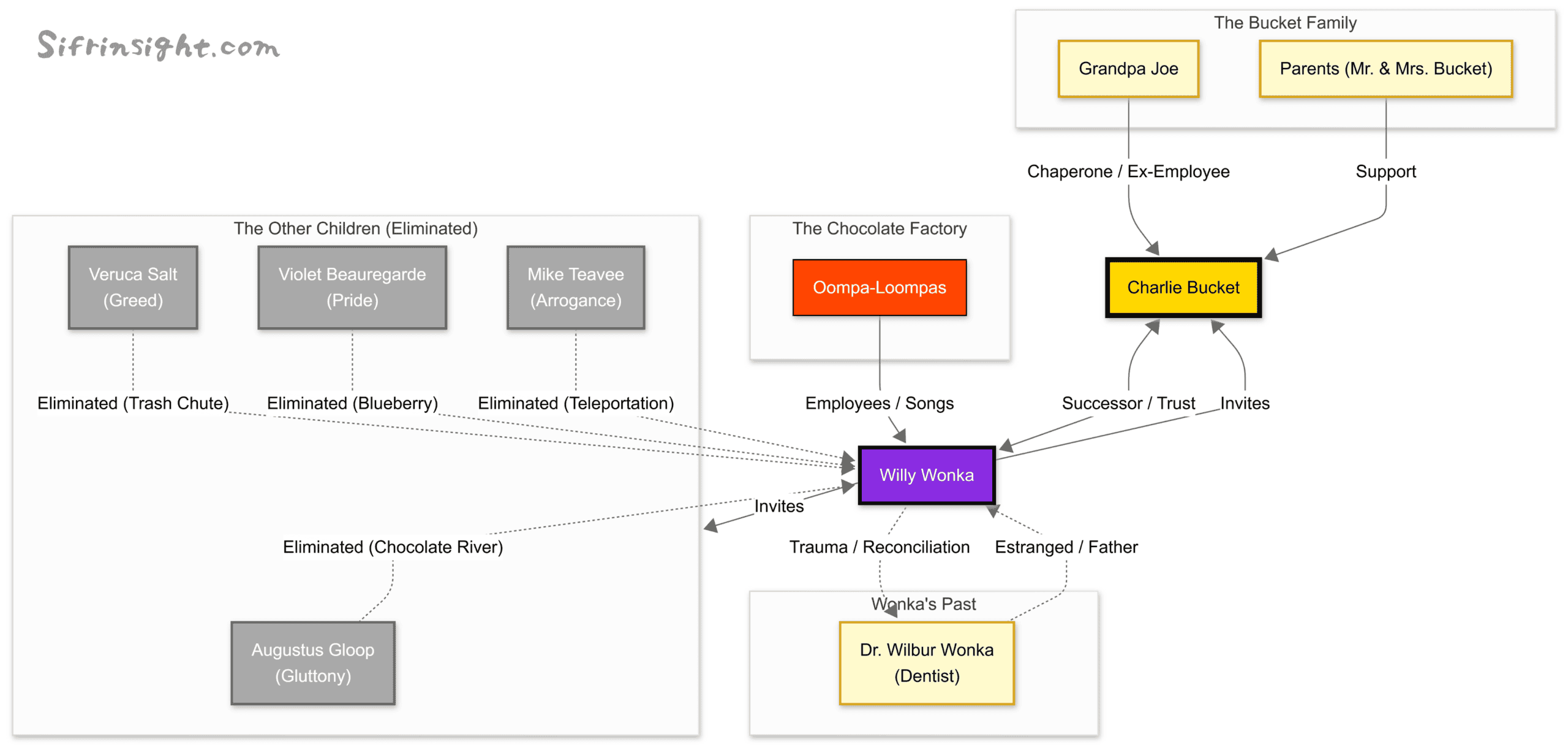
Character Map
Charlie and the Chocolate Factory (2005): Quick Synopsis (Spoiler-Free)

The story centers on Charlie Bucket, a boy living in crushing poverty with his parents and four bedridden grandparents in a tiny, leaning shack. Looming over their squalid town is the colossal, mysterious “Willy Wonka Chocolate Factory.” Decades ago, it employed thousands of locals, but after suffering from rampant industrial espionage, the paranoid Wonka fired every single human employee and locked the gates forever. Yet, bizarrely, the smoke stacks never stopped blowing, and massive shipments of innovative candy never stopped rolling out to the world.
One ordinary day, breaking his long silence, the reclusive Willy Wonka makes a global announcement: he has hidden five gleaming “Golden Tickets” inside ordinary Wonka Bars. The five children who find them will be granted unprecedented access to tour his magical factory, and one of them will receive an unimaginable, life-changing “Special Prize.”
As the world descends into a consumerist frenzy, the tickets are snapped up by four highly unpleasant children: a glutton, a spoiled heiress, a hyper-competitive gymnast, and an arrogant tech-geek. Against impossible mathematical odds, the impoverished Charlie finds the final ticket inside a chocolate bar bought with a single, lucky dollar bill he found buried in the snow. Accompanied by his Grandpa Joe, Charlie steps through the gates into a whimsical, highly dangerous wonderland.
Charlie and the Chocolate Factory (2005): Full Synopsis & Ending (Spoilers Ahead)
(*Warning: The following section contains a highly detailed breakdown of the plot, the fates of the children, and the emotional climax of the film. Proceed with caution.)
Introduction: The Golden Tickets and the Impoverished Boy
Charlie Bucket lives in a dilapidated, freezing house with his hardworking parents and his four elderly, bedridden grandparents. Looming in the distance is the massive, impenetrable Willy Wonka Chocolate Factory. Years ago, Charlie’s Grandpa Joe worked there until Wonka, betrayed by corporate spies stealing his secret recipes, fired his entire workforce and locked the factory down. Despite having no visible employees, the factory mysteriously continues to produce the world’s greatest sweets.
The world goes mad when Wonka announces the “Golden Ticket” contest. The first four tickets are found by children who embody the worst traits of modern parenting and excess: Augustus Gloop (gluttony), Veruca Salt (greed), Violet Beauregarde (arrogance), and Mike Teavee (cynicism). Charlie, whose family is so poor they survive on watered-down cabbage soup, can only afford one chocolate bar a year for his birthday. His birthday bar yields nothing. His grandfather’s secret savings also fail.
However, while walking home in a blizzard, Charlie finds a partially buried ten-dollar bill in the snow. He buys one final Wonka Bar and miraculously uncovers the fifth and final Golden Ticket. Accompanied by the ecstatic Grandpa Joe, Charlie joins the other awful children at the gates of the factory.
Development: The Cruel “Elimination” Game
Once inside, the children are introduced to the socially awkward, flamboyant Willy Wonka. He reveals that the factory is now staffed entirely by “Oompa-Loompas,” a tribe of diminutive workers rescued from a dangerous jungle. However, the tour quickly devolves into a terrifying, psychological elimination game designed to punish the children’s specific vices.
First, in the stunning Chocolate Room, Augustus ignores Wonka’s warnings and drinks directly from the chocolate river. He falls in, gets sucked into a massive industrial extraction pipe, and is eliminated. The Oompa-Loompas immediately perform a highly choreographed musical number mocking his gluttony.
Next, in the highly experimental Inventing Room, the fiercely competitive Violet steals an unperfected “Three-Course Dinner Gum.” Despite Wonka’s warnings, she chews it, triggering a disastrous side effect. She swells up into a massive, spherical purple blueberry and is rolled away by the Oompa-Loompas to be “juiced.”
In the Nut Room, Veruca Salt demands to own one of the highly trained worker squirrels sorting nuts. When her father fails to buy one, she storms the factory floor. The squirrels swarm her, physically tap her forehead, categorize her as a “bad nut” (empty inside), and violently drag her down a garbage chute leading to an incinerator. Her spineless father falls in after her.
The Twist: The Last Child Standing and Wonka’s True Intention
The group dwindles down to just Charlie and Mike Teavee. Wonka leads them to the highly advanced Television Room, where he has invented a machine that physically teleports chocolate bars directly into television sets. Mike, a cynical, violent tech-obsessive, is furious that Wonka is wasting revolutionary teleportation technology on candy. To prove his intellectual superiority, Mike forces himself into the teleporter. He is successfully transmitted but shrinks to the size of a paper doll. He is sent off to the “Taffy Puller” to be violently stretched back to a normal size.
Charlie, who remained respectful, quiet, and obedient, is the sole survivor. Wonka enthusiastically congratulates him and reveals the true purpose of the tour and the nature of the “Special Prize”: he is giving Charlie the entire factory.
Wonka explains that he recently discovered his first gray hair. Terrified of his own mortality and the death of his empire, he orchestrated the contest to find a pure, uncorrupted heir. However, there is a catch. Wonka demands that Charlie abandon his family entirely and move into the factory alone, arguing that “a chocolatier must run completely free” and that families are nothing but a hindrance to creative genius.
Charlie, deeply grounded in his love for his family, firmly rejects the offer: “I wouldn’t give up my family for anything. Not for all the chocolate in the world.” Completely shattered by this rejection, a depressed Wonka leaves Charlie behind and returns to his solitary empire.
Conclusion: The Father’s Trauma and True Reconciliation
Time passes. While Charlie’s family experiences a stroke of luck and begins to climb out of poverty, Wonka falls into a severe, crippling depression. His creative genius vanishes, and his candies begin to taste terrible. Desperate, he seeks out Charlie, who is working as a shoe-shiner. Charlie explains that a person’s strength comes from their family and offers to help Wonka confront his deepest trauma.
Through flashbacks, the audience learns the dark truth. Wonka’s father, Dr. Wilbur Wonka, was the most terrifying, prominent dentist in the city. He forced young Willy to wear horrific, head-encasing orthodontic braces and strictly forbade the consumption of any candy, brutally throwing Willy’s Halloween haul into an open fireplace. Driven by a rebellious, desperate curiosity, Willy secretly tasted a piece of chocolate and was instantly captivated. When his father violently rejected his dream of becoming a chocolatier, Willy ran away from home, dedicating his entire life to conquering the world with the very thing his father hated.
With Charlie’s quiet support, Willy returns to his childhood home to confront his father. Inside the sterile dental clinic, Willy makes a shocking discovery: the walls are absolutely covered in framed newspaper clippings detailing his massive global success. Despite the estrangement, his father had been obsessively, proudly tracking his son’s achievements for decades.
Dr. Wonka recognizes Willy not by his flamboyant clothes, but by examining his perfect teeth. The hardened, long-standing grudge shatters, and father and son share a quiet, awkward, but deeply emotional embrace.
Liberated from the suffocating psychological “curse” of his father, Wonka’s creative block lifts. He returns to Charlie and offers him the factory once again—but this time, under Charlie’s terms. The film ends with the entire, dilapidated Bucket family shack physically relocated inside the whimsical Chocolate Room. Wonka joins the impoverished family for dinner, having finally found both a worthy successor to his empire and the warm, loving family he spent his entire life running away from.
In-Depth Analysis: Decoding Tim Burton’s Psychological Nightmare
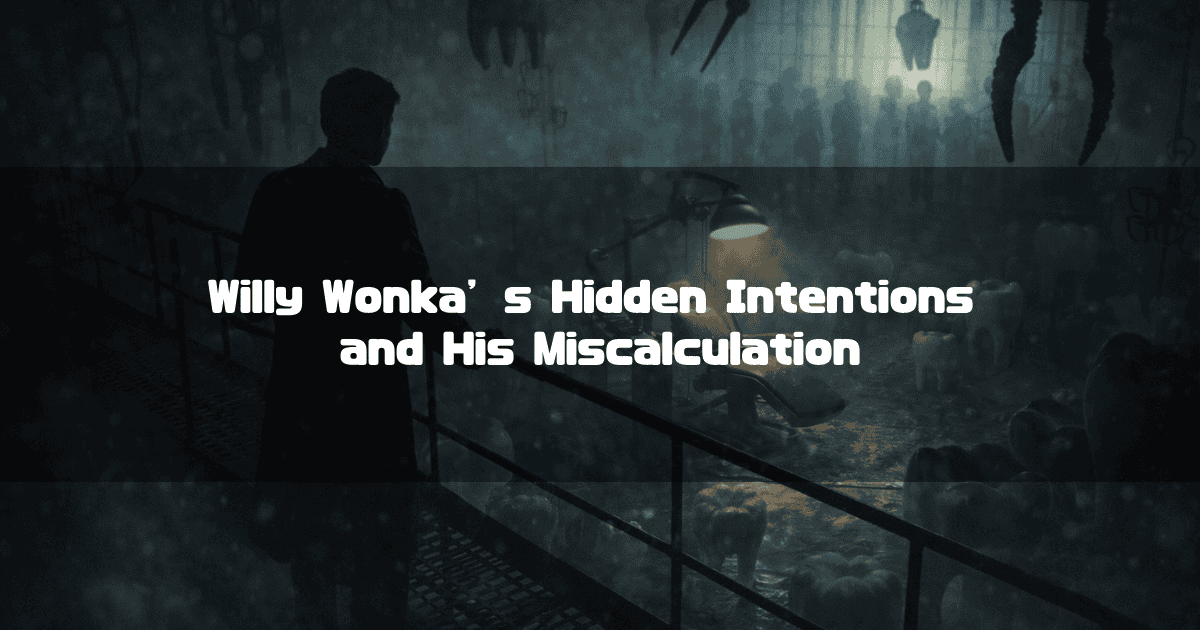
- Jealousy Disguised as Justice: Wonka’s Revenge on the “Parents”
The four eliminated children are obnoxious monsters, but crucially, they are fiercely affirmed and loved by their parents for exactly who they are. This unconditional affirmation is exactly what young Wonka was violently denied. His sadistic traps are not just moral punishments; they are acts of blinding “jealousy” directed at the children, and an act of brutal “revenge” against the parents who spoiled them. - The Quest for Immortality and a “Carbon Copy”
The entire contest was triggered by Wonka finding a single gray hair. Terrified of death, he wasn’t looking for a creative partner; he was hunting for a “copy of himself”—someone completely detached from family who could maintain the immortal brand of “Willy Wonka.” - Charlie’s Perfection as a “Transparent Vessel”
Why did Wonka specifically choose Charlie? Because unlike the other children whose identities were already cemented by their aggressive egos, Charlie was humble, unassuming, and “transparent.” Wonka viewed him as a blank canvas—the perfect psychological vessel to manipulate, dye with his own obsessions, and mold into a perfect clone.
The “Father” as a Deliberate Foreign Body: Tim Burton’s Malice
Before diving into a psychological analysis of the film, we must acknowledge a massive, undeniable premise: the entire backstory regarding Willy Wonka’s father (Dr. Wilbur Wonka) does not exist in Roald Dahl’s original novel. It is an invention created entirely for this film adaptation.
In the original 1964 book, Wonka is simply a whimsical, chaotic, and slightly dangerous magical guide. He lacks any deep psychological trauma. However, director Tim Burton intentionally injected a heavy, hyper-realistic, Freudian “foreign body” into the center of this colorful fairy tale: an adult man suffering from crippling Daddy Issues.
Why did Burton purposefully complicate a simple children’s story?
Because he wanted to fundamentally reconstruct the narrative. Burton transforms the film from a simple “morality play where bad children are punished” into the deeply personal “revenge fantasy of a traumatized, emotionally stunted adult.”
This “shadow of the father” is the absolute master key to decoding Wonka’s bizarre behavior. You cannot accurately discuss the cruel, sadistic gaze he directs at the touring families without understanding his psychological scars.
The Factory as a “Court of Condemnation” and a “Vent for Jealousy”
On a superficial level, Burton’s film operates just like the book: bad children do bad things and receive ironic, horrific punishments. However, when we dissect the psychology behind Wonka’s traps, we realize his actions are fueled by a deep, festering personal resentment.
Yes, Augustus, Veruca, Violet, and Mike are objectively terrible human beings. However, if you look closely at the dynamic between the children and their chaperones, a fascinating pattern emerges: they are never scolded, denied, or suppressed by their parents. In fact, their worst traits are celebrated.
Augustus’s mother proudly boasts that her son’s obesity is a sign of robust health. Veruca’s father bends over backward, mobilizing his entire workforce to secure his daughter a ticket. Violet’s mother lives vicariously through her daughter’s vicious competitive streak, completely enabling her arrogance. Mike’s father, while annoyed, passively surrenders to his son’s technological dominance.
In short, these are children who are entirely affirmed by their parents for “exactly who they are (even if they are sociopathic monsters).”
To Willy Wonka, this is the ultimate, unforgivable sin. He may not consciously realize it, but watching these children receive the absolute, unconditional parental affirmation that his strict father violently denied him is psychological torture. His core identity—his love for sweets—was brutally rejected. Watching these children be celebrated for their gluttony and greed rips open his deepest childhood wounds.
Therefore, the cruel, torturous traps are not just whimsical justice. They are the explosive manifestation of Wonka’s blinding “jealousy” toward the children. But the malice runs deeper.
By forcing the children into these agonizing, humiliating fates right in front of their chaperones, Wonka is acting as judge, jury, and executioner. He is condemning the “parents who failed to guide their children” and executing a proxy revenge against the very concept of “parenthood” itself.
The Pathology of the “Dentist Father” and Wonka’s Fear of Death
Why does Wonka despise the concept of “family” with such visceral intensity? The film provides the answer through terrifying, gothic flashbacks.
His father, Dr. Wilbur Wonka, was the most prominent dentist in town. He was a terrifying authoritarian who forced his son to wear nightmarish, cage-like braces and violently threw his Halloween candy into an open fire, preaching that “candy is the root of all cavities.”
This trauma permanently warped Wonka’s psyche. His decision to build the world’s largest, most magnificent chocolate factory is not merely a testament to his culinary genius; it is a massive, globally broadcast act of spite directed squarely at his father. He is screaming, “I will conquer the entire world using the exact substance you forbade me from touching.”
To cope with his trauma, Wonka refused to mature emotionally. He locked himself inside a massive, colorful “children’s room” (the factory) and shut out the adult world. However, the discovery of a single “gray hair” shattered his delusion. He was forced to confront the horrifying reality that aging and death are inescapable.
He didn’t organize the Golden Ticket contest because he wanted to mentor a child. He was hunting for a “carbon copy of himself.” He needed an heir who would discard all human connections and dedicate their entire existence to ensuring the immortal brand of “Willy Wonka” survived his physical death.
This is precisely why he demanded Charlie “abandon his family.” In Wonka’s warped worldview, “family” was an oppressive, destructive force that killed creativity and joy.
Why Charlie Was Chosen: The Allure of a “Transparent Vessel”
If Wonka’s motives were so sinister, why did he choose Charlie? The superficial, fairy-tale answer is simply “because Charlie was a good, polite boy.” But within the psychological framework of Burton’s film, the true reason is far more calculating: “Because Charlie lacked a massive, ego-driven identity.”
The other four children had identities carved in stone: “appetite,” “materialism,” “narcissism,” and “cynicism.” Their egos were fully formed and reinforced by their parents. They were already “someone,” meaning there was absolutely no room for Wonka to break them down and rebuild them into the “perfect clone” he desired.
In stark contrast, Charlie was poor, quiet, humble, and essentially “transparent.” He had no aggressive individuality or loud demands to be affirmed. He was simply a boy who loved his family.
To Wonka, this made him the ultimate prize. Charlie was a “colorless, transparent vessel” waiting to be filled. Wonka calculated that he could easily sever Charlie’s weak ties to the outside world, pour his own obsession with chocolate into the boy’s soul, and achieve true immortality through his new puppet.
Saved Because He Failed
However, Wonka’s sociopathic master plan hits a brick wall in the final act. When he presents his ultimate demand—”abandon your family to inherit my empire”—Charlie doesn’t hesitate. He replies, “I wouldn’t trade my family for anything. Not for all the chocolate in the world.”
This was Wonka’s fatal miscalculation. He assumed Charlie was “empty.” But beneath the quiet, transparent exterior lay a core of solid, unbreakable steel: an unconditional “love for his family”—a concept Wonka literally could not comprehend.
Paradoxically, it is this exact defeat that ultimately saves Wonka’s soul.
Paralyzed by his inability to understand Charlie’s choice, Wonka enters a profound depression. Guided by Charlie, he finally returns to the dentist’s office. When he sees the walls plastered with decades of news clippings, his worldview crumbles. He realizes that the father he viewed as a tyrannical monster was, in reality, just a flawed human being trying to express a clumsy, quiet love. The ice around Wonka’s heart melts, and his emotional development finally resumes.
This psychological breakthrough explains the film’s bizarre, heartwarming final image: it isn’t just “Charlie inheriting the factory”; it is “the entire Bucket family moving into the factory.”
Charlie acquired immense wealth, but more importantly, Wonka acquired a family. A lonely, traumatized dictator regains the very concept of “family” he spent his entire life running from, all thanks to the stubborn, selfless love of a poverty-stricken boy.
This is the extraordinarily sweet, hard-earned “salvation” that Tim Burton’s dark, poisonous, and ironic fairy tale delivers at the very end.
This concludes my extensive synopsis, breakdown, and psychological analysis of Tim Burton’s Charlie and the Chocolate Factory. If forced to summarize this film in a single sentence, it would be: “The story of a deeply traumatized adult factory owner who receives intense psychological therapy from a starving boy.”
While the ultimate conclusion mirrors the classic morality tale of the original book, the film’s true brilliance lies in the dark humor, the toxic psychology of the traps, and the intricate deconstruction of Wonka’s trauma along the way.
Personally, I find the way Wonka projects his daddy issues onto the terrible children and their enabling parents to be a stroke of cinematic genius. But what did you take away from the film? How did Charlie and the Chocolate Factory resonate with you?




Reader Comments