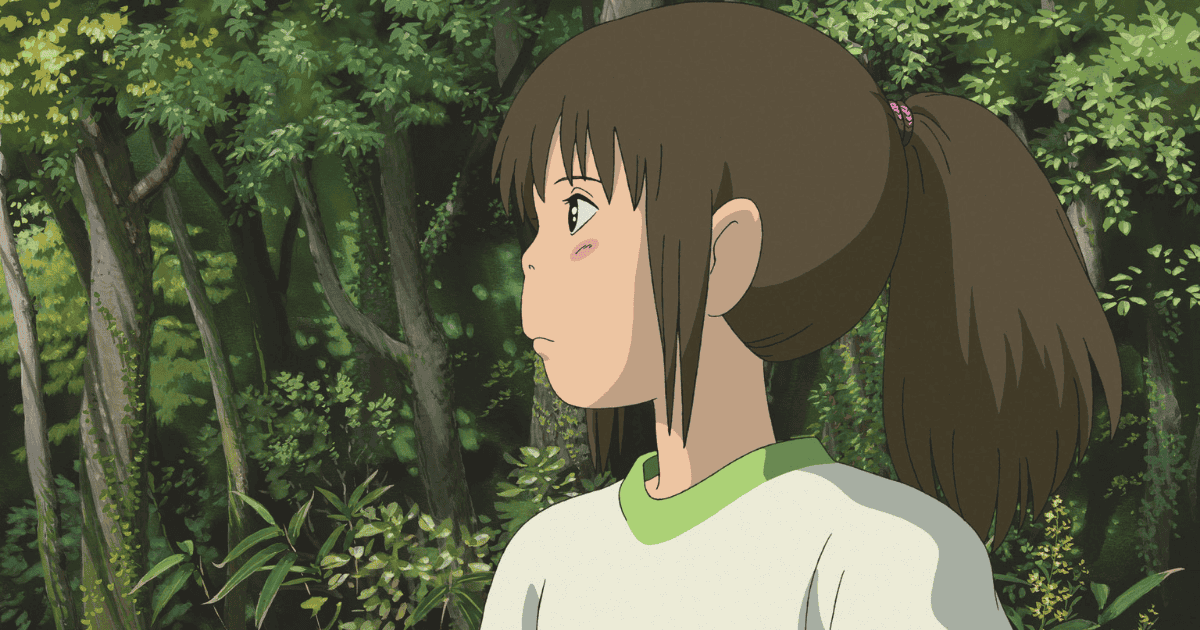
Released on July 20, 2001, Hayao Miyazaki’s Spirited Away (Studio Ghibli Official) is an absolute titan of global cinema. It remains one of the highest-grossing films in Japanese history and holds the prestigious honor of winning the Academy Award for Best Animated Feature. Decades later, its popularity and cultural footprint remain unshakable.
Today, I am going to comprehensively break down the plot of Spirited Away and unpack four of the most heavily debated, lingering mysteries within the film. (I have written dedicated, deep-dive articles for each mystery, linked below). Please be warned: when I say I am doing a plot summary, I mean I am going to spoil everything from start to finish. If you want to avoid spoilers, bookmark this page, go watch the movie, and come back.
*This is a translated version. The original (Japanese) is available here.
- Detailed Synopsis & Character Map
A brief summary of the film: “A sulking 10-year-old girl named Chihiro wanders into a supernatural realm where her parents are magically transformed into pigs. Forced to work in a bizarre bathhouse for the spirits, she must navigate strange allies, overcome terrifying trials, and mature as a person to win back her family’s freedom.” This article provides a comprehensive scene-by-scene breakdown and a visual character map. - Deep Thematic Analysis & Hidden Lore
Beyond the plot, we will dissect the film’s deepest mysteries. We explore the psychological reasons behind “Why Yubaba Steals Names,” the corporate logic of “Zeniba’s Contract Seal,” the true meaning behind “How Chihiro Solved the Final Test,” the haunting “Dead Brother Theory regarding Haku,” and the terrifying internet phenomenon of the “Lost Phantom Ending.”
On this pageContents
Spirited Away (2001) Full Synopsis: The Journey of Labor and Growth (Spoilers)

Quick Summary: The 9 Core Plot Points
To grasp the narrative flow of Spirited Away, here are the vital milestones:
-
The Wrong Turn
While moving to a new town, 10-year-old Chihiro Ogino and her parents take a wrong turn and stumble into a seemingly abandoned theme park. -
The Curse of Gluttony
Chihiro’s parents ravenously eat food meant for the spirits and are horrifyingly transformed into massive pigs. -
The Boy on the Bridge
Trapped in the spirit world, Chihiro is rescued by a mysterious, magical boy named Haku, who instructs her on how to survive. -
The Slave Contract
Chihiro confronts the terrifying witch Yubaba, signs a labor contract, and has her name stolen, becoming “Sen.” She begins grueling work at the Aburaya, a bathhouse for the gods. -
Unlikely Allies
She forms a bond with Lin, a tough senior worker, and Kamaji, the multi-armed boiler man who secretly protects her. -
The Stolen Seal
Haku, operating under Yubaba’s dark orders, steals a magical contract seal from Zeniba (Yubaba’s twin sister). He is lethally cursed in the process. -
The Train Ride to Swamp Bottom
To save Haku’s life, Chihiro boards the spirit train to Swamp Bottom to return the stolen seal and beg Zeniba for forgiveness. -
The Final Test
Having proven her maturity and empathy, Chihiro returns to the bathhouse and successfully passes Yubaba’s final trick question regarding her parents. -
The Return
Chihiro and her human parents are freed. They exit the tunnel back into the real world, though her parents remember nothing, and Chihiro’s memories immediately begin to fade into a dream.
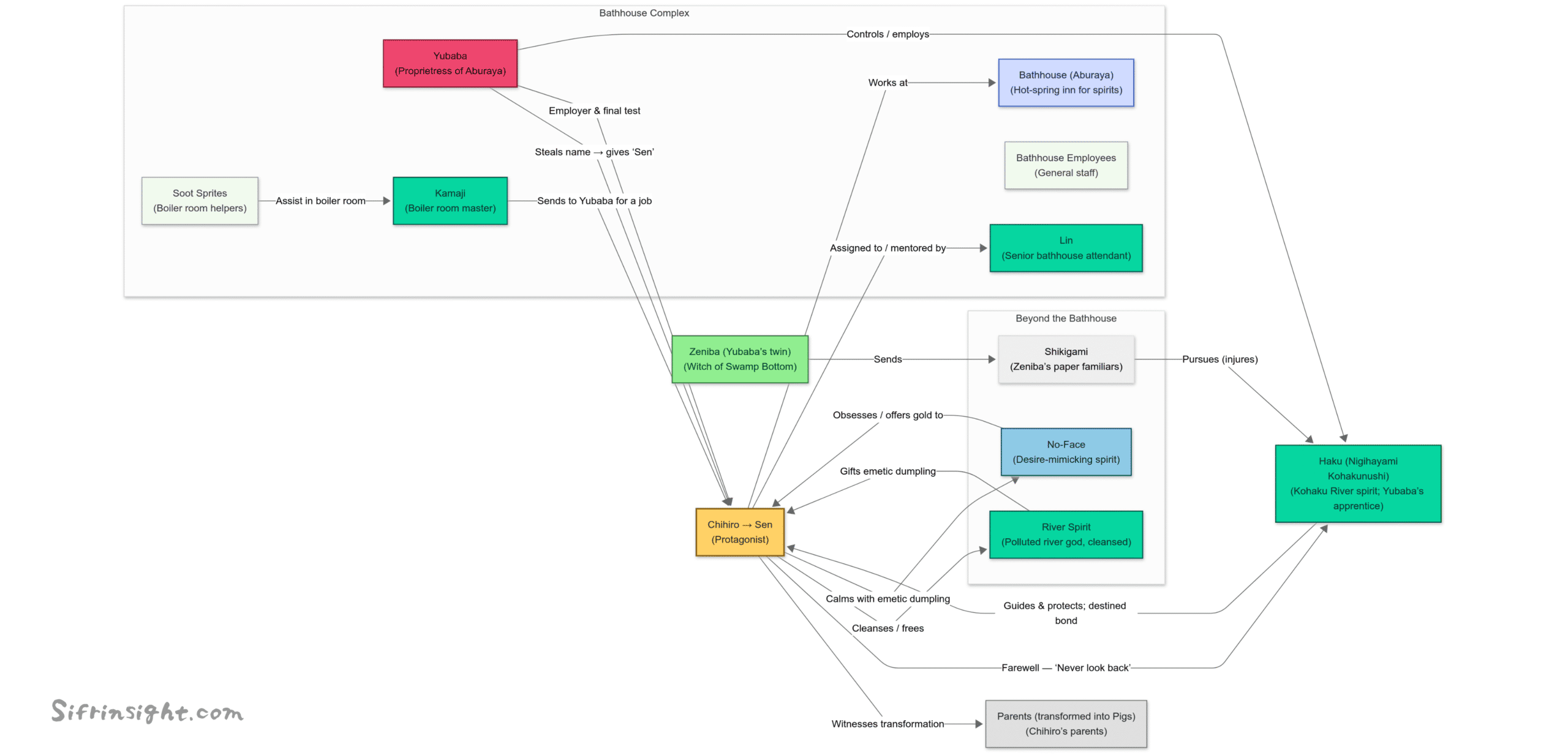
Complete Character Map
The Deeper Meaning of the Narrative
At its core, Spirited Away is an “Alice in Wonderland” coming-of-age story where the protagonist achieves emotional independence exclusively through the dignity of hard labor.
While the film ends with Chihiro successfully escaping the Spirit Realm, there is a crucial, melancholic detail: she instantly forgets the specifics of her magical journey. While the movie implies this subtly, Miyazaki’s official storyboards confirm it explicitly.


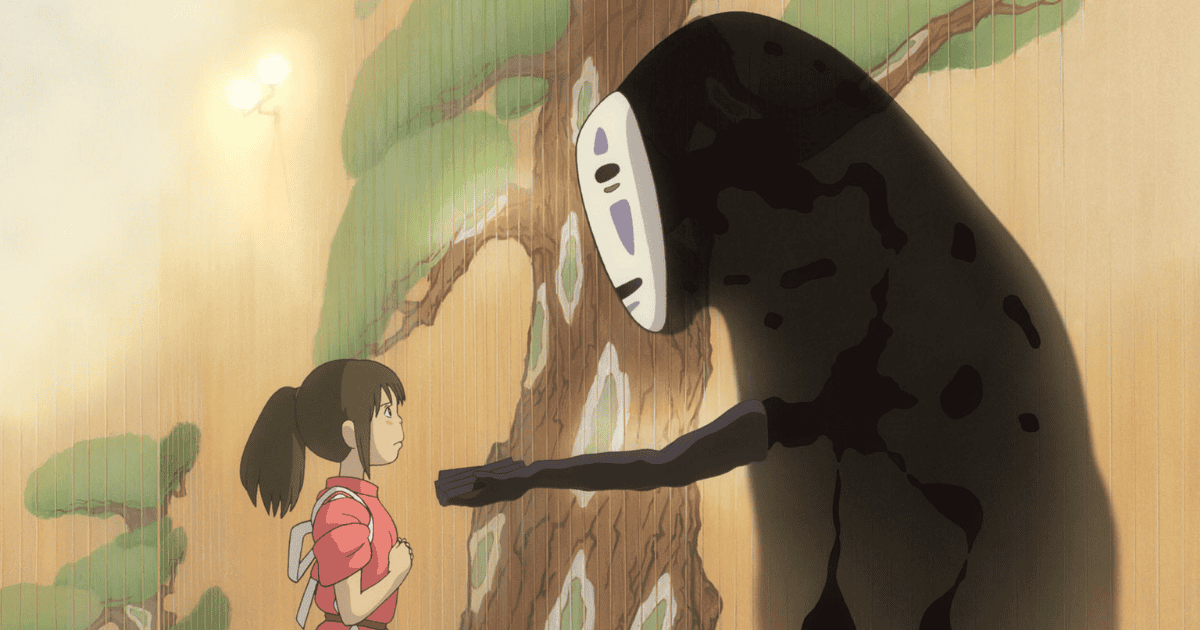
Furthermore, we must discuss No-Face (Kaonashi). In a story about growth, No-Face represents the absolute inverse. He is the symbol of a hollow, parasitic consumer who cannot speak with his own voice or assert his own identity. He simply absorbs the toxicity of his environment and grows bloated on the labor of others. He stands as a dark reflection of what Chihiro could have become if she remained a spoiled child.
With that thematic foundation established, let’s dive into the detailed scene-by-scene breakdown.
Detailed Synopsis: A Scene-by-Scene Breakdown
The Tunnel to Another World
Our protagonist is 10-year-old Chihiro Ogino. She is sulking in the back seat of her parents’ Audi as they drive toward their new home in a new town. Clutching a dying bouquet of farewell flowers from her old classmates, she is deeply resentful of the move.
Attempting to find a shortcut, her father recklessly drives down a strange, unpaved forest road, nearly crashing before stopping dead at the entrance of a massive, red plaster tunnel building.

Her curious parents decide to explore on foot. Chihiro begs them to go back, terrified by the eerie atmosphere, but is forced to follow them into the dark tunnel.
They emerge into a vast, grassy plain leading to a sprawling, bizarrely quiet town. Her father confidently assumes it is an abandoned 1990s theme park that went bankrupt during the economic bubble. Suddenly, the tantalizing smell of roasted meat wafts through the air.

Her parents trace the smell to an empty restaurant counter overflowing with massive, steaming platters of strange food. Assuming they can just pay the owner later, the parents sit down and begin ravenously devouring the meal. Disgusted, Chihiro refuses to eat.

She wanders further into the town, discovering a massive, multi-story bathhouse dominating the skyline. Standing on the bridge leading to the complex, she is suddenly confronted by a severe boy named Haku. Recognizing her as human, he violently orders her to leave immediately before the sun sets, using magic to blow petals into the air to buy her time.

Panicking as the sky rapidly darkens, Chihiro sprints back to the restaurant. To her absolute horror, her parents are gone. In their place, wearing their clothes, sit two massive, grotesque pigs still gorging themselves on food.

Chihiro runs blindly through the now-bustling streets. The town has come alive, teeming with terrifying, translucent shadow-spirits.

She reaches the grassy plain, only to find it has transformed into a massive, uncrossable ocean. An ornate, glowing ferry arrives, unleashing a horde of bizarre gods and monsters onto the shore.

Cowering in an alley, Chihiro realizes her hands are becoming transparent—she is fading out of existence. Haku finds her and forces her to swallow a magical berry from the spirit world, anchoring her physical form to reality.
Haku explains the brutal rules of this realm: to survive and save her parents, she must get a job at the Aburaya (the Bathhouse). The magical law dictates that the witch Yubaba cannot refuse anyone who demands work.

Haku sneaks her across the main bridge, but she is nearly discovered when a frog spirit startles her into taking a breath. After a chaotic escape, Haku points her toward the external stairs leading to the boiler room.
Chihiro navigates the treacherous, decaying stairs and meets Kamaji, a terrifying, six-armed boiler man commanding an army of soot sprites (Susuwatari).

Despite her fear, Chihiro stubbornly demands a job. Kamaji initially rejects her, but recognizing her tenacity, he eventually vouches for her, telling Lin (a snarky bathhouse attendant) that Chihiro is his granddaughter. Lin begrudgingly agrees to guide the human girl up to the top floor to face Yubaba.
Chihiro is brought before Yubaba, a massive, intimidating witch with an enormous head.

Yubaba attempts to terrify Chihiro into submission, threatening to turn her into a piglet. However, Chihiro stubbornly repeats her demand for a job. A sudden temper tantrum from Yubaba’s giant baby (Boh) distracts the witch, forcing her to finally agree to the magical contract.
Chihiro’s repeated request, “Let me work here,” is one of the lines that best captures her determination at this point in the story. For the original Japanese and English translation, see our Spirited Away quotes guide.
Chihiro signs her full name. Yubaba magically lifts the characters off the paper, “stealing” her name and declaring, “From now on, your name is Sen.”
Haku arrives to escort the newly named Sen to the worker’s quarters. Shockingly, his demeanor has completely changed; he treats her with cold, cruel indifference in front of the other staff.

The staff actively discriminate against her because she is human. Ultimately, she is assigned to assist Lin. Though Lin plays the bully in public, in private, she is fiercely protective and proud of Sen for standing up to Yubaba.
The Crucible of the Bathhouse
Early the next morning, Haku secretly leads Sen out to the pigpens.

He points out two sleeping hogs and confirms they are her parents. Chihiro weeps, promising them she will find a way to save them. Haku returns her discarded clothes, which contain a farewell card. Because she read her real name on the card, she remembers her identity. Haku reveals that if Yubaba successfully makes you forget your true name, you can never leave the Spirit Realm.
Sen begins her grueling physical labor under Lin’s harsh but fair tutelage.

During a massive rainstorm, Sen inadvertently invites a strange, silent, masked spirit (No-Face) into the bathhouse out of pity.
Soon after, a horrifying, sludge-covered “Stink Spirit” oozes into the building. Yubaba maliciously assigns the impossible task of cleaning it to Sen. Despite the literal physical trauma of the stench, Sen braves the sludge and discovers a massive “thorn” lodged in the spirit’s side.
With the entire staff pulling on ropes, they dislodge the thorn, triggering an avalanche of bicycles, refrigerators, and toxic human garbage to pour out of the spirit.
The entity was never a Stink Spirit; it was an ancient, powerful River God heavily polluted by human waste. The cleansed god laughs joyfully and gifts Sen a mysterious, bitter “Emetic Dumpling” before flying away. Yubaba is thrilled by the massive influx of gold left behind and finally embraces Sen as a true employee.

The Chaos of No-Face and the Fall of Haku
The next day, chaos consumes the bathhouse. No-Face, having learned that the staff worships greed, begins generating fake gold from his hands to lure workers in. When a frog spirit gets too close, No-Face violently eats him, absorbing his voice and personality.
No-Face transforms into a massive, bloated monster, demanding endless food and specifically calling for Sen.

Meanwhile, Sen notices a white dragon (Haku’s true form) being violently attacked in the sky by a swarm of paper Shikigami birds. The bleeding dragon crashes into Yubaba’s penthouse suite.
Sen ignores the gold from No-Face and races up the exterior pipes to reach the penthouse. Inside, she discovers the horrifying truth: Haku was operating as Yubaba’s magical assassin. He had stolen a golden contract seal from Yubaba’s twin sister, Zeniba, and was dying from the fatal curse placed upon the seal.
One of the paper birds transforms into a magical projection of Zeniba. She demands the seal back, transforming Yubaba’s giant baby (Boh) into a mouse and her harpy bird into a tiny fly just for fun. Haku manages to smash the projection, but the physical effort sends him plummeting down a dark shaft, dragging Sen with him.
They crash into the boiler room. Haku is convulsing, moments from death. Operating on pure instinct, Sen violently shoves half of the River God’s Emetic Dumpling down the dragon’s throat.
Haku violently vomits up the golden seal, along with a black slug (a mind-control parasite planted by Yubaba, which Sen promptly squashes). Haku’s life is saved, but he remains comatose.
Knowing Zeniba will never stop hunting him, Sen resolves to travel to Swamp Bottom, return the seal, and beg for Haku’s life.
But first, she must neutralize No-Face, who has now eaten three employees and is tearing the bathhouse apart. Sen confronts him and force-feeds him the remaining half of her Emetic Dumpling. The dumpling causes No-Face to violently vomit everything he consumed, including the three employees. He shrinks back to his original, silent size and meekly follows Sen out of the building.
Sen, No-Face, the mouse (Boh), and the fly board the phantom train crossing the flooded ocean.

The Resolution at Swamp Bottom
They arrive at Swamp Bottom and meet the true Zeniba. Unlike her tyrannical sister, Zeniba is a warm, grandmotherly figure living a quiet, domestic life.

Sen returns the seal and formally apologizes for Haku’s actions. Zeniba smiles, noting that the protective curse on the seal had already been broken (squashing the slug cured it). Zeniba gives Sen a magical, woven hair tie as a protective charm and offers No-Face a permanent, peaceful job as her spinning assistant.
Suddenly, a massive rush of wind signals an arrival. Sen opens the door to find Haku, fully healed in his majestic dragon form.

Zeniba fully forgives him, and Haku flies Sen back toward the bathhouse.
During the flight, Sen suddenly remembers her childhood. She tells Haku that years ago, she fell into the Kohaku River, and the river itself washed her safely ashore. She looks at the dragon and says, “Your real name is the Kohaku River.”
The spell breaks. Haku sheds his dragon scales, transforming back into a boy. He remembers his true identity: Nigihayami Kohakunushi. Reclaiming his name frees him from Yubaba’s enslavement forever.
The Final Trial
They arrive back at the bathhouse. Haku negotiated a deal with Yubaba: if he safely returned her baby (Boh), she would release Sen and her parents. However, magical law dictates Sen must pass one final test to break her contract.
Yubaba lines up a dozen identical pigs in the courtyard. She demands Sen point out exactly which two are her parents.
Sen stares at the squealing pigs. Trusting her instinct and emotional maturity, she confidently declares, “None of them are here.”
The contract spectacularly shatters into pieces. Sen has won. The bathhouse erupts in cheers.
Haku leads her back across the dried-out riverbed toward the tunnel. At the boundary, Haku stops, explaining he cannot cross into the human world. He promises they will meet again someday, but issues one final, crucial warning: “Do not look back until you exit the tunnel.”

Chihiro runs toward the tunnel entrance, where she finds her parents waiting. They are completely oblivious, acting as if they had only been gone a few minutes.
As they walk through the dark tunnel, Chihiro fights the overwhelming urge to look back at the spirit world. She holds her ground and steps out into the blinding sunlight.
The Audi is covered in deep dust and dead leaves, implying months have passed in the real world. Her father assumes someone played a prank. As they get into the car, Chihiro turns and stares blankly at the dark tunnel.

Her memories of the magic have faded into a hazy dream. But as she turns to leave, the woven hairband given to her by Zeniba sparkles brilliantly in the sunlight—the only physical proof that the journey was real.
That concludes the raw plot of Spirited Away. However, this is a film designed to be picked apart and analyzed. Let’s explore the deepest, most debated mysteries of the film.
Spirited Away (2001) Deep Analysis: Unlocking the Film’s Mysteries

Why Does Yubaba Steal Names?
The central, terrifying mechanism of the movie is Yubaba physically “stealing” Chihiro’s name off her contract. As viewers, we accept it as dark magic used to enslave children. The theatrical trailers heavily pushed this narrative.
But what if we reframe the magic? What if Yubaba isn’t “stealing” a name, but is aggressively assigning a mandatory “workplace nickname” to strip away an employee’s individuality?
When you apply a corporate lens, the act of assigning a nickname becomes a brilliant meta-commentary on the real-world dictatorial practices of Hayao Miyazaki within Studio Ghibli.
Read the full analysis: The Hidden Corporate Toxicity of Yubaba’s Name Theft
The Secret of Zeniba’s Contract Seal
One of the most elusive plot points in the film is why exactly Yubaba forced Haku to risk his life to steal Zeniba’s golden contract seal.
We know the twin sisters hate each other. But if we analyze the specific magical oaths that govern their lives, a tragic, brilliant motivation emerges. If Yubaba’s oath is to “give work,” then Zeniba’s oath must be to “complete work.”
Therefore, stealing the seal was the ultimate hostile corporate takeover: Yubaba was trying to magically enslave her hyper-competent sister.
Read the full analysis: Why Yubaba Stole the Seal (And the Divided Soul of Hayao Miyazaki)
How Did Chihiro Solve the Final Test? (And the Truth of the Dumpling)
The climax of the film hinges on Chihiro successfully calling Yubaba’s bluff and declaring that her parents aren’t among the pigs. I remember watching this in theaters and thinking, “Wait, how did she actually know?”
The answer lies in metaphor, legal loopholes, and the bizarre psychological growth triggered by the bitter “Emetic Dumpling.” By realizing her parents weren’t “pigs” (greedy, mindless monsters), she proved she was no longer a child. And magically, only an “adult” possesses the legal authority to void a slave contract.
Furthermore, what if the parents never actually turned into pigs in the first place? What if we, the audience, were the ones actively manipulated and deceived by Miyazaki’s direction?
Read the full analysis: The Ultimate Twist: How Chihiro Broke the Illusion
The “Dead Brother” Theory Regarding Haku
Haku is a beautiful, dedicated protector. But his nature is deeply contradictory: he loves Chihiro, yet the bathhouse staff despise him as a ruthless enforcer.
Because of this mysterious duality, a massive, poignant fan theory has circulated for decades: What if Haku is the spirit of Chihiro’s deceased older brother who drowned trying to save her?
When you examine the official storyboards (specifically the “child’s hand” notation), the mother’s bizarrely cold attitude, and the deep thematic parallels to Kenji Miyazawa’s novel Night on the Galactic Railroad, the “Dead Brother Theory” becomes terrifyingly persuasive.
Read the full psychological breakdown: Is Haku Her Dead Brother? Unlocking the Galactic Railroad Connection
Lore Appendix: The Urban Legend of the “Lost Phantom Ending”
There are countless silly creepypastas surrounding Ghibli films (like “Totoro is the God of Death”). Most of them are utterly baseless and frankly quite boring.
However, there is one internet phenomenon regarding Spirited Away that is genuinely fascinating: The “Lost Phantom Ending.”
Thousands of fans across the globe swear they distinctly remember an alternate ending where Chihiro drives to her new house, sees the moving men, and discovers a small stream near her home, realizing it is the reincarnation of Haku.
This ending does not exist. It has never existed. So how did a mass hallucination of this specific scene infect so many brains?
Read the full dive into the Mandela Effect: The Brilliance of the Phantom Ending and the Art of Fabricating Memory
Did you personally remember the true ending, or were you infected by the Phantom Ending?
The images used in this article are from Studio Ghibli Works Still Images.
Can you name the movie before the scene comes into focus?
Put your visual memory to the test with a blurred Studio Ghibli scene.
Reader Comments