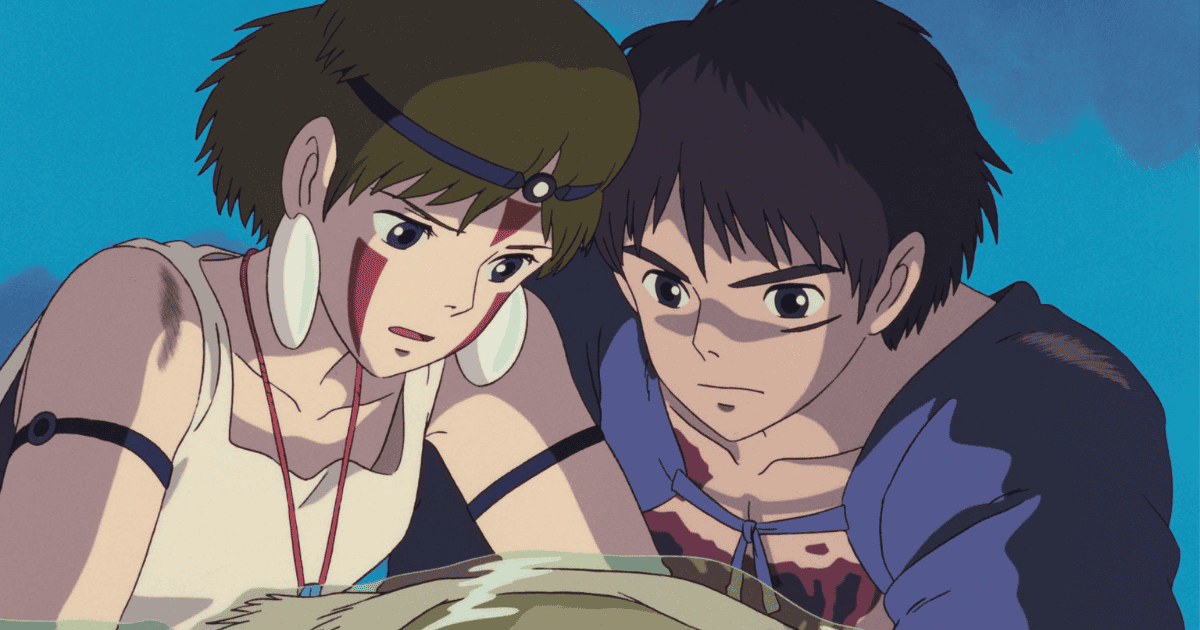
Released on July 12, 1997, Princess Mononoke(Studio Ghibli Official) is an animated epic directed by Hayao Miyazaki. It was a massive cultural phenomenon, becoming the very first Studio Ghibli film—and the first Japanese film in history—to smash through the 10 billion yen box office barrier. (Its total currently sits at 20.1 billion yen, including the 2020 pandemic re-screenings).
Despite its staggering commercial success, one of the film’s defining characteristics is its extreme moral ambiguity. Fans universally agree, “It is an incredible masterpiece, but it’s incredibly difficult to explain exactly why.” I first saw Princess Mononoke in elementary school, and I distinctly remember leaving the dark theater overwhelmed, confused by what I had just witnessed, and struggling to process the bittersweet ending.
Today, I am going to comprehensively break down the plot and uncover the deep psychological themes of Princess Mononoke. Please be warned: when I say I am doing a deep dive, I mean this article contains massive spoilers for the entire film. If you haven’t seen it yet, please watch the movie first and come back.
*This is a translated version. The original (Japanese) is available here.
- Detailed Synopsis & Character Map
A brief summary of the film: “Cursed by a terrifying Demon (Tatarigami), a young prince named Ashitaka is exiled from his village. Journeying west, he becomes trapped in a brutal, bloody war between the industrialized humans of Irontown and the ancient gods of the forest, including a feral girl named San. Seeking a path of coexistence, he fights to stop the cycle of hatred.” This article provides a comprehensive scene-by-scene breakdown and a visual character map. - Deep Thematic Analysis & Hidden Lore
Beyond the plot, we will dissect the film’s deeper layers. We explore the psychological mystery of Kaya’s Dagger, the terrifying implications of Deicide, the truth behind the Pitch-Black End Credits, Lady Eboshi’s Hidden Ambition, and why Princess Mononoke is essentially Miyazaki’s version of Godzilla.
On this pageContents
Princess Mononoke (1997) Full Synopsis: The Struggle for Coexistence (Spoilers)

Quick Summary: The 10 Core Plot Points
To grasp the massive narrative scale of Princess Mononoke, here are the vital milestones:
-
The Curse and the Exile
Ashitaka, the last prince of the Emishi tribe, is fatally cursed while defending his village from a maddened Demon God. He is permanently exiled and sent west to seek a cure. -
The Discovery of Irontown
Guided by a mercenary monk named Jiko-bō, Ashitaka reaches the ancient “Forest of the Forest Spirit” and discovers Irontown, a heavily fortified ironworks settlement. -
The Wrath of the Gods
The ancient animal gods of the forest are waging a bloody, desperate guerrilla war against the humans to stop the deforestation. -
The Wolf Princess
San, a human girl abandoned by her parents and raised by the giant wolf god Moro, leads the charge against the humans as “Princess Mononoke.” -
The Catalyst in the Middle
Ashitaka intercepts an assassination attempt by San and saves her life. Caught between two warring factions, they slowly begin to understand each other’s trauma. -
The Imperial Conspiracy
Lady Eboshi, the magnetic ruler of Irontown, makes a secret, treacherous pact with the Emperor’s mercenaries: she will kill the Forest Spirit in exchange for political protection for her town. -
The Apocalyptic War
To protect their sacred sanctuary, a massive army of boar gods, led by the blind Okkoto, arrives from the west and launches a suicidal, frontal assault against the human firearms. -
The Burden of Neutrality
Despite his fatal curse accelerating, Ashitaka refuses to take a side. He desperately fights to stop the bloodshed and force a truce before the forest is annihilated. -
Deicide and Destruction
Lady Eboshi successfully decapitates the Forest Spirit. The resulting explosive mutation nearly wipes out the entire forest and Irontown. -
A Pathetic Revival
Ashitaka and San force the mercenaries to return the head, saving the world but permanently altering it. The two agree to live separately but peacefully—Ashitaka in Irontown, San in the forest—embracing a new era of difficult coexistence.
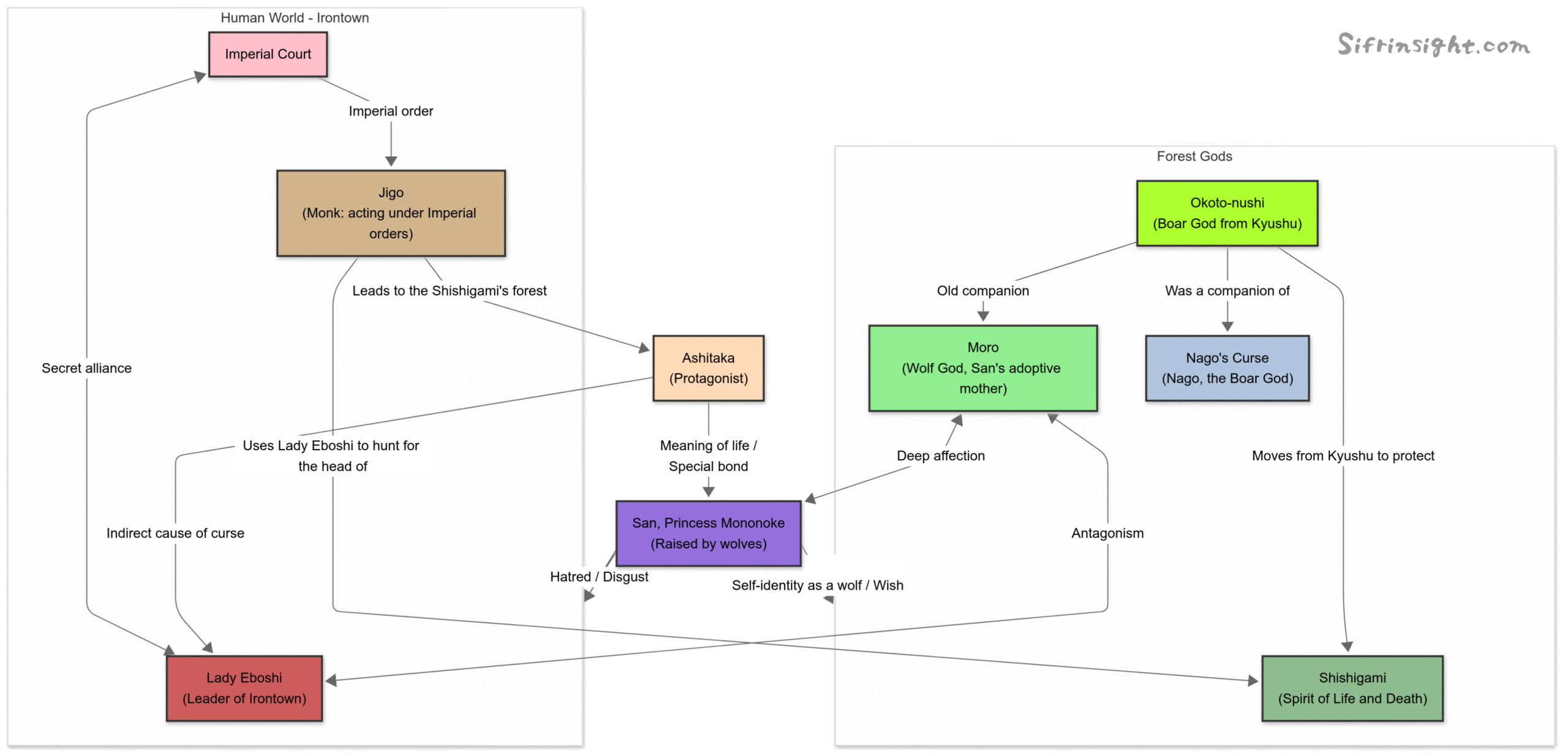
Complete Character Map
The Deeper Meaning of the Narrative
Because the film is titled Princess Mononoke, many casual viewers assume San is the primary protagonist. However, structurally and philosophically, the story is entirely anchored by Ashitaka.
When you view Ashitaka as the core protagonist, the true defining theme of the film becomes clear: “Absurdity.“
Ashitaka is a noble, innocent young man destined to lead his people. He performs an act of absolute heroism to save his village, and his “reward” is a rotting, fatal curse and permanent exile. He did absolutely nothing wrong. It is pointless to search for a moral reason behind the Demon’s attack; it is simply a horrific tragedy that “happened against his will.” Yet, Ashitaka alone is forced to bear the crushing weight of that absurdity.
The Tatarigami (Demon God) in Princess Mononoke is the literal, physical manifestation of this “unavoidable, unfair absurdity.”
The Godzilla Connection: When we think of “unavoidable absurdity” in the real world, we think of massive natural disasters like earthquakes, tsunamis, or typhoons. In Japanese cinematic history, the original 1954 Godzilla serves as the ultimate metaphor for unstoppable, absurd destruction.
Godzilla appears from the sea for reasons beyond human control, violently destroys the city, and vanishes. The citizens cannot reason with it; they can only endure the trauma and attempt to rebuild. Because Princess Mononoke utilizes the Tatarigami to explore this exact same psychological trauma of surviving an “unavoidable calamity,” I firmly believe Mononoke is essentially “Hayao Miyazaki’s version of Godzilla.”
While the ending of the film is highly bittersweet, considering that Ashitaka successfully conquered his suicidal despair, survived the apocalypse, and forged a new life in Irontown, I personally categorize Ashitaka’s journey as a triumphant happy ending.
With that thematic foundation established, let’s dive into the detailed scene-by-scene breakdown.
Detailed Synopsis: A Scene-by-Scene Breakdown
The Fall of the Prince
The story opens in the Muromachi period (roughly the 14th-16th centuries). Hidden deep in the mountains of the eastern Tohoku region lives the Emishi tribe, an indigenous people largely erased from the political history of Japan. Our protagonist, Ashitaka, is the tribe’s last prince and future leader.
His peaceful life is violently shattered when a terrifying, writhing mass of corrupted flesh—a Tatarigami (Demon God)—charges out of the deep forest, heading straight for the village.
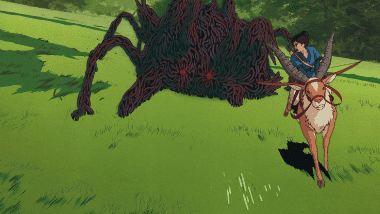
Knowing that killing a god is a mortal sin, Ashitaka attempts to pacify the beast. When it refuses to stop, he is forced to draw his bow. His first arrow strikes the beast’s eye, but the demonic tendrils lash out and violently wrap around Ashitaka’s right arm, searing a deadly curse into his flesh. Ignoring the agonizing pain, Ashitaka fires a second, fatal shot.

The beast dissolves, revealing the rotting corpse of a giant boar god. The village is saved, but the curse on Ashitaka’s arm is a fatal death sentence.
The village oracle divines his fate: the curse will slowly rot his body from the inside out. He must cut his topknot, officially severing his ties to the tribe, and leave the village forever. He is to travel west to discover what corrupted the boar god, in the faint hope of finding a cure.

Ashitaka accepts this brutal, unfair exile without complaint. As he departs in the dead of night with his loyal red elk, Yakul, his fiancée Kaya breaks the village law to see him off. Weeping, she gifts him a precious obsidian crystal dagger, promising, “I will think of you always.”

Burying his own terror and grief, Ashitaka flashes her a warm, reassuring smile: “I will think of you too, Kaya.” It is a heartbreaking farewell.
Ashitaka travels aimlessly westward for weeks. In a bustling market town, he attempts to buy a bag of rice using a nugget of pure gold, causing a tense standoff with the suspicious locals. A mysterious, pragmatic monk named Jiko-bō intervenes, smoothing over the transaction.

That night, over dinner, Ashitaka shows Jiko-bō a mangled iron ball he pulled from the rotting boar god’s flesh. Jiko-bō claims ignorance about the bullet, but casually points Ashitaka toward a pristine, ancient woodland further west known as the “Forest of the Forest Spirit” (Shishigami). It is the first glimmer of hope for the exiled prince.
As Ashitaka nears the forest, he discovers a group of severely wounded men washed up on a riverbank. Across the raging river, he spots two massive, bleeding wolf gods and a fierce human girl sucking poisoned blood from a wound.

Fascinated, Ashitaka calls out to her, but she aggressively snarls, “Go away!” before vanishing into the trees.
Ashitaka rescues the wounded men and carries them into the primeval forest. The terrified men are panicked by the appearance of Kodama (small, rattling tree spirits), but Ashitaka calmly notes that their presence proves the forest is healthy. He trusts the Kodama, allowing them to guide his path.

The Kodama lead them deep into a silent, mystical swamp. Ashitaka approaches the water’s edge and spots an impossibly majestic, multi-antlered creature stepping through the shallows in the distance.

The moment the creature looks at him, Ashitaka’s cursed arm throbs with violent, excruciating agony. He realizes immediately that this majestic being is the fabled Forest Spirit.
Irontown and the Human War
After escaping the deep forest, Ashitaka safely delivers the wounded men to their home: Irontown (Tataraba), a massive, heavily fortified ironworks settlement led by the charismatic Lady Eboshi. The working-class citizens hail Ashitaka as a hero.

During his stay, Ashitaka uncovers the brutal truth of the conflict. Lady Eboshi clear-cuts the ancient forest to strip-mine the iron sand required for her forges. When the giant boar god Nago attempted to protect his territory, Eboshi utilized newly developed firearms (ishibiya) to shoot him. Driven mad by the burning iron bullet lodged in his bones, Nago fled east, ultimately attacking Ashitaka’s village.
Lady Eboshi is the direct cause of Ashitaka’s fatal curse.
Ashitaka confronts her, his cursed arm vibrating with murderous rage. Eboshi calmly asks him, “And what exactly do you intend to do about it?” Ashitaka wrestles his curse into submission, replying, “To see with eyes unclouded by hate.”
Impressed by his stoicism, Eboshi gives him a tour of her “secret garden.” He discovers that the terrifying firearms are being meticulously crafted by lepers. These outcasts, completely discarded by society, worship Eboshi because she was the only human who treated them with dignity. He also meets the women operating the massive bellows—former brothel slaves whose contracts Eboshi bought out. Ashitaka, a boy wallowing in the pity of his own “unjust curse,” is profoundly humbled by the sheer grit and resilience of these marginalized people fighting to survive.
That night, chaos erupts. San (Princess Mononoke) launches a suicidal, solo assassination attempt on Lady Eboshi. Armed only with a bone dagger, she breaches the fortress walls, entirely surrounded by heavily armed gunmen.

San and Eboshi engage in a brutal, bloody duel in the central courtyard. Knowing San will inevitably be slaughtered, Ashitaka intervenes. Fueled by the superhuman strength of his curse, he violently bends a solid iron sword with his bare hand, knocking both women unconscious to stop the fight.

Hoisting the unconscious San over his shoulder, Ashitaka marches toward the town gates. A villager accidentally shoots him straight through the chest with a hand cannon. Bleeding profusely, Ashitaka refuses to die, using his cursed strength to push open the massive wooden gates and carry San to safety.
He eventually collapses in the forest. When San awakens, she is furious that a human intervened in her revenge. She presses her blade to his throat, preparing to kill him. In his delirium, Ashitaka looks up at her and whispers, “Live. You are beautiful.”
Stunned and flustered by his raw sincerity, San lowers her weapon. She drags his dying body back to the sacred swamp and leaves his fate to the Forest Spirit.
As midnight falls, the towering, gelatinous Night-Walker (Didarabotchi) emerges from the canopy.

As the moon hits the water, the Night-Walker shrinks and transforms into the physical, deer-like form of the Forest Spirit. The god approaches Ashitaka and lightly touches the bullet wound on his chest, miraculously healing the fatal injury.

When Ashitaka awakens days later, he realizes the bullet hole is closed, but the black, creeping curse on his arm remains untouched. The Forest Spirit saved his life, but refused to cure his terminal illness. Accepting his fate, Ashitaka sheds a single tear.
Suddenly, the forest shakes. A massive, terrifying army of giant boars, led by the ancient, blind god Okkoto, arrives from the island of Kyushu. The boars are fanatically determined to launch an all-out, suicidal war against the humans to protect the Forest Spirit. Okkoto smells the human Ashitaka and warns him to leave the forest, or he will be slaughtered in the coming massacre.
Deicide and the Apocalypse
While recovering in the wolves’ den, Ashitaka has a tense conversation with San’s adoptive mother, the giant wolf god Moro.

Ashitaka begs her to spare San from the impending slaughter, arguing that San is biologically human. Moro angrily reveals the tragic truth: San’s human parents threw her to the wolves as a sacrifice to save their own lives. Moro took pity on the baby and raised her. She dismisses Ashitaka’s naive idealism, vowing to bite Lady Eboshi’s head off before the war ends.

When Ashitaka wakes the next morning, San and the wolves are already gone, having joined the boars on the front lines. Before leaving, Ashitaka hands Kaya’s precious obsidian dagger to a young wolf, asking him to deliver it to San as a token of protection. He then rides Yakul back toward Irontown to stop the violence.
Upon arriving, he finds Irontown under heavy siege by a ruthless army of rival samurai. The women are barely holding the walls, because Lady Eboshi and her elite riflemen are missing. Ashitaka learns the horrific truth: Jiko-bō is actually an imperial agent. He provided Eboshi with the firearms in exchange for a contract—Eboshi must march into the deep forest and decapitate the Forest Spirit, bringing the head back to the Emperor in exchange for political protection for Irontown.
Ashitaka races into the forest to warn Eboshi that her town is burning. He stumbles upon a literal bloodbath: the Imperial mercenaries used explosive landmines to completely slaughter the charging boar army. The forest floor is littered with hundreds of massive, bleeding corpses.
Ashitaka finally locates Eboshi deep in the woods and informs her of the siege. Coldly obsessed with her mission, Eboshi refuses to turn back, stating the women of Irontown have enough weapons to defend themselves. She continues marching toward the sacred swamp.
Realizing he cannot stop her, Ashitaka desperately searches for San. He finds her at the swamp, trapped in a horrifying nightmare. The blind boar god Okkoto, severely wounded and grieving his slaughtered army, has succumbed to hatred and is mutating into a massive Tatarigami. San is physically trapped in the writhing, demonic worms covering his body.

Ashitaka dives into the corruption to pull her out, but is violently thrown back. Just as all hope seems lost, a dying Moro uses her final ounce of strength to charge the boar, ripping San free from the demonic mass.
As the sun sets, the Forest Spirit finally appears in the swamp. Lady Eboshi takes aim and fires her rifle, hitting the god directly in the neck. The Forest Spirit ignores the wound entirely. It walks gracefully toward the corrupted Okkoto and, with a gentle touch, instantly absorbs the boar’s life force, granting him peace in death.

The Forest Spirit then looks to the darkening sky and begins its nightly transformation into the towering Night-Walker.

Lady Eboshi seizes the vulnerable moment of transformation. Despite Ashitaka screaming at her to stop, she fires a second, devastating shot, completely decapitating the god. Jigo-bō immediately catches the severed head in a lead-lined box and flees.
The apocalypse begins. The headless, mutating body of the god erupts into a massive wave of lethal, black ooze, frantically searching for its head. Everything the ooze touches—trees, animals, humans, Kodama—instantly dies.

Ashitaka and San race after Jiko-bō, determined to return the head before the ooze consumes the entire world.

The lethal ooze eventually corners Jiko-bō. Realizing he will die if he doesn’t surrender, he tosses the box to Ashitaka and San. Standing shoulder-to-shoulder, the two teenagers lift the glowing head into the air, formally offering it back to the rampaging god through human hands.
The god accepts the head just as the dawn breaks. Because it is caught in its Night-Walker form while exposed to the lethal sunlight, the god physically collapses and dissolves across the valley.
The blast of its death sweeps over the barren, destroyed landscape. Miraculously, the blast acts as a wave of healing. Small, scrubby green shoots begin to sprout from the scorched earth. Furthermore, the blast completely cures Ashitaka’s curse and heals the horrific wounds of the lepers in Irontown.
Looking at the pathetic, scrubby new growth, San weeps, stating the forest is dead. Ashitaka gently corrects her: “The Forest Spirit cannot die. He is life itself.”
In the quiet aftermath, San turns to Ashitaka. “Ashitaka, you mean so much to me. But I can never forgive the humans.” Ashitaka smiles, fully accepting her truth. He tells her he will live and work in Irontown, but promises he will ride Yakul into the forest to visit her. They have chosen a path of difficult, messy coexistence.

Meanwhile, in the ruins of Irontown, a humbled, one-armed Lady Eboshi addresses her surviving citizens. Laughing softly at her own hubris, she vows to rebuild Irontown, “but a better one this time.”

The world is broken, but they will fight to survive. The end credits roll.
That concludes the raw plot of Princess Mononoke. However, the brilliance of this film lies entirely in the subtext. Let’s explore the hidden themes and controversial mysteries that keep fans debating this film decades later.
Princess Mononoke (1997) Deep Analysis: Unlocking the Film’s Mysteries

The Controversy of Kaya’s Dagger
If you have ever watched Princess Mononoke, you have undoubtedly paused during the scene where Ashitaka casually gives the obsidian dagger—a precious parting gift from his fiancée, Kaya—to San. Even as a kid, I remember thinking, “Ashitaka, what is wrong with you?!”
However, when you deeply analyze the sheer psychological trauma of Ashitaka’s exile, and view the dagger not as a romantic trinket but as a heavy emotional anchor, his decision to give it away completely changes the context of his character arc.
Read the full psychological breakdown: Why Did Ashitaka Give Kaya’s Dagger to San?
The True Meaning of Deicide
At its core, Princess Mononoke is a story about “deicide”—the literal killing of a god. But what does that act actually represent historically and philosophically?
When Lady Eboshi shoots the Forest Spirit, she isn’t just killing a deer; she is actively destroying humanity’s primal “fear” of nature and stripping the world of its “sacredness.” It marks the brutal transition into the modern, industrialized era. The consequences of that cultural shift are staggering.
Read the full analysis: The Meaning of Deicide and the Fall of the Forest Spirit
The Mystery of the Pitch-Black End Credits
If you examine Hayao Miyazaki’s filmography, the end credits of Princess Mononoke stand out as a glaring anomaly. Every single film before it (Totoro, Kiki, Porco Rosso) utilized the end credits to show charming illustrations depicting the “happily ever after” aftermath of the story.
Princess Mononoke, however, fades into absolute, pitch-black darkness. Why did Miyazaki break his own tradition? Because the film tackles “unsolvable” modern problems, a neat, happy epilogue would have been a lie.
Read the full analysis: Why Are the End Credits of Princess Mononoke Completely Black?
Lady Eboshi’s Hidden Ambition
Lady Eboshi is arguably the most fascinating, morally complex antagonist in anime history. We initially view her as a fiercely progressive “good ruler” who emancipates women and lepers. Yet, during the climax, she completely abandons her town to burn just so she can hunt the Forest Spirit.
To truly understand her betrayal, you must dig into her horrific, suppressed backstory as a slave sold overseas, and her apocalyptic ambition to overthrow the male-dominated political structure of Japan.
Read the full character analysis: The Trauma and Hidden Ambition of Lady Eboshi
The “True Protagonist” Debate
Despite the film’s title being Princess Mononoke, there is a fierce analytical debate regarding who the actual protagonist is. While San is the ideological center of the conflict, the narrative structure undeniably belongs to Ashitaka.
His brutal, blunt honesty and his frustrating tendency to completely ignore social norms (“tactlessness”) are the exact tools he uses to force the other characters to confront their suppressed trauma. He is the ultimate catalyst for change.
Read the full analysis: Why Ashitaka is the True Protagonist
What Exactly was the Tatarigami (Demon)?
It is easy to dismiss the writhing Demon at the beginning of the film as a simple “monster.” Philosophically, it serves as the physical manifestation of “hatred.”
But why did Miyazaki need to visualize hatred as a mindless, infectious disease? Because he wanted to depict hatred as an “unavoidable, absurd calamity”—a natural disaster that ruins innocent lives for absolutely no logical reason.
Read the full analysis: What Was the Tatarigami? Hatred as an Absurd Calamity
Princess Mononoke as Miyazaki’s “Godzilla”
In the final frames of the film, we see that the cursed scar on Ashitaka’s hand did not completely disappear; a faint bruise remains.
While this symbolizes the film’s theme of “living with trauma,” it also draws massive parallels to the original 1954 Godzilla. By surviving an apocalyptic, uncontrollable disaster but forever carrying the physical scars of the fallout, Ashitaka’s survival is a deeply political, triumphant statement.
Read the full analysis: The Meaning of Ashitaka’s Scar and the Godzilla Connection
The Meaning of “He is Life Itself”
When San cries that the Forest Spirit is dead, Ashitaka famously replies, “He cannot die. He is life itself. He is both life and death.”
It sounds like poetic, comforting fluff. However, Miyazaki has explicitly stated in interviews that the physical deer-like creature was actually a “low-class god.” When you apply Shinto theology to Ashitaka’s quote, it suggests that by having its physical body destroyed, the god was actually elevated into a higher, omnipresent state of divinity.
Read the full theological breakdown: The True Meaning of “He is Life Itself”
Lore Appendix: San’s Muscular Arms and the Animation Budget
Let’s conclude with a fun, slightly technical piece of trivia. Look closely at the official Ghibli still below:

Notice how thick and muscular San’s arms are? Miyazaki insisted on this anatomical accuracy. A girl spending her entire life sprinting on all fours, hunting, and fighting through a primeval forest would naturally develop massive upper body strength.
However, there is one anatomical detail missing: armpit hair. In real life, a feral girl raised by wolves would absolutely not be shaving. So why didn’t Ghibli draw it?
The answer is brutally pragmatic: animation budgets. If they drew armpit hair in one scene, they would have to meticulously track and animate it in every single frame where her arms are raised. The sheer volume of extra labor would have delayed the film’s release and cost millions of yen. Sometimes, biological accuracy has to bow to the constraints of the production schedule!
Princess Mononoke (1997) Trivia & Fun Facts Collection
While researching these deep dives, I stumbled across a massive trove of fascinating, behind-the-scenes Ghibli lore. If you want to learn more about the chaotic production of the film, check out the article below:
Read the trivia list: Princess Mononoke: Ultimate Trivia & Fun Facts Collection
The images used in this article are from Studio Ghibli Still Images.
Can you name the movie before the scene comes into focus?
Put your visual memory to the test with a blurred Studio Ghibli scene.

Excellent and thought-provoking analyze!