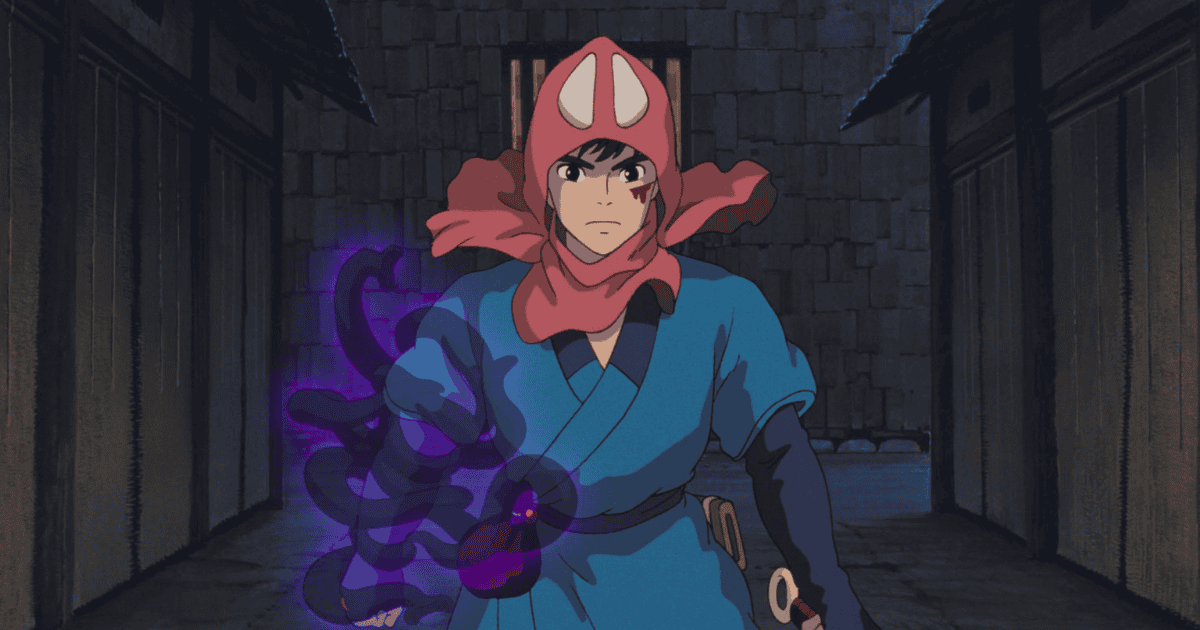
Released in 1997, Hayao Miyazaki’s epic Princess Mononoke(Studio Ghibli Official) is an animated masterpiece renowned for its moral ambiguity and complex cast. However, when discussing the film, a surprisingly common debate arises among fans: Who is the actual protagonist?
Despite the film being titled after San, I firmly believe the true protagonist is Ashitaka. This isn’t just a subjective opinion; early in production, Miyazaki famously considered titling the film The Legend of Ashitaka (Ashitaka Sekki). But looking beyond production trivia, the film’s narrative structure explicitly defines Ashitaka’s role. He possesses a fundamental psychological difference from every other character in the story.
Today, we will analyze exactly what makes Ashitaka the true “protagonist” by comparing him to the rest of the cast. Specifically, we will explore a unifying, tragic flaw shared by everyone else in the film: they are all “people who hide their true feelings.”
*This is a translated version. The original (Japanese) is available here.
- A World of Hidden Agendas
Jiko-bō, Lady Eboshi, San, Moro, and the people of Irontown all navigate the world by suppressing their true emotions. Jiko-bō hides his imperial mission, Eboshi masks her trauma and ambition, San violently denies her human nature, Moro hides her maternal empathy, and the ironworkers mask their crushing physical pain. - Ashitaka’s Initial Suppression
Ashitaka begins the film exactly like them. When exiled with a terminal curse, he masks his paralyzing terror and grief behind a stoic, heroic smile. - The Birth of the Protagonist
Ashitaka officially ascends to the role of “protagonist” only when he conquers his own hatred. After realizing the Forest Spirit will not cure his curse, he sheds a single tear, surrenders his ego, and dedicates his remaining life entirely to saving others. - The Power of Radical Honesty
As the only character who speaks with absolute, blunt honesty, Ashitaka creates a psychological “wavering” in those around him. He forces others to confront the true feelings they are hiding, acting as a spiritual “liberator.” - The Necessity of “Tactlessness”
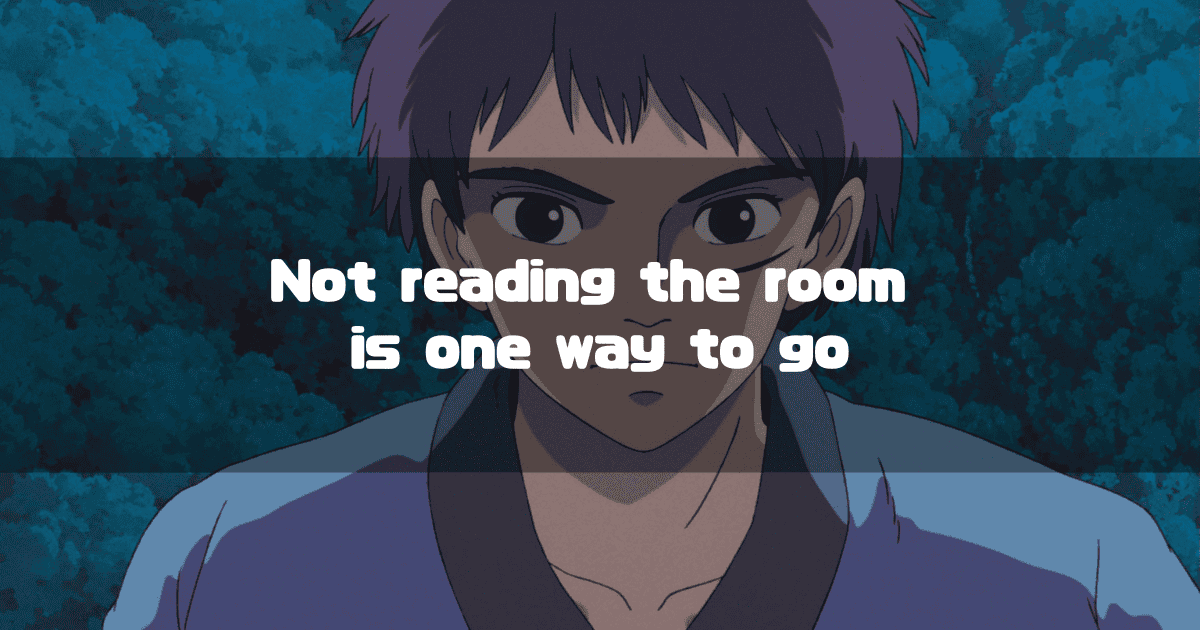
Ashitaka’s tendency to stubbornly preach his ideals—often completely ignoring the social room or the political reality of the situation—is exactly what makes him the protagonist. His blunt “tactlessness” is the chaotic force that moves the plot forward and ultimately earns him the respect of the wolf gods.
On this pageContents
Princess Mononoke (1997) Character Analysis: The Danger of Hidden Feelings
The Devious Monk, Jiko-bō
The first character to introduce the theme of deception is the wandering monk, Jiko-bō.
When Ashitaka shows him the cursed iron ball pulled from Nago’s corpse, Jiko-bō instantly understands the entire geopolitical situation. Yet, he masterfully plays dumb. He offers absolutely no insight regarding the iron ball, only reacting to Ashitaka’s mention of a “giant boar” before casually pointing him toward the Forest Spirit’s domain.
If we unpack Jiko-bō’s internal calculus in that moment, it looks something like this:
- I want to point this kid in the right direction because he saved my life.
- However, I absolutely cannot reveal my imperial mission to hunt the Forest Spirit.
- Furthermore, admitting I know about the iron ball connects me to the escalating war, which blows my cover as a simple monk.
Jiko-bō is the ultimate pragmatist. He is a man who never reveals all the cards in his hand.
Lady Eboshi: Trauma Masked as Ambition
Lady Eboshi, the magnetic ruler of Irontown, is perhaps the film’s most tightly wound master of suppression.
You wouldn’t know it from just watching the film, but Miyazaki established a horrific backstory for her. Before the events of the movie, Eboshi was sold overseas as a slave and forced to become the wife of a Wakō (Japanese pirate) chieftain (Reference: How Princess Mononoke Was Born (「もののけ姫」はこうして生まれた, in Japanese)). Surviving that hellish environment, she eventually assassinated the chieftain, seized his wealth, and returned to Japan with her loyal subordinate, Gonza.
She never speaks of this trauma on screen. But this horrific past fuels the dark, hidden truth she suppresses: a burning, unquenchable desire to take revenge on the male-dominated world that allowed her to be sold into slavery.
While she masks her actions as simply “protecting Irontown,” her true ambition slips out through a joke made by one of the lepers in her secret garden:
“Watch out. Lady Eboshi wants to rule the country.”
While delivered lightly, this line reveals her true endgame. The fact that Eboshi doesn’t even blink or deny the comment serves as quiet confirmation.
In summary, the truths Eboshi hides behind her confident smile are:
- The agonizing trauma of her past.
- Her apocalyptic ambition to completely overthrow the current world order.
San: The Denial of Humanity
Unlike Eboshi and Jiko-bō, San appears entirely transparent. She operates on pure, feral instinct, violently attacking any human who encroaches on the forest. But look closer, and you will find a massive, painful suppression of her own identity.
While her exact origins are murky, Moro explains how she acquired San:
“The humans who violated the forest threw her in my path as they ran from me.”
Raised by wolves, it is entirely logical for San to align herself with the forest. However, her aggressive, constant insistence that “I am a wolf” often borders on the psychotic.
Psychologically speaking, when people aggressively overcompensate to prove they are something they are not, it is because they are terrified of the truth. San acts like an extremist “fundamentalist wolf” precisely because she is acutely, painfully aware that she is biologically human. She hates her own body.
In other words, the agonizing truth she suppresses is her own undeniable humanity.
When you view her through this lens of self-hatred, the climactic scene where she screams, “I am a wolf!” at Ashitaka feels less like a battle cry and more like the desperate wail of a broken child.
Moro: The Suppressed Empathy
San’s adoptive mother, the terrifying wolf god Moro, also harbors a massive contradiction.
The ultimate proof of her hidden feelings lies in one undeniable fact: she chose to raise a human infant.
If Moro truly despised humanity with every fiber of her being, she would have killed the baby San immediately. Instead, she raised her with profound maternal love. This proves that Moro’s war against the humans is born of geopolitical necessity (protecting her territory from Irontown’s expansion), not absolute biological hatred.
Yet, Moro projects an aura of pure, unadulterated hatred toward humanity. Why?
Because of San. Moro deeply understands her daughter’s agonizing struggle. She knows San desperately wants to be a wolf, despite being born human. To support her traumatized daughter, Moro matches her feral energy, projecting a unified front of absolute human hatred.
The Hidden Hope: It is highly probable that Moro secretly harbored a desperate hope that San could one day act as a bridge between the humans and the forest gods. But when San became violently radicalized, Moro accepted her fate. When Ashitaka arrives—a noble, exiled human actively seeking coexistence—Moro likely recognizes him as the exact bridge she had been hoping for. Her brutal testing of him is simply her way of ensuring he is worthy of entrusting her daughter’s future to.
The Ironworkers: Suppressing Agony
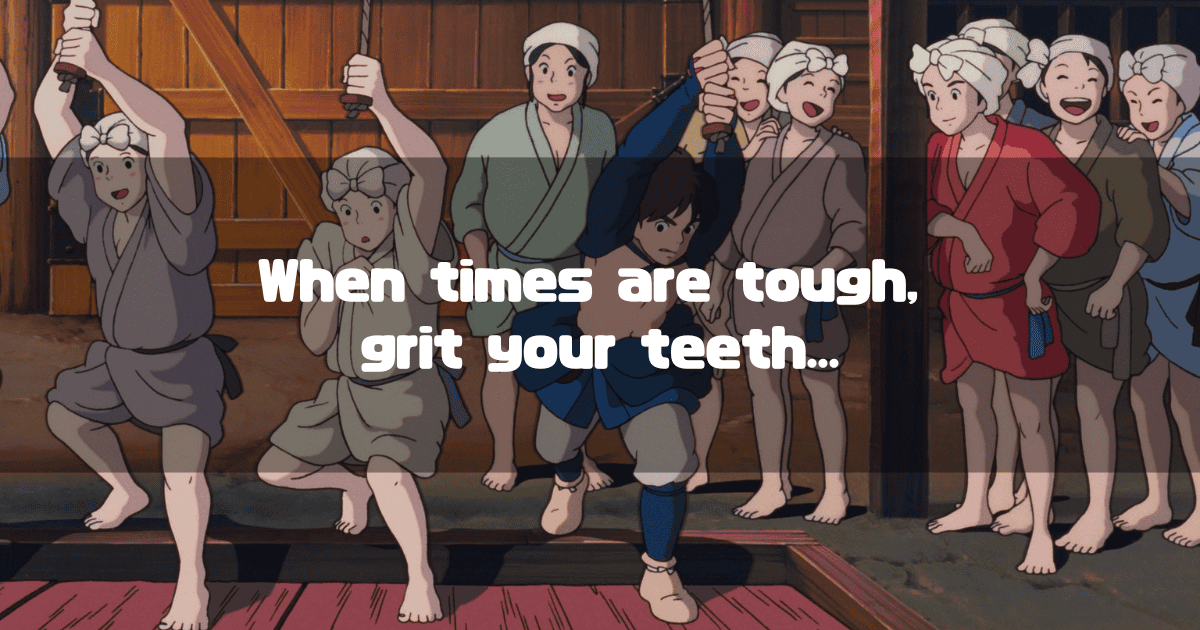
Even the background characters—specifically the women working the massive iron bellows (fuigo) in Irontown—are actively suppressing their reality.
In the documentary How Princess Mononoke Was Born, Director Miyazaki explicitly instructs an animator regarding how to draw the women’s faces during this grueling labor:
“Thinking, ‘It’s tough work, so I should just draw them looking in pain’ is far too simplistic… If you ask whether a marathon runner makes a pained face right before they collapse, the answer is no, they grit their teeth and endure it, right? In a job where you have to endure like that just to keep going, if you do it for hours on end, you don’t look pained. You become dazed. You become expressionless.”
The women of Irontown are enduring backbreaking, agonizing labor. But they do it with blank, stoic expressions. Why? Because the lives they lived before Eboshi rescued them—likely in brothels—were infinitely worse. They suppress their physical pain out of profound gratitude for their freedom.
Because they are broken people who have survived hell, they instantly recognize a fellow survivor. This is why they immediately welcome Ashitaka. They see that he walked into this hellscape completely alone, carrying a heavy burden.
Ashitaka: The Stoic Exile
To analyze Ashitaka as the “protagonist,” we must recognize that he begins the film suffering from the exact same flaw as everyone else: he suppresses his truth.
What was he hiding? The crushing despair of being permanently exiled from the only home he has ever known, and the paralyzing terror of dying from a rotting curse.
The defining moment of his emotional suppression occurs when he leaves his village. As his fiancée, Kaya, tearfully hands him her dagger, Ashitaka faces an abyss of absolute uncertainty and impending death. Yet, to spare her feelings, he buries his terror and flashes her a warm, heroic smile.
He is a boy smiling through his own funeral.
Princess Mononoke (1997) Character Arc: How Ashitaka Becomes the Protagonist
How does Ashitaka break out of this cycle of suppression to become the true “protagonist”? While the others continue to hide in the shadows, Ashitaka evolves into a force of radical, blunt honesty. At first glance, his relentless moralizing makes him seem like a nuisance, but it is precisely this bluntness that makes him the liberator of the narrative.
The Two Milestones of the Protagonist
In most films, the protagonist is defined in minute one. But in Mononoke, both Ashitaka and San act as co-leads. I argue that Ashitaka officially claims the mantle of the true protagonist only after passing two specific psychological milestones:
- The speech he gives while holding back both Eboshi and San in Irontown.
- The single tear he sheds by the pond when he realizes the Forest Spirit will not cure him.
Prior to San’s assault on Irontown, Ashitaka’s cursed arm violently lashes out of his control twice (once saving Jiko-bō, and once when confronting Eboshi). But during the courtyard fight between San and Eboshi, his cursed arm does not go berserk.
Why? Because Ashitaka has finally mastered his own internal hatred.
The Misunderstanding of the Curse: The visual rules of the curse are intentionally misleading. When Eboshi famously taunts him, “Foolish boar. If you must curse someone, curse me,” Ashitaka’s arm instantly tries to draw his sword. This tricks the audience into believing the arm is entirely controlled by the dead boar’s lingering hatred. However, if that were true, Ashitaka couldn’t have peacefully broken up the fight later. The brutal truth is that the arm feeds on Ashitaka’s own subconscious anger. When he masters his own rage, the arm obeys him. This is why he earns the moral authority to scream at everyone else: “Do not let hatred consume you!”
While mastering his rage is heroic, his ultimate transition into the protagonist occurs later.
When the Forest Spirit heals his bullet wound but deliberately leaves his fatal curse intact, Ashitaka finally accepts the crushing reality: he is going to die, and his journey to save himself has failed.
In that moment of absolute despair, he sheds a single tear. This is the death of his ego. Before that tear, he was fighting to survive. After that tear, his operational principle shifts entirely: he decides to spend his remaining days fighting exclusively for San.
A character who abandons his own salvation to fight for others is the ultimate definition of a protagonist.
The Weapon of Radical Honesty
Once Ashitaka decides to “live for others,” what is his actual strategy?
In Princess Mononoke, his strategy is simple: he acts as a psychological battering ram to free people from the “hatred” they are hiding behind.
He constantly throws out frustratingly pure, idealistic questions: “Do not be consumed by hatred!” and “Is there no way for the forest and humans to coexist?!”
The characters he preaches to (Eboshi, Moro, Jiko-bō) already know the philosophical answers to these questions. But they are trapped in a geopolitical sunk-cost fallacy, operating under the cynical assumption that “there is no turning back now; we must destroy or be destroyed.”
To these hardened veterans, Ashitaka’s pure idealism feels like the naive nonsense of a child. Yet, it constantly strikes a nerve. The harder they try to dismiss him, the more they are secretly drawn to his unwavering morality.
In reality, the characters who react violently to Ashitaka’s preaching are actually furious because they secretly wish they had the courage to scream their own hidden truths just like he does.
Ashitaka’s ultimate role is to act as a disruptor, creating a “wavering” in the cynical hearts of the cast, forcing them to look inward. While he doesn’t achieve a magical, utopian peace treaty by the end of the film, his radical honesty successfully pulls the world back from the brink of total annihilation.
The Protagonist’s Burden: Miyazaki has noted that Ashitaka’s future is agonizing. He commits to living and working in the industrialized Irontown, but his heart remains with San in the forest. He is doomed to physically and emotionally commute between two fundamentally opposed worlds, constantly mediating their conflicts. It sounds like a miserable existence. But from the perspective of defeating “hatred,” it is a brilliant conclusion. Hatred thrives in echo chambers. By placing himself permanently in the middle, Ashitaka acts as a living, breathing disruptor. Embodying that uncomfortable “wavering” with his own life is the truest mark of a Ghibli protagonist.
Lore Appendix: The Hilarious “Tactlessness” of Ashitaka
While we just spent an entire article praising Ashitaka’s noble honesty, if you watch the film closely, his radical bluntness frequently crosses the line into hilarious, socially oblivious “tactlessness.” Ironically, being a complete nuisance is what makes him so effective.
Ashitaka: The Ultimate Mansplainer
The most glaring example of his oblivious nature is his interaction with the women of Irontown.
When the exhausted women playfully flirt with the handsome stranger, saying, “You should come see us work,” they are engaging in standard social banter. They do not actually want a heavily armed samurai invading their sweatshop.
But Ashitaka, possessing zero social awareness, takes them completely literally. He barges into their restricted workspace and actually insists on taking over the bellows. He likely thought he was being a chivalrous hero, but to the women operating on a grueling, synchronized schedule, he was a massive disruption.
Toki, the foreman, is clearly annoyed. She is grateful he saved her husband, but she desperately needs this samurai out of her forge. Her strategy is essentially: “Let the boy pump the iron for a minute so his ego is satisfied, and then get him out of here.”
It is a wonderfully subtle joke about how oblivious and self-centered “heroic” men can be in working-class spaces.
Lecturing a God: “She is Human!”
Ashitaka’s absolute peak of “tactlessness” occurs during his iconic confrontation with the giant wolf god, Moro.
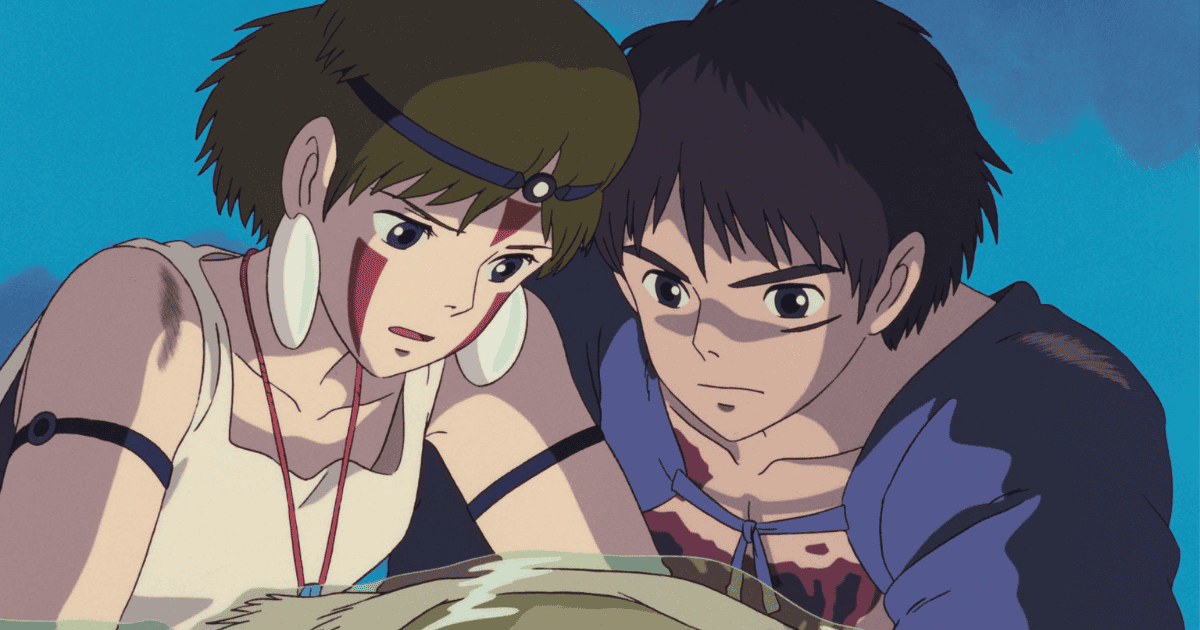
When Moro corners him, Ashitaka boldly screams his most famous line: “Set her free! She is human!”
It makes for a fantastic movie trailer soundbite. But put yourself in Moro’s paws for a second. She likely thought: “Are you kidding me, kid? I know she’s human. I raised her! I have agonized for a decade over her identity crisis, wondering if I am holding her back from a normal life. We are a deeply traumatized, loving family. And you, a teenager who met her two days ago, have the audacity to waltz in here and tell me to ‘set her free’?”
Frankly, I am astounded by Moro’s immense restraint. Her simple reply of “Silence, boy!” is an act of incredible mercy. Given his staggering arrogance, she had every right to bite his head off.
Yet, it is exactly this reckless, “tactless” honesty that breaks through the cynicism. Moro ultimately decides to trust Ashitaka with San’s future because he possessed the sheer, idiotic bravery to look a 300-year-old god in the eye and state his truth without flinching.
In the end, the ability to completely “fail to read the room” might be the most vital requirement for a protagonist. If you always play by the rules of society, you remain an ordinary person. Ashitaka changed the world because he refused to learn the rules.
What are your thoughts on Ashitaka’s role? Do you view his blunt honesty as heroic, or was he just an arrogant prince failing to read the room? Let me know!
The images used in this article are from Studio Ghibli Works Stills.
Can you name the movie before the scene comes into focus?
Put your visual memory to the test with a blurred Studio Ghibli scene.

Reader Comments