
Weathering with You (Official Website) is a spectacularly visual, feature-length animated film directed by Makoto Shinkai, released in 2019. Following the massive global phenomenon of his previous work, Your Name., this film was unleashed into theaters under the weight of astronomical expectations. While its final box office numbers didn’t completely eclipse its predecessor, it cemented its place as a massive, defining hit of the era.
The film was released on July 19, 2019. Tragically, just one day prior, the horrific Kyoto Animation arson attack occurred. I vividly remember sitting in the theater the day after the tragedy. My mind was a chaotic mix of confusion—thinking, “What am I doing sitting in a movie theater right now?”—and a suffocating sense of pathetic helplessness. Unsurprisingly, I couldn’t watch the film with a normal, objective mindset.
In this article, I want to strip away the romance and analyze the mythological core of Weathering with You. By examining the true existence of the “Weather Maiden” (Sunshine Girl), we can uncover the film’s hidden message. Ultimately, I will attempt to reconstruct the tragic, forgotten history of the “Weather Maiden” (though this relies heavily on my own interpretive theory). To achieve this, we must first analyze the unique visual language Shinkai uses to depict nature, and pose two vital questions.
(Note: For a comprehensive breakdown of the plot, character maps, the true meaning behind “We’ll be alright,” and the mystery of Hodaka’s facial scars, please refer to our full guide: Weathering With You: Synopsis & Analysis Summary)
*This is a translated version. The original (Japanese) is available here.
- The Rain is Depicted as “Returning Home”
Visually, the film never portrays the rain as something “evil” or “loathsome.” Instead, the raindrops are animated with a lively, joyful kinetic energy, evoking the profound, moving sensation of returning to one’s hometown. - “Floating” Symbolizes Curses and Powerlessness
In stark contrast to traditional anime, the scenes where Hina and Hodaka float in the sky do not represent freedom or hope. Rather, they evoke a creeping, horror-like unease—symbolizing their cursed fate, absolute helplessness, and emotions that cannot reach their destination. - The “Weather Maiden” Was Once a Mediator
The original, ancient role of the “Weather Maiden” was to negotiate harmony between Humanity and the Sky. However, as modern society stopped “conversing” with nature, her role was violently corrupted into that of a convenient “human sacrifice.” - “Falling” represents Salvation and Self-Affirmation
For Hodaka and Hina—two youths desperate to escape the suffocating expectations and “curses” of adult society—falling freely back to the ground represents ultimate “liberation.” It brings a far greater sense of raw life than floating endlessly in the sky. - The Duality of the End Credits
The unique visual structure of the end credits (names falling from above, then eventually rising from below) serves as a brilliant metaphor for the film’s core theme: “falling,” and the inevitable “circulation of life that begins again from the bottom.”
On this pageContents
The Joy of Rain and the Horror of Floating
Question 1: Why is the Rain so Happy?
The narrative engine of Weathering with You runs entirely on “rain.” In the first act, Tokyo is drowning in endless downpours, and Hina utilizes her prayers to miraculously clear the sky.
The script goes to immense lengths to tell the audience how depressing the rain is, and how wonderful a blue sky is for the human psyche. The clear skies Shinkai paints are staggering, and the sunset Hina summons during the fireworks festival is breathtaking. Undeniably, clear weather brings joy to the people.
However, we are faced with a massive visual contradiction. While the script tells us the rain is “loathed,” the actual animation of the rain falling to the ground is depicted with incredible vibrancy and life.
Visually, the water isn’t painted as a villain. It dances. It looks pure, innocent, and completely divorced from the negative emotions the human characters project onto it. Why does this visual contradiction exist?
Question 2: Why are the “Floating” Scenes so Creepy?
Another fascinating visual motif in the film is the act of “floating.” There are two critical scenes where characters defy gravity:
- After finishing her final job as the “Sunshine Girl,” just as Hodaka summons the courage to confess his feelings, Hina’s body suddenly and involuntarily lifts off the ground into the air.
- During the climax, after Hodaka passes through the rooftop Torii gate and enters the sky realm, he floats aimlessly around Hina, desperately reaching out but unable to grasp her.
The crucial takeaway here is that “floating” is never depicted as an exciting, magical phenomenon.
In fact, to my eyes, these sequences border on psychological horror. In the first scene, Hina is literally being abducted by the sky against her will; it marks the terrifying realization that her physical body is mutating into water. The scene is saturated with a creeping, helpless dread.
In the climax, Hodaka bobs erratically around Hina in the clouds. There is absolutely zero aerodynamic control, and zero sense of heroic momentum. Even though the girl he wants to save is inches away, the physics of “floating” make it feel completely, agonizingly impossible to reach her.
In anime, the ability to float or fly is almost universally portrayed as the ultimate realization of human freedom and joy. Why does Weathering with You frame it as a terrifying loss of control?
Having established these two visual contradictions, let’s explore the answer to the first question.
The True Role of the Weather Maiden: A Tragic History
The Rain Simply Wants to Return to the Earth
The answer to the first question—”Why is the loathed rain animated so vibrantly?”—is actually quite poetic: “Because the rain is simply joyous to return to the earth.“
From a meteorological standpoint, the clouds floating in the sky were originally water resting on the earth’s surface (mostly oceans). The physical act of “raining” can easily be personified as “water that traveled far away finally returning to its hometown.”
The raindrops smashing into the Tokyo pavement aren’t trying to ruin anyone’s day; they are celebrating their long-awaited homecoming. They are yelling, “Man, I’m finally back! It’s been too long!” This explosion of pure, elemental joy is perfectly visualized in the breathtaking sequence right after Hodaka and Hina return from the sky world, just before the three-year deluge begins. It is the majestic cinematic moment when the massive Sky Dragon finally returns to the earth.
Humanity’s Arrogance in Blocking the Rain
When you view the rain as a natural entity simply trying to return home, humanity’s constant whining of “I don’t want it to rain today” begins to feel incredibly selfish. Obviously, rainwater is vital for human survival, and endless droughts are catastrophic.
But setting utility aside, humans show absolutely zero consideration for the “feelings” or natural cycle of the rain. When Hina and Hodaka monetize her powers as the “Sunshine Girl,” they are essentially standing at the train station of the rain’s hometown and violently shouting, “Go back! We don’t want you here!”
Every time the “Weather Maiden” uses her supernatural power to make these “unreasonable demands” against nature, the Sky extracts a toll, slowly taking the Maiden’s body. From the Sky’s perspective, this is a perfectly fair transaction: “If you want to disrupt the ancient cycle for your own convenience, you must pay the price.”
But if that is the absolute rule, the destiny of the girl who inherits the power is monstrously cursed. Why would the role of the Maiden be designed this way? The key to unlocking this ancient mystery lies in a specific, bizarre phenomenon during the trio’s escape from the police.
As the police corner them, Hina prays and violently calls down a massive lightning strike. Wait a minute. We were told her power was strictly to “clear the rain.” Why can she suddenly weaponize lightning?
From this single anomaly, let’s spread the wings of mythological imagination and reconstruct the tragic, forgotten history of the “Weather Maiden.”
The Mediator Corrupted into a Human Sacrifice
If the “Weather Maiden” can summon lightning, it logically follows that she possesses the power to conjure rain, wind, and all meteorological phenomena.
If she wields control over the entire weather spectrum, a new hypothesis emerges: The “Weather Maiden” was never originally designed to be a “human sacrifice” taken by the sky.
In ancient times, the “Weather Maiden” would indeed ask the Sky to stop the rain when humans were desperate. In exchange, she offered a piece of her life force. However, crucially, she would also listen to the “Sky’s circumstances” and turn to the humans, telling them, “The earth is parched, we must endure the rain today.” By allowing the rain to fall when nature demanded it, the Sky would heal the Maiden, returning the life force it had taken.
In its purest, original form, the role of the “Weather Maiden” was not to be a convenient “rain-clearing machine.” Her sacred duty was “to mediate a harmonious dialogue between the Sky and Humanity.”
Therefore, as long as humanity lived in harmony with the weather, the Maiden maintained an equilibrium and would never be entirely consumed by the sky.
However, modern humanity grew arrogant. We stopped listening to the weather and demanded absolute control over our environment. Consequently, the “Weather Maiden” was violently stripped of her dual role. She was forced to become a one-way transmitter, exclusively forcing humanity’s selfish demands onto the heavens.
This tragic corruption is brilliantly highlighted in Hina’s dialogue. She tells Hodaka, “I heard that if the Sunshine Girl becomes a human sacrifice and disappears, this crazy weather will return to normal.” She uses the word “crazy.” But as the old Shinto priest explains earlier in the film, the concept of “abnormal weather” is entirely a human construct.
To nature, a three-year flood isn’t “crazy”; it is simply the Earth reverting to its ancient, pre-human state. But because humanity refuses to adapt and instead labels it “abnormal,” the “Weather Maiden” is stripped of her agency and downgraded into a disposable human sacrifice (hence why society only values her as a “Sunshine Girl”).
Viewing the lore through this lens, the scene where Hina summons the lightning is incredibly profound. It is the first time in centuries that a Weather Maiden actually listened to the Sky’s desires. The lightning desperately wanted to strike the earth, and Hina finally mediated on its behalf, telling it, “You may fall.”
This tragic history answers our first question. Now, we can answer the second: “Why do the floating scenes feel so chilling?”
Liberation from the “Curse” and the Joy of “Falling”
Two Children Desperate to “Fall”
Hina wields her sacred power in a modern world that only values her as a tool to guarantee sunny weekends. While her power is divine, her inevitable fate is a “curse” placed upon her by a selfish society. And yet, because she is a kind girl, she briefly chooses to martyr herself to that curse to secure a normal life for Hodaka and her brother Nagi.
Therefore, Hodaka’s ultimate, climactic action is an act of violent rebellion: he chooses to “liberate Hina from the curse of society.” By doing so, he dooms Tokyo to drown. But the three years of endless rain is simply the “karma of humanity” coming home to roost. Society had been quietly murdering a teenage girl to keep their shoes dry; the flood is the price of their arrogance.
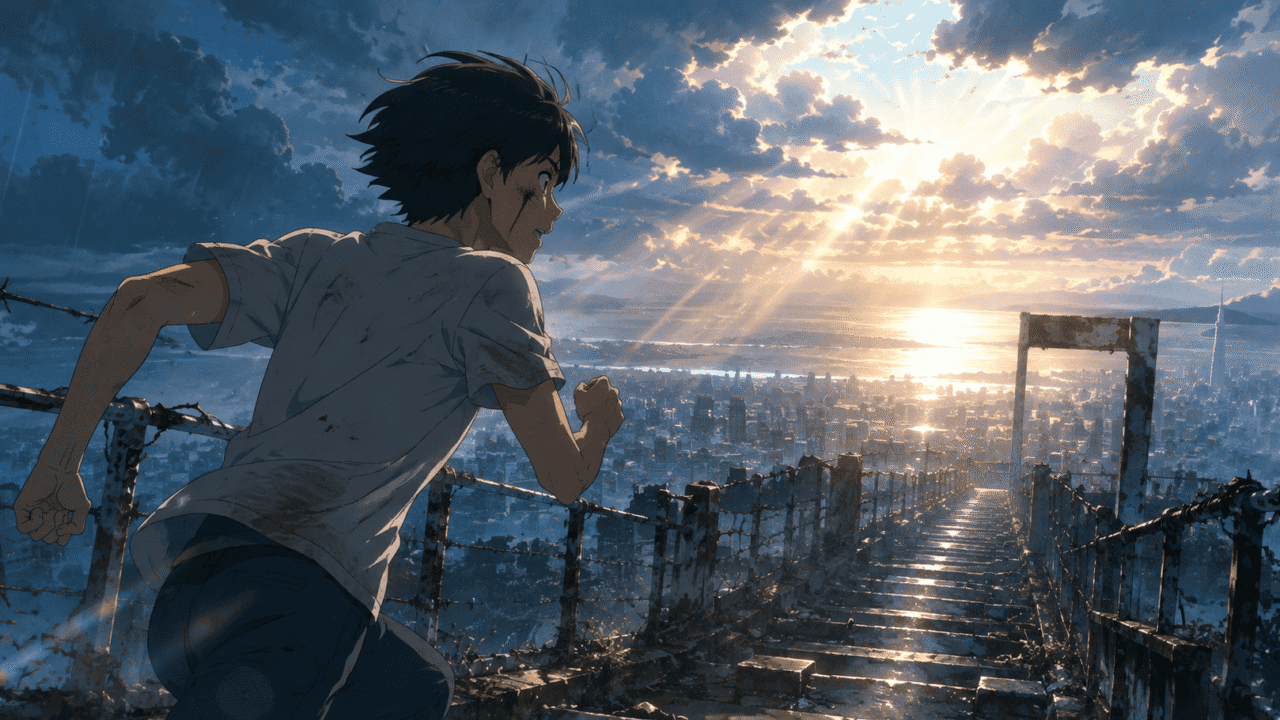
Meanwhile, Hodaka is also running from a curse. He fled his suffocating hometown, arriving in Tokyo battered and bruised, desperately searching for “a place where I can breathe.” Both Hina and Hodaka are actively fighting against the oppressive “curses” and expectations imposed upon them by adult society.
Just as the rain desperately wanted to fall to the earth, Hina and Hodaka had spent their entire lives wanting to “fall” out of the suffocating systems that trapped them. In the emotional climax of the film, as they plummet through the sky, they are finally, truly falling.
This provides the answer to our second question: “Why do the floating scenes feel so chilling?” Because floating directly conflicts with their deepest psychological desires. Hina and Hodaka want to escape a world that demands they stay suspended in roles they hate. For both of them, “floating” represents a terrifying lack of footing, a loss of agency, and a state of being “undead.” They were subconsciously screaming, “I want to fall. I want to fall. Let me fall.”
When they finally clasp hands and plunge toward the earth, their rapid descent is visually paralleled with the joyful, heavy rain finally returning home.
In essence, Weathering with You is a cinematic celebration of the “joy of falling out of line.” If the film has a central message for the youth of today, it is this: “Isn’t it okay to fail the system and fall on your own terms?“
The “Circulation” Hidden in the End Credits
To wrap up this thematic analysis, we must look at a brilliant detail in the end credits.
When I first watched the film, I was struck by the fact that there are essentially two sets of credits.
Immediately after Hina and Hodaka reunite on the flooded streets of Tokyo, the names of the voice cast begin to fall from the top of the screen downward. It is a stunning visual motif that reinforces the theme of “falling.” However, after Makoto Shinkai’s directorial credit appears, the movie doesn’t end. The screen cuts to black, and the standard, traditional credits begin to rise from the bottom of the screen upward.
While it feels slightly redundant, this visual structure perfectly symbolizes the “circulation of nature.” Weathering with You is a story about the joy of “falling,” but the water that falls to the earth will eventually evaporate and return to the sky. The credits climbing upward symbolize that even after hitting rock bottom, the lives of Hina and Hodaka will inevitably begin to rise again.
Conclusion: The Ultimate Message of “Weathering with You”
To summarize this deep dive:
Weathering with You introduces the concept of the “Sunshine Girl” to initially celebrate the beauty of clear skies and the psychological comfort good weather brings to humanity.
However, the narrative quickly deconstructs this. The “Sunshine Girl” is actually the corrupted, ruined remnants of the ancient “Weather Maiden.” She is a tragic symbol of humanity’s sheer arrogance—a society that forgot how to converse with nature and simply demands that the sky bend to its will. Hina, burdened with this power, is a victim of a societal “curse.” Hodaka’s ultimate choice is to liberate her from being a human sacrifice.
But “liberating her from the curse” severs the final diplomatic tie between the Sky and Humanity. Without a mediator, the sky simply lets the water fall, plunging Tokyo underwater. From a societal standpoint, Hodaka’s choice is a catastrophic “failure” and a deviation from the greater good. Yet, the film refuses to condemn them. Like the vibrant, joyful rain, the two youths plummeting from the sky are depicted as beautifully refreshed—having finally reclaimed their right to live for themselves.
Weathering with You is a triumphant defense of choosing personal salvation over societal expectation. Its final, resonating message to a suffocated generation is simply: “It’s okay to fall.”
Deconstructing the mythology of the lightning strike and the lore of the Maiden makes me appreciate Shinkai’s vision even more. Of course, this analysis relies on some interpretive leaps, but unpacking these hidden layers is the true thrill of cinema.
In our next deep dive, we will tackle the film’s other massive mystery: what exactly does Hodaka mean when he declares in the final scene, “Hina, we’ll be alright”?
For a detailed breakdown of the plot and the resolution to the “We’ll be alright” mystery, check out our comprehensive guide:
Weathering With You: Synopsis & Analysis Summary
Appendix: Hidden Details and Ghibli Parallels

Why is the World Above the Clouds So Lush and Green?
One of the most breathtaking visual sequences in the film is the world resting on top of the cumulonimbus clouds. It is depicted as a sprawling, lush meadow of green grass. While the film offers no scientific explanation for this ecosystem, we can deduce a rather humorous (and slightly gross) biological theory.
Consider the exact sequence of events when Hodaka breaches the sky world. He passes through the Torii gate, falls into the realm of the Sky Dragons, and is literally swallowed whole by a massive water dragon. He travels through the dragon’s internal anatomy and is deposited onto the grassy “Sky Garden” below, where he finds Hina.
If he went into the dragon’s mouth and came out the other end… there is only one biological exit point.
Therefore, we can jokingly conclude that the top of the clouds is so lush and green because it is constantly fertilized by the incredibly nutrient-rich manure of the Sky Dragons! (Please take this with a massive grain of salt).
The Mystery of the Ceiling Painting
The ancient ceiling painting inside the Weather Shrine is a crucial piece of world-building. It clearly depicts four distinct types of divine weather beasts. Yet, throughout the film, the audience only explicitly sees the massive water “dragons.” Or do we?
The film highlights four major, catastrophic rain events: the bizarre localized storm Hodaka encounters on the ferry; the torrential downpour immediately after Hina first demonstrates her power; the freak summer snowstorm during their escape; and finally, the apocalyptic rain that lasts for three years.
It is highly probable that during these massive meteorological events, those other specific divine beasts were descending to earth. The water masses that crash down after the first two events are likely the physical manifestations of those beasts. However, the three-year rain presents a massive mythological problem. While typhoons are common, a three-year deluge is a near-biblical anomaly.
Perhaps, in the hierarchy of the sky, the Dragon is the supreme deity who rarely visits earth. But when the contract with the final “Weather Maiden” was permanently broken, the Dragon decided to permanently relocate to the surface. However, because nature operates on cycles, the three-year rain will eventually cease. We just don’t know when.
The Thematic Battle Against “Laputa”
When watching Weathering with You, it is impossible for anime fans not to draw immediate comparisons to Hayao Miyazaki’s masterpiece, Castle in the Sky (Laputa). The climax, where Hodaka floats through the clouds desperately reaching for Hina, is a direct visual echo of Pazu reaching out to catch Sheeta from his glider.
However, the emotional texture of these two scenes is diametrically opposed. Pazu’s rescue is framed as a triumphant, thrilling moment of heroic action; the audience knows he is going to catch her. In stark contrast, Hodaka’s floating sequence is framed with agonizing, suffocating helplessness. It genuinely feels like he will fail. It operates as psychological horror.
Furthermore, the cinematic treatment of “falling” creates a brilliant contrast between the two directors. In Laputa, free-falling is an absolute terror, and the magical Levitation Stone that slows their descent is the romantic savior. In Weathering with You, floating via magical power is the terrifying trap, and free-falling at terminal velocity is the ultimate, romantic liberation.
It feels as though Shinkai deliberately challenged Miyazaki’s legacy by weaponizing the “romanticism of the free fall.”
The “Princess Mononoke” Connection
The concept of characters being burdened with a “curse” also draws heavy parallels to Princess Mononoke. Miyazaki’s epic follows Ashitaka, a boy afflicted with an absurd, fatal curse who is banished from his hometown and forced to find a new reason to live.
In Weathering with You, Shinkai splits Ashitaka’s narrative burden into two characters: Hina bears the physical “curse,” while Hodaka bears the social “banishment.” In the opening scene, Hodaka is riding his bike with a face full of bandages. While the film never explicitly explains the injuries, it is heavily implied he suffered physical abuse at the hands of his father.
Later in the film, the police show Hina a missing person flyer for Hodaka. The photo features a stern, intimidating man standing next to him—almost certainly his father. It is highly likely that after a violent altercation, Hodaka was told to “Get out!” just like Ashitaka.
Ultimately, both films tell the story of cursed, banished youths finding salvation in each other and declaring, “We will survive.”
If we apply the lore of Mononoke—where a curse is essentially the overwhelming power of a god—we can re-examine Hina’s fate. Her body wasn’t just “disappearing”; she was slowly ascending into a divine state. Once she crossed the threshold into the sky world, she could not return to the mortal plane without discarding that divine power.
Because previous Weather Maidens never had someone reckless enough to cross into the divine realm to pull them back, they remain trapped in the sky as eternal “human sacrifices.” Unpacking these layers transforms the film into a profound exploration of Shinkai’s views on life, death, and defiance.

Reader Comments