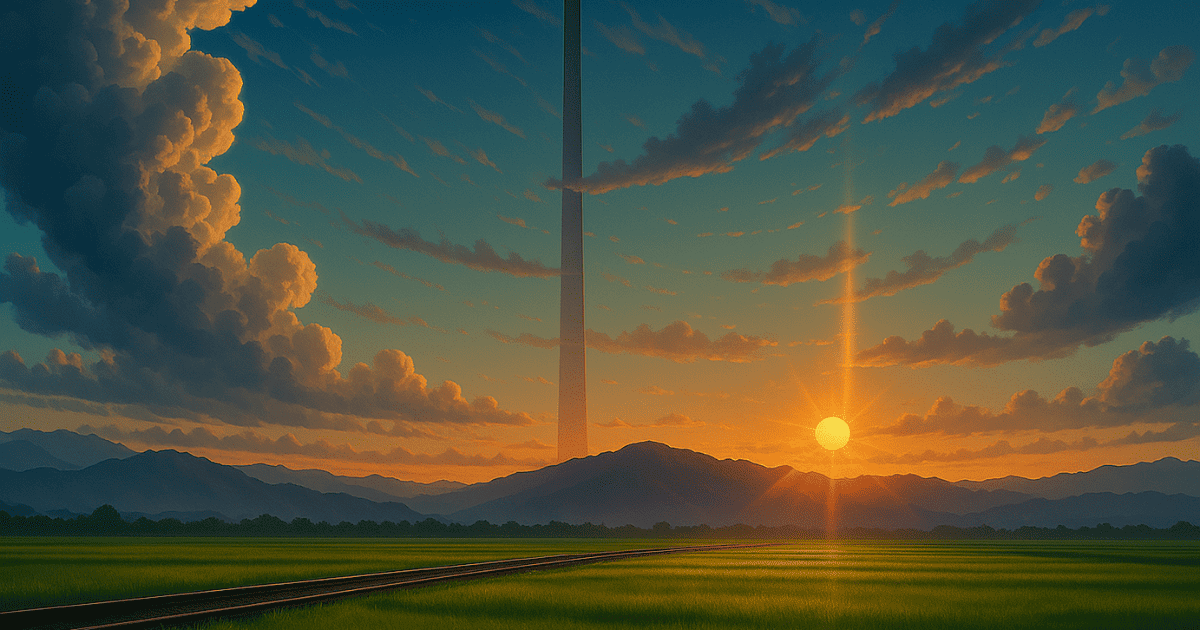
The Place Promised in Our Early Days is an animated feature directed by Makoto Shinkai and released in 2004.
I think I was still a teenager when I first saw it. A friend told me, “There’s a film set in Aomori,” and I thought, “Someone actually wanted to make that?” Aomori is my hometown. In the end, it felt more like a film set at the northern tip of Honshu than in Aomori itself, but it remains a favorite.
I suspect many people love this film without quite being able to explain why. For years, I simply knew I liked it. Eventually, though, a thought came to me: it is a version of Roman Holiday that is not romantic at all. At the same time, I think it is an ultimate hero’s tale.
I want to explore that idea, but first let’s look back at the story. The synopsis below contains major spoilers.
*This is a translated version. The original (Japanese) is available here.
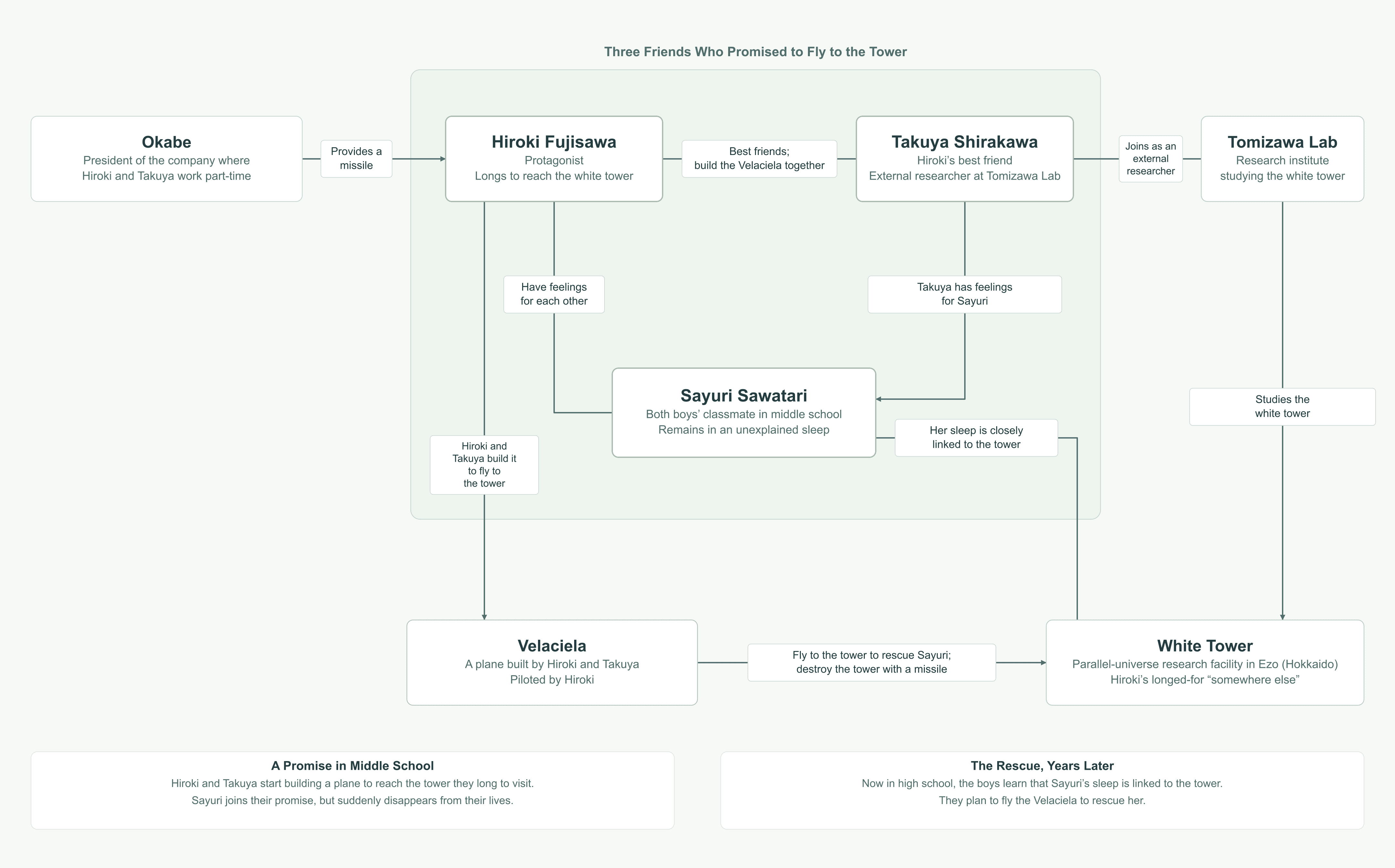
- Detailed Synopsis and Character Map
Hiroki, Takuya, and Sayuri dream of flying to the white tower in Ezo, but Sayuri suddenly disappears. Years later, Hiroki and Takuya learn that she is in a coma and set out to save her. Yet she loses her memories of Hiroki from the dream. The detailed synopsis and character map follow. - A Story of Loss That Undercuts Roman Holiday
Sayuri forgets the special time that should have become a shared memory. Returning to the film’s opening makes the loss more painful: Hiroki alone carries the memory of what they experienced. - A Lonely Hero’s Tale
Even without a romantic reward, Hiroki saves Sayuri. In this reading, his solitary return to the place of their memories is not only a sign of loss; it also suggests a quiet pride in what he managed to save.
On this pageContents
The Place Promised in Our Early Days Synopsis (Spoilers Ahead)
A Quick Summary and Character Map
- A Divided Japan and Two Fascinations
Middle schooler Hiroki Fujisawa is fascinated by the white tower rising above Ezo (Hokkaido), and by his classmate Sayuri Sawatari. He and his best friend, Takuya Shirakawa, build an airplane so they can fly to the tower. But Sayuri suddenly disappears. - Separate Paths and Research into the Tower
Hiroki goes to high school in Tokyo. Takuya stays in his hometown and works as a researcher while still a high school student. Sayuri, meanwhile, is in an unexplained coma and is brought to Takuya’s research institute because of a possible connection with the tower. - Sayuri’s Sleep and Parallel Universes
The white tower observes countless parallel universes. Information from them flows into Sayuri’s brain, leaving her unable to wake. In her dreams, she wanders through a strange landscape of towers, yet never entirely forgets Hiroki. - The Plan and the Flight of the Velaciela
Hiroki and Takuya finish their abandoned airplane, the Velaciela, to rescue Sayuri. Taking advantage of fighting between North and South, they put their plan to destroy the tower into action. Hiroki flies toward it with Sayuri aboard. - Awakening, Loss, and a Life That Continues
Sayuri wakes as they approach the tower, but the memories of Hiroki she formed in her dreams disappear. Hiroki destroys the tower and leaves Ezo, knowing he has at least saved her. He loses both dreams at once, but his life continues.
Character Map
Detailed Synopsis
The protagonist is Hiroki Fujisawa. As a middle school student, he is absorbed by just two things: the white tower rising beyond the clouds in Ezo, a symbol of Japan’s division, and his classmate Sayuri Sawatari.
Hiroki and his closest friend, Takuya Shirakawa, share a dream known only to them: build an airplane and reach the tower. That takes money, of course, so they work part-time and gather materials for it.
Hiroki tells Sayuri about their secret—not surprising, really, since he is in love with her. What had been a dream shared by two boys seems about to become a dream for all three. But Sayuri suddenly disappears, and the boys’ dream vanishes with her.
Hiroki goes to high school in Tokyo, while Takuya stays in their hometown and works as an external researcher at the Tomizawa laboratory, studying the tower. He is doing this while still in high school. Quite a talent!
What neither boy knows is that Sayuri did not leave by choice. She has fallen into an unexplained sleep. Learning this rekindles Hiroki’s determination to reach the tower and finish the Velaciela. Takuya, meanwhile, learns that Sayuri has been brought to his institute because her sleep seems fundamentally connected to the tower.
Sayuri is asleep, but her mind is not empty. She dreams constantly, wandering among strange towers that symbolize parallel universes. The tower in Ezo was built to study those universes, and somehow the information it observes flows into her brain. When that information exceeds her mind’s capacity, she falls asleep.
Even in that dream world, Sayuri does not forget Hiroki. He is her only “spider’s thread” connecting her to reality. Yet she cannot return by herself—or rather, every possibility has become a reality for her.
Hiroki and Takuya eventually plan to blow up the white tower. They conclude that destroying it will release Sayuri from her sleep.
Fighting between North and South begins around the same time. Taking advantage of the confusion, they launch their plan. Hiroki pilots the completed Velaciela, carrying Sayuri, whom Takuya has somehow managed to take out of the institute.
As Hiroki approaches the tower, Sayuri regains consciousness. Perhaps the many possibilities flowing into her converge at that moment. But everything she experienced while searching for Hiroki in her dreams, including their recovery of reality together, disappears from her memory. For her, it has all become a dream.
Hiroki nevertheless holds on to one fact: he has rescued Sayuri from her coma. He destroys the tower and leaves Ezo.
He loses his two dreams at once. Even so, his life goes on.
What, Ultimately, Is The Place Promised in Our Early Days About?
As the synopsis shows, this is a story in which Hiroki loses his two dreams: the white tower and Sayuri. It seems easy enough to understand it as a story of loss. But what, ultimately, is the film about?
The Roman Holiday Connection
A useful point of reference is Roman Holiday. What happens in Roman Holiday?
Princess Ann, played by Audrey Hepburn, is exhausted by her official travels. She escapes her accommodation and happens to meet Joe, a newspaper reporter.
Joe intends to turn the princess’s escapade into a story. Despite those calculations, however, he gradually falls for her, and she for him.
Their special time in Rome cannot last. Ann must return to her position as a princess; they cannot remain together indefinitely.
At the press conference the next day, they meet again and behave as though they have never met before.
They have shared a special time, but it has become something they must never speak of.
The sadness of Roman Holiday lies in this: two people who have shared something special must finally behave as though it never happened. At the very least, it is an experience they cannot reveal to others.
It is a painful story, but we should not forget that their special time really happened, and both will surely remember it.
The ending of La La Land has a similar meaning. When the two look at each other, they remember that those days really existed. They are living different lives now and will never tell others about that time. It is deeply sad.
A Version of Roman Holiday That Is Not Romantic
At heart, The Place Promised in Our Early Days is also a love story between Hiroki and Sayuri. On the surface, it looks as though Hiroki alone rescues her. Yet she, too, has been struggling desperately in her dreams.
The two ought to have a proper reunion inside the Velaciela. But that is not what happens.
The device that separates them while also connecting them is a dream. That creates the tragedy: just before she wakes, Sayuri forgets everything that has led to this moment.
Like Roman Holiday, it ends with the two unable to be together. But the decisive difference is that one of them has forgotten everything.
In Roman Holiday, the princess and the reporter are kept apart by their positions. In The Place Promised in Our Early Days, no such difference separates the two, yet they still do not come together. Thus the film moves well beyond a story of separation and becomes a story of loss.
At the start, an older Hiroki visits the place of their memories alone, looking lonely. It is easy to forget this scene as the film unfolds. For me, though, that solitary Hiroki is the most important part of the film.
In Roman Holiday and La La Land, both people acknowledge that they once shared a special time. Here, only one person recognizes it: Hiroki.
In this structure, I sense a rejection of the traditional romantic formula, and a kind of nihilism.
More bluntly, it seems to say: in the end, only the man remembers, doesn’t he?
I read it as a story that deliberately avoids becoming another Roman Holiday. And to keep that refusal from becoming too obvious, it begins with the final scene and ends just before that aftermath. Because it ends when Hiroki saves Sayuri, the loss is not emphasized, and we can come away with the impression that things have ended well.
The Making of a Lonely Hero
So far, I have read the first scene as the sadness of a lonely man. But there is another way to understand the film: as an ultimate hero’s tale.
Hiroki has, beyond doubt, saved a girl. We must not forget that.
Destroying the northern tower may save Sayuri, but it could also destroy the world beyond her. In that sense, we might say he is doing something similar to the protagonist of Shinkai’s later Weathering with You.
Seen this way, Hiroki’s solitary return is not simply a visit to what he has lost. Perhaps he has come to remember what he nevertheless managed to save. I take his need to revisit those days as a sign that his present life is not going well. Even so—or perhaps because of that—he seems to have come to hold on to the knowledge that he once accomplished something.
A hero is lonely, and is a hero precisely because of that loneliness. Perhaps Hiroki carries something of that Kamen Rider-like image.
The Place Promised in Our Early Days remains difficult to pin down. Even after trying hard to put these thoughts into words, I still feel I may have missed something. Perhaps that elusiveness is part of its appeal. Let’s leave it at that: the film is still compelling.
What did you think of the bittersweet ending? Did you view Hiroki’s journey as a romantic tragedy, or a triumph of a lonely hero? Let me know your thoughts!


Reader Comments