
Indiana Jones and the Dial of Destiny, directed by James Mangold, was released on June 30, 2023. It is the fifth film in the Indiana Jones series, with Harrison Ford returning as Indy. Steven Spielberg, who directed the previous films, serves as an executive producer.
More than a decade had passed since Kingdom of the Crystal Skull (2008), and I remember how much I was looking forward to seeing the new film at the cinema.
Instead, I found a world in which Indy and Marion’s son, Mutt, had been killed in the war. Indy and Marion are going through a divorce, and Indy is retiring from the university. Nothing seems left for him to look forward to.
The joy of seeing Mutt and Marion in Kingdom of the Crystal Skull is swept away.
The film is enveloped in a tremendous sadness. Near the end, the Dial of Archimedes takes Indy into the past, to the era he has spent his life studying. He tries to stay there, only for Helena, a new character in this film, to punch him unconscious and haul him back to the present.
Of course, he wants to remain in a world he has long dreamed of as an archaeologist, especially when only despair seems to await him at home. But I think he may have had another intention too.
Helena Shaw presents a contradiction of her own. She has the audacity to auction off antiquities, yet possesses deep historical knowledge and enough intelligence to memorize her father’s research notes.
I want to consider the film through two questions:
- Why did Indy really want to stay in the past?
- What explains Helena’s contradictory behavior?
First, let’s revisit the story of Indiana Jones and the Dial of Destiny.
*This is a translated version. The original (Japanese) is available here.
- Indy’s Wish to Stay in the Past
I suspect his wish went beyond archaeological curiosity and despair about the present. Perhaps, as a grieving father, he hoped that staying behind would change history and create a future in which Mutt did not die in Vietnam. In that reading, Indy and Voller share a desire to change the past, despite being enemies. - The Purpose Behind Helena’s Contradictions
I read her behavior as a conflict between revenge against the archaeology that consumed her father and an attachment to his work that she cannot sever. Through a “virtual parent–child quarrel” with Indy, her adventure becomes a way of recovering her relationship with her father. - The Losses of the Vietnam War
Mutt’s death represents the pain that coexisted with America’s glory in this period. The film conveys that loss through Indy and Marion’s enduring grief, without showing the war itself. In that sense, I see it as a Vietnam War film too. - Helena and a New Generation
I see an irony in Helena’s character: even an exceptionally intelligent woman might find it difficult to make a fortune independently without resorting to dubious means. She approaches antiquities with values different from Indy’s, representing a new generation.
On this pageContents
Indiana Jones and the Dial of Destiny (2023): Synopsis with Spoilers

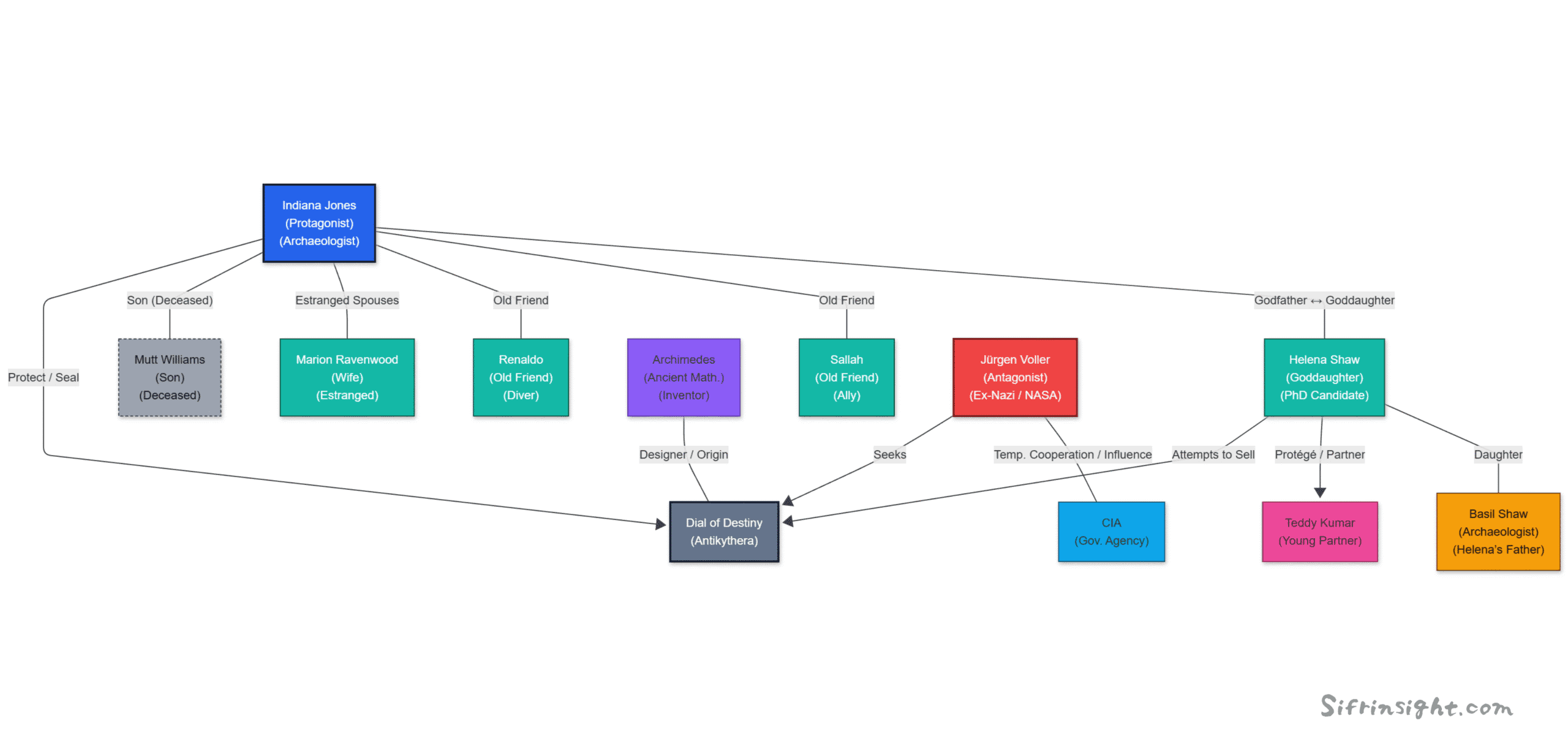
Synopsis Points and Character Map
- A Wartime Prologue: From the Lance to the Dial
In 1944, Indy and his fellow archaeologist Basil Shaw try to recover the Lance of Longinus from Nazi forces. The scientist Jürgen Voller dismisses it as a fake. His real interest is Archimedes’ Dial, a device said to locate fissures in time. After a battle on a train, Indy and Basil escape with half of it. - New York, 1969: Loss and Reunion
As New York celebrates the Apollo 11 Moon landing, Indy reaches retirement. His son has died in Vietnam, and he is separated from Marion. Helena, the daughter of his old friend Basil, appears and says she wants to continue her father’s work on the dial. - An Attack at the Archives: Framed for Murder
When Indy shows Helena the dial in the university archives, Voller’s men attack with CIA assistance. University employees are killed, and Helena flees with the dial. Framed for the murders, Indy goes into hiding. With Sallah’s help, he concludes that Helena has gone to Tangier to sell it at a black-market auction. - Tangier: A Three-Way Struggle
Indy finds Helena at an illegal auction in a hotel, but Voller’s men and gangsters led by her former fiancé also arrive. Voller takes the dial during the struggle. Indy and Helena turn to the Graphikos, a tablet that points to the missing half. - The Aegean Sea: Recovering the Graphikos
With help from Renaldo, a skilled diver and Indy’s old friend, they recover the Graphikos from a shipwreck. Voller ambushes them and shoots Renaldo to force Indy to translate it, but Helena finds a way for them to escape. - A Two-Part Clue: The Way to Sicily
The Graphikos contains two layers of clues. Its surface points to Alexandria as a decoy; a gold disc hidden inside directs them to the Ear of Dionysius, a cave in Sicily. - Archimedes’ Tomb: Completing the Dial
Indy and Helena find Archimedes’ tomb deep in the cave. A wristwatch on the ancient remains deepens the mystery of time. They find the dial’s missing half, but Voller catches up, takes both pieces, and assembles them. - Ancient Syracuse: An Error—or the Designer’s Intention?
Voller activates the dial, intending to reach 1939 and rewrite history. Instead, the fissure takes him to Syracuse in 214 BC. Ancient weapons bring down his bomber, killing him. Archimedes retrieves his wristwatch and the completed dial from the wreckage. Indy wants to remain in the history he has studied, but Helena punches him unconscious and takes him home. - New York, 1969: Reconciliation After Loss
Indy wakes in his apartment, where Helena is looking after him. Marion arrives. Separated by the death of their son, the two begin to find their way back to one another.
Character Map
The Film’s Historical Background
Dial of Destiny is an adventure through time built around a fictional version of the Antikythera mechanism. Its puzzles and chases draw on both history and legend.
You do not need all the historical details to enjoy the film, but they add context to its story. My separate guide discusses Nazi art theft, Wernher von Braun as a possible model for Dr. Schmidt, and the Siege of Syracuse:
Read the historical background: WWII, Dr. Schmidt, Archimedes, and the Antikythera Mechanism
The Vietnam War is never shown directly, but it shapes Indy’s grief. The social position of women in this period also matters to my reading of Helena. Here is some background to those two subjects.
The Vietnam War and America in 1969
In 1969, the first Moon landing was a source of national glory, while the Vietnam War brought loss into American homes. Apollo 11’s astronauts were celebrated in a New York parade on August 13. Meanwhile, conscription and television coverage made the war part of everyday life.
The conflict developed after the 1954 Geneva Accords, which temporarily divided Vietnam. U.S. involvement escalated after the Gulf of Tonkin Resolution in 1964; by 1965, large deployments of American ground troops and bombing of the North had brought the United States fully into the war.
- The Draft Lottery (1969): On December 1, a lottery assigned draft priorities for the following year by drawing capsules representing birthdays. This made the risk of conscription painfully visible to families. It took place after the film’s August setting.
- Anti-War Protests: Millions took part in the October Moratorium across the United States, and the November march in Washington drew around half a million people. Opposition to the war had become a mass movement.
- The War on Television: Following the Tet Offensive of 1968, television made the fighting a reality people watched in their living rooms, influencing public attitudes toward the war.
As a result, glory and pain coexisted in America in 1969, leaving the country profoundly divided.
This makes 1969 a particularly apt year for Indy to turn 70 and retire.
I read the film as expressing the pain of the Vietnam War through the death of Indy’s son, Mutt Williams.

The armed forces included both draftees and volunteers. Indy’s following line indicates that Mutt volunteered rather than being drafted. That also makes his enlistment an act of defiance against his father.
“I’d stop my son from enlisting.”
A slightly unkind viewer might ask, “Even if Indy had stopped him enlisting, couldn’t he still have been drafted and killed?” The lottery discussed here applied to younger men. Mutt seems to be about 19 in 1957, during Crystal Skull. If his death occurred shortly before 1969, as I am assuming for this reading, he would have been older than that group. Stopping him from volunteering might therefore have prevented his death. The argument depends on that timing.
That possibility may be part of what makes his death so painful for Indy and Marion.
Next, I want to consider women’s opportunities in America at the time, a background that seems important to Helena’s character even though the film does not explain it directly.
Women’s Opportunities in America in 1969
Second-wave feminism was increasingly visible in 1969. Measures such as the Equal Pay Act of 1963 and the Civil Rights Act of 1964 were changing the legal framework, but everyday working practices were slower to follow.
- Barriers at Work: Biases about marriage and age, assumptions that women belonged in supporting roles, and prejudice in tenure decisions still obstructed hiring, assessment, and promotion.
- Progress and Its Limits: More women were entering employment and professional work, but unequal pay, occupational divisions, and barriers to promotion persisted. Women’s work in computing, software, and engineering during the space program offered visible examples of what they could achieve.
How This Background Relates to Helena
Against this background of legal progress and lingering practical barriers, Helena appears a little ahead of her time in taking an active role in scholarship, trade, and adventure. It also brings out the irony I see in her efforts to make a fortune by auctioning stolen objects.
Perhaps the film is making a sardonic suggestion: for an intelligent, resourceful woman in that period, what way was there to make a fortune on her own, other than something bordering on crime?
It also pokes at an obvious problem in the Indiana Jones series itself: its hero has been raiding tombs all along.
In my reading, the Vietnam War and women’s rights are present without being directly explained. They give the time-travel adventure greater depth.
Helena says she is a doctoral candidate. I think it is reasonable to read that claim as a lie intended to deceive Indy, rather than simply take it at face value.
Now I will turn to Indy and Helena’s motives, beginning with the climax.
Detailed Synopsis
World War II: Encountering the Dial
In 1944, Indiana Jones and his friend Basil Shaw enter a castle in the French Alps to recover the Lance of Longinus from Nazi forces. They are captured, but Indy escapes and follows the train carrying Basil and the relic.
On the train, the Nazi scientist Jürgen Voller argues that the lance is a fake and the real prize is Archimedes’ Dial, half of which he has. He believes the complete device will give him godlike power. Indy rescues Basil and strikes Voller during the fight. Basil takes the dial, and the two leap from the railway bridge into the river to escape.
1969: A New Shadow for a Retiring Hero
In 1969, Indy is retiring from Hunter College. His son Mutt has died in Vietnam, and he and Marion are going through a divorce. While New York celebrates the Apollo 11 astronauts’ return, he sits drinking quietly in a bar, weighed down by loneliness and helplessness.
Helena Shaw, Basil’s daughter and Indy’s goddaughter, arrives. They have not seen one another for 18 years. Claiming to be a doctoral student in archaeology, she says she is continuing her father’s research into the dial.
Late in life, Basil became obsessed with the dial and convinced that it could predict dangerous fissures in time. He asked Indy to destroy it, but Indy could not bring himself to destroy the result of his friend’s passion. He hid it in the university archives.
Indy calls Helena his “goddaughter.” The term comes from the Christian tradition of a sponsor at a child’s baptism. Here, it expresses a special bond: Indy is someone who could care for Helena even in her father’s place.
The Chase for the Dial Begins
As Indy shows Helena the dial, he senses something wrong. Then Voller’s men attack, with CIA assistance. Voller now calls himself Dr. Schmidt and has contributed to NASA’s Apollo program. His men have already killed two university employees.
Helena takes the dial and escapes, leaving Indy behind. He gets out too, but is framed for the employees’ murders. Sallah helps him hide and discover Helena’s links to stolen-artifact auctions and gangsters in Tangier, Morocco.
Indy goes to Tangier, expecting Helena to auction the dial. He finds her at a hotel, but Voller’s men arrive too. Helena had been working for Voller before deciding to sell the dial herself. A struggle follows, and Voller takes it. Gangsters led by her former fiancé add to the chaos. Indy escapes Tangier with Helena and her young companion Teddy.
A Clue Beneath the Aegean Sea
Now facing a common enemy, Indy and Helena cooperate to find the other half. Having memorized Basil’s notes, Helena believes the Graphikos tablet lies in the Aegean Sea. With Renaldo, a skilled diver and Indy’s old friend, they find it in a Roman shipwreck.
Voller’s men are waiting when they surface. When Indy refuses to translate the tablet, Voller shoots Renaldo. Helena pretends to cooperate to stay alive, giving a reading that points to Alexandria. She then creates a diversion with dynamite and escapes with the tablet.
Completing Archimedes’ Dial
After escaping, Indy realizes the Graphikos is more than a tablet. A gold disc hidden beneath its wax and wood points to the Ear of Dionysius in Sicily. Voller discovers their destination too and kidnaps Teddy on the island.
Worried about Teddy, Indy and Helena nevertheless enter the cave first. They find Archimedes’ tomb and the dial’s other half. Inexplicably, the ancient remains wear a wristwatch. Voller arrives and takes both halves, completing the dial.
Voller intends to reach Munich in 1939, kill Hitler, and change World War II’s outcome in Germany’s favor. Indy suggests that Archimedes’ calculations did not account for continental drift. When their bomber enters the fissure, it emerges not in 1939 Germany but at the Siege of Syracuse in 214 BC.
Yet I find another reading more natural: Archimedes designed the dial to bring help to his own time. Voller mistakes it for a device that can take him wherever he chooses, and instead does what its maker intended. Helena also makes a remark to that effect.
An Ending Across Time
The Roman forces attack the bomber, which crashes, killing Voller and his men.
Archimedes appears at the wreckage and retrieves Voller’s watch and the completed dial, explaining the watch Indy saw in the tomb.
Indy and Helena parachute to safety. Confronted with the history he has spent his life pursuing, Indy decides to stay. Helena refuses to leave him with his worsening gunshot wound. When he will not listen, she punches him unconscious and takes him back.
Indy wakes in his apartment in 1969 and tells Helena again that he wanted to remain in the past. Then Marion arrives. The bond he thought he had lost returns; they kiss quietly, and his tumultuous adventure ends in a moment of love.
Indiana Jones and the Dial of Destiny: Analysis

Why Did Indy Want to Stay in the Past?
At the climax, a badly wounded Indy desperately wants to remain in Archimedes’ time. Archaeological curiosity and despair about the present seem to explain it. But might he have had another purpose? That is what I want to consider.
What Voller and Indy Share: A Past They Want to Change
Voller wants to return to the past, assassinate Hitler, and change the war’s outcome in the Nazis’ favor. He intends to rewrite history himself.
Indy has also lost his son in Vietnam, and his relationship with Marion has broken down in their grief. Mutt’s death is a past he desperately wants to change. Voller seeks to alter history while Indy tries to stop him, yet they are two sides of the same coin in having a past they wish to undo.
Rejecting Historical Change—and Feeling Its Pull
As an archaeologist, Indy understands the dangers of intervening in history. That is why he works so hard to stop Voller’s plan.
Yet when Indy reaches the time he has long dreamed of, he wavers. If he returns home, he faces grief for his son, separation from his wife, and retirement. The attraction of witnessing history and his despair about the present combine to make him choose to stay.
But I suspect he may have had another intention.
A Faint Hope for a Future in Which His Son Lives
A hint of that intention appears in his conversation with Helena after he wakes at home:
Indy should understand the dangers of changing the future by staying in the past. Yet perhaps he has a desperate wish deep down: “If my staying behind changes history even a little, maybe it will create a future in which Mutt does not die.” I read this as a grieving father’s faint hope, not a logical plan.
Perhaps it is the cry of someone overwhelmed by grief. When Helena brings him back and he reunites with Marion, we might see that wish fulfilled in another form. Mutt’s death saddened those of us who had followed the series for years, too. The film also seems to remind us that real parents suffered the same loss as Indy and Marion.
Helena’s Contradictions: Revenge, Attachment, and the Connection with Mutt
Helena’s behavior initially looks selfish and driven by money. Looking more closely, I see contradictory feelings rooted in her relationship with Basil: revenge and an attachment she cannot break.
Apparently Contradictory Actions
Several things about Helena seem contradictory:
- She says cash is the only thing worth believing in. She acts as though even the dial, her father’s legacy, is merely a way to make money.
- With her intelligence and resourcefulness, she might have been able to build wealth without trafficking in antiquities. Yet, as I argued earlier, her choice may carry a social irony about the limited routes to independent wealth available to women at the time.
- The largest contradiction is her attachment to the dial itself. If money alone mattered, she could look for another opportunity once Voller took it. Instead, she keeps pursuing it despite the danger.
These contradictions suggest that money is not her only motive.
Her Father’s Obsession and the Burden of His Teaching
The key to Helena’s contradictions may lie in Basil. Her skill at deciphering codes comes from his intensive teaching. Yet the father who taught her was also losing himself in his obsession with the dial.
In this reading, the knowledge her father gave her is inseparable from the pursuit that took him away. She loves him, yet feels hatred for the world of archaeology that drove him into obsession.
“Revenge” on Archaeology and Attachment to the Dial
I see those opposing feelings as the source of her behavior. Stealing antiquities and auctioning them is more than a way to make money: it is revenge against the field her father held sacred, which shattered their family. Turning historic objects into cash may be her way of rejecting his values and protecting a wounded self.
At the same time, she cannot simply hate her father and let him go. She seems unable to abandon the need to know what made the dial so compelling: does it have no supernatural power, or was her father right?
Finding that answer herself would give meaning to his obsession and help her face her own past.
An Adventure to Recover Her Father
For Helena, the journey can be both a money-making venture and an “adventure to recover her father.” By learning whether he was right, she tries to reclaim, in her mind, the father he was before his obsession—and her own past.
Indy as the Lost Father, Helena as the Lost Child
Helena’s attitude toward antiquities is the opposite of Indy’s. I see an old set of values meeting a new one, a conflict that repeats through history and often becomes most painful between parent and child.
In Kingdom of the Crystal Skull, Indy accepts Mutt’s choice not to attend college while he thinks they are unrelated, then changes his attitude when he learns Mutt is his son. Perhaps similarly fierce disagreements about how to live preceded Mutt’s enlistment to spite him. Had Mutt lived, they might eventually have made peace—or simply kept arguing.
Helena, meanwhile, watched Basil become consumed by research and probably questioned his way of life. The film does not establish exactly when he died. If, as the depiction suggests to me, it was soon after Indy took the dial, Helena may not even have had the chance to quarrel with him over those choices.
Both have been unfairly deprived of experiences an ordinary parent and child might share: one by war, the other by an obsession with research.
In that sense, their adventure can also be seen as a vast “virtual parent–child quarrel.”
Through Indy, Helena comes to make sense of her father’s passion and obsession, while Indy passes her the baton he could not pass to Mutt. That is how I read their relationship.
It remains terribly sad that Mutt is not the one receiving that baton. But without expressing that sadness—the pain of the Vietnam War—the film could not, I think, truly depict America in that period. Given the nature of the Indiana Jones series, it could hardly leave that pain out.
I see this as a “Vietnam War film” that conveys its sorrow without directly showing the war; a “film expressing a wish for greater rights for women”; and a “film about the sadness of division and the hope of overcoming it” through conflict between generations.
To bring those themes together without explaining them directly, and still make an entertaining adventure, is remarkable. Isn’t Dial of Destiny a masterpiece in that respect?
These are my own thoughts on Indiana Jones and the Dial of Destiny. Trying to put them into an article revealed its many sides to me. It really does seem to be a film about America.
As a story, I think it is a masterpiece. My one disappointment was the number and length of the action scenes. During the Tangier chase, even on my first viewing at the cinema, I found myself thinking, “This is going on a bit. Enough already!”
Put another way, that is about all I have to complain about. What kind of film was it for you?





Reader Comments