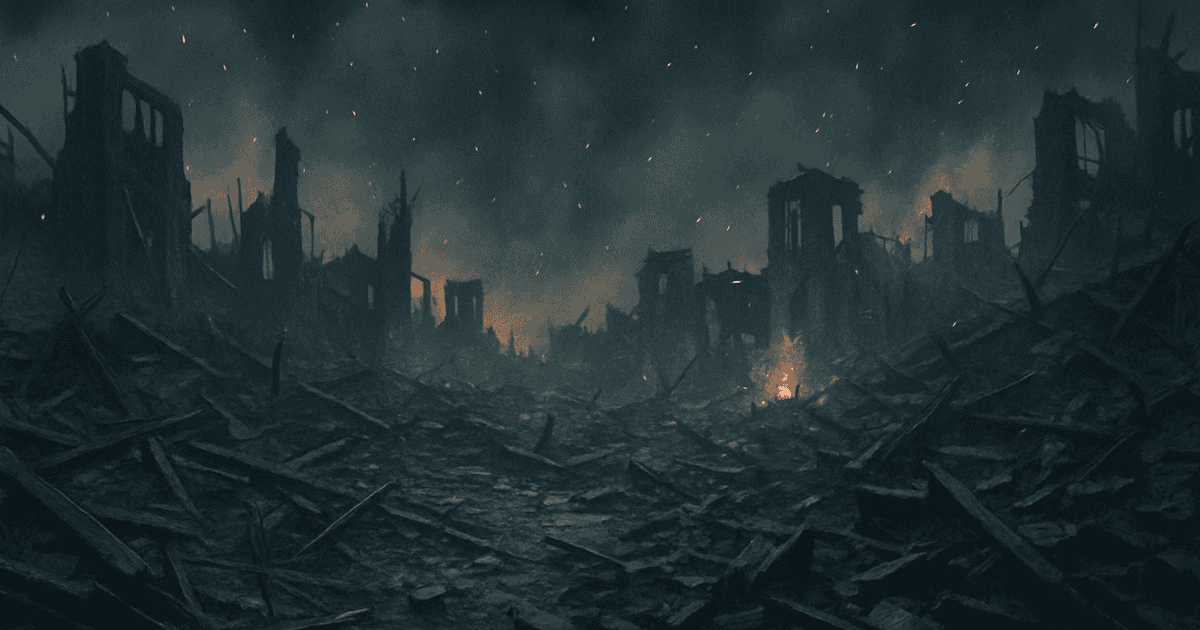
Director Isao Takahata survived a literal living hell when he was just nine years old. When he set out to direct his 1988 animated masterpiece, Grave of the Fireflies(Official Studio Ghibli), he was fiercely determined to accurately recreate the apocalyptic “rain of fire” he witnessed during the devastating air raids on Japan. Yet, when his production team consulted a military expert from the Japan Self-Defense Forces to understand the exact mechanics of the falling bombs, they were met with a blunt, frustrating dismissal: “Due to their structure, it is mechanically impossible for these incendiary bombs to ignite in mid-air.“
This stark contradiction created a fascinating historical and cinematic mystery. If the military experts were right, what exactly did Takahata and thousands of other traumatized survivors actually see falling from the night sky?
Today, we are going to dive into the terrifying mechanics of the M69 incendiary bomb and uncover how the paradox of the “rain of fire” and the cold laws of physics can actually both be true. First, we must understand the brutal reality of the weapon itself.
*Note: Molotov’s Bread Basket is a dark nickname for cluster incendiary bombs, such as the E46 used in these specific air raids, ironically named after Soviet politician Vyacheslav Molotov. (Reference: Wikipedia)
*This is a translated version. The original (Japanese) is available here.
- The Brutal Mechanics of the M69 Incendiary Bomb The M69 wasn’t just a single explosive; it was a devastating cluster bomb. A massive canister bundled 38 individual bomblets together, designed to scatter mid-air and violently eject burning jellied gasoline (napalm) only upon impact with the ground.
- Two Theories Explaining the “Rain of Fire” If the bombs couldn’t ignite mid-air, why do survivors describe burning rain? Historians propose two theories: the cloth stabilizing ribbons attached to the bombs caught fire from the deployment explosive, or the terrifying glow of the burning city below simply reflected off the falling ribbons.
- Takahata’s Intentional Departure from Reality In the film, the bombs are depicted as glowing fireballs dropping directly from B-29s, without the cluster canister separating. While this contradicts official military blueprints, it perfectly captures the subjective, terrifying perspective of a traumatized child experiencing the raid.
- The Gap Between “Mechanical Fact” and “Emotional Truth” Takahata’s visual choices seemingly contradict the SDF expert’s structural documents. However, this highlights the director’s genius: he prioritized the visceral, emotional truth of the survivors’ memories over sterile mechanical accuracy, resulting in an unforgettable anti-war masterpiece.
On this pageContents
Grave of the Fireflies (1988) Analysis: The Terrifying Mystery of Molotov’s Bread Basket
The Brutal Architecture of an Incendiary Bomb
The specific weapons used to annihilate Kobe and Tokyo during the great air raids were called “M69 incendiary bombs.” Their core design was ruthlessly efficient, as illustrated in the diagram below.
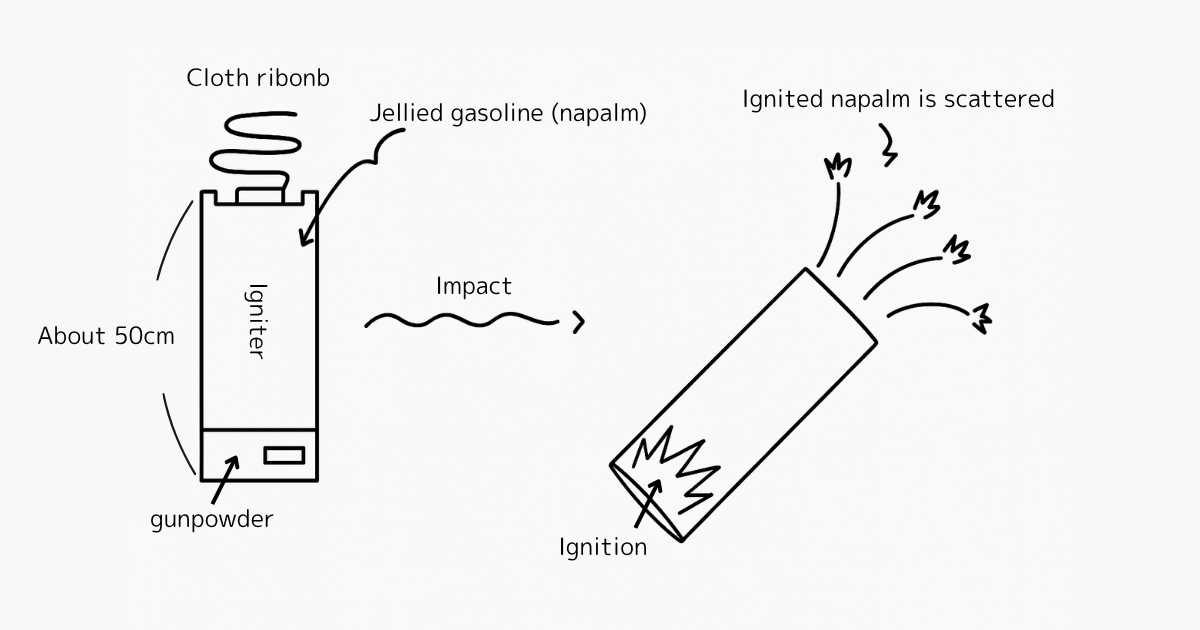
Designed for maximum devastation, the fuse at the tip would ignite immediately upon impact with a solid surface. This impact violently ejected the incendiary agent—napalm—creating countless, uncontrollable sources of fire that instantly consumed traditional wooden Japanese houses. The clinical term “incendiary bomb” almost sounds too mild; if you think of them as “napalm bombs,” you begin to grasp their true, vicious intensity.
Actual archival test footage of these weapons still exists today.
Loading video...
Furthermore, as you can see in the footage, these bombs were not dropped individually from the B-29 bombers. They were deployed as massive “cluster bombs.” A single, large E46 canister packed with 38 individual M69 bomblets would be dropped from the plane. At an altitude of around 700 meters, a timed explosive charge would blow the canister open, scattering the 38 lethal bomblets across a wide radius.
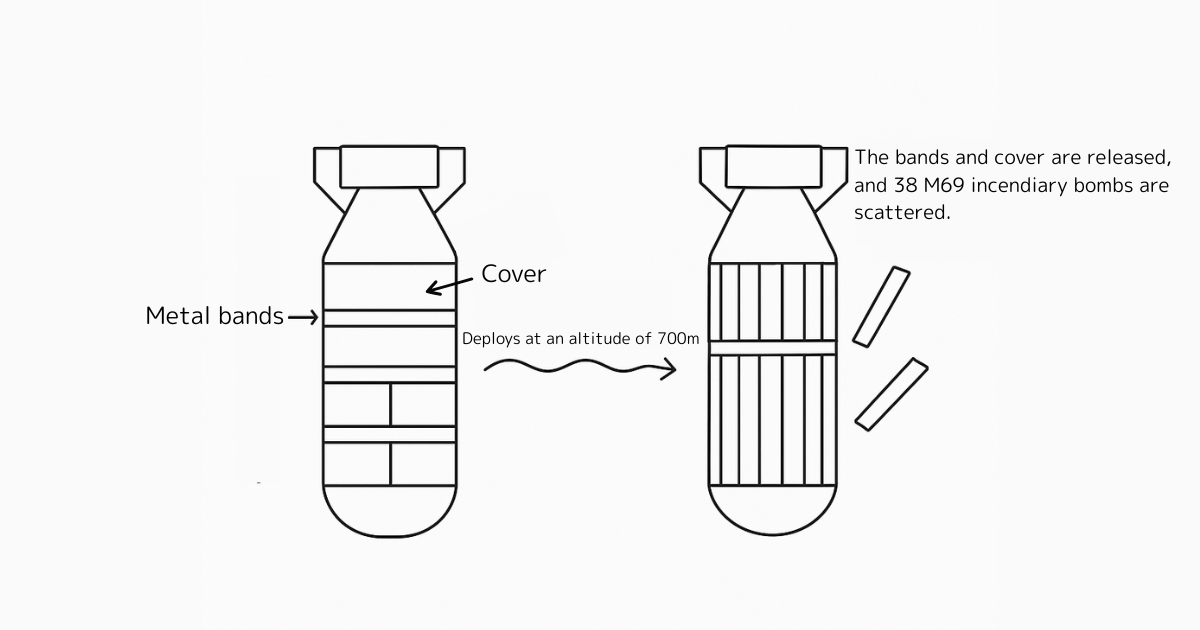
You can clearly observe this terrifying cluster deployment in the initial test footage, and it is vividly captured in actual combat footage starting around the 2:35 mark in the video below.
Loading video...
Understanding this drastically changes how we visualize the air raids. Many assume an incendiary bomb was simply a flaming projectile dropped straight from a plane, completely unaware of the highly engineered, multi-stage cluster mechanics involved.
Takahata’s Dilemma: The Impossible Mid-Air Ignition
Director Takahata possessed a burning desire to translate the apocalyptic “rain of fire” he had lived through into a flawless animated sequence.
The very poetic title of the film, Grave of the Fireflies (Hotaru no Haka), relies heavily on visual metaphor. If the incendiary bombs didn’t fall from the sky while visibly burning, it would shatter the core symbolic imagery of the entire story. (In Japanese, the characters used for “hotaru” in the title—火垂—are a deliberate double entendre, meaning both “fireflies” and “falling fire.”)
As mentioned earlier, when Assistant Director “S-kun” consulted an expert from the Japan Self-Defense Forces (SDF) to ensure mechanical accuracy, he was shut down. The expert firmly stated, “Due to their structure, it’s impossible for incendiary bombs to ignite in mid-air.”
Takahata was absolutely infuriated by this clinical dismissal of his lived trauma. In an essay titled The Mystery of Molotov’s Bread Basket, included in Ghibli Textbook 4: Grave of the Fireflies (ジブリの教科書4:火垂るの墓, in Japanese), the director vented his intense frustration:
Truly, the Self-Defense Forces cultivates excellent scientists. And for S-kun to say, “I was somehow convinced myself…” is just pathetic. At this rate, in this day and age where over sixty percent of the population was born after the war, I wonder if even the fact that so many people died in the air raids will be denied due to statistical errors. I feel sorry for the expert who was kind enough to help, but I was so shocked and appalled by the whole affair that I couldn’t contain my anger.
(Original Text, in Japanese) まったく自衛隊は優秀な科学者を育てているものだ。そしてS君もまた、「ぼくもなんとなく納得してしまったんですけど・・・」とは情けない。この分では、戦後生まれが六割を超えた今日、空襲であれだけ多くの人が死んだことさえ、統計の不備によって否定されてしまうのではなかろうか。親切に対応してくれたその専門家にはもうしわけないけれど、ぼくは事の次第に驚きあきれ、怒りをおさえることができなかった。
It is a brief passage, but you can feel the heat of a master auteur deeply offended by those who prioritize sterile blueprints over human history.
However, if we look strictly at the mechanical structure of the M69 we reviewed earlier, the SDF expert was technically correct: mid-air ignition was by design impossible.
If mid-air ignition did occur, it would represent a catastrophic malfunction of the weapon. But it is highly improbable that tens of thousands of bombs simultaneously malfunctioned in the exact same way to create a uniform “rain of fire.” If they ignited in the sky without impact, the napalm would have burned out harmlessly before ever reaching the wooden rooftops of Japan.
So, what was the haunting “rain of fire” that Director Takahata and countless other survivors undeniably witnessed?
Historical researchers have proposed two plausible answers.
Solving the Mystery: What Was the True “Rain of Fire”?
Both of the leading theories (which are also debated on the Japanese Wikipedia page for Incendiary bombs) hinge on a single, crucial design element: the stabilizing cloth ribbons attached to the tail of the M69 bomblets. These long streamers were designed to pop out and ensure the bomb fell perfectly vertically for maximum impact.
Theory 1: The Ribbons Caught Fire
The first and most widely accepted theory posits that it was the cloth ribbons themselves, not the napalm payload, that caught fire mid-air.
Because the M69s were deployed via an E46 cluster canister, an explosive charge was required to blow the canister apart at 700 meters. This theory suggests that the flash from this deployment explosive accidentally ignited the highly flammable cloth streamers attached to the bomblets.
This explanation is noted on Wikipedia and is further supported on page 32 of Masao Hiratsuka’s comprehensive book, The Complete Picture of the Air Raids on Japan (日本空襲の全貌, in Japanese):
When the “M69 cluster incendiary bomb” is dropped, the bands holding it together are released, and the M69s are scattered into the air. Then, a cloth ribbon about one meter long (a streamer) pops out to prevent the M69 from tumbling. At this time, the ribbon also catches fire, so from the ground, it looked like a rain of fire was falling.
(Original Text, in Japanese) 「M69集束焼夷弾」は、投下されると収束していた帯が解かれ、M69はバラバラに空中に放り出される。すると布製の約一メートルのリボン(ストリーマー)が飛び出してM69の揺れを防ぐ。この時、リボンにも火がつくので、地上からは火の雨が降っているように見えた。
While this sounds perfectly logical, the literature remains slightly vague on *exactly* what sparked the fire on the ribbons. Was it definitely the canister’s explosive charge, or was there another undiscovered mechanism?
While this remains the mainstream explanation for the “rain of fire,” we must treat it with slight caution until military blueprints confirm the deployment flash radius.
If any history buffs reading this possess access to the original, detailed structural blueprints of the E46 cluster bomb canister, I would be incredibly grateful if you could share them in the comments!
Theory 2: The Reflection of a Burning City
The second theory is an optical illusion: the sheer, blinding light from the apocalyptic fires already consuming the city below reflected brightly off the fluttering cloth ribbons falling from the sky.
According to historical records, the Okayama air raid that a 9-year-old Isao Takahata survived began in the dead of night at 2:45 AM. (Similarly, the horrific Bombing of Tokyo commenced at night).
In total darkness, a city engulfed in a raging firestorm would illuminate the sky with a hellish glow. It is entirely scientifically sound that thousands of pale cloth ribbons plummeting toward the inferno would reflect the orange flames, appearing exactly like glowing streaks of fire to a terrified child looking up.
Of course, Grave of the Fireflies depicts the Great Kobe air raid occurring during the daytime. Even in daylight, however, the immense, blinding infernos consuming entire neighborhoods could theoretically cast a vivid reflection on the falling debris.
However, this theory also requires strict caution.
Japanese Wikipedia carefully frames this as “some theories suggest,” and when investigating the cited source—an Asahi Shimbun investigative article titled The Weapon that Aimed for ‘Unextinguishable Fires’: The Reality of the Incendiary Bombs Used by the US Military (『消せない火災』狙った兵器 米軍が使った焼夷弾の実態, in Japanese)—the article doesn’t explicitly confirm the reflection theory.
Despite the lack of concrete journalistic confirmation, the optical illusion theory remains a fascinating, highly plausible explanation for the survivors’ traumatic memories.
The Verdict on the Incendiary Mystery
To summarize: the military experts are correct that the M69’s napalm payload was mechanically incapable of igniting mid-air. However, the survivors’ accounts of a “rain of fire” are also entirely truthful, likely caused either by the stabilizing ribbons catching fire from the deployment blast, or by the ribbons acting as terrifying mirrors reflecting the burning city below.
While Director Takahata remained deeply insulted by the SDF’s clinical response, these historical theories offer a compelling, logical bridge between the engineering blueprints and human memory. The deeper you dig into the fog of war, the more complex the mystery becomes.
So, armed with all this conflicting mechanical and historical data, how did Director Takahata ultimately choose to animate the bombs in his final film?
Grave of the Fireflies (1988) Director’s Vision: Historical Inaccuracy or Artistic Genius?

The Argument That Takahata Made a Mistake
If we scrutinize the animation in Grave of the Fireflies with a strict historical lens, we notice several glaring inconsistencies:
- The tail ends of the falling incendiary bombs are visibly burning in the sky.
- There is absolutely no sign of the cloth stabilizing ribbons; the metallic casing itself appears to be the source of the fire.
- When the bombs hit the ground, they make a dull, metallic thud, but there is no explosive burst scattering the napalm.
- Visually, it appears as though individual M69 bomblets are raining directly out of the B-29 bomb bay doors, completely omitting the large E46 cluster canisters.
From a purely technical standpoint, one could argue Takahata attempted to adopt the “ignited ribbon” theory, but because he didn’t actually draw the ribbons, the animation falsely implies that the napalm payload ignited in mid-air and the steel casing itself became a fireball.
Furthermore, omitting the massive cluster canisters completely changes the visual scale of the bomber deployment.
Looking at this rigid list of mechanical discrepancies, a harsh critic could easily conclude that Director Takahata simply made a mistake.
But ending the conversation there is a massive disservice to cinema. Why would a legendary perfectionist like Isao Takahata go out of his way to consult a military expert, only to completely ignore their advice and deliberately animate an “incorrect” weapon? Let’s explore the psychology behind his decision.
Visualizing Trauma: Why the “Mistake” Was Intentional
The reason Takahata allowed a mechanical “inaccuracy” into his magnum opus is deeply profound: he radically prioritized the emotional, subjective truth of his own trauma over sterile military blueprints.
It is perfectly fine for military historians to critique the animation. However, Grave of the Fireflies is not a documentary; it is a cinematic memorial. We must watch it with the understanding that the lens is inherently subjective.
This rule applies to all great historical fiction. If you read Ryotaro Shiba’s epic historical novel Ryoma ga Yuku and blindly accept every line of dialogue as recorded fact, you are missing the point of literature.
The golden rule for engaging with art about the past is understanding the difference between “factual accuracy” and “emotional truth.”
What we must take away from Grave of the Fireflies is not the physics of the M69 bomb, but Isao Takahata’s desperate, screaming truth: “This is what it felt like!”
As a man who miraculously survived a firebombing at nine years old, Takahata wasn’t trying to animate a weapons schematic. He was trying to visualize the sheer, paralyzing terror of a child watching the sky turn to fire. The driving force behind adapting this novel was likely his intense need to confront and immortalize his own autobiographical trauma.
When viewed through this empathetic lens, you realize that Director Takahata didn’t make a mistake at all. By defying the mechanical facts, he managed to flawlessly animate the terrifying truth of his own soul.
That concludes my deep dive into the Mystery of Molotov’s Bread Basket and the controversial depiction of incendiary bombs in Ghibli’s darkest film.
Analyzing art based on real-world tragedy requires profound sensitivity. But peeling back these layers has only deepened my respect for the agonizing difficulty of visualizing the horrors of the past.
When you rewatch Grave of the Fireflies, how do you interpret the burning rain? Is it a mechanical error, or a masterpiece of subjective terror? I would love to hear your thoughts.
Can you name the movie before the scene comes into focus?
Put your visual memory to the test with a blurred Studio Ghibli scene.



Reader Comments