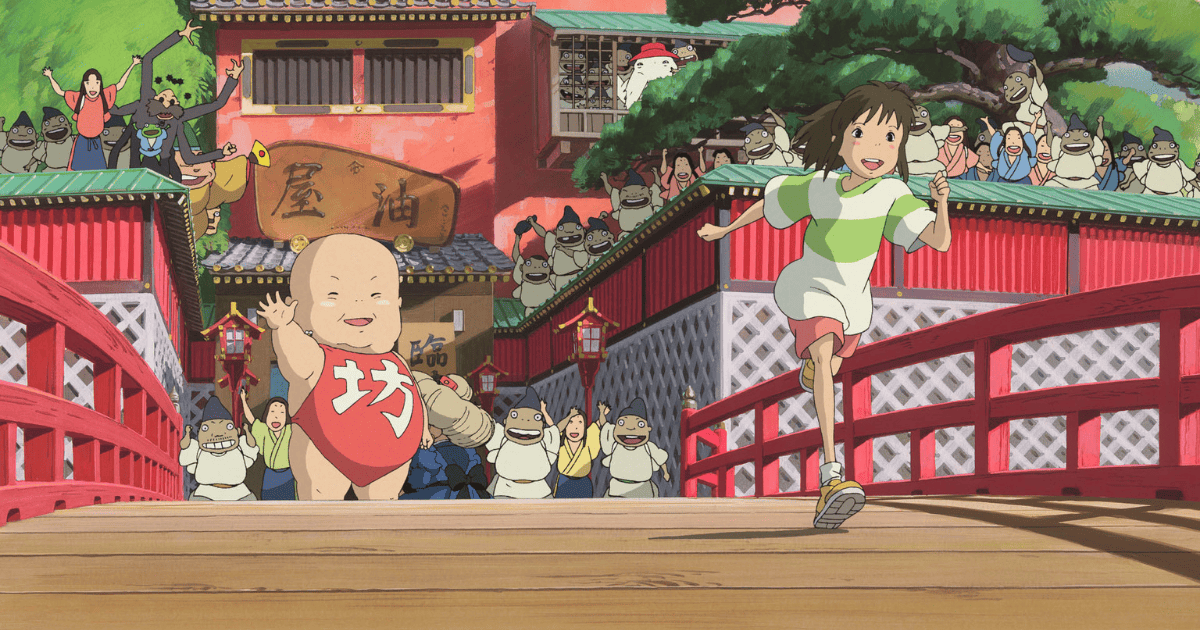
Hayao Miyazaki’s 2001 animated feature, Spirited Away(Studio Ghibli Official), left me without much to say when I first saw it. I think I was in middle school at the time. It went on to become a record-breaking hit, but I only saw it once in the theater.
Does that mean I found it boring? Not really. It was a puzzling film. So much is left unexplained that I think you have to find your own points of interest as you watch.
I suspect many viewers share a question about the ending of Spirited Away: “How did Chihiro know her parents weren’t among the pigs?” It puzzled me on my first viewing, and I spent years looking for an answer. Eventually, a little “wordplay” gave me an explanation I could accept. I want to explore that reading here, though it is not my only conclusion. I will also consider the mysterious bitter dumpling, whose strangeness we tend to overlook.
This is, after all, a coming-of-age story. Let’s trace Chihiro’s growth on the way to the ending.
*This is a translated version. The original (Japanese) is available here.
- Growth Through Empathy and Independence
The opening draws us toward Chihiro’s frustration about changing schools. In my reading, she gradually comes to understand the love behind her parents’ actions, until she can say, “My parents are not pigs.” - The Bitter Dumpling as a Symbol of Growth
I read the dumpling as the “bitterness of life” Chihiro earns through her efforts. Giving it to Haku helps free him from his curse, though she does not understand quite what she has done. - The Final Trial and the Right to End a Contract
By answering that her parents are not among the pigs, Chihiro shows that she can judge for herself. I see this as proof of the maturity she needs to escape her servitude to Yubaba. - The Audience Is Deceived Too
We never see the moment her parents turn into pigs, yet we readily accept that they have. Perhaps Chihiro’s return to reality also invites us to leave the film’s imagined world and return to our own lives.
On this pageContents
Chihiro’s Growth and the Pigpen Dream in Spirited Away
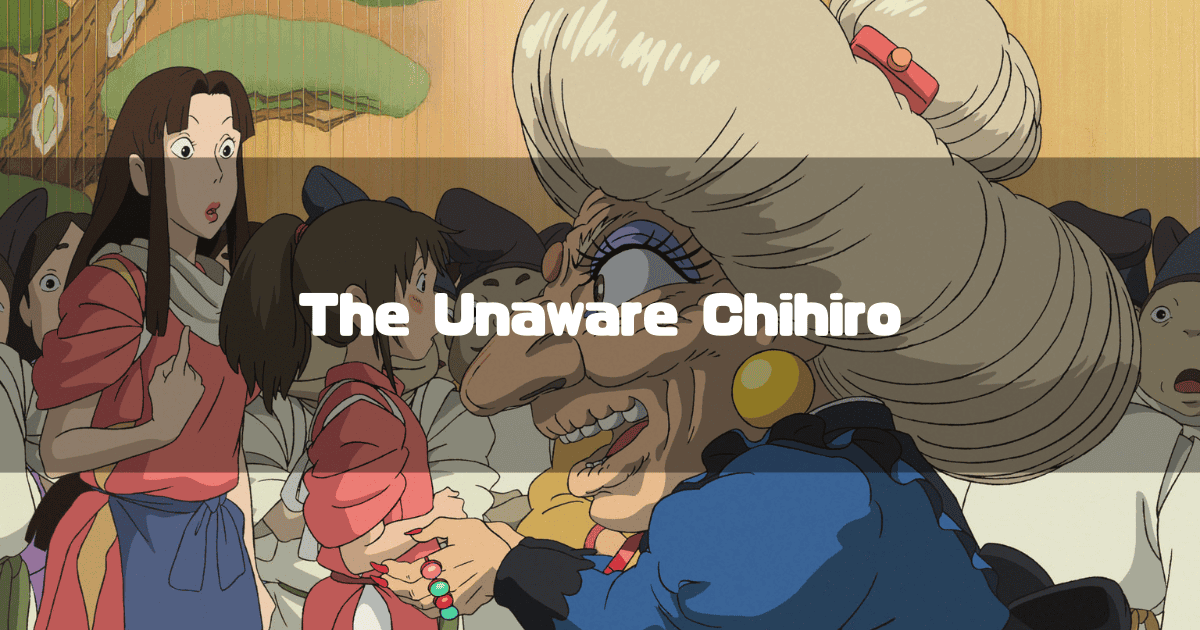
The Sulking Daughter and the Father Who Steps on the Gas
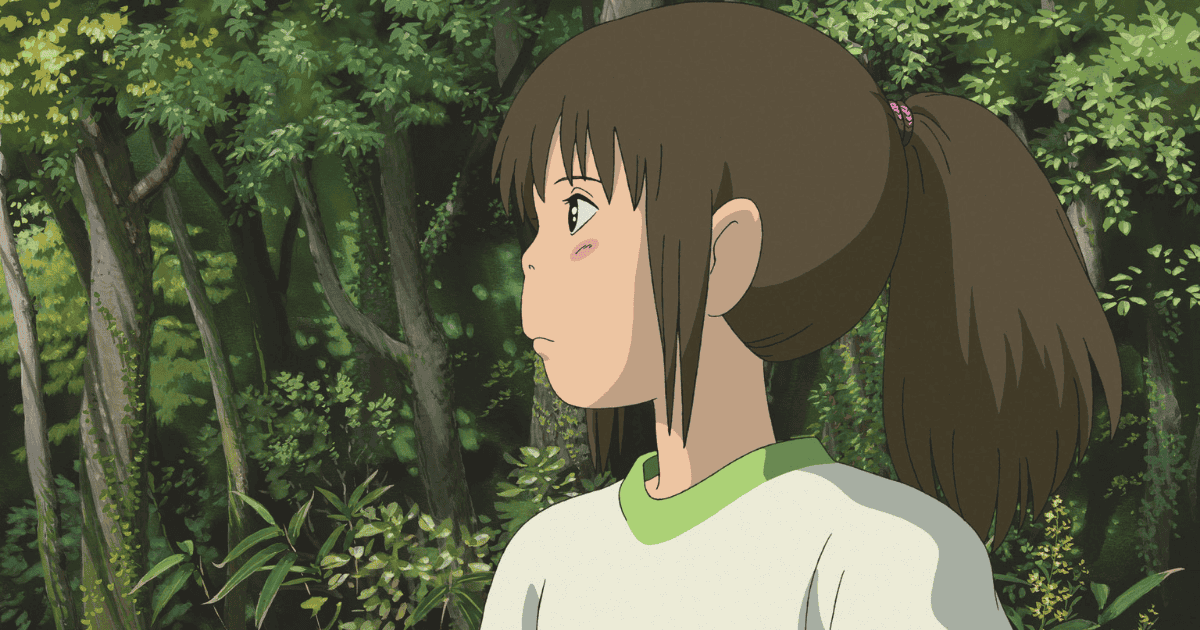
For me, one of the strengths of Spirited Away is its opening: Chihiro sulking in the car.
I never changed schools as a child. To me, it seems an almost unimaginable upheaval—one you do not even get to choose. Several transfer students joined my classes, and I have nothing but respect for the way they adapted to a new environment.
So when I see Chihiro sulking, I find myself thinking, “Well, of course she would.” It is a curious sort of empathy, given that I have never experienced a transfer myself. Still, I want to understand her frustration.
But we should also spare a thought for the parents who can feel their daughter sulking behind them, especially her father.
Because we identify with Chihiro, her parents’ words and actions grate on us. Yet they must know that changing schools is hard on a child. I imagine they explained the move beforehand, and that Chihiro tried to accept it: “I suppose it can’t be helped.” But when the day came, she sulked.
What might her father have been thinking?
I suspect he kept driving, even after taking a wrong turn, not because he was an idiot, but because he wanted to change the mood. He probably felt guilty too.
Already on Chihiro’s side, though, we think, “What are you doing, Dad?” And as her parents head through the tunnel, we become frustrated with them.
Where does all this come into play? In the scene where her parents become pigs.
The Parents Who Became Pigs
From my first viewing to the present, I have found it hard to watch her parents help themselves to the food.
“How can they behave so shamelessly?” It is painful to watch, and I feel sorry for Chihiro as she keeps pleading with them to go home.
But perhaps I feel that way because the opening has so deftly drawn me to Chihiro’s side. As a result, we readily accept that her parents have turned into pigs.
At this point, a small gap opens up between Chihiro and us. Does she immediately accept what has happened when she sees the pigs?
No. After seeing them, she runs off to look for her parents.
Of course she does.
If enormous pigs appeared where your parents had been, you would naturally think your parents had gone somewhere else. “Oh, Mum and Dad have turned into pigs!” would hardly be your first thought.
In other words, Chihiro is the first to reject the idea of two people becoming pigs.
She later asks Haku whether they have really become pigs. But to us, that is already what seems to have happened.
I think this gap helps explain why the ending is so difficult to accept.
The Spoils: The Bitter Dumpling
After the shock of her parents becoming pigs, Chihiro faces an even more alarming problem: she begins to disappear. With Haku’s help, she manages to get through it.
The story then shifts toward how Chihiro will survive in that world. But we should remember that this is our perspective. She is still on a journey to find her parents.
Haku’s guidance, Kamaji’s kindness, and Lin’s care bring Chihiro to Yubaba, who takes her name. Now a member of the bathhouse staff, she faces the Stink Spirit and, after a great deal of effort, earns the bitter dumpling.
To me, the dumpling represents the “bitterness of life.” Without realizing it, Chihiro has gained both that bitterness and the joy of achievement.
The next scene, however, makes the dumpling harder to understand.
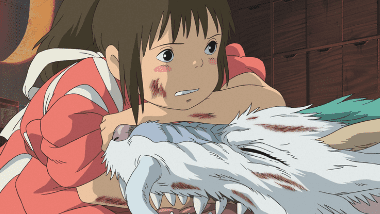
Haku returns badly wounded after being sent to Zeniba. Seeing him in that state, Chihiro for some reason gives him the dumpling.
Since it was a gift from a river god, she may have assumed it had some useful effect. And it appears to work.
It may not be the effect she hoped for, but somehow Yubaba’s hold over Haku is broken.
Why did this happen?
This is entirely my own interpretation, but I think the curse is broken not by the dumpling’s medicinal effect, but because Chihiro pushes her arm down Haku’s throat.
She gives him the dumpling believing it will help. Something does seem to happen—but perhaps he simply vomits because she has pushed her arm down his throat.
Translation Note: “Haku Throws Up”
In Japanese, “Haku throws up” is “Haku ga haku” (ハクが吐く). The sound repeats because:
- Haku (ハク): The name of the boy/dragon.
- Haku (吐く): The Japanese verb for “to vomit/throw up.”
Perhaps, then, “Haku throws up” is also a bit of comic relief. The repeated sound adds another layer to that reading.
Perhaps the scene comically presents Chihiro as someone unaware of her own growth. Read that way, I can still see the dumpling as a symbol of life’s bitterness.
I have wandered off the subject. To return to the ending, what matters is the dream Chihiro has on the night she receives the dumpling.
In the dream, she cannot find her parents among the many pigs in the pen.
The scene recalls an earlier visit to the pigpen, before the Stink Spirit arrives. Haku tells her that the pigs before her are her parents. She promises them, “I’ll turn you back,” and leaves.
This promise to her parents is also one of Chihiro’s memorable lines in the film. You can compare the original Japanese, romanization, English subtitle, and literal meaning in our collection of Spirited Away quotes.
Yet after receiving the dumpling, she dreams that she cannot find the parents who are supposed to be among the pigs.
Why? After all that, it is time to work toward a conclusion.
How Did Chihiro Know Her Parents Weren’t Among the Pigs?
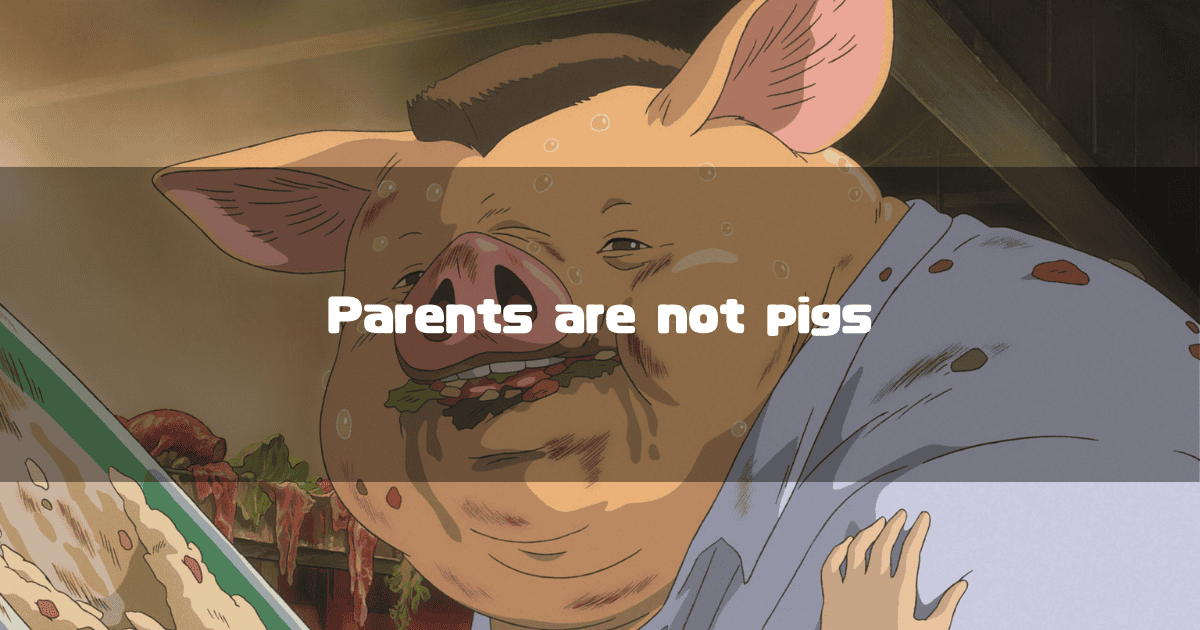
Conclusion One: Wordplay
My first answer is that Chihiro knew her parents were not among the pigs because her parents are not pigs.
That is the “wordplay” I mentioned at the beginning.
The question becomes difficult because she has to choose her parents from a few pigs. But imagine every pig in the world standing before her. “Choose your parents” could then become “Are your parents pigs?” There would be too many to inspect, after all.
Here, “pig” is an insult. We might rephrase the question again: “Are you still too much of a child to understand what your parents go through?”
But after earning the bitter dumpling, Chihiro no longer sees her parents in the pigs before her.
Making a child change schools because of the parents’ circumstances; stepping on the gas to cheer up a sulking daughter; trying to find something for her to eat when she must be hungry…
In this reading, Chihiro recognizes the concern for her behind those actions. That is why she can say, “My parents are not among these pigs. My parents are not ‘pigs.’”
She has grown enough to reach what should be obvious: her parents are not “pigs.” But that alone does not explain why the final trial exists. Why does she have to take it at all?
For my next reading, the question is who is able to enter into a contract.
The answer, in this analogy, is an “adult.”
Modern society “protects” children, whether they ask for it or not, by limiting their freedom to contract. Turn that argument around, and a child’s agreement begins to look like a form of enslavement—the very thing society tries to prevent.
Chihiro seems to enter into a contract with Yubaba as a child. In this reading, though, an arrangement in which she must simply keep obeying looks more like enslavement.
The distinction I am drawing is whether she can end the contract.
Perhaps the final trial exists because, in this interpretation, only an “adult” can end the contract, so Chihiro must prove that she has become one.
The trial asks whether she understands her parents’ struggles. She answers it: her parents are not “pigs.” Her conclusion becomes proof of her maturity, allowing her to end the contract—as an “adult.”
That is one way I make sense of the ending. But I think another reading is possible.
Conclusion Two: Breaking the “Illusion” of Society
My second conclusion is not fundamentally different, though the emphasis changes. It also follows the direction of the discussion so far. An important point is that, in Spirited Away, only Haku and Yubaba tell Chihiro that her parents have become pigs.
She believes them on the strength of those two accounts; she has never seen the transformation herself.
In one sense, that makes her trusting. Yet taking other people’s words at face value also suggests that she is still a child. In this strange world, words have led her astray.
At the end, she is about to be misled again: Yubaba tries to make her believe her parents are among the pigs, though they are not. We in the audience fall for it.
But Chihiro has grown. Yubaba’s words no longer deceive her, and she reaches the simple conclusion that her parents are not pigs. In a sense, she returns to her first response at the food stall: instead of accepting the pigs as her parents, she ran off to find them.
Growing up means knowing your own mind, judging for yourself, and acting on what you can see rather than being misled by someone else’s words.
If I were to put the film’s possible message into words, it might sound like this:
“Children, you are still growing! Society uses words to lead you astray, turn your eyes from the facts before you, and keep you from truly growing up. It produces people like No-Face: bodies that grow bigger and bigger, without a voice of their own. Don’t become like that! Act for yourselves, experience things, endure bitterness, and achieve a little at a time. Develop the strength to see through society’s illusions! How? Surely that’s obvious… work!”
Or something along those lines. What a celebration of work this film becomes, read that way.
I could stop there, but let’s think a little further.
Conclusion Three: We Are the Ones Being Deceived
Chihiro is led astray by the words of those around her. But the same is true of us watching the film.
We never actually see her parents change into pigs.
Miyazaki’s direction draws us to Chihiro’s side and makes it easy to accept her parents becoming pigs. Of course, animation helps us accept it too. Perhaps we have wandered into his imagined world and been thoroughly deceived.
What, then, might Chihiro’s victory over Yubaba’s illusion mean for us? I imagine a message like this:
“Thank you for watching. How did you like the strange world I made? I hope you enjoyed it. But a film is a film. Just as Chihiro overcame Yubaba, please don’t stay trapped in the film’s world forever. Return to your everyday lives. A film is a film, after all.”
On this reading, we were the ones caught in that strange world, not Chihiro.
It sounds a little preachy. But perhaps it is also a reflection on the way films themselves can mislead us.
And let’s ask the question once more: did her parents really become pigs?
The title is Sen to Chihiro no Kamikakushi—the spiriting away of Sen and Chihiro. Following that wording, Chihiro alone ought to be the one who disappears.
Otherwise, it would be “The Spiriting Away of Sen, Chihiro, and Her Parents.”
Perhaps her parents were never there as pigs at all. Perhaps they were searching for her in the ordinary world, and, from their perspective, she returned after only a short time.
That would be another way to understand their reunion when Chihiro returns.
Perhaps animation had caught us in that strange world all along. I think it is a wonderful summer film: a little frightening, and a little mysterious.
Some of this may not fit neatly with what happens in the film. But these are my thoughts on the ending for now. Perhaps next I will write about why Yubaba takes people’s names.
The images used in this article are from Studio Ghibli Works Still Images.
Can you name the movie before the scene comes into focus?
Put your visual memory to the test with a blurred Studio Ghibli scene.
Reader Comments