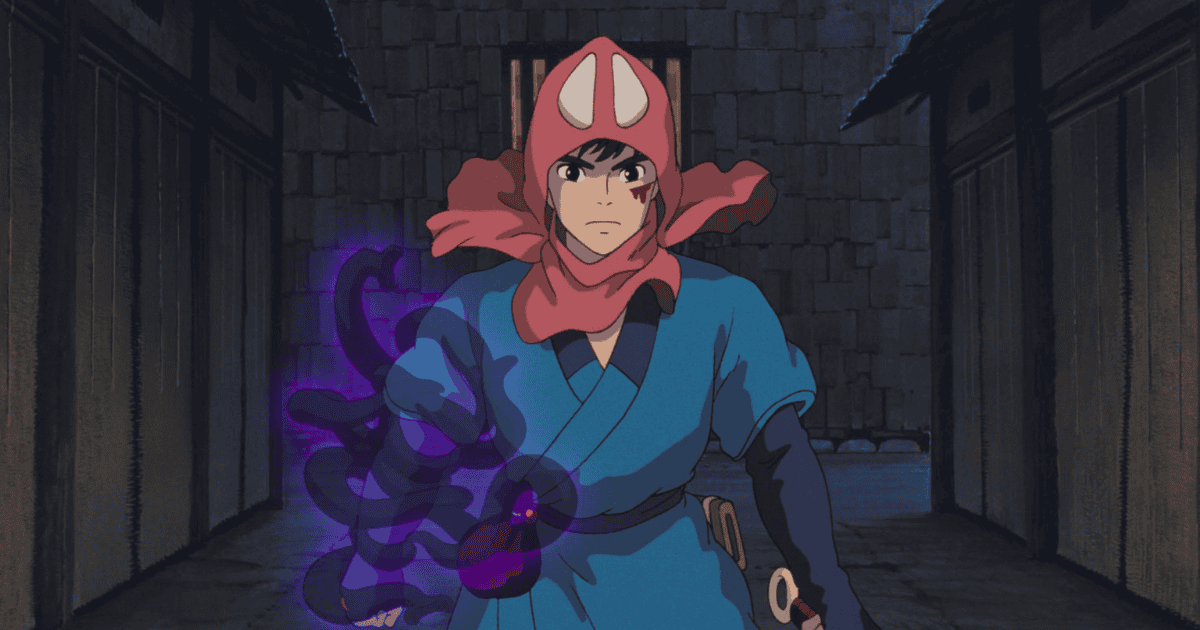
Hayao Miyazaki’s Princess Mononoke(Studio Ghibli Official) was released in 1997. Ghibli had recently released Isao Takahata’s Pom Poko (1994) and Yoshifumi Kondō’s Whisper of the Heart (1995); its television film Ocean Waves had aired in 1993. For Miyazaki himself, though, five years had passed since Porco Rosso (1992), making this a long-awaited film for his fans.
Hideaki Anno’s Neon Genesis Evangelion began airing on television in 1995. Evangelion‘s theatrical conclusion, The End of Evangelion, followed in 1997, the same year as Mononoke. What a contrast between their slogans: “Live!” for Miyazaki’s film, and “So, everyone should just die…” for one of Evangelion’s campaigns.
By comparing the two works, I want to consider why the end credits of Princess Mononoke appear against a completely black background. What might that darkness mean?
*This is a translated version. The original (Japanese) is available here.
- A Different Approach to the End Credits
Unlike earlier Miyazaki films that use pictures or animation behind their credits, Princess Mononoke leaves the background black. I read that difference in relation to the film’s subject. - Ashitaka and Irontown: The Outcasts’ Shared Fate
Ashitaka is fundamentally a man who has been “told he is not needed.” Similarly, the people of Irontown represent those who have “drawn the short straw” in society. The film explores their struggle to exist in a world that has no place for them. - Unsolvable Problems and a Documentary Quality
In my reading, Princess Mononoke takes on a documentary-like quality because it portrays problems that cannot simply be solved. The black background gives visual form to the absence of an easy resolution. - Miyazaki’s “Small Lie” of Hope
By depicting an awareness of what people themselves have done, Miyazaki offers a little hope of moving forward. I see that as a “small lie” that lets the film retain its documentary quality while still offering something to its audience.
On this pageContents
The Black End Credits: A Departure from Earlier Films
The end credits of Princess Mononoke differ from those of Miyazaki’s earlier films: the background is completely black, with neither animation nor still images. Consider what came before:
- The Castle of Cagliostro: Fades to a simple “The End.”
- Nausicaä of the Valley of the Wind: Animation showing life after the story.
- Castle in the Sky: Laputa watching over the earth below.
- My Neighbor Totoro: Still images of Mei and Satsuki after the story.
- Kiki’s Delivery Service: Animation showing the town and Kiki and Tombo after the story.
- Porco Rosso: A sequence resembling photographs of pig-faced people whose lives are bound up with flight.
Against those backgrounds, the darkness of Princess Mononoke stands apart. I think it deserves attention as one of the film’s distinctive features.
The “Unwanted People” and the Film’s Documentary Quality
To think about the black end credits, we need to consider the film itself. Its many facets make it difficult to sum up at once, so I will begin with these comments by Miyazaki in the documentary How Princess Mononoke Was Born (「もののけ姫」はこうして生まれた, in Japanese):
“…In short, although we don’t show it openly, he is clearly someone who is told he is not needed. That they could do without him… (inaudible) …that even if he does something, he won’t be praised. That what he does has no place here. And the protagonist is told this not because he did something wrong, but because he did the right thing. That’s the kind of person he is. Whether that will be accepted as entertainment—well, we won’t know until we make it.”
“People living in this world who have unfairly, absurdly drawn the short straw, physically and spiritually as well—how will they feel about it? This is a common fate among young people. The sense of being trapped that he feels in this age, and all those other feelings, must have been felt again and again in different places throughout history.”
The people who are “not needed,” or who have “drawn the short straw,” include Ashitaka and the people of Irontown. Yes: Ashitaka is portrayed as someone who is not wanted. I never considered that when I first saw the film in elementary school. Sorry, Miyazaki. Perhaps I was happy enough not to have to question my own existence or worth.
Once it is pointed out, though, I can see that reading. His good looks, the bravery of his opening scene, and above all his status as the protagonist shape our first impression. We read his departure as a new adventure rather than an expulsion—as if the village were saying, “You saved us and were meant to be our future leader, but we don’t need you now that you’re cursed.” Our assumptions can make us overlook what is on the screen.
Even his smile to Kaya looks so much like a hero’s smile that we can miss the spirit behind it: to give his best smile when things are at their worst. That is the starting point for my reading of Mononoke‘s ending: it is a story about people who are not wanted, people who have drawn the short straw.
What Ending Can an Unsolvable Problem Have?
How can a story about people who are not wanted, who have drawn the short straw, end?
A children’s film—in the worst sense—could perform a miracle: everyone discovers they were needed all along, and that drawing the short straw was merely a matter of attitude. In this case, the forest would be fully restored, Ashitaka’s curse would vanish, San would reconcile with humanity, and the people of Irontown would leave the mountains. But that would be a lie.
The harsher reality is that unwanted people remain unwanted, and those who draw the short straw have to keep holding it. Because Princess Mononoke contains problems that cannot simply be solved, I think it has to become a kind of documentary. Its world is fictional, but once that world exists, it has to show people doing their best to live within it; otherwise it would be merely a lie. Such a film cannot give us an ending that neatly produces happiness, sadness, or loneliness on cue.
So when the credits begin, we may find ourselves thinking, “Wait—what?” As we watch that black background, we have to absorb what has happened and think about it. To me, that is at least one reason for the darkness. Others will see it differently, but this is how I read it at present.
In my reading, Princess Mononoke is a fantasy with a documentary-like aspect: it portrays people living in the modern world with problems that cannot simply be resolved. Without a neat resolution, it cannot give us reassuring images of what happens afterward. That is one way to understand its black end credits.
The “Small Lie” of Hope Within the Darkness
Yet the film is not wholly a documentary. At the end, Miyazaki tells a small lie that, in my reading, preserves that quality as far as possible while still making the film entertainment. This is what he calls the “pathetic revival.”
Ashitaka and San return the head to the Forest Spirit, but neither the god nor the forest is restored as before. The Night-Walker collapses, enveloping the area, and afterward there is a small renewal. Ashitaka’s wish to return the head “with human hands” seems to express an awareness of what people have done. The power to give life brings a little miracle: the ruined world is not left entirely unchanged. It is not a full restoration, but it is something.
This does not irresponsibly promise deliverance to people whose misfortunes were not of their own making. But when a problem is one we have caused ourselves, becoming conscious of that fact might allow a little progress. That, I think, is Miyazaki’s small lie: a little hope for those who came to watch, and a sign of the filmmaker’s generosity.
This brings us back to Neon Genesis Evangelion.
Read more: Evangelion vs. Gundam: The Message of the Final Episode
Both Mononoke and Evangelion tell stories of people with serious problems. Ending Evangelion with Shinji and Gendo reconciled, or Misato overcoming her father, would likewise be a great lie. Yet Shinji’s affirmation that he is allowed to be here—an astonishing miracle for the protagonist—seems to me an act of generosity toward those who kept watching.
At least it is better than “Disgusting,” isn’t it? Perhaps Miyazaki and Anno, working in the same era on films born of similar concerns, offered their audiences a similar gesture. That is how I see the connection.
In Conclusion: I see Mononoke as a story about modern people living with problems that cannot be resolved, and thus as a fantasy with a documentary-like aspect. It cannot offer an easy resolution, or a reassuring picture of life afterward. In that reading, the black credits follow from the story itself.
The images used in this article are from Studio Ghibli Works Still Images.
Can you name the movie before the scene comes into focus?
Put your visual memory to the test with a blurred Studio Ghibli scene.

Reader Comments