
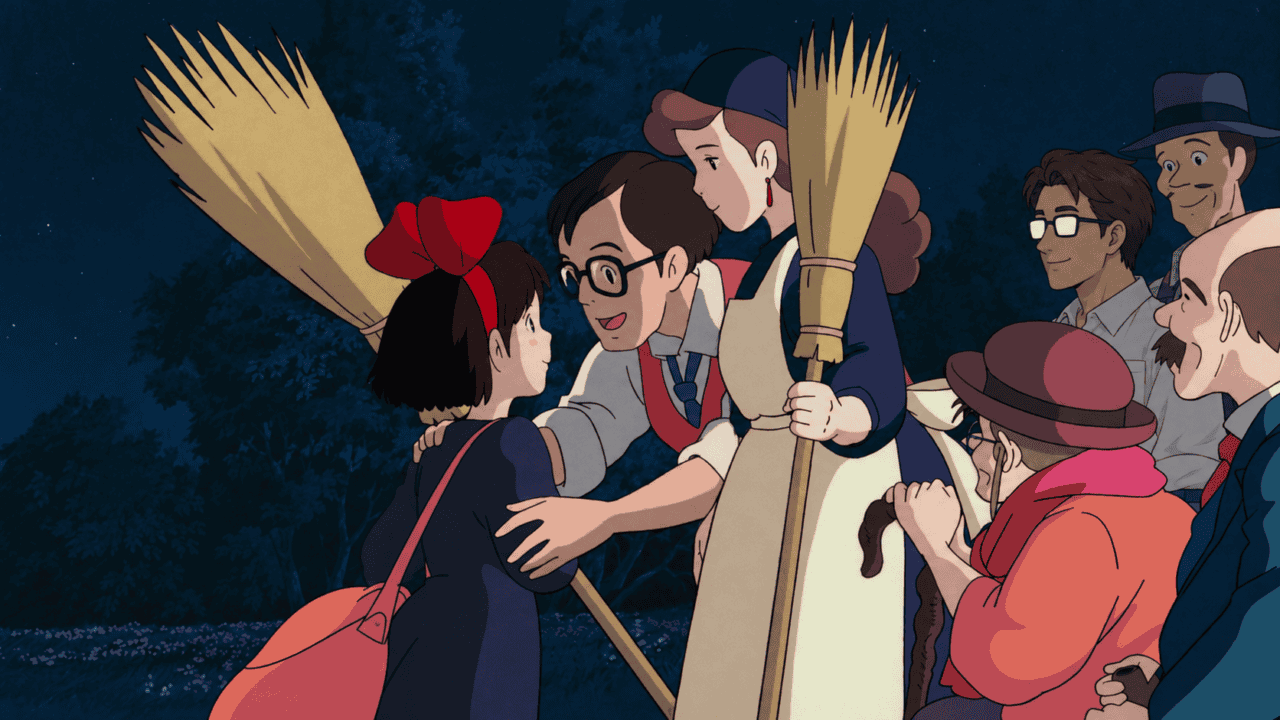
Why does Kiki lose the power to fly in Hayao Miyazaki’s 1989 film Kiki’s Delivery Service(Studio Ghibli Official)?
There are many interpretations of this question, and I think they can each be valid as interpretations. Here is my own. If I had to put it in one sentence, at the risk of being misunderstood:
Kiki loses the power to fly because she was never flying quite so high in the first place.
That probably makes little sense on its own. Let me trace the path that led me to this reading: why does her magic weaken, and why did the film need to show that happening?
*This is a translated version. The original (Japanese) is available here.
-
A Groundless Sense of Invincibility
Kiki’s wish to leave on a broom she made herself expresses a young person’s confidence in doing everything alone. I read that confidence as drawing on the “savings” accumulated under her parents’ protection. -
The Mother’s Broom and Inherited Talent
In this reading, the old broom represents the abilities Kiki has inherited. It lets her make full use of her talent, but that talent alone will not see her through every difficulty. -
When the “Savings” Run Out
After the herring-pie incident and her discomfort around Tombo’s friends, Kiki faces loneliness and the limits of what she already knows. Her inability to fly gives that change a visible form. -
A Film About Living with Talent
Kiki’s conversation with Ursula recalls Miyazaki’s own words about drawing. I see the film as an exploration of how to live with talent when relying on it alone is no longer enough.
On this pageContents
Kiki’s Delivery Service (1989): Why Does Kiki Lose the Power to Fly?
Early in Kiki’s Delivery Service, Kiki is told not to take the broom she has made. Instead, she leaves with her mother’s old broom.
The scene feels so natural that we may take it for granted. But I think asking why this happens at the beginning matters if we want to understand why Kiki later stops flying.
First, let’s think about why she goes to the trouble of making her own broom.
What It Means to Leave on Her Own Broom
Her wish to travel on a broom she made herself seems to express a familiar youthful feeling: “I’ll do it all on my own!”
Even as adults, we sometimes insist on doing everything ourselves. I think we should recognize the “childishness” in that impulse. There is no need to do it all alone. Work with other people—they are often quite happy to help.
Of course, we leave our parents, travel, and change our surroundings to develop our own abilities. But none of that means we must refuse help. Really, it doesn’t. Learning to draw on other people’s strengths is part of getting anywhere.
Perhaps one mark of youth is “not realizing that you are still inexperienced enough to need other people.”
Look at Kiki at the start. She sees the bright future ahead, rather than the difficulties of the journey, and does not doubt that she can reach it. We might call this a “groundless sense of invincibility.”
Put another way, she believes the “savings” accumulated in thirteen years under her parents’ protection will be enough to build her future.
That is what lets her contemplate the rather rash act of leaving on a broom made with her own limited knowledge. Her wish to use that broom gives her inexperience a concrete form.
The Mother’s Broom as a Symbol of “Savings”
Kiki’s mother looks gentle, but she understands the risks of the journey. I imagine she sees how dangerously naive the plan to use a homemade broom is.
Yet, no matter how naive the child is, the time has come for her to leave.
What can a parent do at that point? Give the child something to take along. A journey needs some means of support.
She probably gives Kiki some money too, but the parting gift we actually see her hand over is a broom.
This is a matter of interpretation, but I read the broom as representing “the ability inherited through her parents”—what we call talent.
At the point of departure, Kiki has not yet learned how to ask for help, so she starts by relying on herself. But what does that consist of?
- The ways of behaving she has learned through her relationships.
- Her talent for flying.
That is all she has. And those relationships have mostly been with friends and people who protect her, so they have given her only limited experience of the world.
Then there is flight. By using her homemade broom, Kiki nearly prevents herself from making full use of that talent. Accepting her mother’s broom lets her use it fully.
She has, of course, accumulated some experience through the people she has known. When young people set out, they have to see those modest savings as boundless if they are to move forward at all—the “groundless sense of invincibility” I mentioned earlier.
I think the broom her mother gives her represents those accumulated “savings” from life so far.
But savings eventually run out.
Unbeaten at Home. But Then…
Kiki leaves with the experience of relationships in her hometown and the talent inherited from her parents. She also thinks rather highly of herself. Back home, she feels unbeatable.
But being unbeatable in the world of a thirteen-year-old is not quite as impressive as it feels.
Her groundless invincibility begins to crumble on the very day she reaches the seaside town.
Tombo and Osono help her keep going. Without quite intending it, she begins to rely on other people.
Through those days, she gradually learns how little she can do alone. Still, the extraordinary gift of flight allows her to get by.
Then two problems arise:
- The herring-pie incident.
- Her dislike of Tombo’s friends.
The herring-pie incident happens after Kiki has used more than her ability to fly: she has made full use of her knack for working an old oven, too. That alone might have been bearable. But when she turns to her friendship with Tombo to soothe the hurt, she discovers friends of his who she finds somehow unpleasant.
Kiki feels lonely again—or perhaps truly lonely for the first time. She faces “a problem she cannot solve with what she has accumulated so far.”
Her previous experience of relationships does not help, and Tombo is now the only one who finds her ability to fly special.
Her savings have run out. She now has to deal with something unfamiliar.
Why Kiki Can No Longer Fly
Seen this way, her loss of flight begins to make sense—or at least we can begin to understand what it means.
She realizes that what she already has—her experience of relationships and her ability to fly—is not enough to build the life ahead of her.
When she left home, she thought that special ability would be enough to create a bright future. Reality turns out to be less accommodating.
The early image of Kiki soaring can be read as that of a child who has not yet faced reality and is still getting by on what she already has. She has not discovered how limited those abilities are.
To put that realization in a phrase: she discovers that she was not flying quite as high as she thought.
In this reading, she loses the power to fly because she is finally able to see that she was never flying so high in the first place.
Kiki’s Delivery Service as Miyazaki’s Reflection on Talent
Thinking about why Kiki cannot fly brings the theme of inherited talent into focus in Kiki’s Delivery Service.
Miyazaki himself began his career as a gifted animator, with a remarkable talent for drawing.
Did he, too, have days like Kiki’s?
There is an interesting scene in the production documentary This Is How Ponyo Was Born (ポニョはこうして生まれた, in Japanese).
At a Studio Ghibli training session on May 8, 2006, a new animator asks Miyazaki:
“Sometimes, while drawing, I suddenly find I can’t draw anymore—a slump, I suppose. It has happened occasionally since I was a student. At times like that, could you suggest a good way to take a break?”
(Original Text, in Japanese)
「絵を描いてて、急に描けなくなるとか、スランプですね。そうなることが、たまに、学生の頃からあるんですけど。そういう時の、何かいい息抜きの方法とか、教えてもらいたいんですけど。」
Miyazaki replies:
“Once you’ve taken it on, you have to keep carrying it. You really do. Deliberately taking a break doesn’t revive me. Even when I go to sleep face-to-face with the problem, I dream about it. The moment I wake up in bed, I’m already thinking about it. So I must have been thinking about it half-asleep. Unless you reach that state, the answer doesn’t come.”
(Original Text, in Japanese)
「背負ったらね 背負い続けるしかないんですよ。ほんとに。息抜きを意図的にやることによって僕は蘇生することはないですね。その問題と鼻付合わせて寝てても夢見てる。寝床で起きた瞬間にもう考えてる。だからきっと夢うつつの中で考えたに違いない。そういう状態にならないと答えは見つかってこないんですよ。」
This brings to mind the conversation between Kiki and Ursula:
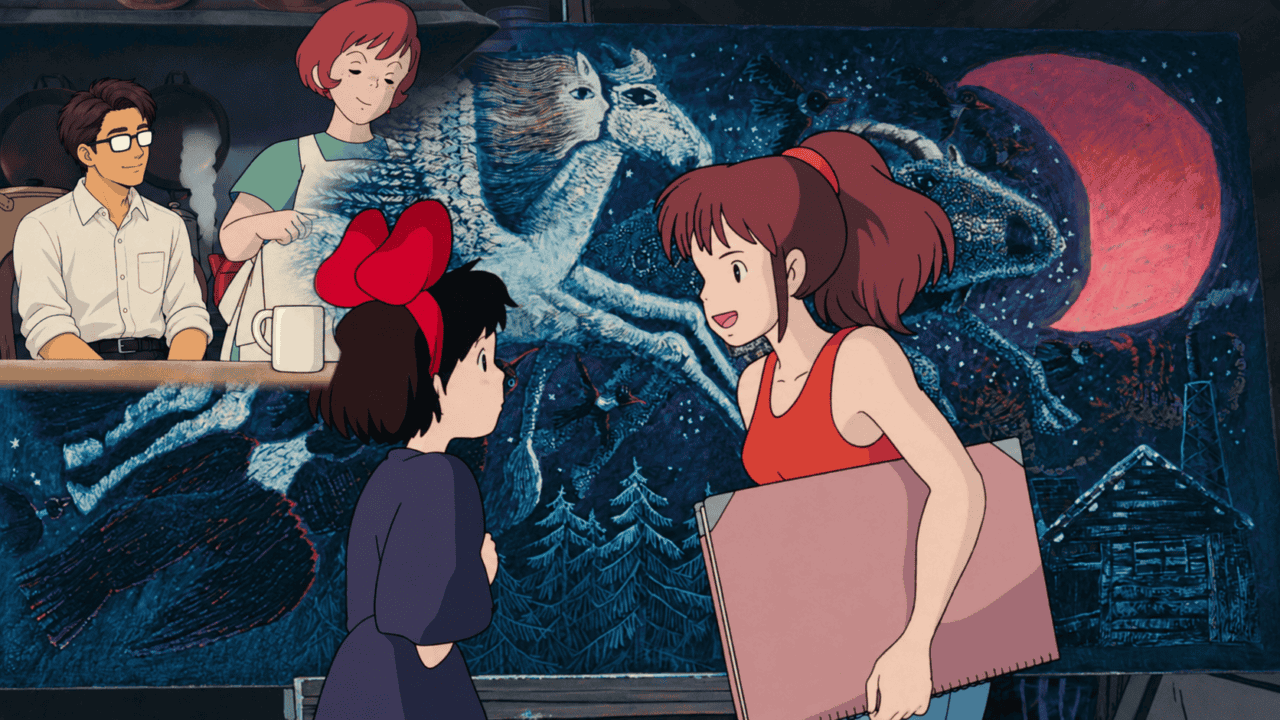
Ursula: “Painting and magical powers seem to be very similar. Sometimes I can’t paint a thing.” Kiki: “You mean it? Then what happens? Without even thinking about it, I used to be able to fly. Now I can’t even begin to remember how I ever managed to do it.” Ursula: “At times like that, you know what I do? Paint. That gets rid of my frustrations. Draw, draw, and keep drawing!” Kiki: “But still, if I can’t fly…” Ursula: “Then I just stop. Take long walks, look at the scenery, doze off at noon. Don’t do a single thing. Then, suddenly I’m able to paint again.”
Kiki’s confession that she can no longer remember how to fly becomes even more revealing when the Japanese wording is compared with the English subtitle. See the original Japanese, romanization, literal translation, and the different wording used in the dub in our analysis of “Without even thinking about it, I used to be able to fly.”
Miyazaki does not tell the new animators to stop drawing. But Ursula’s “Draw, draw, and keep drawing!” seems to echo his words.
However gifted someone is, at some point they have to find a way of living with that talent. Miyazaki must have had his own difficulties and conflicts of that kind.
I see Kiki’s Delivery Service as Miyazaki’s reflection on talent, addressed to young people whose talent is still their only savings. Perhaps that is also what makes it encouraging.
As for me, I have no great talent, so I have been able to live free of that luxury called a “slump.” A truly sad state of affairs.
Your Take
What is your view? Choose the answer that comes closest to your own response.
Reader poll
Can you name the movie before the scene comes into focus?
Put your visual memory to the test with a blurred Studio Ghibli scene.

Reader Comments
Have a thought or interpretation? Leave a comment