
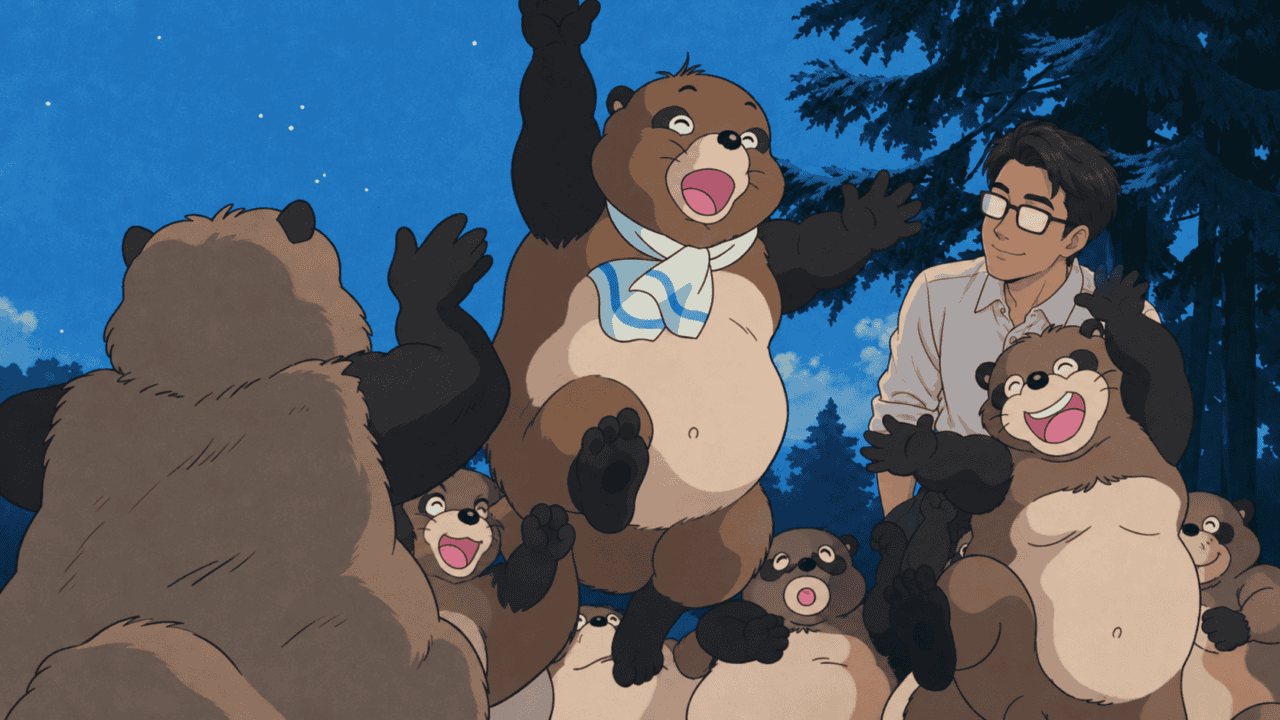
Isao Takahata’s Pom Poko(Studio Ghibli Official) was released on July 16, 1994. I once watched it as part of an elementary school lesson. I suspect the teacher wanted us to learn to cherish nature. But Pom Poko is not that gentle a film.
Its tagline was “Even tanuki are doing their best!” Nobody seems to understand my choice, but it is my favorite Studio Ghibli film.
Here I will summarize its story and discuss my interpretations. The synopsis tells the whole story, so if you want to avoid spoilers, stop partway through and watch the film first.
*This is a translated version. The original (Japanese) is available here.
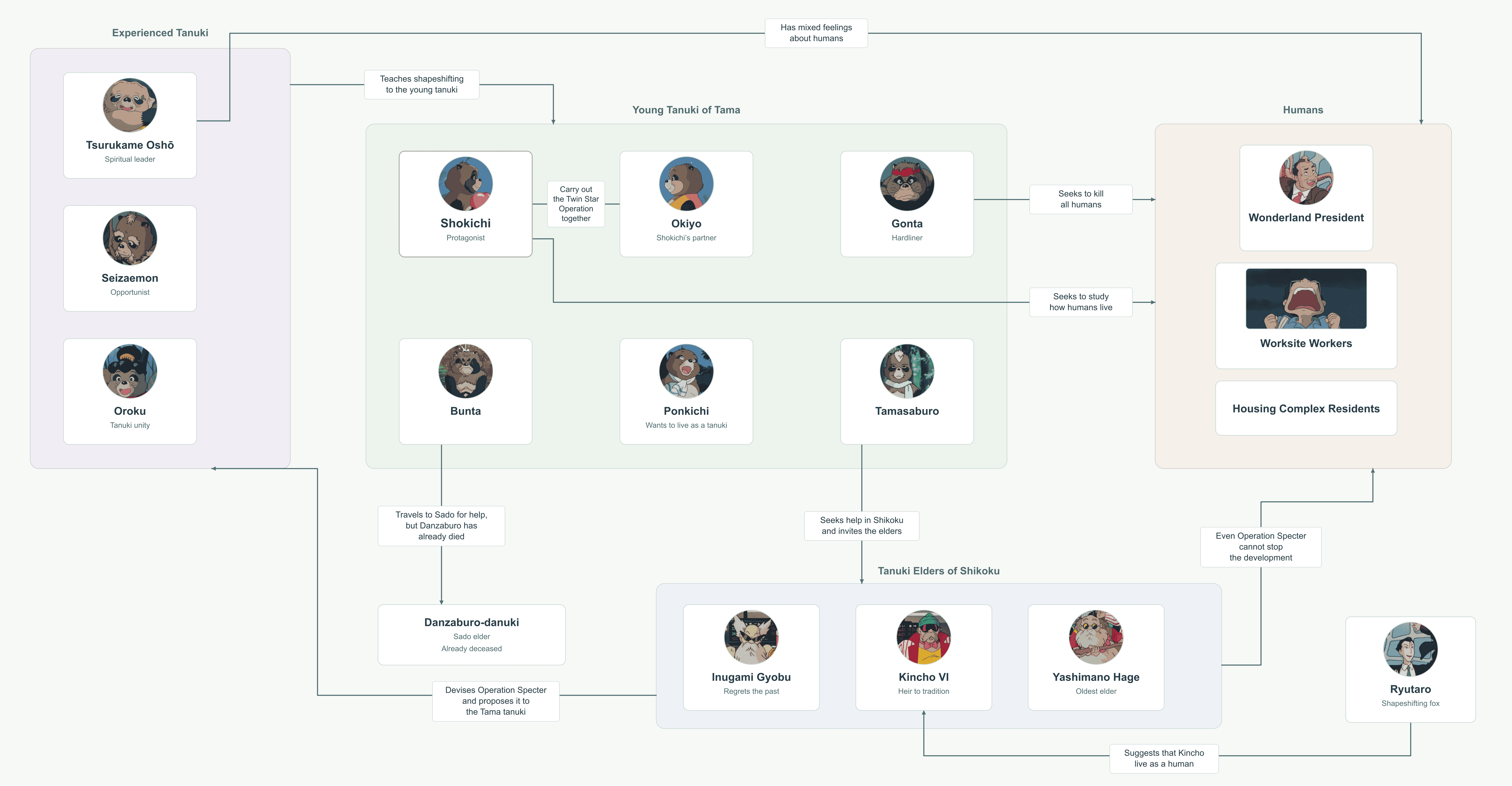
- Detailed Synopsis and Character Map
The tanuki—Japanese raccoon dogs—of the Tama Hills revive their transformation skills to resist the development destroying their home. They fail, then face difficult choices: a last charge, death, or life as humans. Yet they somehow keep living. Below are a detailed synopsis, a character map, and a reading of the story. - Questions and Interpretations
I consider Oroku’s scolding, Operation Specter, the use of rakugo storytellers, and connections with Princess Mononoke and Porco Rosso, with links to articles exploring each question in more detail.
On this pageContents
Pom Poko: Synopsis (Spoilers)
The synopsis follows the tanuki’s resistance to development and the different paths they take after their struggle fails.
Ten Plot Points
Here are the main points of Pom Poko:
- Their Home Is Threatened
The tanuki of the Tama Hills are losing their habitat to human housing development, including Tama New Town. - The Tanuki’s Portrayal
They are mainly shown walking on two legs and behaving in very human ways. - The Attempt to Reclaim Tama
The tanuki join forces against humans to take back their home. - Transformation and the Elders
Their main weapon is bakegaku, the art of transformation. Experienced tanuki teach the younger ones, while messengers seek help from elders in Shikoku and Sado, where the art is more advanced. - The Elders Arrive
As training progresses and a decisive confrontation approaches, three elders from Shikoku arrive. They teach the Tama tanuki Operation Specter, the Yokai Grand Operation. - Human Opportunism
The operation fails to change human behavior. Worse, a theme park called Wonderland claims it was a publicity stunt. - Three Strategies After Defeat
The distraught tanuki divide into three groups:- Hardliners who plan to fight humans physically.
- A dancing Buddhist group that turns away from unbearable reality toward nirvana.
- A group that wants to tell humans the tanuki were responsible for Operation Specter.
- Sacrifice and Defeat
The hardliners make a charge reminiscent of a suicide attack and are defeated. The Buddhist group goes to a collective death. - A Small Response
The group appealing to humans succeeds in involving television and making its case, but the effect is small. - A New Way to Live
After the fighting, the surviving shapeshifters choose to live as humans.
Complete Character Map
Reading the Story as One of Defeat
To me, the crucial point about Pom Poko is that we know from the beginning that the tanuki will lose.
The setting in modern Japan makes this a story whose outcome we already know.
After all, humans have not lost control of the world to tanuki. Tama New Town exists.
What follows is the harsh spectacle of their earnest efforts going nowhere. Told seriously with human characters, such a story might be almost unbearable to watch.
I think Takahata makes that defeat watchable through the tanuki and the comic storytelling of rakugo. The voices of rakugo performers tell us that we are allowed to laugh, turning the tragedy into comedy.
In the original Japanese version, Kokontei Shinchō’s narration is especially important to me. In Pom Poko, that storytelling voice gives us some distance from the tragedy. I feel it lets us laugh while still recognizing what the tanuki are losing.
I have returned to Pom Poko since childhood and continue to find new things in it. When asked about my favorite Ghibli film, I answer Pom Poko.
Let us now follow the story through to its ending.
Detailed Synopsis Through the Ending
Part 1: Reviving Transformation and Resisting Humans
In autumn of the thirty-first year of the Pom Poko era, tanuki whose habitats have been reduced by human development fight over territory. The two groups come from Takagamori and Suzugamori. Their battle is ferocious.
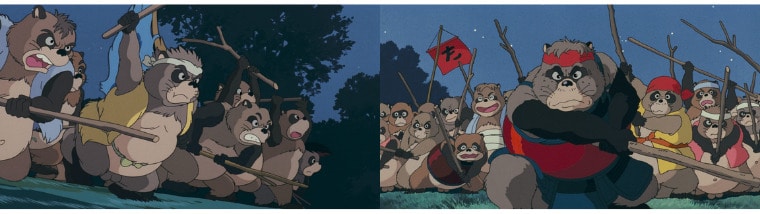
Neither side can win, and the fighting reaches a stalemate. Oroku of the Fireballs intervenes. She takes the tanuki up a transmission tower to show them how humans are clearing the forest.
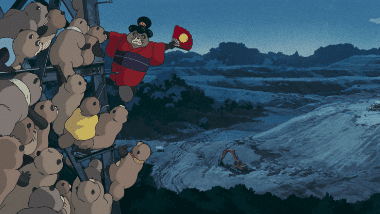
Seeing what is happening, the Tama tanuki unite against humans. They plan to revive their neglected transformation skills and invite elders from Shikoku and Sado. Since fetching them means a long, difficult journey, the local elders first concentrate on training the young.
The elders work hard, but training is not easy. Transformation requires intense concentration, at odds with the tanuki’s carefree nature.
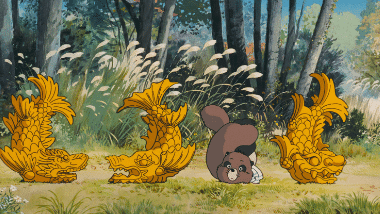
After training and examinations, some of the young tanuki are ready for action. Gonta, a hot-blooded tanuki from Takagamori, gathers volunteers for an operation aimed at annihilating humans. The elders are reluctant, but cannot stop him. Oroku relents and teaches them a secret art: if they are killed, their bodies will appear to be those of foxes for five days.
On a rainy night, Gonta’s attack on a nearby construction site succeeds, killing human workers. The tanuki rejoice at the news.
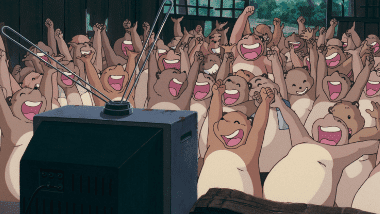
But the deaths are treated as unfortunate accidents, and development continues. Behind the celebrations, Gonta has been badly injured.
Part 2: Operation Specter and Its Failure
Encouraged by Gonta’s success, the other tanuki begin their own operations against humans. They sincerely mean to stop development, but their actions are unlike his attack: they merely play tricks on people.
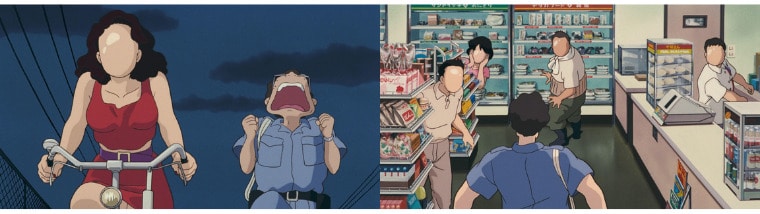
Unable to move because of his injuries, Gonta watches with frustration as development steadily advances. Meanwhile, population growth brings a serious food shortage. Having restrained themselves during training, the tanuki can no longer resist their instincts and begin having children. They organize raids on human settlements to collect scraps and other food.
The shapeshifters are responsible for gathering food. But hunger also drives ordinary tanuki into human neighborhoods, where many fall into traps or are hit by cars. With the situation worsening, Gonta urges a decisive battle. His wounds have healed.
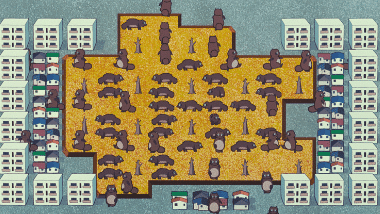
Then the young messenger Tamasaburo finally returns from Shikoku with the long-awaited elders.
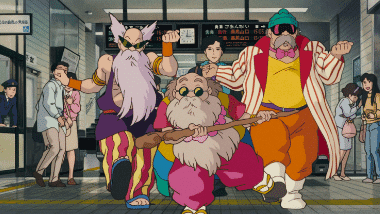
The elders bring a secret art: Operation Specter, the Yokai Grand Operation. The tanuki stake everything on it and begin preparing. Those who can transform and those who cannot all take part in the preparations. After so many setbacks, it is their one remaining hope.
In spring of the thirty-third year, the day arrives. Thirteen degrees Celsius, sixty-five percent humidity: perfect weather for apparitions.
The tanuki fill the streets with supernatural creatures through their transformations. To the people watching, the apparitions are unmistakably real.
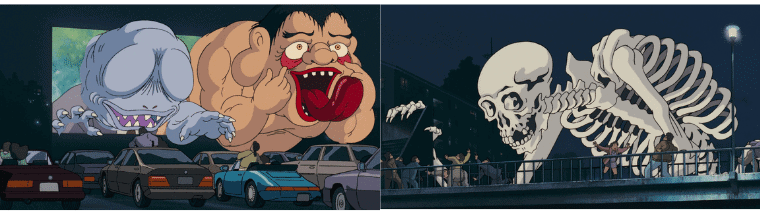
During the operation, Inugami Gyōbu, one of the Shikoku elders, dies. His central role means the operation is cut short. Yet the tanuki are convinced it has succeeded. Surely humans will change now.
Part 3: Defeat and Different Paths
Contrary to their hopes, Operation Specter changes nothing. The operator of Wonderland seizes the opportunity to claim it was a publicity stunt for the theme park. People who saw the apparitions deny that explanation, but the situation does not improve. The tanuki weep at the failure of their final operation.
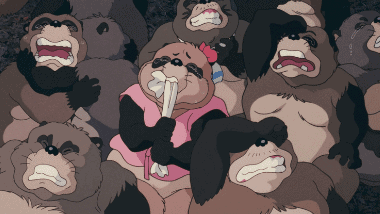
Their unity collapses. A group led by Gonta prepares for a last charge; another, led by Yashimano Hage of Shikoku, turns away from reality. Meanwhile, the Tama elder Tsurukame Oshō decides to appeal directly to humans.
Gonta’s group moves first. Posing as an environmental protection group, they barricade themselves in the forest and confront the security forces. Gonta charges, believing others will follow. But the tanuki cannot win a physical battle against humans.
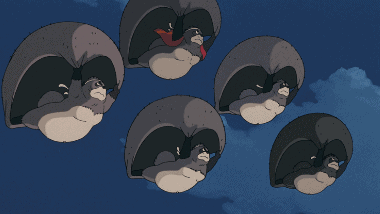
Tsurukame Oshō writes to a television station to say that the tanuki created Operation Specter and to ask humans not to take their home. Many oppose him, but no one can stop him now, and they end up helping. While Gonta fights, Tsurukame pours out his feelings to humans.
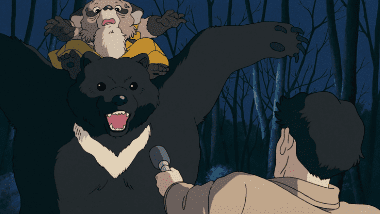
Alongside these last struggles, the despairing tanuki who cannot transform build a great treasure ship, led by Yashimano Hage. It is meant to take them to the Buddhist Pure Land. They board it and hurry toward the railway tracks. I read this final act as collective suicide. What would humans have thought of their bodies?
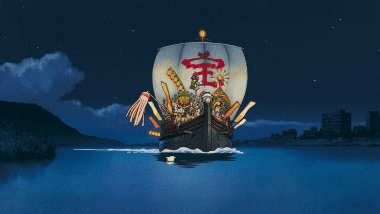
After defeat, the remaining shapeshifters make a final decision: to live as humans. Some become fortune-tellers; others succeed in real estate, clearing the very hills and fields they once defended. They take different forms and keep living. Perhaps one of them is beside us even now.
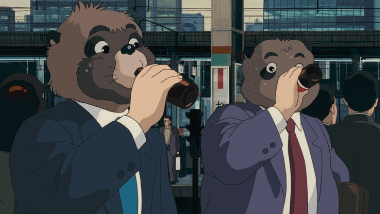
Near the end, Shoukichi leaves his human disguise to rejoin Ponkichi and other non-transforming tanuki on a golf course. It is Ponkichi who addresses us, asking humans to consider the animals that cannot transform and not destroy their homes. The tanuki’s disappearance is not something they chose: humans have taken their lives and habitats. We ought at least to live with an awareness of that.
That is my synopsis of Pom Poko. Next, I will turn to its ideas and my readings of them.
▼ Explore the film’s memorable dialogue in Japanese and English
Many of the film’s most important ideas are expressed through its deceptively comic dialogue—from Ponkichi worrying about losing tempura and Tsurukame Oshō mourning the human victims to Bunta declaring that the humans were the real tanuki. Compare the original Japanese, romanization, English subtitles, literal translations, and detailed commentary in 8 Pom Poko Quotes in Japanese and English, Explained.
Pom Poko: Analysis and Interpretation
The tanuki’s actions, the film’s comic storytelling, and its connections with other Ghibli works offer several ways to consider its meaning.
What Does Oroku’s Scolding Mean?
Oroku’s “This is no time for this!” starts the story’s real struggle by turning the tanuki against humans. She is right: had they kept fighting one another, their home would have disappeared before they noticed. Fighting humans did not change the result, of course.
I cannot help hearing her scolding as directed at Miyazaki and Suzuki, too. The project began with a request to adapt Shigeru Sugiura’s Happyakuya-danuki, but Takahata rejected that proposal and made the film we know. I read Oroku’s words as a rebuke to making a carefree tanuki tale at such a time—and to us when we consume animation as an escape from reality.
Read my analysis: Oroku’s Scolding and the Mystery of Her Secret Art
Why Do the Tanuki Attempt Operation Specter?
Anyone watching might think, “That will never work.” But stopping there misses much of Pom Poko. Why do the tanuki try it, and why does Takahata have them do so? One clue is the appearance of characters from Miyazaki’s films among the apparitions.
I read the transforming tanuki as animators and the operation as animation itself. Their miracle, made through desperate effort, is misunderstood by spectators and claimed by a theme park. The operation is also the comic highlight of their earnest efforts going nowhere. My fuller interpretation is below.
Read my analysis: Operation Specter as Animation Itself
Why Use Rakugo Storytellers?
An important feature of the original Japanese version is the use of rakugo storytellers. I take their presence as a signal: “This is a comic tale. You may laugh.” The tanuki are, after all, earnestly running in circles.
Why tell it that way? I think a serious version with human characters could become as unbearable as Grave of the Fireflies. Making the characters tanuki and giving the story a comic voice lets us keep watching the harshness of their defeat.
Read my analysis: Defeat and the Meaning of Somehow Living On
Connections with Princess Mononoke and Porco Rosso
Shoukichi is the protagonist, and his conflict with Gonta forms the story’s main axis. Yet thinking about Tsurukame Oshō and Ponkichi also leads me to comparisons with Miyazaki’s films.
I see an unexpected resemblance between Tsurukame and Moro, and another between Ponkichi and Porco. The first pair cannot entirely hate humans; the second seem to stand a little apart from the struggle around them. There is no need to force these connections, but considering them can deepen our understanding of each film, including Pom Poko. Do you see them too?
Read my comparison: Princess Mononoke as Miyazaki’s Pom Poko: A Personal Reading
Read my comparison: Ponkichi as a Hidden Protagonist and His Connection with Porco Rosso
Your Take: Pom Poko’s Ending
The tanuki lose their home, yet the story also shows them finding ways to live on. How does that ending feel to you?
Poll results
How does the ending of Pom Poko feel to you?
- Mostly sad, because of what the tanuki have lost.0%
- Mostly hopeful, because they find ways to keep living.0%
- Both sad and hopeful.0%
- I see it differently.0%
- I’m not sure.0%
The images used in this article are from Still Images from Studio Ghibli Works.
Can you name the movie before the scene comes into focus?
Put your visual memory to the test with a blurred Studio Ghibli scene.


Reader Comments
Have a thought or interpretation? Leave a comment