
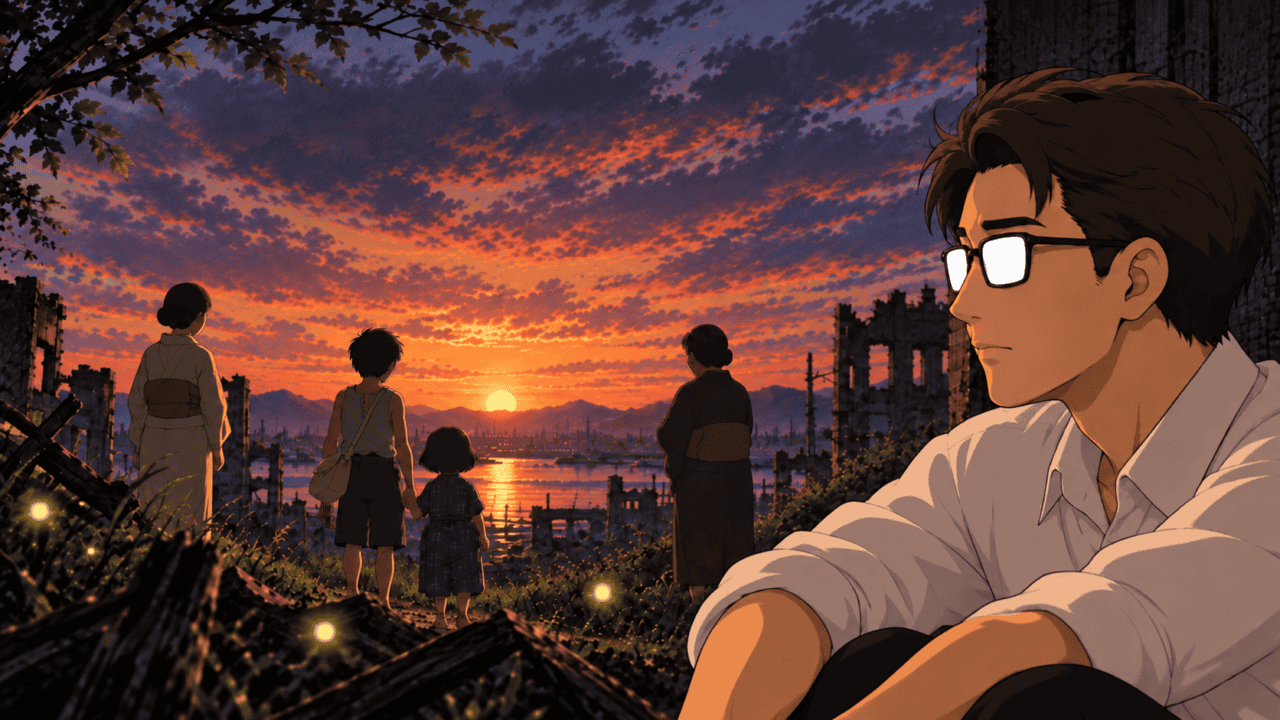
Isao Takahata directed the 1988 animated film Grave of the Fireflies(Official Studio Ghibli).
For many Japanese viewers, I suspect it ranks first among films they never want to see again. Yet it has left them with something precisely because it is so painful—even if putting that something into words is difficult.
Here, I want to revisit the characters and voices of Grave of the Fireflies and think about the people who make up its story.
Please be warned: this deep-dive character guide contains major spoilers for the entire film.
*This is a translated version. The original (Japanese) is available here.
On this pageContents
Grave of the Fireflies (1988): Main Characters and English Voices (CPM Dub)
The table below pairs the main characters with the English voices covered in this guide.
| Name | Age | Voice Actor (English Dub) |
|---|---|---|
Seita | 14 | J. Robert Spencer |
Setsuko | 4 | Rhoda Chrosite |
Aunt | Unknown | Amy Jones |
Mother | Unknown | Veronica Taylor |
Grave of the Fireflies (1988) Character Map
The map brings together the central family relationships discussed below.
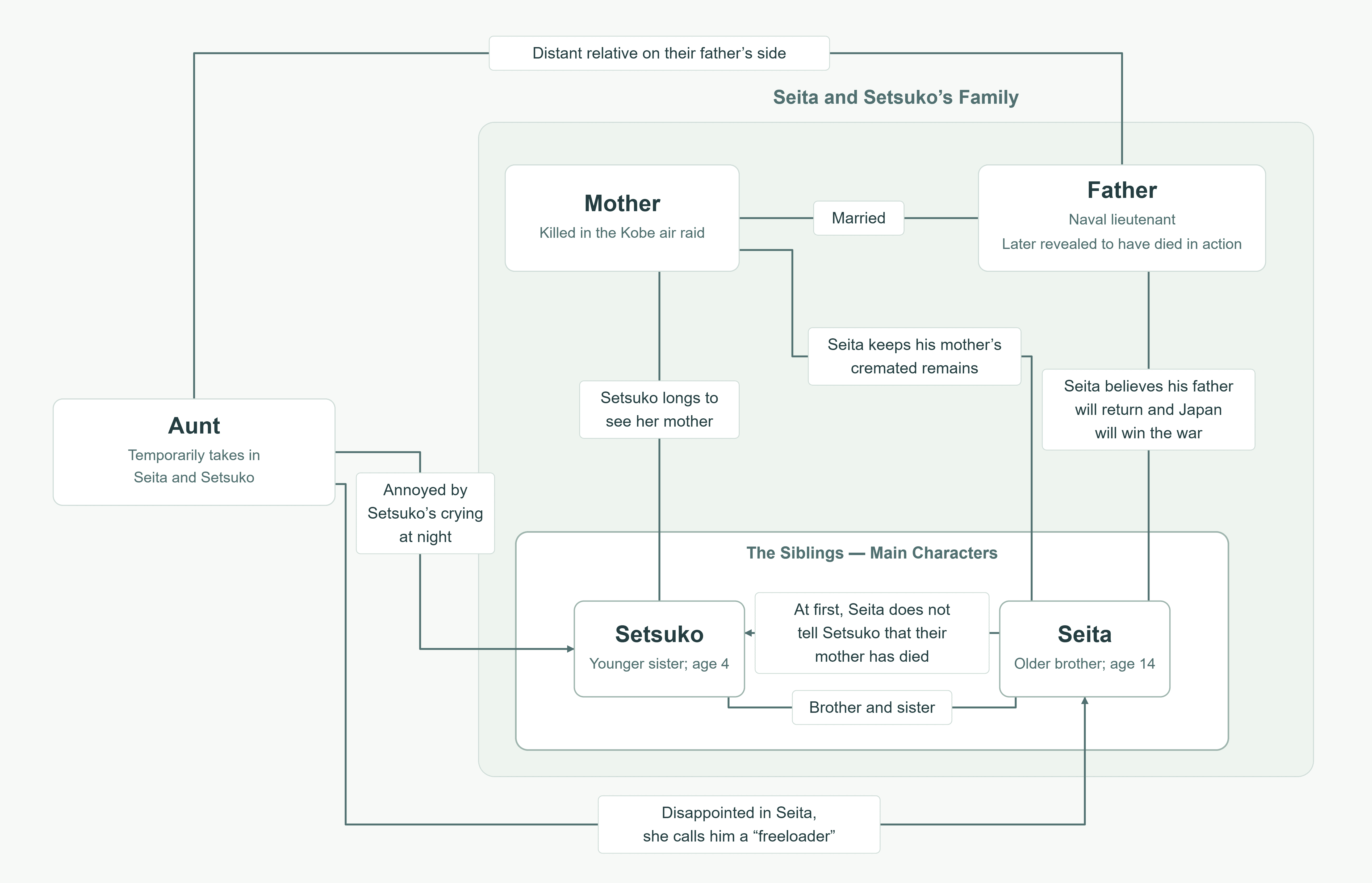
Seita cannot bring himself to tell Setsuko that their mother has died. Before the story reaches its final stages, however, the aunt has told her.
Grave of the Fireflies (1988): Character Profiles and Analysis
Seita and Setsuko’s story involves both close relatives and people they meet only briefly. Their encounters raise questions about care, hardship, and isolation.
Seita | Voiced by: J. Robert Spencer

Seita: Background
Seita is the fourteen-year-old protagonist. Grave of the Fireflies unfolds as his recollection, beginning on the day he dies: September 21, 1945.
His father is a naval lieutenant. Seita lives in Kobe with his mother and four-year-old sister, Setsuko, but loses his home and mother in the air raid. The siblings then go to live with an aunt.
When relations with the aunt worsen, Seita takes Setsuko to a nearby dugout shelter, relying on the 7,000 yen their mother left in savings. Setsuko eventually dies of malnutrition, and Seita dies of the same cause a month later.
What Kind of Person Is Seita?
Seita’s actions contribute to his sister’s death and his own. But how should we describe him?
“Selfish” is one possible answer. Even in a relative’s home, he could have behaved with more consideration for the people taking him in.
What strikes me more strongly, though, is that he is thoughtless and caught up in the moment.
What he tries to build with Setsuko is a “secret base.” It seems a little childish even for a fourteen-year-old. But he has something most children do not: 7,000 yen left by his mother, a powerful ally in this project.
With that money behind him, he begins his secret-base operation. But his thoughtlessness keeps him from recognizing the strength of his connections with other people.
In peacetime, isolation might be manageable. In such a period of upheaval, it is a risk you cannot afford. There will be plenty to resent, but enduring those frustrations may offer a better chance of survival than going it alone. His failure to do that is why “thoughtless” seems the right word to me.
Even so, we must not forget that he is fourteen. He is someone the adults around him should have protected.
We can hold him responsible for Setsuko’s death, but I think we must also reckon with the fact that no one saves them. There are reasons for that too: they are living through the chaos of war. I explore this in more detail elsewhere. How do you see it?
Read the full analysis: Why Did Seita and Setsuko Have to Die?
Setsuko | Voiced by: Rhoda Chrosite
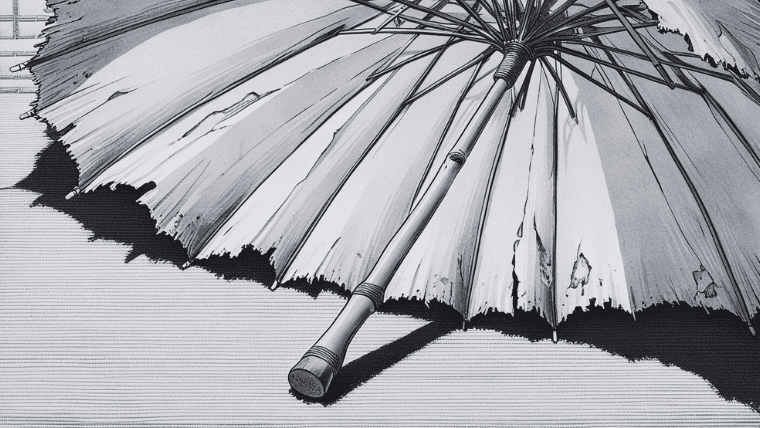
Setsuko: Background
Setsuko is Seita’s four-year-old sister. After the Kobe air raid, she lives with him at their aunt’s house.
Seita cannot tell her their mother has died before they leave the aunt’s house. But the aunt has already told Setsuko. She carries on without revealing to him that she knows.
There is something touching about her quiet endurance. Yet after following Seita to the shelter, she grows weak from malnutrition and dies.
The Debate About Setsuko’s Death
Many people find Setsuko’s death too sad to face a second viewing. Perhaps that also makes it hard to talk about the film: we have barely seen it enough to discuss it, and may not much want to.
When we do try to discuss it, Setsuko’s death tends to become the central question.
How could she have been saved? Where does responsibility for her death lie?
The debate tends to divide into the “Seita is to blame” and “the aunt is to blame” camps. I suspect the former is more common today.
Takahata expected more viewers to blame Seita, and said he was surprised by the sympathy Seita received at the time of release, as he recalls in a Blu-ray interview. He made the film with a clear awareness of Seita’s selfishness.
Perhaps people then felt a stronger obligation to endure hardship, or perhaps memories of the war were more immediate. Either way, I think this film becomes a mirror of who we are when we watch it.
Aunt | Voiced by: Amy Jones
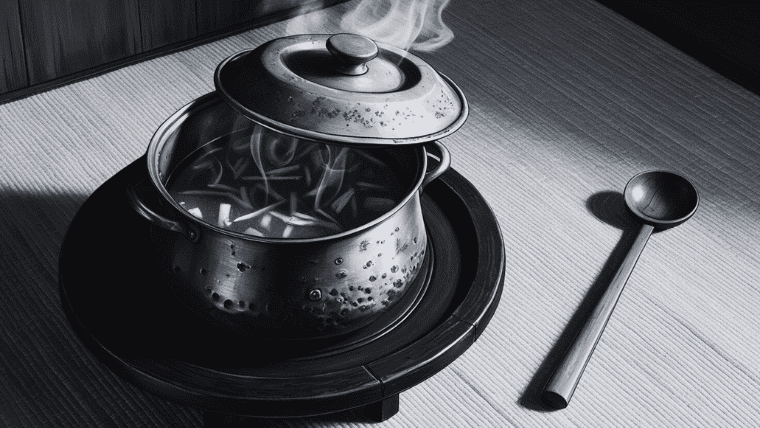
The Aunt: Background
The children’s aunt lives in Nishinomiya and takes them in after the air raid.
There are no problems at first, but her relationship with Seita gradually worsens, and she becomes harsh toward him.
Her treatment of him is the immediate reason he takes Setsuko to live in the nearby shelter.
How Should We Read the Aunt’s Attitude?
Her harshness is so plain that, watching it, we may find ourselves thinking, “You don’t have to go that far.”
But if we ask what lies behind that attitude, I think the key is “endurance” (gaman). It is an important word for understanding the film.
Seita seems to have been rather indulged as a child. He shows little concern for those around him and little desire to contribute. He is depicted as lacking the idea of endurance—though he may feel that he is enduring a great deal himself.
The aunt, meanwhile, is being forced to endure by the social pressures of wartime. Everyone around Seita seems to be living under that demand; he is the exception.
Everyone in that period was a victim of circumstances. We cannot judge the aunt’s harshness in isolation.
We have to weigh Seita’s selfishness against the aunt’s harshness and ask what we could have done in either position. I think the answer depends on our own state of mind at the time.
That is why you should not watch Grave of the Fireflies when you have no emotional room to spare. Really, don’t.
Mother | Voiced by: Veronica Taylor
The Mother: Background
During the Kobe air raid, the mother goes ahead to a shelter while Seita buries provisions such as pickled plums in the garden.
She suffers severe burns and dies from her injuries.
We have very little to go on about her personality. But her brief exchange with Seita before the raid suggests a calm, gentle woman. She also has a weak heart.
The way she responds to Seita with an easy “yes, yes” makes a clear contrast with the aunt who appears later.
Seita seems unable to change from the boy he was with his mother, even after his circumstances change completely. I feel she would have embraced him despite his behavior. And, as I keep saying, he is fourteen: perhaps his inability to adapt is understandable.
Other Characters
Seita and Setsuko’s Father
A naval lieutenant whose career is on the rise, he appears only in photographs and recollections. Seita tries hard to contact him, but receives no reply.
After the war, Seita learns at the bank that the Combined Fleet has been destroyed. His father’s fate is not explicitly shown.
The Aunt’s Daughter
The aunt’s daughter appears only briefly, including at meals with Seita and Setsuko. She is present when her mother gives the siblings watery porridge while serving her own household a fuller meal. Even as a child, she seems to feel uncomfortable.
The Lodger
A young man lodging at the aunt’s house, he is diligent in his wartime labor duties.
Ever since I first saw the film as a child, I had thought he was the aunt’s son. He is not: he is a lodger.
Like the daughter, he shows some concern for Seita and Setsuko without becoming actively involved. As a lodger, perhaps he could neither challenge the aunt nor do much for the children.
The Woman Across the Street
Early in the film, she tells Seita that his injured mother has been taken to the school. She also shows concern for the children afterward. For me, she provides one of the story’s rare moments of kindness.
Perhaps Seita should have turned to her. She would probably have scolded him, but I doubt she would have let two children live alone in a shelter. Sometimes, “an acquaintance nearby is better than a relative far away.”
*The recording script included on the Japanese Blu-ray identifies her as the “high-miss across the street.” “High-miss” was a term for an unmarried woman considered past marriageable age. It is not a term to use today.*
The Four Elementary School Students
These boys come to tease the siblings in their shelter. It is unpleasant to watch, but the scene also tells us that “there were children having fun, whatever else was going on.” I think that may have been one of the things Takahata wanted to leave on screen.
The Farmer Who Lent the Cart
After Seita decides to leave the aunt’s house, this man lends him a cart to move his belongings to the shelter. He also sells the children a little food.
But when Seita asks for food again, he rebukes him and urges him to apologize to the aunt.
Perhaps the earlier help had become a subject of neighborhood gossip. It could look as though he was supporting Seita’s little coup, so his concern for relations with his neighbors may explain the advice to apologize. What he actually felt, we cannot know.
The Farmer Who Beat Up Seita
Late in the story, Seita is caught by the owner of a field where he is stealing food. The man beats him thoroughly and takes him to the police.
It seems excessive, though Seita’s resistance may have added to his anger. Seita eventually tries pleading, bringing up Setsuko. But the start of such an encounter matters: if you are going to apologize, do it straight away.
The Police Officer
The farmer brings Seita to this officer, apparently expecting a severe response. But the officer is understanding, and Seita returns to Setsuko without being punished.
As a local officer, he would probably have known something of the children’s circumstances, and may have suspected Seita was behind thefts nearby. He would also have been aware that Seita was the son of a naval lieutenant. I think he made a judgment that took all of this into account.
The Doctor
The doctor examines Setsuko when her health has seriously declined. His diagnosis is weakness caused by malnutrition.
Seita asks for treatment, but the doctor gives an entirely reasonable answer: she needs nourishment.
Perhaps this was the moment for Seita to return to the aunt and beg her forgiveness. Instead, he angrily asks the doctor, “Where am I supposed to find nourishment?!” and goes back to the same life. I cannot help thinking this was his last chance.
The commercial subtitle renders Seita’s reply as “But where can I get that?!,” while the Japanese directly asks where nourishment could possibly be found. Compare the original Japanese, romanization, subtitle, and literal translation in our detailed analysis of Seita’s desperate outburst.
The Three Old Men at the Bank
These are the three men at the bank where Seita withdraws his money. Two are talking at first, and a third joins them. Their conversation tells him of Japan’s defeat and the destruction of the Combined Fleet.
Here we see how isolation has left Seita without information: he does not even know the war is over. The scene shows a fundamental danger in cutting ties with other people. Sometimes losing access to information can be an even deeper problem than losing access to food.
The Man Who Gave Them Charcoal
This man gives Seita a bale of charcoal for Setsuko’s cremation. We do not know what Seita tells him, but he explains how to burn the body with remarkable cheerfulness.
His manner seems unfeeling. But perhaps that was simply how things were; perhaps being able to cremate someone with care was itself something to be grateful for.
To me, the discomfort of this scene suggests that there is no longer a world in which Seita can live. It marks a major break in Grave of the Fireflies: what follows is a “world where people abruptly change their tune.” Seita cannot do that. He seems destined to reach the end of his life left behind by the changing times.
Your Take: The Adults Around the Children
The adults around Seita and Setsuko show kindness, strain, and distance in different ways. Which aspect of their behavior stays with you most?
Poll results
What stays with you most about the adults in Grave of the Fireflies?
- Their small acts of kindness.0%
- The pressure they face during wartime.0%
- The gap between showing concern and offering lasting help.0%
- Several of these equally.0%
- Something else.0%
- I’m not sure.0%
Can you name the movie before the scene comes into focus?
Put your visual memory to the test with a blurred Studio Ghibli scene.


Reader Comments
Have a thought or interpretation? Leave a comment