
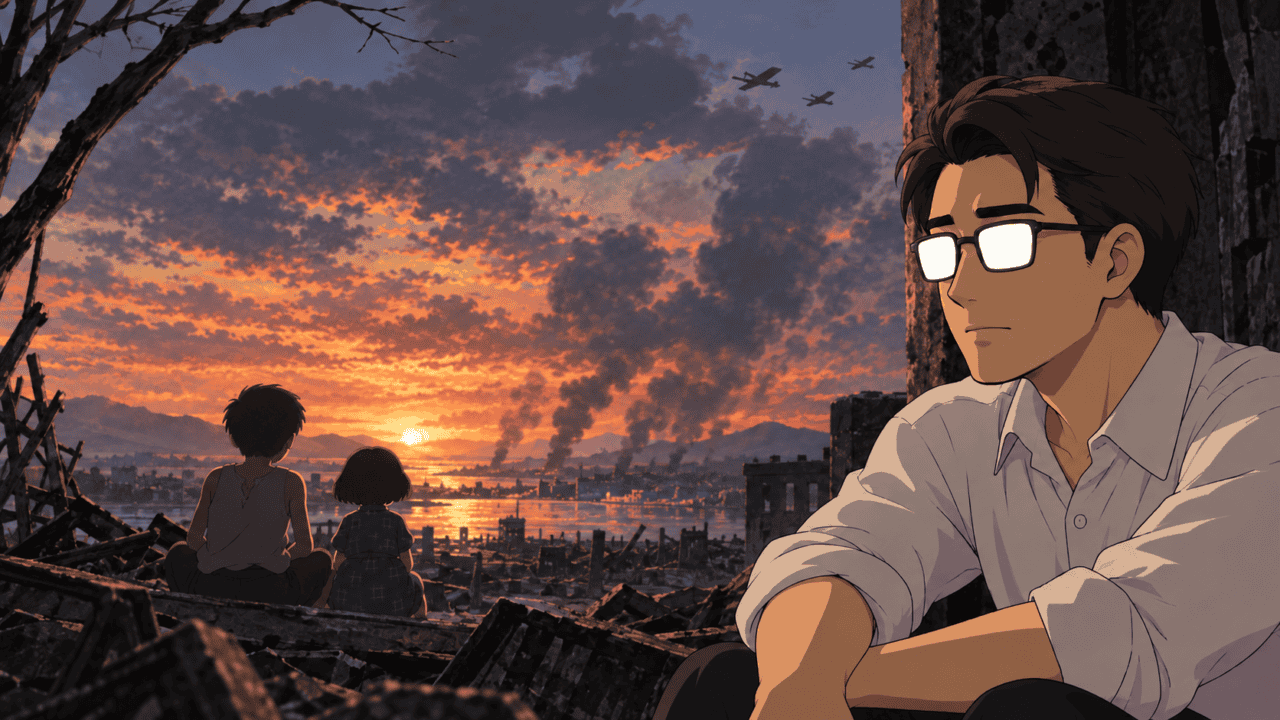
Isao Takahata’s Grave of the Fireflies(Studio Ghibli Official) was released in 1988. I have written about many films, but for a long time I could not put my thoughts about this one into words. “War is tragic” is a sufficient response, and this is hardly a film to watch over and over. Yet leaving it at that also seemed a waste. The question that finally brought my thoughts together was: Why did Seita and Setsuko have to die?
How far can we think through their deaths? I want to begin with Takahata’s own words about the film.
*This is a translated version. The original (Japanese) is available here.
- Takahata’s Words and His Approach to the Film
Takahata described the film as neither an anti-war anime nor a simple tearjerker. He spoke of resistance to totalitarianism and the tragedy of an ordinary child. I wonder whether his refusal of the anti-war label reflects the fact that the film offers no method for ending war. - Blaming Seita—and Our Own Unease
It is understandable to blame Seita for taking Setsuko with him towards death. But might that anger also conceal our unease at the adults who fail to help—and at the possibility that we, too, might ignore someone in need? - The Structure of a “Shinju” Story
Takahata saw a shinju-story structure in two people moving towards death within a closed world. I consider both the reading that Seita takes Setsuko with him and the uncomfortable reverse possibility that caring for her helps bring about his own ruin. - Wartime Life as Ethnographic Testimony
The film shows banks functioning, doctors seeing patients, and children playing amid wartime hardship. Although fiction, its detailed depiction of everyday life may also serve as testimony to the period. - The Risk of Isolation
Cut off from other people, Seita does not even know the war has ended. To me, this gives force to a simple message: we need to live in connection with others.
On this pageContents
Grave of the Fireflies (1988): Analysis
Takahata’s comments, the children’s isolation, and the responses of people around them offer several ways to consider the tragedy.
Isao Takahata’s Words
The words of a story’s creator carry weight, and they interest me deeply. This often-quoted comment by Takahata about Grave of the Fireflies is particularly important:
At the time, an extremely oppressive form of “totalitarianism”—the worst kind of social order—was accepted as right. Seita resists that totalitarian age and tries to build a “pure family” with just Setsuko and himself. But is that possible? It is not, and that is why Seita lets Setsuko die. Can we criticize him for it, though? We today can readily sympathize with Seita because the times have changed. If the times change back someday, opinions condemning Seita even more harshly than the widow did may become the majority. I find that frightening.
(Original Text, in Japanese)
当時は非常に抑圧的な、社会生活の中でも最低最悪の『全体主義』が是とされた時代。清太はそんな全体主義の時代に抗い、節子と2人きりの『純粋な家族』を築こうとするが、そんなことが可能か、可能でないから清太は節子を死なせてしまう。しかし私たちにそれを批判できるでしょうか。我々現代人が心情的に清太に共感しやすいのは時代が逆転したせいなんです。いつかまた時代が再逆転したら、あの未亡人(親戚の叔母さん)以上に清太を糾弾する意見が大勢を占める時代が来るかもしれず、ぼくはおそろしい気がします
Other comments by Takahata are collected on the Japanese Wikipedia page for Grave of the Fireflies.
For example, he famously stated:
“It is not an anti-war anime at all, and it contains no such message.”
(Original Text, in Japanese)
「反戦アニメなどでは全くない、そのようなメッセージは一切含まれていない」
“This work is by no means just an anti-war film, nor is it a tear-jerking story about pitiful victims of war; it depicts the tragic story of a very ordinary child who lived in an age of war.”
(Original Text, in Japanese)
「本作は決して単なる反戦映画ではなく、お涙頂戴のかわいそうな戦争の犠牲者の物語でもなく、戦争の時代に生きた、ごく普通の子供がたどった悲劇の物語を描いた」
For me, these comments seem contradictory at first. They also seem at odds with my own response to the film.
Yet I do not think they contradict one another. Here is how I understand them.
What Might Lie Behind Our Anger at Seita?
Watching Grave of the Fireflies, we may understandably want to blame Seita. At the heart of that response, I think, is the fact that he took Setsuko with him towards death.
That response is valid, and I share it.
But even if Seita could not be saved, were there not several people in the story who could have saved Setsuko?
His aunt may have disliked him, but she could have said, “Leave Setsuko here.” That would hardly have seemed out of place. After the children move into the shelter, no one comes to help them either.
The usual explanation is that, near the end of the war, everyone was struggling to look after themselves. I think that is true.
Even so, there seems to be a troubling difference between excusing the adults on those grounds and condemning Seita.
Might we also fear that, even now, outside wartime, we could leave people like Seita to die?
We could find plenty of reasons. We, too, have work and daily lives to manage. Perhaps we remember an occasion when we ignored our sense of what was right and later thought, “I should have said something.” If you have never felt that, great!
We may feel a little guilty about it: “Yes, I had my own difficulties, but not so many that I could not have helped.”
Could our attacks on Seita sometimes be a way of hiding that unease?
Takahata’s Fear—and a Harsh “Simulation”
The Loss of Fundamental Human Kindness
I wonder whether we have become the society Takahata found frightening. This is not merely a question of how we judge a film, but of a society in which we feel uneasy about people in difficulty and still fail to help them.
Perhaps we are losing the basic kindness involved in helping someone—or losing the ability to act on it.
Takahata experienced the Okayama air raid at nine. He and his sister, a year older, fled through the city and spent the night by a river, exposed to the rain (Reference: A Dialogue with Director Isao Takahata, in Japanese).
I do not know whether adults saw and ignored him that night. It must, however, have been intensely lonely.
And if a society where many people have enough food and clothing, and no one has to flee incendiary bombs, still fails to help an isolated nine-year-old boy and his sister by a river, that is frightening.
That raises another question. This may sound harsh, but an earlier tragedy might have made that fear easier to grasp. Why do Seita and Setsuko manage to live in the shelter for as long as they do?
I read the film as a harsh simulation: if the rest of the family were gone and only the children remained, how far could they get? Of course, it is based on Akiyuki Nosaka’s story, but perhaps that question helped draw Takahata to it. I hear something more forceful than idle speculation: “All right, then. If no one will help, let’s see what happens.”
Takahata is no mere dreamer. I do not see him trying to beguile us with an easy fantasy. Considered realistically, the experiment is heading towards catastrophe.
Perhaps the film is saying: “See? However hard a child tries, there are limits. Yes, in Seita and Setsuko’s case, Seita could have endured more. But what about today? Is the person in trouble always to blame?“
The “Rice Ball” as a Singular Ray of Hope
Even if I can follow this reading of Takahata’s argument, the film feels almost unbearably bleak. Yet it contains one glimmer of hope.
At the beginning, Seita sits in the station looking like a discarded rag. Passers-by look at him—and treat him—as though he were filth.
Then one person gives him a rice ball. That moment makes me weep whenever I watch it.
For me, it is the one moment of relief in an otherwise devastating story.
Perhaps Takahata is asking us to live in a way that lets us offer a rice ball to someone in need. Put into words, that is simple enough. Expressed through this carefully made film, it strikes home.
Why Did Takahata Say It Was Not an “Anti-War” Film?
Let’s return to the comment that puzzles us most: “It is not an anti-war anime at all.” What might Takahata mean?
I see two possible approaches: the film does not tell us how to end war, and it can also be read as a kind of autobiography.
The Lack of a Methodology for Peace
An important starting point, I think, is that we scarcely encounter war stories that are not anti-war—at least in post-1945 Japan.
What story have you seen that takes the opposite position? The stories I have grown up with treat opposition to war as a given. Beyond that, the question becomes “What do we do about it?”
I imagine that, by Takahata’s demanding standards, an anti-war film would have to offer a method for bringing war to an end, rather than simply show that war is bad. And it could not be a fantasy.
Perhaps he rejected the label because this film does not do that.
Animation as Ethnographic Testimony
Alongside that reading, Grave of the Fireflies may be understood as a kind of autobiography for Takahata.
This is reflected in his quote: “…it depicts the tragic story of a very ordinary child who lived in an age of war.“
Perhaps Takahata wanted viewers to feel something of what he experienced during the air raid and while fleeing with his sister. The film is based on Nosaka’s novel, of course; I think its reality must have given him a reason to adapt it. Tears and anti-war feelings may follow, without necessarily being its primary purpose. Animation lets viewers experience the details of life in that period through images. For those who did not live through it, that matters.
Someone who knew the period could give those details weight. In that sense, Grave of the Fireflies, though fiction, also becomes a documentary about the past. We cannot go back and film those lives, but animation can reconstruct them. That must have involved considerable work.
There is an account that two scenes were still uncoloured when the film first opened. Takahata’s insistence on quality delayed production beyond the scheduled release. The people around him must have had a terrible time; yet the result was a masterpiece. He deserves praise, though I imagine the staff had plenty to endure.
One result of that work and sacrifice, I think, is a film with value as ethnographic material.
Documents, excavated objects, and accounts of everyday life offer different ways of approaching the past. I see the value of Grave of the Fireflies particularly in its testimony to lived experience. Its images are subjective, not an unquestionable historical record—and it is hardly an archaeological object, though perhaps the animation will become one in a thousand years.
- It shows banks still functioning.
- It shows ordinary life continuing amid hardship.
- It shows that people could still visit a doctor.
- It shows children playing.
Textbooks can make the final days of the war seem like unbroken darkness. The film suggests something more complicated. These depictions must be open to criticism, but they offer a form of testimony.
I think the wish to leave that testimony may have helped motivate the adaptation. Perhaps calling it something other than an anti-war film also means: this is a testimony.
(That does not mean every detail should be accepted as an accurate record. The depiction of incendiary bombs in the Kobe air raid, for example, can be questioned. Read the related analysis: Did Takahata Make a Historical Mistake?)
Why Was Seita Dying at the Train Station?
One related question is why Seita dies in Sannomiya Station. After living with Setsuko in the shelter, he might have been expected to die there too.
The opening line gives us a clue: “September 21, 1945. That night, I died.” Setsuko’s death, dated August 22 in the novel, comes about a month earlier. Seita has survived another month.
The subtitle slightly restructures the original Japanese statement. For its exact Japanese wording, romanization, literal translation, and an analysis of why the date matters, see our guide to the film’s unforgettable opening line.
What might he have done during that month?
He has his parents’ savings, but the film shows that money alone is of little use. A malnourished fourteen-year-old could hardly live another month without eating. He must have been finding enough food to keep himself alive.
Perhaps he survives from day to day by stealing. When there is nowhere left to steal from, or he no longer has the strength, he may turn to begging. A station, with its passing crowds, would be a place to try. This is how I imagine his movement there.
What I see in that month is the basic human impulse to keep living, somehow.
Even in the despair of Setsuko’s death, he becomes hungry; when hungry, he tries to eat. Anyone would. Perhaps the film is exploring that aspect of being human, as well as war. It may be another reason Takahata wanted us to see more than a war story. And to be clear, I do not wish Seita had died sooner: I wanted him to survive for as long as possible.
The Structure of a “Shinju” Story
I also want to offer my own reading of Takahata’s description of the story as a shinju-mono. I cannot yet put his artistic ambition into words; instead, I will consider his idea of two people moving towards death in a closed world.
What drew me to Akiyuki Nosaka’s original work was the structure of a “shinju-mono” (suicide pact story), which depicts how the two of them head toward their deaths in a closed world. I had a strong creative ambition that I could depict it with a new kind of appeal through animation.
(Original Text, in Japanese)
野坂昭如さんの原作にひかれたのは、2人がいかに死に向かっていったかを閉じた世界の中で描くという「心中もの」の構造があったこと。アニメなら新しい求心力で描けるのではないかという表現上の野心が強かった。
From “My Air Raid Experience, Properly in a Film: ‘Grave of the Fireflies’ Director Isao Takahata”
One-Sided “Shinju” and Ruin
Traditionally, a shinju story involves lovers agreeing to die together, hoping at least to be united in the next world. But when two people die, how can we tell whether both agreed?
My own conjecture is that what one person sees as shinju may often be muri-shinju—a double death forced on the other. Two people can have unequal power. I wonder whether Takahata saw that one-sidedness in Nosaka’s story. Setsuko may have wanted to stay with Seita, but that does not settle the question.
Seita survives while Setsuko dies. Then he, too, dies. They have lived in a closed world, and one person’s choices have brought both to ruin.
Applied to the present, I read that as if we do not reach out, we may be the ones who die. We can impose isolation on others or have it imposed on us; those positions change with circumstance. Somehow, we have to muddle through together. That seems the only way, and it is difficult. What are we to do? I do not know.
The Uncomfortable Reverse Perspective
Underlying this argument is the thought that Seita takes Setsuko with him towards death. Yet shinju also allows the unsettling reverse reading: could Setsuko’s presence have helped bring Seita to his death?
That may offend readers, but I think fiction matters partly because it lets us consider uncomfortable possibilities. Looking from more than one direction may help us view the story with some distance:
- Seita is foolish, but his aunt is unkind.
- Seita’s choices lead to Setsuko’s death, but he takes good care of her.
- The children’s deaths follow Seita’s withdrawal, but society does not help them.
- It is uncomfortable to imagine, but without Setsuko, Seita might have remained at his aunt’s house.
- Setsuko dies, but her life with Seita may have been more fulfilling than remaining with their aunt.
We also forget that Seita is fourteen. Even if we can blame his decisions within the story’s structure, it is cruel to make a child bear responsibility for another life. Takahata seems to avoid giving us an absolute moral position: we blame Seita, then society, excuse wartime necessity, and wonder what else anyone could have done. Perhaps that is right for his films. We watch them in order to wrestle with such questions.
Two Hearts Already Broken by War
Finally, consider the wounds Seita and Setsuko carry into this closed world.
At fourteen and four, they experience terror during the Kobe air raid and lose their mother. Seita sees her severely burned and wrapped in bandages. He then sees her body treated as an object and cremated with little that resembles mourning. Could a fourteen-year-old bear that? It would be no surprise if he could not.
Read our analysis: The Unseen Emotional Scars of Seita
Both children have suffered terribly. Because Seita does not show his hurt openly, we may fail to notice it. Yet it is too convenient to assume that the air raid and their mother’s death leave them unchanged. I wonder whether their wounds have taken away their ability to live among other people. The boy we see early in the story hardly seems likely to spend his days doing nothing at his aunt’s house, yet that is what happens. In this reading, retreating into a world of two is born of despair at the larger world, which seems to reject them. If we need something to blame, perhaps it should be the war that inflicted those wounds, rather than Seita. A single aspect of Takahata’s film gives us so much to think about.
Read our analysis: Why Seita and Setsuko Cannot Pass On
Reconsidering the Aunt
The Aunt’s Wartime Jealousy
Finally, let’s spend a little more time with the aunt.
In a sense, the aunt drives the story: if she offered the children boundless kindness, this particular tragedy could not unfold. Why, then, is she so harsh? Seita’s behaviour and the strain of wartime life offer explanations. But let me speculate a little further: the children’s father was a naval lieutenant.
In wartime, servicemen carry prestige, and an officer more so. Seita’s family may have enjoyed relative comfort—not only financially, but in their sense of security. Perhaps the aunt feels some envy towards them.
Even knowing that these are children who need protection, she may detect the air of a naval officer’s household in their words and behaviour. Their father’s position helps explain the savings, and I think it may also help explain her harshness.
The Aunt as a Victim of Narrative Framing
From the standpoint of the story’s construction, I see the aunt as another victim. She is made to play the disliked, unkind relative so that the story can happen.
As criticism of Seita grows, the aunt’s behaviour can attract sympathy. Takahata found that prospect frightening; the aunt, viewed from outside the story, might say, “The times have finally caught up with me!” Within the story, I imagine she might feel deep regret after the war. She, too, is a victim of it.
People Need to Live in Connection with Others
Setsuko’s death is one reason Grave of the Fireflies stays with us. Personally, the image of the children’s bandaged mother struck me even harder. The tragedy is intensified by the fact that Seita does not know the war has ended. Outside his aunt’s household, he has become cut off from information.
Nosaka’s novel dates Setsuko’s death to August 22. If Seita had known the war was over, perhaps he could have apologized to his aunt. At least, it might have changed how he acted—and perhaps Setsuko might have lived. I want to believe that, although her malnutrition had already begun, and a change in his behaviour might not have saved her. Still, I cannot help thinking that the news could have changed something.
For me, that isolation gives painful force to a simple message: we need to live in connection with other people. It is easy to say, and everyone seems to know it. Confronting it in this story is another matter.
Since the 1990s, we seem to have tried to escape the burdens of community. In one sense, that may reflect a society mature enough for isolation not automatically to mean death. Yet Grave of the Fireflies makes me think about the risks that remain. Perhaps there is no permanent, secure arrangement: connection can produce isolation, and isolation can create a wish to reconnect. We keep responding against the conditions we find ourselves in.
If society regains some sense of community and its protection, perhaps Seita will again be seen as someone who resisted it. The future is unknowable, of course.
These are my personal thoughts on Grave of the Fireflies, a story I cannot forget. I have called this an analysis, but it is also a response from one viewer. How do you see the film?
Your Take: Seeing Seita
Seita is fourteen, grieving his mother, and trying to care for Setsuko. Which part of his situation stays with you most?
Poll results
What stays with you most about Seita’s situation?
- His grief after losing his mother.0%
- The burden of trying to protect Setsuko at fourteen.0%
- His growing isolation from people who might have helped.0%
- Several of these equally.0%
- Something else.0%
- I’m not sure.0%
Can you name the movie before the scene comes into focus?
Put your visual memory to the test with a blurred Studio Ghibli scene.

i just finished watching this film and can’t stop crying, mainly because i see seita and setsuko and it reminds me of the countless children in gaza, sudan, and other places who are facing worse conditions.
i wish we had learnt a lesson.