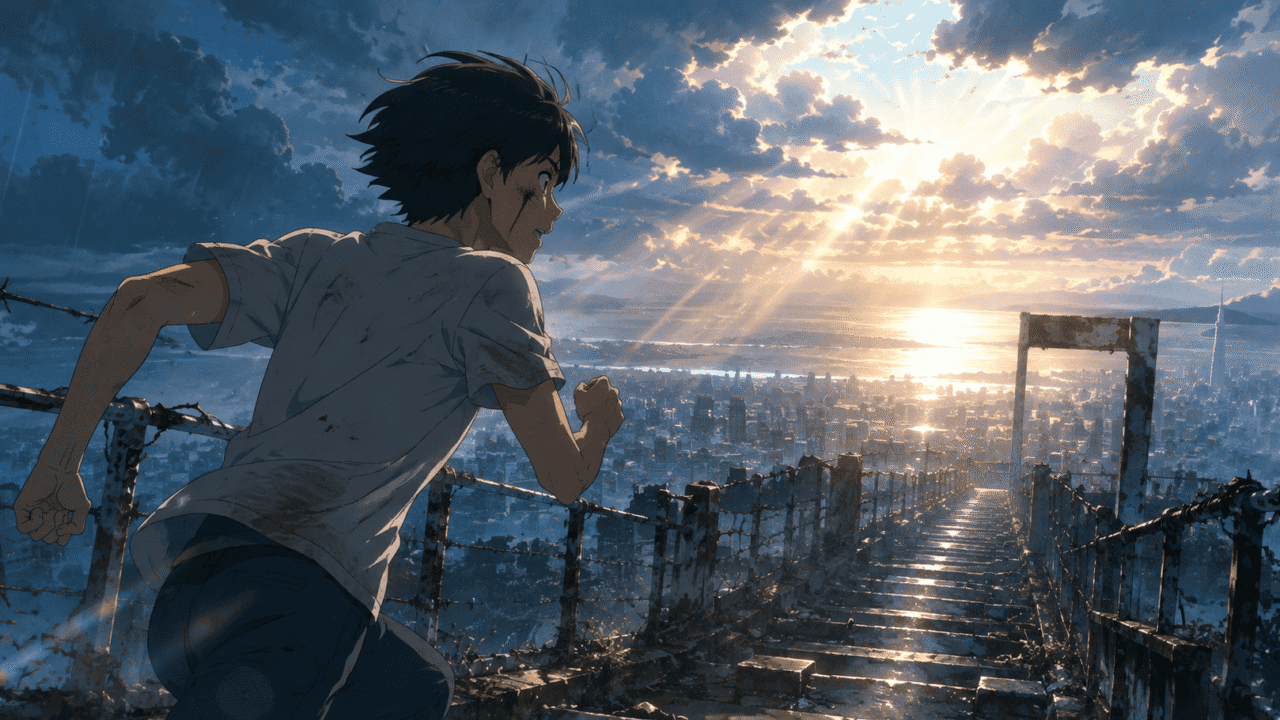
In previous articles, we explored the hidden lore of the “Weather Maidens” and decoded the true, psychological meaning behind the film’s controversial final line: “We’re gonna be OK!” For this deep dive, I want to focus on the emotional climax of Makoto Shinkai’s Weathering With You (Official Website): Hodaka’s desperate, breathless run across Tokyo.
Specifically, I want to analyze a very specific visual detail: why did Hodaka suffer a deep, bleeding gash on his left cheek from the barbed wire during his final sprint? On a surface level, it is clearly an “expression of physical desperation.” However, in animation, every frame is a deliberate choice. Let’s let the wings of our imagination fly a little further. Why was this specific injury so necessary for the narrative?
For a comprehensive breakdown of the entire film, including the true power of the “Weather Maiden” and the ending explained, please refer to our ultimate guide: “Weathering With You Synopsis & Analysis“.
*This is a translated version. The original (Japanese) is available here.
- Self-Transformation Symbolized by “Nakedness” in Run, Melos!
In the classic Japanese story, Melos initially operates strictly by his “own moral rules.” However, after surviving extreme psychological setbacks and pushing his body past its limits, he truly begins to run for the sake of someone else. This profound spiritual shift is emphasized by the bold, physical metaphor of him becoming completely “naked.” - Hodaka’s “Facial Scar” Symbolizes Absolute Devotion to Another
Similar to Melos, Hodaka lived his life in Tokyo entirely by his “own selfish rules.” But after witnessing Hina’s devastating act of self-sacrifice, his worldview shatters. For the first time in his life, he begins to run truly, completely for the sake of another human being. The permanent, visible symbol of this spiritual transformation is the “scar on his left cheek.”
On this pageContents
Weathering With You (2019): The Evolution of Hodaka’s Purpose

To fully understand the narrative weight of Hodaka’s facial injury, we must draw an auxiliary line to one of the most famous pieces of Japanese literature: the story of the “running man,” Run, Melos!
Melos Ran Harder Than Hodaka—and Ended Up Naked
For those unfamiliar, Run, Melos! (Hashire Merosu) is a legendary, slightly bizarre short story penned by the iconic Osamu Dazai.
The protagonist, Melos, visits a town for his younger sister’s wedding. Driven by sudden, fiery righteous indignation upon hearing of the local tyrant King Dionysus’s cruelty, Melos impulsively attempts to assassinate him. He fails miserably and is sentenced to death. However, Melos negotiates a three-day grace period to attend his sister’s wedding by offering his best friend, Selinuntius, as a hostage to be executed in his place if he fails to return.
Melos attends the wedding but encounters a series of horrific, agonizing obstacles on his journey back to save his friend. Exhausted, beaten, and broken, Melos actually contemplates giving up and letting his friend die. However, after drinking from a miraculous spring, his spirit is revived. He embarks on his final, desperate sprint to save Selinuntius. His running is so impossibly fierce and violent that his clothes are ripped away, and he arrives at the execution grounds completely stark naked.
He arrives just in time, saves his friend, and the sheer power of their mutual trust moves the tyrant King to tears, changing his heart. A young girl blushes and hands the newly minted hero a cloak, prompting Melos to finally realize he is naked, and he blushes in return.
While Dazai’s brilliant prose makes the story a masterpiece, we must ask a vital structural question: Why did Dazai deliberately make his hero naked at the climax? Of course, it is an “expression of physical desperation,” but the metaphor runs much deeper.
Partially, it serves as a comedic grounding tool for the ending. Let’s not forget: Melos is a bit of a maniac. He attempted a doomed assassination and callously offered his best friend’s life as collateral just so he could go to a wedding. The final “blushing” joke serves to pull the mythological “hero” Melos back down to earth, reminding the audience he is just a flawed, silly human.
However, the primary reason Melos is stripped naked is to physically represent a fundamental, permanent shift in his behavioral principles.
Yes, Melos ran to save his friend. But fundamentally, if he had failed the assassination, he should have just accepted his execution. Taking a friend hostage with a straight face is insane. This happened because, up until that point, “Melos” only cared about “Melos.” Attempting the assassination, demanding to go to the wedding, gambling his friend’s life—these actions were entirely dictated by his “own selfish rules.” He had absolute, unwavering belief in his own ego.
But when he encountered impossible obstacles on the road and actually considered letting his friend die, Melos was betrayed by his own ego for the very first time. For a man who believed in his own righteousness above all else, realizing his own cowardice was ego-shattering. But that realization changed him.
The revived Melos who sprints the final stretch is no longer running for “his own rules” or his own ego. He has finally, truly started running “for the sake of someone else.” This profound destruction of the ego and the birth of true altruism is brilliantly emphasized by the bold metaphor of becoming completely “naked.”
When a human being who has only ever operated on self-centered “personal rules” finally decides to sacrifice themselves entirely for another, that spiritual shift manifests externally—often in the form of “wounds” or “nakedness.” It is the ultimate symbol of self-transformation.
While I intended to write about Hodaka’s scar, the detour into Melos provides the perfect blueprint. Ultimately, what I am arguing is that “Melos becoming naked” and “Hodaka getting his face slashed open” serve the exact same narrative purpose.
Hodaka Ran for Someone Else for the Very First Time
From the moment the film begins, Hodaka’s journey is inherently a “journey for himself.” (To be fair, a runaway teenager’s journey is rarely anything else). In Hodaka’s case, he was desperately running away from his hometown to find “somewhere that isn’t here.” For the first time in his life, Hodaka was living entirely by his “own rules.” It was a miserable, starving existence, but he actively chose to suffer under his own rules rather than live peacefully under the oppressive rules of his parents and society.
Throughout the first half of the film, Hodaka’s actions are entirely ego-driven. Even when he “saves” Hina from the club scouts for the first time, he isn’t truly doing it “for Hina.” He is doing it because his “own internal justice” dictated that a girl shouldn’t be harassed. When he accidentally fires the gun, it isn’t a calculated move to protect her; it is a raw, impulsive act of revenge against the man who humiliated him.
The pattern continues. When he discovers Hina’s power as a “Weather Maiden,” his idea to monetize it into a business isn’t born from a desire to save her from poverty. In fact, he only learns about her dire family circumstances after he pitches the business idea. At his core, Hodaka is still a runaway living purely for his own survival.
But then, the climax shatters him.
It was Hina who fundamentally rewired Hodaka’s soul. She quietly sacrificed her own existence to return the blue sky to Tokyo, choosing the world over herself. Witnessing this absolute, terrifying act of “altruism,” Hodaka’s behavioral principles undergo a violent paradigm shift.
During his final, desperate sprint across the train tracks and up the stairs of the abandoned building, Hodaka is no longer running for himself. He isn’t running for his ego, his freedom, or his “own rules.” For the first time in his life, he is running entirely, unconditionally for the sake of Hina.
That profound, irreversible transformation of his inner self is violently etched onto his physical body as the “scar on his left cheek.” It is the bloody proof that the selfish runaway boy has died, and a man willing to sacrifice the world for love has been born.
Appendix: The Tears of Ashitaka

While I used the literary classic Run, Melos! as the primary auxiliary line to explain Hodaka’s physical wounds, there is another legendary anime character who undergoes a “decisive, visible shift in their way of life” in a remarkably similar fashion: Ashitaka from Hayao Miyazaki’s Princess Mononoke.
In Princess Mononoke, Ashitaka acts heroically to save his village, yet is cursed with a rotting arm and permanently banished from his home. Forced into exile, he embarks on a lonely, agonizing quest to find a cure for the curse slowly eating him alive. The entire first half of Ashitaka’s journey is fundamentally a journey to “save himself.”
However, when he finally encounters the “Forest Spirit” (Shishigami)—the god he desperately hoped would cure him—the entity heals his gunshot wound but entirely ignores his deadly curse. In the quiet despair of that moonlight, realizing he is truly doomed to die, Ashitaka sheds a single, silent tear.
Before and after those tears, Ashitaka’s behavioral principles completely invert. Before the tears, he was fighting to cure his own curse. After the tears, having accepted his own fate, he dedicates the remainder of his fading life entirely to protecting San (Princess Mononoke) and stopping the war.
Viewed through this analytical lens, Ashitaka’s quiet tears serve the exact same narrative function as Hodaka’s bloody cheek and Melos’s nakedness: they are the physical manifestation of a soul finally learning to live for someone else.



Reader Comments