Released on March 3, 2007, 5 Centimeters per Second (Official Website) is a breathtaking animated feature film directed by the visionary Makoto Shinkai. Serving as his third major theatrical work—following the sci-fi epics Voices of a Distant Star and The Place Promised in Our Early Days—this film marked a radical departure for the director. He entirely stripped away the science fiction and fantasy elements, opting instead for a raw, agonizingly grounded look at human romance and the passage of time.
The film is presented as an anthology of three interconnected short stories: “Oukasho” (Cherry Blossom), “Cosmonaut,” and “5 Centimeters per Second.” All three orbit the life of a single protagonist, Takaki Tono. Interestingly, within the anime community, you rarely hear someone say they “happily love” 5 Centimeters per Second; instead, it is infamous for leaving viewers emotionally devastated. But what kind of story is it, really? Is it truly just a tragedy?
*This is a translated version. The original (Japanese) is available here.
- Detailed Synopsis and Character Map
A brief summary of the film’s core tragedy: “Clinging desperately to the pure feelings of their youth, Takaki Tono and Akari Shinohara find themselves ruthlessly separated by time and physical distance. As they grow older and drift down separate paths, they are haunted by lingering memories. A fairy-tale reunion never materializes, and they are forced to walk toward separate, isolated futures.” This article provides a meticulous scene-by-scene breakdown and a character map. - Reframing the Narrative: Analysis Points
We will challenge the film’s “depressing” reputation by exploring key thematic points, such as “The Crucial Opening Scene of the Third Episode” and “The True Speed Indicated by ‘5 Centimeters per Second,'” linking to our deeper psychological breakdowns.
On this pageContents
5 Centimeters per Second (2007) Full Synopsis (Spoilers Ahead)

A Quick Summary and Character Map
If you need a rapid refresher, here are the essential milestones that define 5 Centimeters per Second:
- The overarching narrative belongs to Takaki Tono. The film is sliced into three distinct eras of his life: “Oukasho,” “Cosmonaut,” and “5 Centimeters per Second.”
- “Oukasho” chronicles Takaki’s middle school years, depicting his intense, pure love for Akari Shinohara and the heartbreaking reality of their physical separation.
- “Cosmonaut” shifts the perspective to Kanae Sumida, a high school girl harboring a desperate, one-sided crush on Takaki after he relocates to the island of Tanegashima. Though her romance fails, she experiences profound personal growth.
- “5 Centimeters per Second” fast-forwards to Takaki’s bleak adulthood in Tokyo. It captures his quiet psychological collapse, culminating in his decision to quit a soul-crushing corporate job to become a freelancer.
- The entire film is draped in a suffocatingly beautiful, melancholic atmosphere.
Character Map
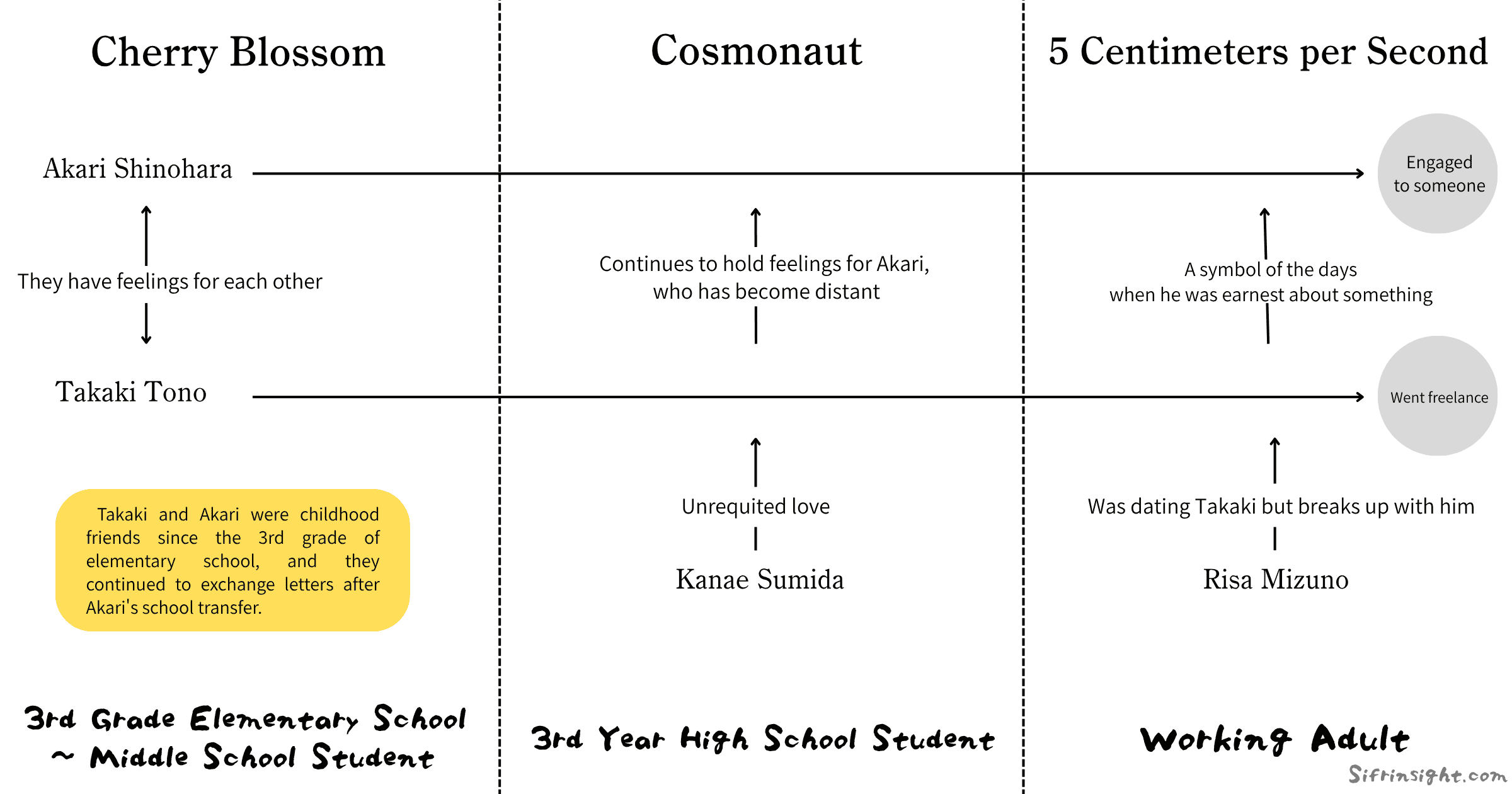
In the character map above, Takaki’s lingering feelings for Akari in the third act are labeled as “A symbol of the days when he was earnest about something.” This is a crucial analytical distinction. On a surface level, it looks like he is tragically hung up on his ex-girlfriend. However, if we read the subtext, it is far more accurate to view Akari as a “symbol of uncorrupted passion” for a burnt-out adult Takaki who feels a suffocating “unease” about his hollow life. She represents his lost innocence, not just a lost romance.
Story Explanation: Beyond the Melancholy
From the opening frame to the closing credits (which actually chronologically loops back to the start of the final act), 5 Centimeters per Second relentlessly focuses on what society deems “negative” states of being: profound loss, unattainable desires, and agonizing dissatisfaction with one’s present reality.
Because of this, the anime community almost universally brands it as a “depressing masterpiece.” However, if you look closely, all three short stories actually depict a painful but necessary preparatory period for a massive leap forward in life. Slapping it with the “depressing” label drastically oversimplifies Shinkai’s vision.
The ultimate, redemptive truth of the film is that Takaki Tono, after enduring years of hollow corporate misery, finally breaks his own chains to become a freelance developer. This narrative arc is an undeniable, direct reflection of Makoto Shinkai’s own life journey, making the film a powerful message of solidarity for anyone currently suffering through their own “unfulfilling days.”
To understand the film, you must understand the director. After graduating from university in 1996, Makoto Shinkai joined the video game company Nihon Falcom. He ground through the corporate gears until 2001, when he finally quit to pursue his own art. Just one year later, he released his groundbreaking solo indie project, Voices of a Distant Star (2002).
If you are currently trapped in a gloomy, stagnant chapter of your life, perhaps it is simply the pressure building before your great leap forward. When you filter the film through this hidden, autobiographical message, the somber atmosphere of 5 Centimeters per Second suddenly feels much more inspiring.
With that psychological framework established, let’s step onto the train tracks and recount the detailed synopsis.
The cinematic journey begins on a breathtaking spring day. A young girl’s voice cuts through the air, explaining a piece of poetic trivia: “Five centimeters per second… that’s the speed at which cherry blossom petals fall.” A boy sprints after her. He catches up to her at a railroad crossing, but the descending barriers and passing train abruptly separate them. Standing on the opposite side, opening a cherry-blossom-pink umbrella, the girl smiles and calls out, “It would be nice if we could watch the cherry blossoms together again next year, wouldn’t it?” In that fleeting moment, the girl herself was as ephemeral and beautiful as a falling blossom.
Detailed Synopsis
Episode 1: Oukasho (Cherry Blossom)
The protagonist is a middle school boy named Takaki Tono. Living in the urban sprawl of Tokyo, his lifeline is the handwritten letters he receives from his childhood friend, Akari Shinohara, who relocated to the snowy prefecture of Tochigi. The two have shared a profound soulmate connection since elementary school but haven’t seen each other since graduation. Her letters carry a wistful nostalgia for Tokyo, but reading between the lines, it is a desperate nostalgia for Takaki himself. Through her ink, Takaki clings to the ghost of his “unforgettable days.”
The clock is ticking: Takaki is scheduled to transfer to a remote school in Kagoshima, at the southernmost tip of Japan. Realizing the physical distance between them is about to become insurmountable, the two arrange to meet in person one last time. On the fateful day, Takaki skips his club activities and boards a train heading north. However, as if the universe itself is conspiring to tear them apart, a massive, historic snowstorm paralyzes the railway system.
Trapped in freezing, delayed train cars for hours, Takaki is pushed to the brink of despair. To make matters worse, stepping onto a transfer platform, a violent gust of wind rips the heartfelt letter he intended to give her from his grasp, carrying it away into the blizzard.
It is vital to analyze why Shinkai included the “lost letter” sequence. On the surface, it provides Takaki with an emotional scapegoat: “My failure to convey my true feelings wasn’t my fault; it was the wind’s fault.” But we must remember that our protagonist is just a scared middle school boy. He subconsciously wants to blame the impending tragedy on an external force, because deep down in his soul, he is already hyper-aware of the inescapable separation that awaits them.
Stripped of his letter and running hours behind schedule, Takaki pushes forward. This is 1995—an era without smartphones or instant messaging. He cannot text her to say he is late. He has no choice but to blindly trust that she will wait.
Finally, deep into the dead of night, Takaki arrives at the desolate, freezing station. And there, sitting alone by a small stove, Akari is waiting.
Watching the film as an adult, one has to ask: Takaki arrives at around 11:15 PM. Even in the 90s, a lone middle school girl waiting in a train station waiting room for hours would have absolutely been questioned by the station attendant and sent home to her parents long before midnight. We just have to assume the station master was a hopeless romantic who played along with the narrative.
In the quiet intimacy of the closed station, Takaki and Akari share the homemade bento she prepared. With the trains shut down for the night, they step out into the snow. They wander until they find themselves standing beneath a massive, barren cherry tree. Stripped of its leaves by the winter, the tree still feels miraculously in full bloom to the two young lovers.
Beneath its branches, they share their first kiss. It is an achingly beautiful moment, but it also acts as a devastating catalyst. Feeling the physical warmth of Akari’s lips, Takaki is instantly crushed by the cold realization that the massive physical distance of their impending futures will eventually steal that warmth away forever. He is a child; he is entirely powerless against the currents of adult life.
Seeking shelter from the blizzard, they spend the night wrapped in blankets inside a small wooden barn near the field.
Logistically speaking, surviving a severe winter blizzard inside an unheated, drafty wooden shed with nothing but a blanket is practically a death sentence. Yet, Shinkai isolates them in a “barn.” What they desperately required in that moment was a private universe completely severed from reality—a sanctuary to hide from the cruel outside world. To put it bluntly, it functioned as a private, chaste love hotel for two tragic souls. One can only imagine the quiet, heartbreaking conversations that filled that night.
The next morning, the storm clears. They stand on the platform, saying their final goodbyes. Akari, wearing a bravely anxious smile, tells him, “Takaki, I’m sure you’ll be okay from now on. Absolutely!” In stark contrast to her maturity, Takaki is paralyzed. All he can manage to choke out is, “Thank you. You take care too, Akari. I’ll write to you.”
As the train doors close and pull Takaki away, we see that Akari’s hands are clutching her own un-delivered letter. Just like Takaki, she sensed the absolute finality of their story and chose to withhold her words.
Staring out the window of the departing train, Takaki makes a fierce, silent vow: “I strongly wished for the strength to protect her.” At that exact moment, the chapter of their childhood decisively closes.
Episode 2: Cosmonaut
The narrative jumps forward to high school, shifting focus to Kanae Sumida, a third-year student living on the island of Tanegashima. Her life revolves around two pillars: surfing (a passion she picked up from her older sister), and a quiet, brooding boy from Tokyo named Takaki Tono.
Kanae forces herself to wake up at the crack of dawn to surf. However, the waves are just a convenient alibi; her true goal is to “accidentally” run into Takaki, who arrives at school early for solo archery practice.
It is the season for high school seniors to submit their future career path forms, but Kanae is paralyzed by indecision. Her profound existential anxiety physically manifests in her surfing—she finds herself completely unable to stand up on her board and catch a wave.
Driven by her desperate, one-sided love, Kanae orchestrates her entire day just to secure the ride home with him.
During a flashback detailing Kanae’s crush, we learn she fell for Takaki the second he transferred to her middle school. Desperate to follow him, she studied obsessively to get accepted into his high school. During this montage, she is shown downing massive quantities of Estaron Mocha (caffeine pills). While we respect the hustle, a middle schooler mainlining caffeine supplements is deeply concerning! But hey, it got the job done.
Kanae successfully engineers their daily commute. Simply riding her scooter down the rural roads alongside Takaki feels like magic to her. But there is a glaring, painful disconnect: whenever she looks away, Takaki pulls out his flip-phone and types messages into the void. Kanae is consumed by jealousy, wondering who the girl on the other end of the screen is, but she lacks the courage to ask.
Trapped in this hazy, suffocating limbo, Kanae remains the only student in her grade who hasn’t submitted her career form. Failing at surfing and failing at love, she blames herself for being “half-hearted” at everything.
One afternoon, her carefully crafted routine shatters when Takaki isn’t at the scooter shed. She eventually spots his moped parked on a grassy hill overlooking the ocean. Approaching him, she finds him staring intently at his phone screen again. Desperate to bridge the gap, Kanae confesses her terrifying anxiety about the future. To her shock, the seemingly stoic Takaki admits that he is just as lost and terrified as she is. This rare moment of vulnerability brings her immense relief.
Up until this emotional climax on the hill, the entire act has been narrated by Kanae. But here, the monologue seamlessly shifts back to Takaki. Living near the JAXA space center, Takaki is obsessed with space exploration. He gazes at the rockets, perfectly overlaying the terrifying “endlessness” of the dark cosmos with the terrifying vastness of his own unwritten future. From this point on, Takaki reclaims his role as the true protagonist.
The brutal truth is revealed to the audience: the text messages that so deeply tormented Kanae had no recipient. Takaki had been typing emails to an empty address field night after night. They weren’t letters to a secret girlfriend; they were a diary of his soul. He was drafting a novel of his own internal despair.
Takaki and Kanae are drowning in the exact same existential frustration. However, Kanae is the one who breaks the surface first. By finally accepting and rationalizing her own “hesitation,” she frees her mind, and miraculously regains her ability to surf.
While Kanae evolves, Takaki remains frozen in his melancholic shell. Empowered by her triumph on the waves, Kanae finally resolves to confess her love to him. But as they walk together, his gentle, distant demeanor remains entirely unchanged. She bursts into tears. In that heartbreaking moment, she realizes the truth: Takaki is stagnant, her feelings will never reach the core of his heart, and most importantly, she has outgrown him.
As if to punctuate her revelation, a colossal NASDA rocket violently splits the sky, soaring into the dark unknown. The two teenagers are now locked onto completely divergent trajectories in life.
Kanae concludes, “Takaki had never even been looking at me from the start.” While tragic, it is her final acceptance. Takaki has transitioned from a future prospect to a bittersweet chapter of her past. Crying in her bed that night, she performs the ultimate act of emotional closure, whispering to herself that she will always cherish the love she felt for him.
Episode 3: 5 Centimeters per Second
The timeline jumps to a bleak, modern Tokyo. Takaki Tono is an adult, working as a programmer. The cherry blossoms are falling. Lured by the gentle spring breeze, he steps out for a walk. At a train crossing, he passes a woman. His soul instantly recognizes her, and he turns around. She turns as well. But before their eyes can meet, two massive trains roar past, obstructing the view. The scene cuts, and a flood of memories washes over the screen.
We see the brutal reality of Takaki’s adult life. After graduating and securing a job in Tokyo, his existence has become hollow. He grinds away in the corporate machine, coding endlessly, but the corporate logic suffocates his spirit. As his career drains his soul, his relationship with his live-in girlfriend completely disintegrates. Takaki is trapped in a suffocating quagmire of depression.
In stark, bright contrast, Akari Shinohara is happily preparing for her upcoming wedding to another man. While visiting her parents’ home in Tokyo, she stumbles across the old, undelivered letter she wrote to Takaki in middle school. Holding the paper, she is briefly transported back to the memory of that snowy night.
Meanwhile, Takaki’s girlfriend delivers the final, crushing blow, officially breaking up with him via text message.
The devastating breakup text reads: “Even though we exchanged 1,000 emails, our hearts only moved about 1 centimeter closer.” It is such an outrageously literary, poetic breakup text that I genuinely have to laugh. Takaki’s subsequent internal monologue is equally poetic, making me want to yell at the screen: “If you two can write prose like that, you should be writing novels instead of coding!”
Sitting in his dark apartment, Takaki reflects on the four grueling years he has spent in the workforce. He had been driven by a vague, obsessive compulsion to simply “move forward” and grasp something unreachable. But the result was a stagnant, soul-crushing routine of merely “getting through the day.” Realizing that the passionate fire of his youth has completely died, Takaki makes a radical, life-altering decision: he quits his corporate job.
Akari steps forward into a new life through marriage, while Takaki steps forward into a new life by reclaiming his freedom as a freelancer. The harsh, freezing winter of their youth has finally thawed into a gentle spring.
We return to the climax at the railroad crossing. Takaki turns to look at the woman he knows is Akari. The trains roar past. When the tracks finally clear, the woman is gone. She didn’t wait.
A brief, quiet shadow of loneliness washes over Takaki’s face. Then, he smiles. He turns his back to the crossing and takes a powerful, resolute step forward into his new life.
5 Centimeters per Second (2007) Analysis: Reframing the Tragedy

Now that we have unpacked the narrative, I want to shatter the illusion that this is a depressing movie. To truly understand the brilliance of 5 Centimeters per Second, we must focus on two critical elements: the chronological trick of the final scene, and the philosophical metaphor hidden in the title’s speed.
The Crucial Chronology of the Final Crossing
At the climax of the film, as the trains roar past the crossing, Masayoshi Yamazaki’s devastatingly beautiful ballad, “One more time, One more chance,” floods the soundtrack.
Loading video...
Because the lyrics of the song plead, “I’m always searching for you somewhere…”, the audience is psychologically manipulated into believing that adult Takaki is still desperately, pathetically chasing the ghost of Akari. When juxtaposed with the montage of Akari happily moving on with her fiancé, it leaves viewers feeling hollow and heartbroken for the protagonist.
But you are being tricked by the music. You must look at the timeline.
The absolute key to understanding this film is realizing that the opening scene of the third episode and the final scene of the movie are the exact same moment.
The film deliberately misleads you. The crushing depression, the breakup text, the grueling corporate job—all of those scenes are flashbacks of the recent past. The moment Takaki steps out into the spring breeze at the railroad crossing represents the “present day”—after he has already quit his job, escaped his depression, and become a freelancer.
When he turns around at the crossing and sees she is gone, he doesn’t break down crying. He smiles and walks away. That single, confident step proves he is no longer chained to the past. If you keep the timeline straight, you realize that 5 Centimeters per Second is the ultimate story of moving on.
What Speed is “5 Centimeters per Second”, Really?
Finally, we must decode the title. We are explicitly told in the opening line that “5 centimeters per second” is the terminal velocity of a falling cherry blossom petal. But it is also the title of the third and final act. Therefore, the speed must carry a secondary, thematic meaning tied to Takaki’s adulthood.
If you convert 5 centimeters per second, it equates to moving roughly three meters per minute. If a human being was walking at that speed, they would look like they were standing completely still. It looks identical to stagnation.
But they are not standing still. They are moving forward.
I explore this life-affirming metaphor in much greater detail in my companion piece.
Read the full deep-dive: Why 5 Centimeters per Second is Actually a Story of Triumph
I highly encourage you to rewatch the film through this positive lens and see how beautifully the pieces fall into place.