
Hideaki Anno’s Neon Genesis Evangelion aired from 1995 to 1996. Set in Japan, it follows Shinji Ikari and NERV in their battles against the mysterious beings called Angels, and remains one of Japanese animation’s great works. Part of its appeal, I think, lies in the mysteries and codes scattered through the story. Much is difficult to grasp on a first viewing, but the efforts of many enthusiasts now help us get an overview of the Evangelion world.
Yoshiyuki Tomino’s Mobile Suit Gundam, meanwhile, aired from 1979 to 1980. Earth has been unified under the Earth Federation, and humanity has settled the Moon and space colonies. The Side 3 colonies declare independence and war on the Federation. Caught up in the fighting, Amuro Ray pilots the Gundam and survives the One Year War with the crew of White Base.
By tracing the parallels between these two series, I want to reconsider the famous final television episode of Neon Genesis Evangelion.
*This is a translated version. The original (Japanese) is available here.
- The Protagonist of the Story and the Protagonist of the World
In both Gundam and Evangelion, the main character stands at the center of the story without standing at the center of his world. I see that distinction as a source of their breadth and depth. - Shinji and Amuro’s Different Inner Lives
Amuro is strongly aware that he is needed, whereas Shinji feels he is an “unnecessary person.” That suffering shapes the meaning of otherwise similar events. - Reconsidering Evangelion’s TV Finale
I read the finale of Evangelion as the culmination of Shinji’s story: can he affirm his own existence? Within the modern reality the series depicts, a conventional resolution is hard to find; it closes instead with words of congratulation. - Why Evangelion Differs from Gundam
In Gundam, Amuro grows and discovers something new amid the fighting. In Evangelion, Shinji struggles to do so despite the upheaval around him. I connect that difference with Evangelion‘s unusual ending.
On this pageContents
Parallels Between the Two Series
Anyone who has seen both series will probably recognize a few parallels in their stories. For example:
- The protagonist pilots a “robot” made through a project in which his father was involved.
- He plays an active part in the fighting,
- suffers, and at times comes close to losing himself,
- tries to escape his situation,
- but ultimately returns to protect everyone.
- Later, he encounters someone in battle with whom he forms a close connection,
- only to end up killing that person.
There are other parallels, but these are the broad outlines. If we limit ourselves to the television series, I do not think their relationships with their parents are especially similar. And even where the events resemble one another, their meaning—particularly for Shinji and Amuro—is quite different. I will return to that difference, but first I want to consider a more important similarity.
Amuro’s Place in the World of Gundam
One answer to what makes Mobile Suit Gundam interesting is its world. Amuro’s actions help enormously in bringing the One Year War to an end, but the decisive factor is the Federation’s victory through superior material resources.
In other words, Amuro is certainly the protagonist of the story, but not the protagonist of the world.
Much the same is true of the other characters. Without being the world’s protagonists, they can only do their best to live within it. Degwin Zabi nearly assumes that position, and Gihren Zabi tries to, but both meet disastrous ends.
Shinji’s Place in Evangelion
Like Amuro in Gundam, Shinji Ikari is the protagonist of his story, but not the protagonist of its world.
That relationship gives the world breadth and depth, making both series compelling. Evangelion also presents mysteries, which lend it particular force. What on earth is the Human Instrumentality Project, anyway?
As the story develops, our attention shifts from Shinji’s suffering and growth toward the world’s secrets. By the finale, we want a full account of the Human Instrumentality Project and an explanation of Gendo Ikari’s purpose.
Perhaps our dissatisfaction arises from that gap between the protagonist of the world and the protagonist of the story. We want the world’s mysteries resolved, but the ending concerns Shinji.
After considering that dissatisfaction, I want to look again at the finale. If it is the culmination of Shinji’s story rather than an explanation of the world’s secrets, what is his story?
Reconsidering the TV Finale: “Congratulations”
One line seems impossible to overlook in the finale of Evangelion: “I am allowed to be here“—Boku wa koko ni ite mo ii n da. At the end of Gundam, Amuro says something that sounds similar but means something quite different: “I still have a place to return to. There’s nothing that could make me happier.”
The difference between those lines reveals something of Shinji’s fundamental suffering. It also helps explain why the apparently similar events listed above mean different things to the two boys.
Both leave their bases: Shinji runs away from NERV, and Amuro from White Base. But Amuro’s response is, in effect, “I can’t stay in a place like this!” He is acutely aware that he is needed, even when those around him try hard to deny it. Shinji’s feeling is not “I can’t stay here,” but “I really am unnecessary.”
The deaths of the people they connect with are different, too. In Gundam, Amuro’s line “Lalah would understand, right?” suggests that he has found some way to make sense of Lalah’s death. Shinji, by contrast, has no time to come to terms with Kaworu’s death: episodes 25 and 26 follow immediately.
Amuro is also given opportunities to move beyond his mother and father; Shinji is not. Or rather, he is not even allowed to reach that stage—a little praise from Gendo is enough to satisfy him.
What does it mean that events so similar on the surface are so different in the characters’ inner lives?
Perhaps Evangelion is, in some sense, an answer to Mobile Suit Gundam. Both are stories of boys caught in war or turmoil. Amuro grows and discovers something new through that experience. But the television series, as I read it, depicts young people in the present day facing circumstances so difficult that they cannot discover anything new, even amid the upheaval of an Angel attack.
Seen that way, Shinji’s story could end only as it did. It is a possible answer to Gundam: try to tell that kind of story in the present, and it becomes impossible to bring it to a conventional close.
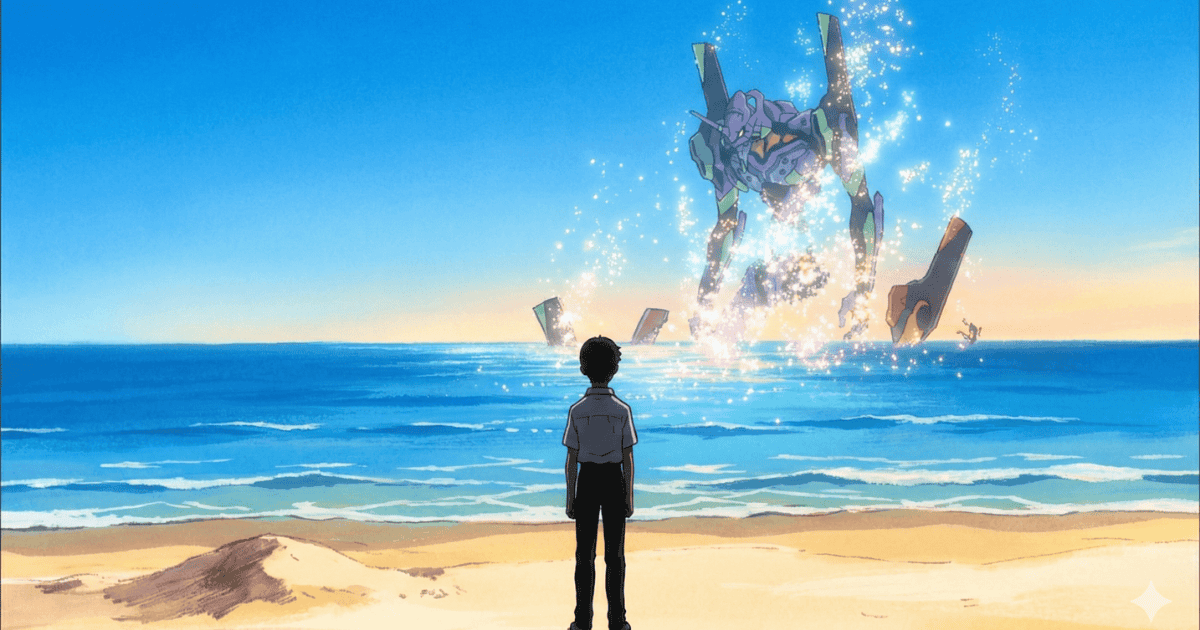
Even so, to end with “Thank you, Father. Goodbye, Mother. And to all the Children, congratulations!” now strikes me as the creators’ attempt to offer something to their audience despite everything.
To summarize this analysis:
The difference between a story’s protagonist and its world’s protagonist gives Evangelion depth and makes it compelling. But our attention turns toward that wider world, leaving us dissatisfied when the finale does not solve its mysteries. Meanwhile, I do not see a resolution that fits the modern reality of Shinji’s suffocating circumstances. Perhaps all the series could do was close his story with a blessing: “Congratulations!”
That is how I read it, at least. People living today may find it easier to see themselves in Shinji.
A Final Thought: The Story and Its World
I have spoken at length about how Evangelion‘s story and world have different protagonists. Shinji is the story’s protagonist; for me, Gendo is the world’s. I see The End of Evangelion as an all-out confrontation between those two protagonists. That is something to consider another time.
Read more: Is Evangelion the Origin of the “Sekai-kei” Genre?
Appendix: A More Skeptical Reading
I have tried to read the television ending of Evangelion as positively as I can. Yet I am tempted by a more skeptical reading. Shinji “miraculously” arrives at the affirmation “I am allowed to be here,” but the process looks rather cruel to me.
In the final episode, Shinji voices what he really feels:
“The reason I mustn’t run away is because if I do, I’ll be abandoned! I’m terrified of being abandoned! Don’t abandon me! Please, don’t abandon me! But no one will ever accept me for who I am anyway! And I hate myself for it!”
But the other characters respond to him with:
“You’re not the only one who’s suffering! You don’t do anything because you’re afraid of getting hurt, right? You say no one will accept you, but you’re just convincing yourself of that, aren’t you? You think everyone hates you, but in the end, that’s just something you’ve made up in your own head, right?”
I hear a wholesale denial of his suffering: in effect, “Your suffering is your own fault.” Then, just before he arrives at “I am allowed to be here,” he is told:
“You are the one who perceives reality as bad and unpleasant—it’s your own heart. It’s your heart that’s replacing reality with your own subjective truth. Just a slight change in the angle you view reality from, the box you put it in, can drastically change the shape of your heart. You’re simply not used to being liked by people.”
The words may sound a little gentler, but to me the message is still: “You are to blame.”
Immediately afterward, his thinking changes at full throttle: “I am allowed to be here!” And everyone tells him, “Congratulations.”
To deny someone so thoroughly, then congratulate him the moment his thinking shifts—doesn’t that amount to bleaching his personality clean? It almost feels as though someone has thrown up their hands: “There’s no way to save Shinji except to bleach him clean!” Given the period in which it aired, the scene also brings the Aum Shinrikyo affair to my mind.
Thinking along those lines is not pleasant, so I generally choose the reading that sees the ending as the creators’ generosity. That may sound ironic after what I have just written, but I mean it sincerely: I think the television ending is wonderful. The more skeptical view belongs in an appendix precisely because it makes me uncomfortable.





Reader Comments