
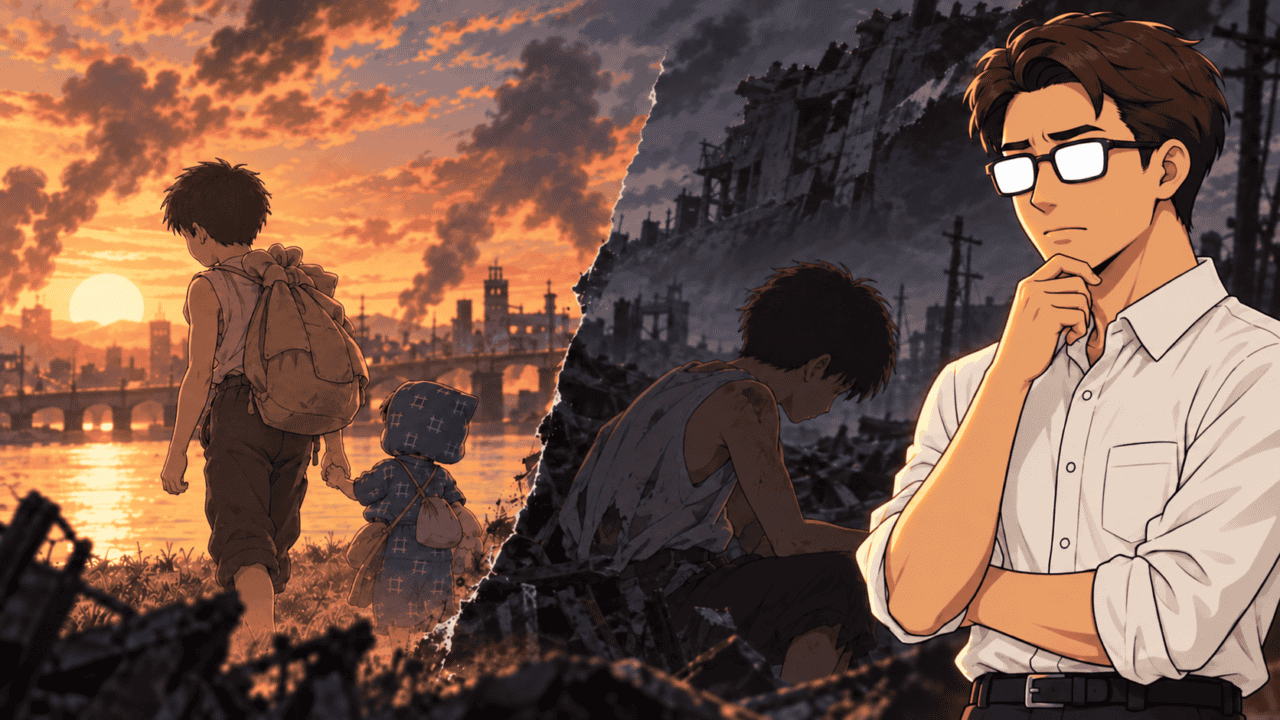
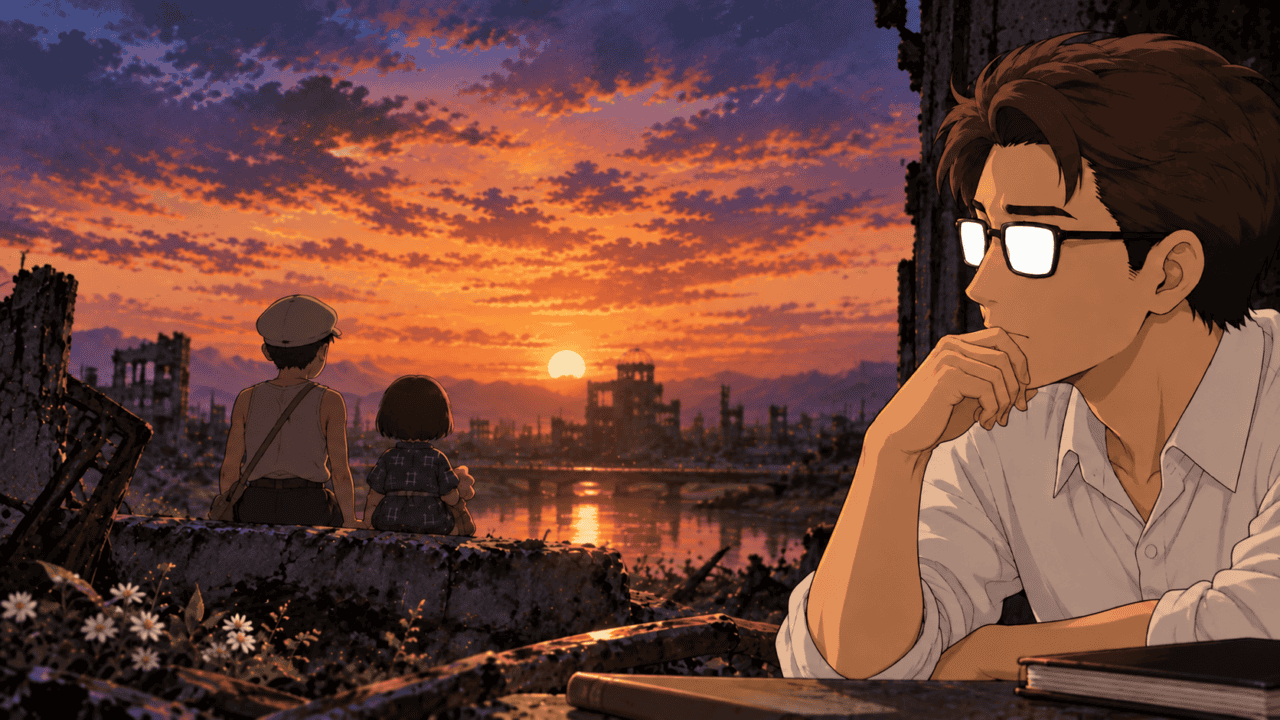
Isao Takahata’s Grave of the Fireflies(Studio Ghibli Official) was released in 1988. Based on Akiyuki Nosaka’s novel, it follows Seita and his younger sister, Setsuko, during the final months of the Pacific War and its aftermath.
Their mother dies after an air raid, and they lose contact with their father, a naval lieutenant. Setsuko eventually dies from malnutrition, and Seita dies about a month later. The ending is so painful that I think the film has become one people watch once and never return to.
It also leaves many of us wanting to blame Seita for Setsuko’s death.
After falling out with the aunt who has taken them in, Seita moves with Setsuko into a shelter—partly in a tit-for-tat response to her hostility. When their struggle to survive ends in Setsuko’s malnutrition, it is understandable to think, “Just apologize to your aunt!“
I want to give Seita a little more consideration. I do not think this changes the fact that his decisions lead Setsuko towards death. My main point, though, is that Grave of the Fireflies is worth watching twice. Three times is not necessary.
*This is a translated version. The original (Japanese) is available here.
Let me explain what I mean.
-
Seita Begins as a Capable Boy
He looks after Setsuko for their mother and prepares for the air raid by burying rice and pickled plums. Amid the confusion, he shows responsibility and resourcefulness. -
The Wounds Left by His Mother’s Death
The air raid and the sight of his mother’s body being treated as an object seem more than a fourteen-year-old could bear. I read his later inability to do much beyond caring for Setsuko in the light of those experiences. -
A Parallel with Shinji Ikari
In the Neon Genesis Evangelion TV series, Shinji is a boy who keeps trying. The older theatrical ending leaves a very different impression. Seita, too, can look markedly different at the beginning and end of his story. -
What a Second Viewing Might Reveal
Setsuko’s death dominates our memory of the film. Returning to the beginning may help us notice both the capable, caring boy Seita was and the wounds behind his later behaviour.
On this pageContents
Grave of the Fireflies (1988): Seita’s Transformation and Unseen Wounds
Comparing Seita’s early actions with his later withdrawal offers a way to consider what the air raid and his mother’s death have done to him.
Seita Before He Reaches His Aunt’s House
After watching Grave of the Fireflies, we may be left with impressions of Seita such as these:
- A freeloader who does nothing at his aunt’s house.
- A selfish boy who thinks only of himself amid wartime chaos.
- A fool who takes his sister with him towards death through his selfishness.
There are aspects of Seita’s behaviour I would not particularly dispute. Return to the beginning, though, and he makes a very different impression:
- He looks after Setsuko for their mother, who has a heart condition, and earns her trust.
- He prepares for the air raid by burying rice and pickled plums in the garden.
- He does not lose his composure when he sees his badly burned mother wrapped in bandages.
- He does his best to comfort Setsuko, who misses their mother.
- He remains present as his mother’s body is treated like an object and cremated.
- He brings Setsuko safely to their relatives.
In short, he seems a capable, decent boy.
Seen against that boy, the Seita of the later scenes almost seems like another person. I cannot imagine the earlier Seita getting into tit-for-tat arguments with his aunt. Surely he would have helped with the housework.
Isn’t it natural to think that something has happened to him?
Seita’s Tears and Emotional Wounds
One of the few clues to that change comes when Setsuko buries the dead fireflies.
As Setsuko puts them in the hole she has dug, Seita learns that she already knows their mother is dead.
The sight brings back the memory of his mother’s body being thrown into a pit in the same way.
I think Seita’s tears have two meanings. He realizes that Setsuko has known about their mother’s death while struggling on. At the same time, they express the shock of her death and the way her body was treated, which he has kept hidden until now.
The scene is inseparable from Setsuko’s quiet question about the fireflies. Its original Japanese is simpler than the subtitle’s slightly more dramatic wording. See the Japanese, romanization, subtitle, literal translation, and wider symbolism in our detailed analysis of Setsuko’s question.
Consider again what he has experienced:
- Fleeing the Kobe air raid in fear for his life.
- Finding his mother so badly burned and covered in bandages that she scarcely resembles the gentle person he knew.
- Seeing her body treated as an object and thrown into a pit with other bodies.
- Receiving remains mixed with those of many others, as though they were his mother’s alone.
It is hard to imagine a fourteen-year-old bearing those experiences.
Perhaps he could not bear them.
I think his heart was in pieces, with his love for Setsuko and his sense of duty towards her barely holding him together.
He cares for her, but has become a boy who can do little beyond caring for his sister. Perhaps he has no strength left for anything else.
We remember Seita alongside Setsuko’s tragedy, which makes it difficult to feel for him. Looking again at the boy before he reaches his aunt’s house, however, we can read the change as the damage war has done to him. If we need to blame something, it should be the war—the Kobe air raid—that hurt him.
Thinking about Seita that way, I find myself recalling Shinji Ikari, the protagonist of Neon Genesis Evangelion.
Comparing Seita with Shinji Ikari
The contrast between Shinji’s efforts in the TV series and the impression left by the older theatrical ending offers a parallel for reconsidering Seita.
The Impression Left by The End of Evangelion
Shinji Ikari is the protagonist of Neon Genesis Evangelion. Now that the series has reached its conclusion in Evangelion: 3.0+1.0 Thrice Upon a Time, I think views of him have settled somewhat. After the 1997 release of The End of Evangelion, however, his reputation was terrible.
At the time, he seemed to have become:
- A boy who frets and cannot decide anything for himself.
- Someone pushed around by everyone else.
- A creep, especially in the hospital scene with Asuka.
- A fool unable to accept even the world he has chosen.
…and, in the older theatrical ending, those are indeed aspects of how he is portrayed.
Return from that film to the original TV series, though, and you may find yourself thinking, “Wait—Shinji really is trying!” There, he:
- Is suddenly told to pilot an Eva by the useless father who has been absent from his life.
- Fights the Angels despite his desire to run away.
- Tries desperately to live amid adults who are little help.
- Experiences a small romance.
- Resists an unreasonable world and reaches an ending that affirms the existence of its children.
He is doing his best, confronting an impossible situation as a fourteen-year-old. Like Seita, he is a decent boy making a remarkable effort.
Yet the older theatrical ending pulled down our view of that boy. The later Rebuild conclusion changes the picture again, but it does not erase how powerful that earlier impression was.
Why It May Be Worth Watching Grave of the Fireflies Twice
Might what happened across Evangelion have happened within a single film in Grave of the Fireflies?
Setsuko’s death, the ending’s overwhelming tragedy, draws us towards blaming Seita, whose choices helped bring it about. We remember him as a failure.
Just as Shinji shows his worst side in The End of Evangelion, Seita really does become unable to cope. That part of the story does not change.
But as returning to the Evangelion TV series can alter our view of Shinji, watching Grave of the Fireflies once more may shift our view of Seita a little. At the beginning, he is certainly a capable, caring boy.
There is no need to watch it three times. But perhaps one more viewing of Grave of the Fireflies will let us give some thought to Seita’s emotional wounds.
Your Take: Seeing Seita
Seita is fourteen, grieving his mother, and trying to care for Setsuko. Which part of his situation stays with you most?
Poll results
What stays with you most about Seita’s situation?
- His grief after losing his mother.0%
- The burden of trying to protect Setsuko at fourteen.0%
- His growing isolation from people who might have helped.0%
- Several of these equally.0%
- Something else.0%
- I’m not sure.0%
Can you name the movie before the scene comes into focus?
Put your visual memory to the test with a blurred Studio Ghibli scene.



Reader Comments
Have a thought or interpretation? Leave a comment