
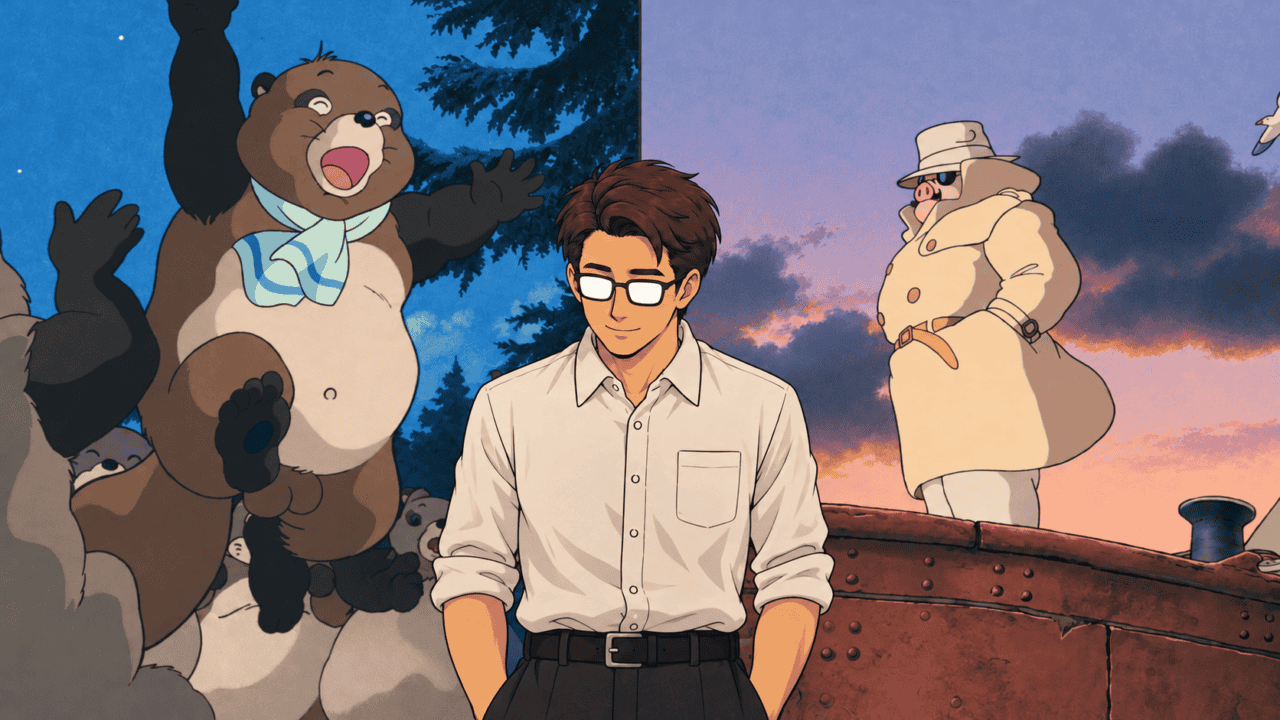
Isao Takahata’s Pom Poko(Official Studio Ghibli Website) was released in 1994. It remains my favorite among the many Studio Ghibli films. This time, I want to focus on Ponkichi, the protagonist Shoukichi’s best friend.
Ponkichi appears from the beginning and studies transformation alongside Shoukichi and the others. Yet he abruptly disappears from the foreground partway through the story, only to return at the end and close the film with his speech.
For such an inconspicuous character, he really does steal the show.
Why structure the film that way? One way of approaching the question is through the protagonist of Hayao Miyazaki’s Porco Rosso(Official Studio Ghibli Website). When I think about Ponkichi, I find myself strangely reminded of the way Porco Rosso lives.
I want to explore Ponkichi’s place in Pom Poko by looking back at Porco’s way of life in Porco Rosso. Just what kind of presence is Ponkichi in the film?
*This is a translated version. The original (Japanese) is available here.
- Ponkichi as the Hidden Protagonist: An Observer
Unlike the tanuki caught up in the conflict with humans, Ponkichi insists on living like a tanuki. His view of the situation from a distance recalls Porco Rosso’s outlook. In this reading, he is a fitting character to close the film: he embodies the spirit of “Somehow, we go on living.” - A Way of Life Within a Story of Defeat
Pom Poko is a thoroughgoing story of defeat, but Ponkichi never forgets what it means to be a tanuki. His ability to remain himself without being swallowed by the turmoil suggests a way of living that has something to offer us humans, too. - What the Contrast with Shoukichi Reveals
Shoukichi, the overt protagonist, remains at the center of the struggle, questioning what he is doing. Ponkichi looks at it from outside. Their reunion brings together these two perspectives and gives the story both depth and hope.
On this pageContents
Pom Poko (1994): Ponkichi’s Role and Porco Rosso’s Way of Life
Before considering Ponkichi’s role, let’s recall how Porco Rosso—also known as Marco Pagot—lives.
The “Porco Rosso” Way of Life
There are many ways to read Porco Rosso, so it may be difficult to isolate the protagonist from the film as a whole. Still, a few points seem important:
- Porco is a hero of World War I.
- The world has entered the Great Depression, an age of “money, money, money.”
- Porco could return to the military, but instead he makes his living hunting air pirates.
What matters here is that Porco has been on the receiving end of a reversal of society’s priorities: from war to the economy.
The values once held dear have been overturned, and the world has become something else entirely. Neither the comrades nor the enemies who died in the war are given another thought.
In that world, Porco Rosso tells the story of a man who has said, “I’m out!” In fact, the air pirates he fights belong to the same “I’m out” crowd.
Perhaps this is what the film’s notion of being cool amounts to: looking at the situation askance and asking, “Isn’t this what living is about?” Of course, part of the charm is that even Porco ends up being captured by Gina. But that’s another story.
Ponkichi: The Master of Observing from a Distance
Looking back at Ponkichi in Pom Poko, I get the impression that, like Porco Rosso, he has deliberately chosen a way of life at odds with the direction the other Tama tanuki are taking.
Perhaps Ponkichi has little talent for transformation. But could it be more than a question of whether he can transform well—or at all? Might he be actively turning his back on a situation in which the tanuki, for all their panic, are delighted to have finally found an “enemy”?
As Shoukichi says in the film, Ponkichi wants to live “like a tanuki.”
The other tanuki grow increasingly absorbed in their fight against humans, reaching a peak with Operation Specter. When it fails, their organization falls apart. The tanuki unable to transform suffer the greatest emotional blow.
They eventually join Yashimano Hage’s Dancing Prayer followers and sail away on the treasure ship in a collective suicide.
But lo and behold, when the dust settles at the end of the film, we realize that Ponkichi somehow escaped this mass suicide.
How was that possible?
Perhaps Ponkichi has been watching from a distance as his companions lose their “tanuki-ness” in the frenzy of fighting humans.
That may be why losing the dream of Operation Specter does not leave him with the same profound despair as the other tanuki unable to transform. I imagine him looking at their despair and confusion and thinking, “If it doesn’t work out, why not carry on in our own way?”
That attitude recalls Porco Rosso, who has survived the upheaval of World War I only to find himself looking askance at a world caught up in the new upheaval of the Great Depression.
Ponkichi as the Hidden Protagonist
Seen this way, we may begin to understand why Ponkichi is the one who brings the story to a close.
Pom Poko is a painfully sad story of defeat, but what matters is what happens after that defeat. With “Somehow, we go on living,” the film offers one possibility for life afterward.
Read through Ponkichi, the phrase takes on a slightly different nuance: it seems to describe the way he, more than anyone, tries to keep living like a tanuki.
In other words, it means carrying on without forgetting who you are, whatever the circumstances.
Ponkichi’s final speech also gives that outlook an environmental dimension. His complaint about animals having “disappeared” asks humans to recognize the lives displaced by development. Compare the Japanese, romanization, English subtitle, literal translation, and dub in our detailed analysis of Ponkichi’s final message.
That may sound rather trite.
But “whatever the circumstances” is, in the end, the hardest part.
Consider what the tanuki have been through:
- They initially mistake a territorial conflict with humans for a territorial conflict among themselves.
- When they finally take the fight to the humans, it gets them nowhere.
- Even Operation Specter, the ultimate weapon prepared by the elder from Shikoku, fails.
In circumstances that severe, you might think living like a tanuki was out of the question. Yet Ponkichi manages it. Even the gifted transformers are caught in the confusion, so his mental strength—or his gift for being oblivious—is no small thing. He embodies “Somehow, we go on living.”
Could we call Ponkichi the hidden protagonist of Pom Poko?
The Duality of Shoukichi and Ponkichi
Having considered Ponkichi as the hidden protagonist, I want to turn briefly to Shoukichi, the overt one.
Ponkichi’s defining quality here is his ability to see the situation from a distance. In fact, Shoukichi has something of that quality, too: he keeps asking, “Is this right?” and spends his youth wrestling with doubts.
The difference is that Shoukichi is at the center of the fight against humans, and has no wish to leave it.
In other words, Shoukichi surveys the conflict from its center, while Ponkichi surveys it from outside.
Their reunion at the end is all the more dramatic for that contrast. I wonder what Shoukichi did afterward.
That is my personal reading of the connection between Ponkichi and Porco Rosso, with a brief look at Shoukichi along the way. Following the resemblance to Porco has helped me see Ponkichi’s importance in Pom Poko.
The film tells a story of tanuki in a tremendous commotion, but we humans living in society are much the same. Or rather, it uses the tanuki to portray our own commotion. It’s rakugo through and through!
Having watched Pom Poko or Porco Rosso, it seems worth trying to look at that commotion from a little distance—as long as we do not forget that we, too, are part of it.
Your Take
What is your view? Choose the answer that comes closest to your own response.
Poll results
Which response to the changing world in Pom Poko do you understand most?
- Resisting the loss of a home.0%
- Adapting to human society in order to survive.0%
- Trying to keep living as a tanuki.0%
- I understand several of these equally.0%
- I see it differently.0%
- I’m not sure.0%
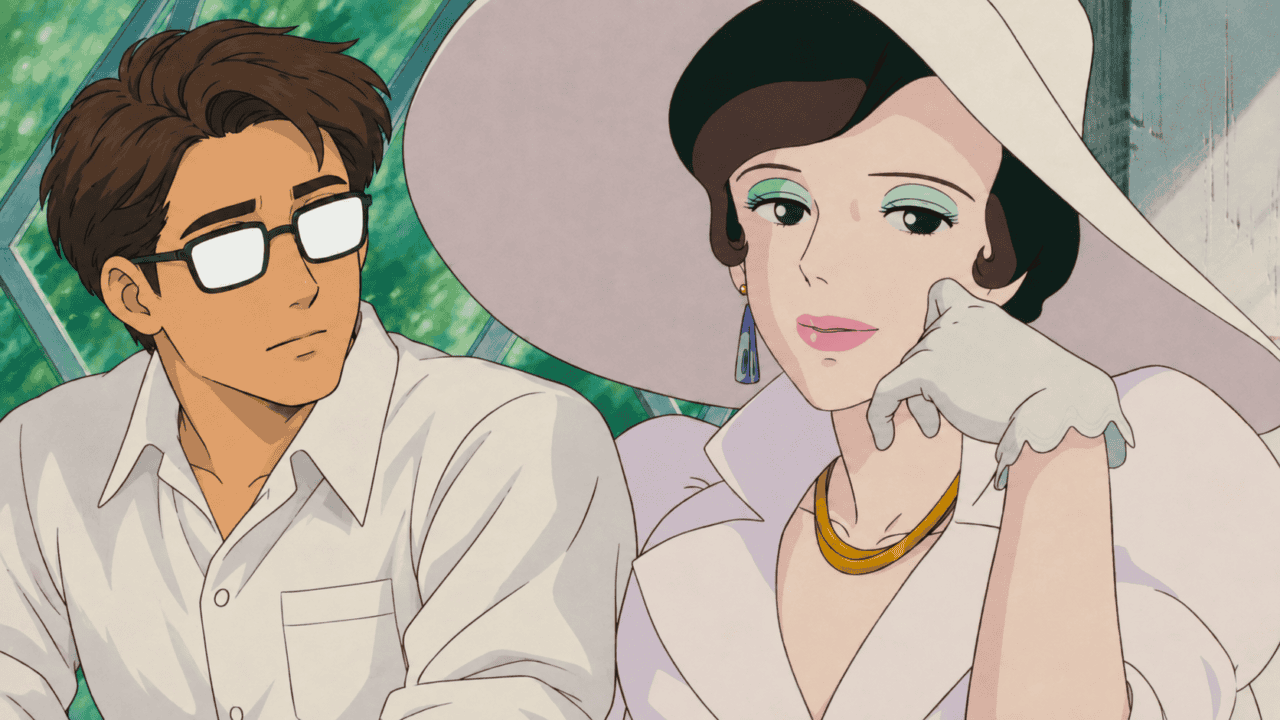
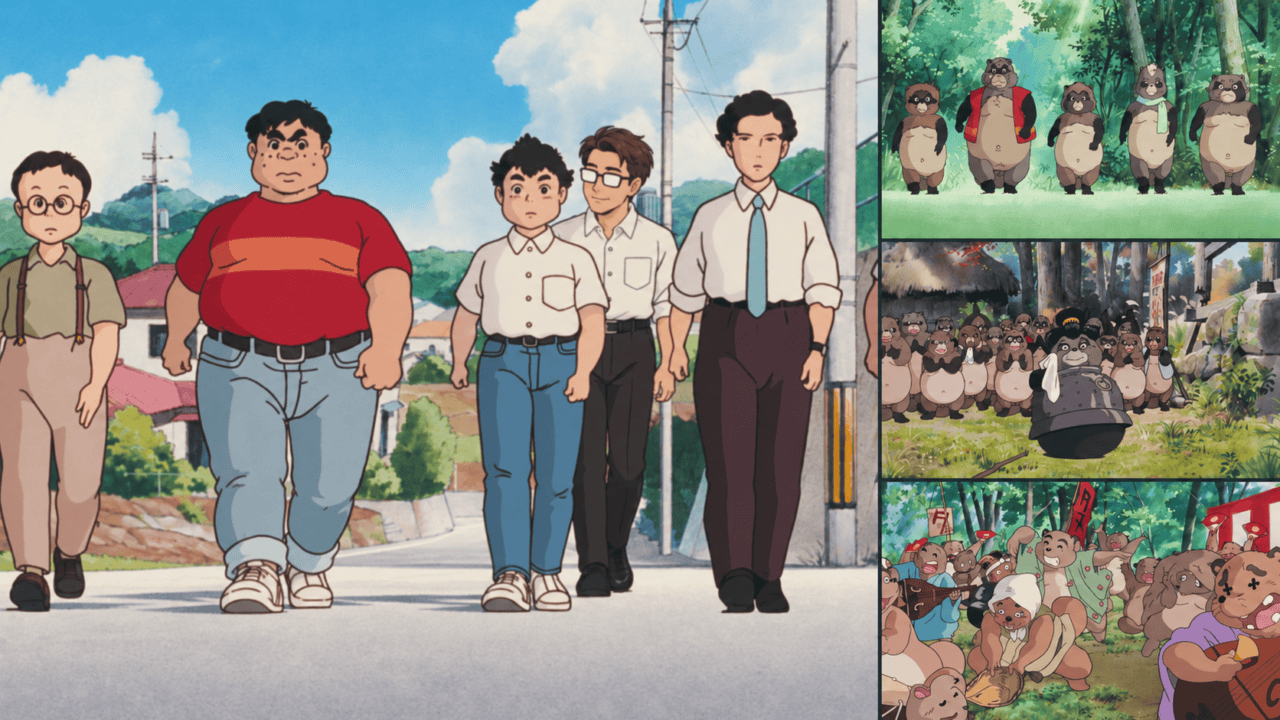
The images used in this article are from the Studio Ghibli Film Stills collection.
Can you name the movie before the scene comes into focus?
Put your visual memory to the test with a blurred Studio Ghibli scene.


Reader Comments
Have a thought or interpretation? Leave a comment