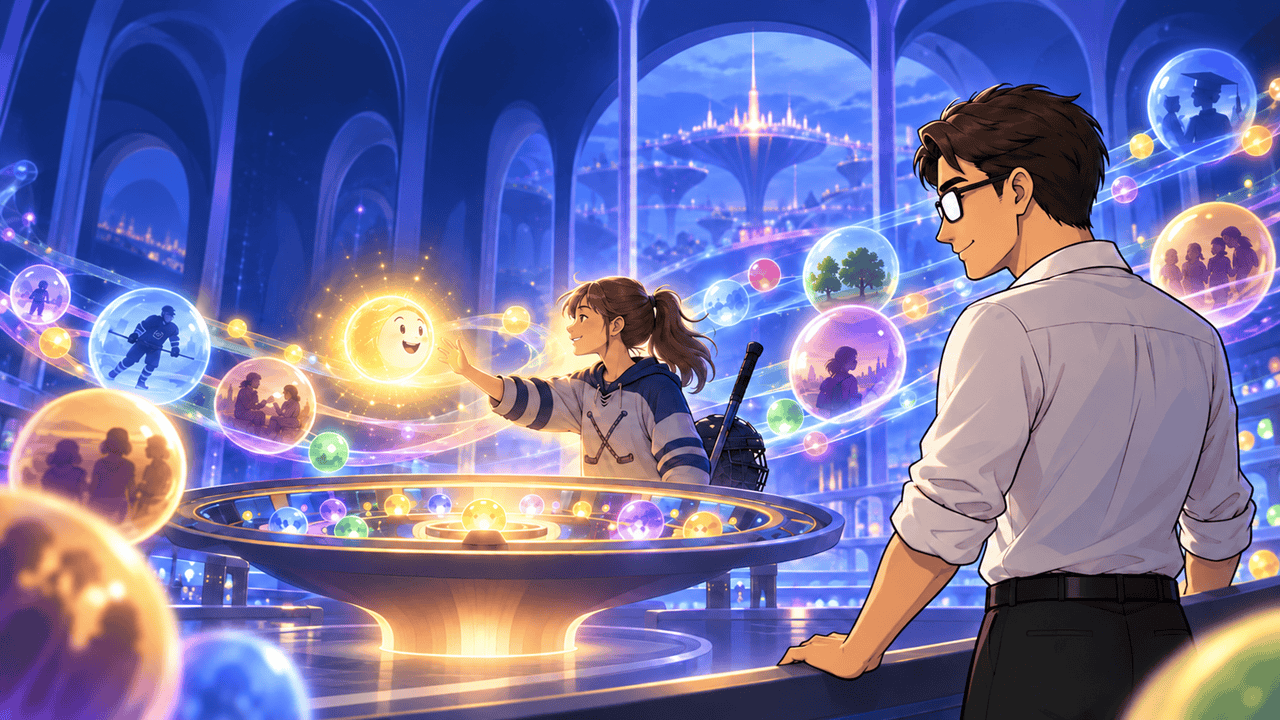
Near the end of Inside Out 2, Riley is panicking as Anxiety spirals out of control. Trying to save her, Joy restores Riley’s earlier Sense of Self: “I’m a good person.” Yet Riley still cannot calm down. If Anxiety were the cause of the problem, we might expect everything to be resolved once Joy regained control. That is not what happens.
On reflection, Joy has also been doing something remarkably similar to Anxiety. Anxiety expelled the original emotions for the sake of Riley’s future. But Joy had been pushing unwanted memories away, collecting only the good ones to build Riley’s Sense of Self. Both mean well. Both, however, take it upon themselves to decide what Riley needs.
Then, at the end of the film, something else strange happens. While Joy is away from the console, Sadness comes to tell her that Riley wants her. Joy returns to the controls, and Riley begins playing hockey with a smile.
Throughout the first film and most of this one, the emotions in Riley’s head have apparently been making her act. Yet at the end, it is Riley who needs Joy.
If the emotions are the ones driving Riley, where, exactly, is the Riley who needs those emotions?
*This is a translated version. The original (Japanese) is available here.
- Emotions as provisional judgments: We cannot analyze every event, so emotions give it an initial meaning. That judgment can change later.
- Why adolescence brings more emotions: Thinking about the future, Riley encounters situations her experience cannot yet handle. With more experience, adults have less frequent need for specialized emotions.
- What Joy and Anxiety share: Joy tries to fit the present to her judgments, while Anxiety tries to do the same with the future. Both distort Riley’s reality.
- Why Embarrassment protects Sadness: Even under Anxiety’s leadership, Embarrassment makes a different judgment. His role in the story resembles Sadness’s in the first film.
- What finally supports Riley: Her accumulated experiences, including painful ones as well as good memories, have shaped her. At the end, Riley herself needs Joy, and her emotions respond.
On this pageContents
Emotions as Provisional Judgments
In the original Inside Out, Riley’s actions were determined by the emotions operating the console inside her head. When Joy took the controls, Riley felt happy. When Anger did, she became angry; when Fear did, she became afraid. Taken at face value, this mechanism suggests that human beings live under the control of their emotions.
But what are emotions in the first place? We encounter all kinds of events every day. We cannot thoroughly analyze each one, understand its meaning, and only then act. There is too much information. If we stopped to think every time something happened, ordinary life would become impossible.
Perhaps, then, emotions are how we give an initial meaning to what is happening in front of us.
Happiness, sadness, anger, fear. An emotion is a provisional judgment about what an event means to us. Of course, that judgment is not always right. You may initially feel angry, then discover that, once you know the circumstances, there was no reason to be. Something that frightened you may turn out to be quite manageable when you actually try it.
Even so, without enough information at the time, some kind of initial judgment was necessary. The fact that emotions can get things wrong does not mean we have no need for them.
I think the films express this through the way the emotions give memory orbs their colors. Joy makes them yellow; Sadness makes them blue. The emotion felt at that moment gives meaning to the event Riley has experienced.
The first emotion we feel about an event, however, does not explain everything about it. A happy memory can become sad with time. Conversely, we may later discover another side to something we originally disliked.
The multicolored memory orbs at the end of the first film probably represented Riley becoming able to understand a single event through more than one emotion.
Why, then, does the sequel once again show so many memories with only one color?
I suspect it is because we do not repeatedly revisit and reconsider everything that has happened to us. New events keep arriving; we cannot reflect on every one of them. Many memories must remain happy or sad as they first were, without our ever having an opportunity to consider another side.
Perhaps a single-colored memory is one that has remained unexamined, still carrying its original provisional judgment. The appearance of multicolored memories in the first film did not mean that every memory would become multicolored. There is nothing especially strange about single-colored ones appearing here.
Why Adolescence Calls for New Emotions
Thinking of emotions as provisional judgments may also help explain the arrival of new emotions more specifically than simply saying that Riley has entered puberty.
Riley is only thirteen. She has less experience than an adult and often encounters situations for the first time. She cannot always draw on something that happened before. Without being able to think, “I’ve been through this,” or “That was what I should have done,” she needs another way to judge the situation.
Perhaps that is why her emotions become more differentiated.
The four newcomers, Anxiety, Embarrassment, Envy, and Ennui, all seem characteristic of adolescence. But I think they have something else in common: each involves imagining the future.
- Anxiety: Anticipates dangers and failures that have not happened yet, unlike Fear, who mainly responds to immediate danger.
- Embarrassment: Considers how others will react to what Riley does.
- Ennui: Anticipates the effort and bother of doing something.
- Envy: Sees the older players Riley admires as the person she hopes to become.
Riley also faced a major change in the first film when her family moved. What troubled her then, however, was leaving a familiar place and disliking her new life. Rather than worrying at length about future relationships, she was unhappy with the situation she was already in.
In Inside Out 2, she starts thinking about high school before it has even begun, and about the relationships that will follow. Nothing has gone seriously wrong in her present life, yet things that might happen later begin shaping what she does now.
Of course, I do not mean that these four emotions concern only the future. But whereas the original emotions mainly responded to things happening in front of Riley, the newcomers seem to extend their judgments to things that have not happened yet.
Entering adolescence, Riley begins imagining a future she has never experienced. Perhaps these four emotions represent the new judgments she needs to make sense of it.
Seen this way, calling them negative emotions does not seem especially useful. Anxiety tries to avoid danger. Embarrassment makes Riley aware of her relationships with others. Envy connects to imagining who she wants to become, while Ennui also anticipates what lies ahead.
Nor does the absence of a new character called Love mean that Riley has no love. Her affection for family and friends was present in the first film and remains here. I do not think the filmmakers tried to turn every human emotion into a character. Rather, they chose these four to represent judgments that the adolescent Riley newly needs.
Where Do the New Emotions Go in Adults?
This raises a question about the minds of Riley’s parents. In both films, their Headquarters are generally staffed by the original five emotions. Becoming an adult obviously does not mean that you stop feeling embarrassed or envious.
If emotions help us make judgments where experience is lacking, that may also explain why the new emotions rarely appear at the adults’ Headquarters.
Adults have accumulated more experience than children. When they face a familiar situation, they can draw on their memories of it. What was a first experience in childhood becomes ordinary in adulthood. More situations can be judged through past experience without calling on a more specialized emotion.
Adults do, however, sometimes face things they have never experienced. When their existing experience is not enough, an emotion they seldom need may come into play.
Indeed, during the sequel’s credits, Anxiety appears in both parents’ heads. Mom’s Anxiety worries about Riley’s hair color, while Dad’s Anxiety is concerned by Riley’s curt reply after returning from camp. In Dad’s Headquarters, however, the worry does not last: things soon return to normal.
We can read this as suggesting that the new emotions still exist in adults, but usually have less to do.
In that respect, Nostalgia is interesting too. She usually stays behind a door and is sent back because it is not her time yet. An emotion can exist without constantly being active at Headquarters.
For children, encountering the unfamiliar is an everyday occurrence. Adults can handle more situations through experience. Perhaps that difference is reflected in the emotions we see at their consoles.
We might also consider another difference in terms of development: the parents’ emotions resemble their owners, while Riley’s all look different.
Riley’s body already has its own distinctive appearance, but her inner self is still taking shape. I think that is why her emotions each have a different form. Her parents, by contrast, have an inner shape formed over many years of experience. Their emotions resemble that shape as it currently is.
Of course, adulthood does not mean that the mind is complete. People keep having new experiences and gradually changing as they grow older. Often that change proceeds without their noticing, rather than happening suddenly at one particular moment.
I imagine that the parents’ emotions simply resemble their owners as they are now. As the owners change, their emotions will change with them.
Anxiety Is Doing What Joy Has Been Doing
Anxiety arrives and starts thinking of every way she can improve Riley’s future. She anticipates possible problems and tries to head them off, hoping to keep Riley from becoming isolated at high school and help her earn recognition on the hockey team.
The result, however, makes Riley’s life harder. Anxiety keeps her awake on a night when she could otherwise have slept, and leads her to distance herself from her longtime friends. In trying to avoid problems in a future that has not happened, she sacrifices Riley’s present.
Yet what Anxiety does closely resembles what Joy has been doing since the first film.
- Joy (the present): Tries to see current events as positively as possible and turn unpleasant things into something positive.
- Anxiety (the future): Tries to avoid bad outcomes that have not happened yet, making Riley suffer in the present.
This becomes especially clear when we learn that Joy has been pushing unwanted memories away. She wants to make Riley happy by building an “I’m a good person” Sense of Self around the good memories. In essence, that is the same thing Anxiety does when she tries to create a new Sense of Self for Riley’s future.
Joy and Anxiety both work for Riley, but each becomes so committed to her own judgments that she moves away from accepting reality as it is.
Why the New Emotions Expel the Old Ones
Anxiety expels Joy and the other emotions who have been running Headquarters so that Riley can adapt to her new environment. She believes the newcomers must take control to improve Riley’s future.
Her actions mirror what Riley is doing in the outside world.
Trying to adapt to her future high school life, Riley distances herself from her old friends and prioritizes the older players she admires. She pulls away from the friends who know her past, trying to become someone who fits the new environment.
The same thing happens inside her head. The emotions that have supported Riley until now are expelled by the newcomers.
It is not unusual for adolescents trying to become someone new to reject who they used to be. Perhaps Anxiety’s expulsion of Joy and the others tells, through the emotions, the very same story Riley is living in the outside world.
A situation that her previous experience and judgments could not handle created a need for new emotions. But those new emotions then rejected all the old judgments.
Anxiety also believes she is doing what is right for Riley. She does not expel the others because she wants Riley to suffer. On the contrary, she considers it necessary to protect her.
This, too, resembles Joy in the first film. To make Riley happy, Joy tried to keep Sadness from doing anything. She believed Riley could be happy if she followed the judgments Joy considered best.
Yet both Joy and Anxiety encounter things their own judgments cannot handle. In this film, I think Embarrassment is the one who reminds us of that.
What Embarrassment’s Protection of Sadness Means
After Joy and the others are expelled, Sadness secretly returns to Headquarters to help her friends. Embarrassment spots her.
Instead of telling Anxiety and the others, he hides Sadness.

A little earlier, we also see Embarrassment looking at a memory of Riley treating her old friends coldly. The film does not explain what he thinks about it. But his protection of Sadness shortly afterward shows that he is not simply following Anxiety in everything.
When the new Sense of Self created by Anxiety undermines Riley’s confidence, Embarrassment again helps Sadness act. Of the new emotions, he sometimes seems the most clearheaded about the situation.
Anxiety is so desperate to improve Riley’s future that she loses sight of what is happening in front of her. Embarrassment, by contrast, does not simply follow Anxiety’s judgment when he finds Sadness. He chooses another course.
In the first film, Sadness played a similar role.
Joy was desperate to make Riley happy and treated Sadness as an obstacle. In the end, though, Joy could not save Riley alone. Sadness had something essential to do.
In the sequel, Anxiety drives the story, while Embarrassment acts outside her judgment. The resemblance between Embarrassment and Sadness lies less in the emotions themselves than in the roles they are given within the story.
Of course, we do not know how fully Embarrassment understands Anxiety’s actions, and we cannot assume the other newcomers share his thoughts. Still, his protection of Sadness may show that Anxiety’s approach is not something every emotion automatically accepts.
An emotion remains a provisional judgment for responding to a situation. No single emotion is guaranteed to be right. Another emotion may judge the same situation differently.
Anxiety is certainly trying to protect Riley. But trying to decide Riley’s entire future through Anxiety alone was always asking too much.
Why could Joy not save Riley alone in the first film, and why was Sadness necessary? I explore how sadness reveals what matters to us in my analysis of the original Inside Out.
Why Restoring “I’m a Good Person” Cannot Bring Riley Back
Near the end of the film, Anxiety becomes desperate for Riley to score in the hockey game. In the process, Riley hurts her friend Grace and is sent to the penalty box for the foul.
Even then, Anxiety keeps trying to fix things, but Riley has already lost control of herself. The emotion that tried to prevent future failures cannot handle a failure happening right in front of her, and spirals further out of control.
Joy returns to Headquarters and gets Anxiety away from the console. She tries to restore the earlier “I’m a good person” Sense of Self. Yet Riley’s panic still does not subside.
What matters here is that both Joy’s Sense of Self and Anxiety’s were built by selecting from Riley’s memories.
Joy kept the memories that suited Riley and sent the unwanted ones away. Anxiety, meanwhile, considered what Riley would need to avoid future failure and tried to build a new Sense of Self for that purpose.
Both, however, draw on only part of the person Riley is.
We cannot adequately explain who we are now by drawing only on the parts of our past that suit us.
We have not lived through good things alone. We have unpleasant memories and experiences we never chose. We have failed and probably have regrets. Unfortunately, all of those things happened before we became the people we are today.
Had a particular event never happened, we might now be different people. In some cases, we might not even be here at all.
I do not mean that unpleasant events were valuable or that painful experiences were necessary. Some events would have been better if they had never happened. Some failures may have taught us nothing.
Even so, in considering how we came to be who we are, we cannot simply remove the inconvenient parts of our past. However unpleasant an experience was, it belongs to the past that led to our present selves.
Joy’s “I’m a good person” and Anxiety’s “I’m not good enough” each draw on only one part of Riley. Riley can be kind and she can be mean. She can be brave and she can be scared. She values her friends and can still hurt them.
That is what people are like. Being kind once does not mean that you can always be kind. Being mean once does not erase every kind thing you have done before.
Both sides are Riley.
Memories Do Not Preserve Events Exactly as They Happened
Moreover, human memory does not preserve past events exactly as they happened.
Some memories in the film show Riley herself. If memories simply recorded what she saw through her own eyes, it would be strange to see her from an outside perspective. But thinking about how people actually remember, this is not especially odd.
When we recall the past, we bring to it knowledge acquired afterward and the way we think now. We may retrospectively picture ourselves from an outside perspective we never actually saw. Repeatedly recalling an event can even change the memory itself.
Unfortunately, human memory cannot keep replaying the past with perfect accuracy forever.
But a memory changing is different from the fact of having lived through an event disappearing. A memory that was initially yellow may turn blue, but that does not mean the experience itself never happened.
Memories can change, and their meanings can shift. That does not leave our present selves freely detached from the past.
What Supports Riley Goes Beyond the Memories Her Emotions Select
Near the end of the film, the mass of memories Joy sent away returns, changing Riley’s Sense of Self.
The arrival of unpleasant memories, however, does not immediately calm Riley. Instead, new beliefs arise from those memories and, together with Anxiety’s spiral, cause her further distress.
Simply bringing the bad memories back does not solve the problem either.
Joy first restores the old “I’m a good person” Sense of Self. When she realizes that it cannot stop the panic, she removes it herself. A new Sense of Self then begins to emerge.
It contains a kind Riley and a mean Riley, a brave Riley and a frightened Riley. She thinks of herself as a good friend, yet she has also treated her friends badly. These apparently contradictory things coexist within the same Riley.
The new Sense of Self does not settle into a fixed form as the old one did. Riley is still growing and changing through experience. Perhaps there was never any need to fix her in one shape in the first place.
Joy embraces the new Sense of Self, and the other emotions gather around it. Riley’s breathing gradually settles, and she begins to emerge from her panic.
Does this mean that Riley has decided to accept the parts of herself she dislikes?
I think it is less a conscious decision than the result of Riley reaching a point where the judgments of her emotions have left her with nowhere to turn.
Anxiety has thought desperately about the future, yet those judgments are making Riley suffer in the present. Joy cannot change the situation by restoring her old Sense of Self. The provisional emotional judgments that have guided Riley until now no longer help.
Nor does Riley then analyze everything logically and arrive at the correct answer. Rather, I think that when emotional judgments reach their limits, the experience Riley has accumulated is still there.
She has played in many hockey games and practiced hard. She has achieved real results and spent time with her friends. None of that disappears, however much Anxiety worries about the future or Joy tries to think positively.
Practicing because she wanted to improve at hockey, performing well in games, building friendships: Riley herself has lived through all of it. The real Riley, who has actually lived, has that accumulated experience, beyond any ideal Riley the emotions might construct.
In this film, those memories do more than store past events. They give rise to beliefs and help form a person’s Sense of Self.
That Sense of Self was never something Joy or Anxiety could create by selecting whichever memories suited them.
Of course, not everyone can recover when emotional judgments stop helping. Emotions may simply erupt and leave a person overwhelmed.
This time, however, Riley does recover. Perhaps the self formed through her experiences and memories gives her a foundation.
Afterward, Riley apologizes to her friends and plays hockey with them again. The future Anxiety worried about has not been resolved in every respect. But Riley can once again face the reality in front of her.
In a sense, Inside Out 2 tells a story in which things work out. Not everyone recovers in the same way. In Riley’s case, however, what she has accumulated throughout her life supports her.
In the End, It Is Riley Who Needs Joy
That brings me back to the other strange scene mentioned at the beginning.
As Riley prepares to play hockey again after making up with her friends, Joy is away from the console. Sadness tells her that Riley needs her, and Joy returns to the controls. Riley begins playing with a smile.
Since the first film, Joy has believed it is her job to make Riley happy and has operated Headquarters to that end. She has tried to make Riley’s circumstances as happy as possible, sometimes even sending unwanted memories away.
In this scene, however, the order is reversed.
Riley needs Joy, and Joy responds.
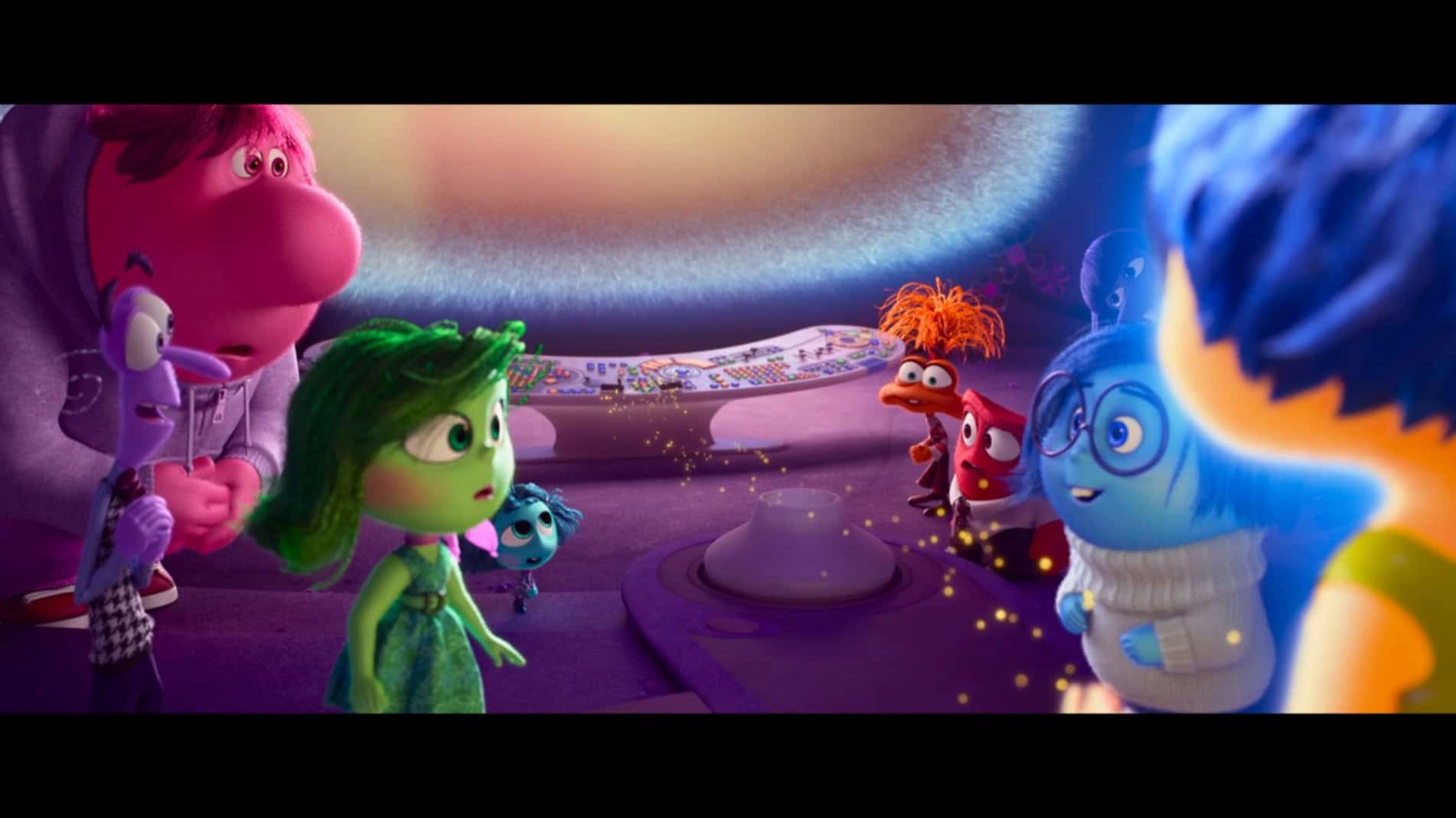
Inside Out appeared to be a world in which the emotions inside Riley’s head determined her actions. At the end of the sequel, however, the film seems to suggest a will of Riley’s own, distinct from those emotions.
Where, then, has Riley herself been?
I think she has been in the experiences and memories she has accumulated.
Joy’s “I’m a good person” and Anxiety’s “I’m not good enough” were only parts of Riley. The actual Riley is a person gradually formed through good experiences and bad, successes and failures.
Nor were those experiences and memories something the emotions could freely select all over again. Sending unwanted memories away did not mean that Riley had never lived through them. Anxiety’s attempt to create someone new did not erase the Riley who had existed before.
Whatever the emotions wanted, Riley had already been taking shape over a long period of time.
Of course, that does not make emotions unnecessary. They began as provisional judgments needed to respond to unfamiliar situations. Riley will keep encountering new things. Sometimes she will need Anxiety, and sometimes Joy or Sadness.
We should also remember that Joy and Anxiety both acted with Riley’s best interests at heart. An emotion does not become unnecessary simply because its judgment turns out to be wrong.
Rejecting emotions and living without being ruled by them are different things.
Riley is not a finished person at the end of the film either. She will have new experiences, accumulate new memories, and change a little each time. I imagine this change proceeding without her even noticing, rather than arriving suddenly at one particular moment.
The same is true in adulthood. As experience grows, an emotion we once needed may have less to do. But another unfamiliar situation may call for a different emotion. We keep changing gradually as we go through life.
Watching the first Inside Out, people seem to be controlled by the emotions in their heads. Joy works the console and Riley feels happy; Sadness does so and Riley feels sad. That mechanism was part of what made the film so engaging.
But taking that world entirely at face value leaves a question: where is Riley herself? If emotions determine a person’s actions and even their personality, the person becomes little more than a container for emotions.
Perhaps Inside Out 2 inherits the first film’s premise while also challenging that view to some extent.
We make many judgments through emotion. But those judgments are not, in themselves, what makes us who we are. We are shaped by the experiences and memories we have accumulated.
Those include unpleasant things and things we never chose, as well as happy ones. We cannot conveniently select among them and make ourselves anew. And we must remember that our emotions, too, are part of who we are.
Joy and Anxiety both tried to direct Riley through their own judgments. Both did so because they wanted what was best for her. An emotion making a mistaken judgment does not mean it needs to be rejected. Those mistakes, too, become part of Riley’s lived experience.
The point is neither to be ruled by emotion nor to discard it and become purely rational. Everything we have experienced, including our emotions, is part of who we are.
In the first film, the emotions drove Riley. At the end of this one, Riley needed Joy.
Rather than being created by her emotions, Riley, shaped by her experiences and memories, lives alongside them.
By finally showing that relationship, I think Inside Out 2 arrives at a slightly different picture of what it means to be human.





Reader Comments