
Watching Inside Out, Sadness initially seems like the least useful of Riley’s emotions.
Joy makes Riley happy. Fear protects her from danger, Disgust steers her away from things she finds unpleasant, and Anger reacts when something is unfair. Sadness, however, does not seem to know what she should do. Worse, she keeps touching Riley’s precious memories, turning their yellow glow blue.
From Joy’s perspective, she is a nuisance. Joy has guarded those happy memories to keep Riley happy, only for Sadness to make them sad one after another. Keeping Sadness from doing anything seems perfectly reasonable.
By the end of the film, though, the emotion that seemed better off doing nothing proves essential to helping Riley.
So why does Riley need Sadness in Inside Out?
We can certainly explain that sadness helps us ask others for support, or that it is a necessary human emotion. The film shows those functions. But to me, that alone does not fully explain why Sadness keeps reaching for happy memories, or why several emotions can eventually share a single memory.
What matters most to me in this film is the idea that sadness is a feeling that reveals what we value.
Seen this way, the blue memories, the collapsing Islands of Personality, Riley’s attempt to run back to Minnesota, and Sadness helping Bing Bong all become parts of the same story.
*This is a translated version. The original (Japanese) is available here.
- What Sadness reveals: We do not feel sad about every possible loss. In this reading, sadness reveals that something we have lost mattered to us.
- Why memories turn blue: The past event itself stays the same, while its meaning changes for the person Riley is becoming.
- Moving forward through sadness: As Bing Bong’s recovery suggests, feeling sad can mean acknowledging that something mattered and accepting its loss, rather than getting it back.
- Growth expressed through several colors: The final memories suggest that Riley can see one event from several perspectives, rather than through a single emotion.
- Self-understanding through sadness: Riley begins to recognize what she values and to develop judgments of her own, distinct from her parents’.
On this pageContents
Sadness Helps Riley Discover What Matters to Her
The first question is why we feel sad at all. If we think of sadness simply as what happens when something unpleasant occurs, it becomes harder to see the role Sadness plays in this film.
Sadness Reveals That What We Lost Was Important
One useful starting point is that we do not grieve over every possible loss. An object disappearing somewhere, with no connection to us, usually means little. But losing something we have used for years, or something given to us by someone important, can hurt regardless of its price.
In those cases, the loss alone does not explain the sadness. It hurts because the thing had come to matter to us.
That applies to Riley. Moving takes her away from her Minnesota home, friends, hockey team, school, and the life she has lived there. Yet she does not instantly understand everything those things meant to her.
- Her Minnesota home: The place where she has lived with her family since she was little
- Her friends: Relationships she had always taken for granted as part of everyday life
- Hockey: Something she loves and associates with who she is
- School and daily routines: The familiar shape of her life
- The time she spent there: A past that can never return in exactly the same form
Only after losing that life does she begin to recognize how much she valued it.
Read this way, Sadness does more than make Riley feel sad. I think she reveals what matters to Riley before Riley herself has fully recognized it.
Joy Alone Cannot Tell Us Everything We Valued
Joy, by contrast, is strongly associated here with gaining something: making a friend, receiving a present, playing well at hockey, or enjoying time with family. The happiness of that moment is immediately apparent.
How much that experience will matter in a life is not always clear at the time. Sometimes it is only years later, or after a loss, that we realize how special a particular stretch of time was.
Joy and Sadness may seem to do opposite things. In this reading, however, they are looking at the same precious things from different points in time.
- Joy: The feeling associated here with gaining something precious
- Sadness: The feeling associated here with losing something precious
That gives meaning to Joy’s early inability to understand Sadness. For Joy, keeping Riley happy means preserving the happy feeling a memory first produced. If an experience was happy, she wants it to remain happy forever.
But we do not keep seeing the past only through the emotion we first felt.
Joy learning that is also the story of this film.
Sadness Touches Happy Memories Because They Now Represent Something Precious That Riley Has Lost
Sadness’s role first becomes visible when she touches happy memories. To Joy, her behavior is clearly wrong. Looking back over the whole film, though, I think there is a reason for what happens here.
Sadness Changes What Memories Mean, Rather Than Destroying Them
One of Inside Out’s first puzzles is why Sadness wants to touch Riley’s happy memories.
Sadness herself does not know, so Joy understands even less. A yellow memory turns blue at her touch, and a happy recollection becomes sad. Joy therefore draws a circle on the floor, puts Sadness inside it, and tries to stop her from touching anything.
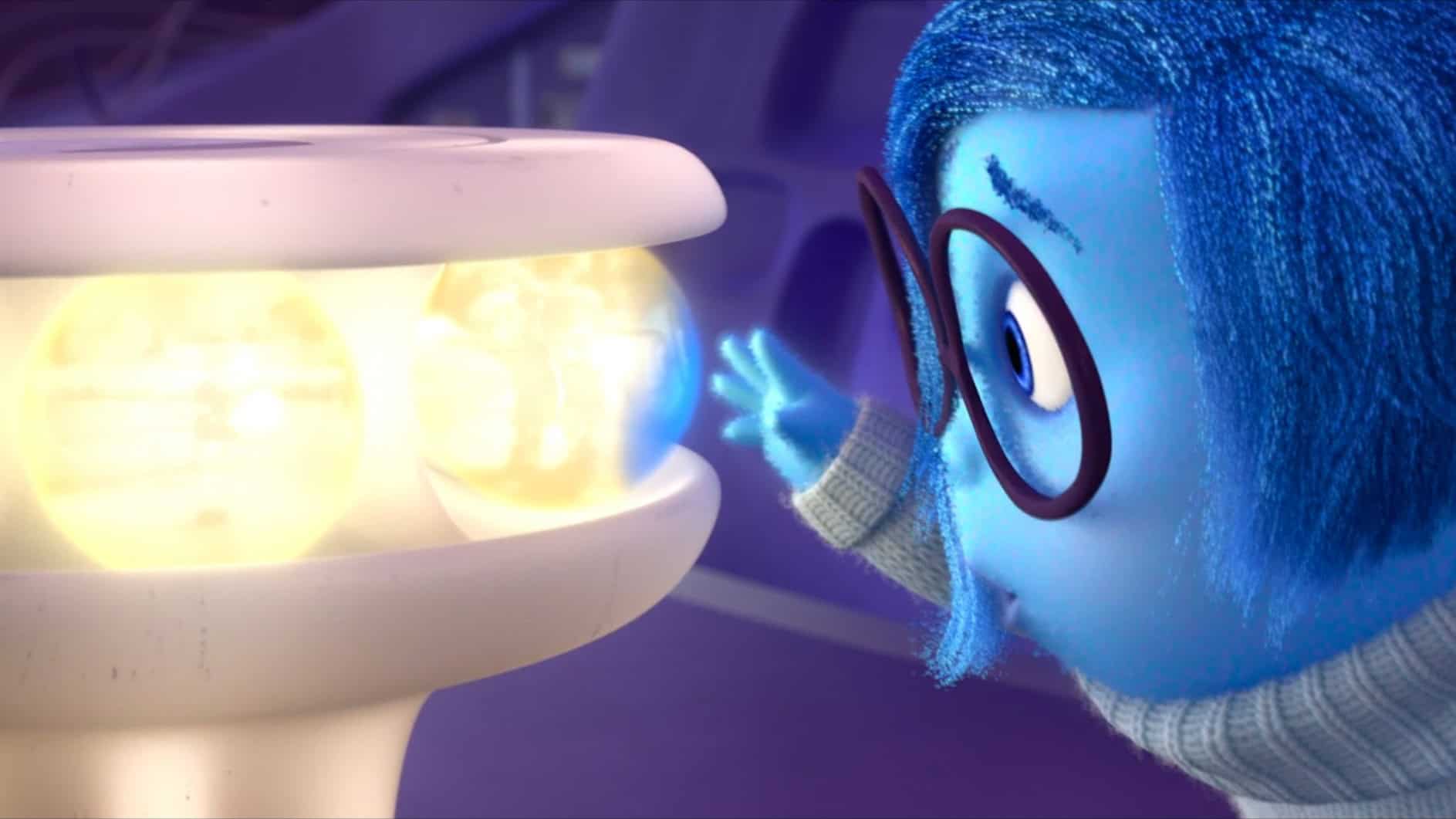
But is the memory itself really being changed in that scene?
Playing with friends in Minnesota, enjoying hockey, laughing with her family: those things still happened. Sadness is not rewriting the past so that the events never took place.
What changes is what the memory means to Riley now.
While she lived in Minnesota, remembering a day with her friends might have been simply happy. After moving to San Francisco, when she can no longer see them as before, that happiness also carries the sadness of knowing she cannot return to the same time.
Rather than seeing Sadness’s touch as destroying a precious memory, I find it more natural to think that sadness joins the memory after the loss precisely because it was precious.
A Happy Memory Can Become Sad Because That Time Mattered
This feeling is not unique to the film. Looking through old photographs, we can feel a little lonely even when the events in them were happy.
Nothing unpleasant is happening in the picture. Sometimes, the happier it looks, the sadder it feels to the person who now knows that time will never come again.
Neither the happiness felt then nor the sadness felt now has to be mistaken. Both can be true.
That is why Joy and Sadness need not be enemies.
It became precious because it was happy. Losing it hurts because it was precious.
They have been talking about the same things all along. Joy simply has not understood that yet.
Blue Memories Reflect a Changed Perspective on the Past
What, then, does a memory turning blue at Sadness’s touch represent? To me, it makes more sense as a change in how the past looks over time than as an emotion painting over the memory itself.
The Same Memory Can Mean Something Different Over Time
If we describe those scenes as happy memories being rewritten into sad ones, Sadness still seems a little dangerous.
But considered alongside our own experience of remembering, the change does not seem so strange.
Something that made us furious as children can become funny when we recall it as adults. Conversely, an everyday moment that once seemed unremarkable can later become a treasured memory.
The event in the past has not changed.
The person looking back on it has.
- The past events themselves remain the same
Playing with friends and spending time with her family in Minnesota still happened. - What changes is their meaning to her now
A memory that once seemed simply happy gains another meaning: she cannot return to that time. - That allows several emotions into one memory
The memory has not been destroyed. Riley, the person looking back on it, has changed.
That makes the changing colors easier to understand. Perhaps the memory has not simply gone from yellow to blue. It has become a memory that yellow alone can no longer explain.
Reinterpreting the Past Is Part of Riley’s Growth
If our first emotional response permanently determined how we saw an event, happy experiences would remain only happy, and unpleasant ones only unpleasant.
Experience changes our perspective. We may come to understand another person’s circumstances, or recognize the value of something we once dismissed.
For me, this is a central part of growing up in Inside Out.
An event has sides we did not see at first.
Recognizing them lets us change the meaning of the past without erasing the past itself. Sadness does not take Riley’s happy memories away. She adds another side that Riley is becoming able to see as she grows.
Multicolored Memories Show That One Experience Can Have Several Sides
At the end, the film changes its own earlier rule that one memory has one color. Several colors sharing a memory offer, I think, the clearest expression of the changes Riley has undergone.
Riley No Longer Judges Each Event Through Just One Emotion
The multicolored memories that appear at the end make this especially clear.
Previously, a memory’s color was generally determined by one emotion: yellow for Joy, blue for Sadness, red for Anger. By the end, several colors can mix within a single memory.
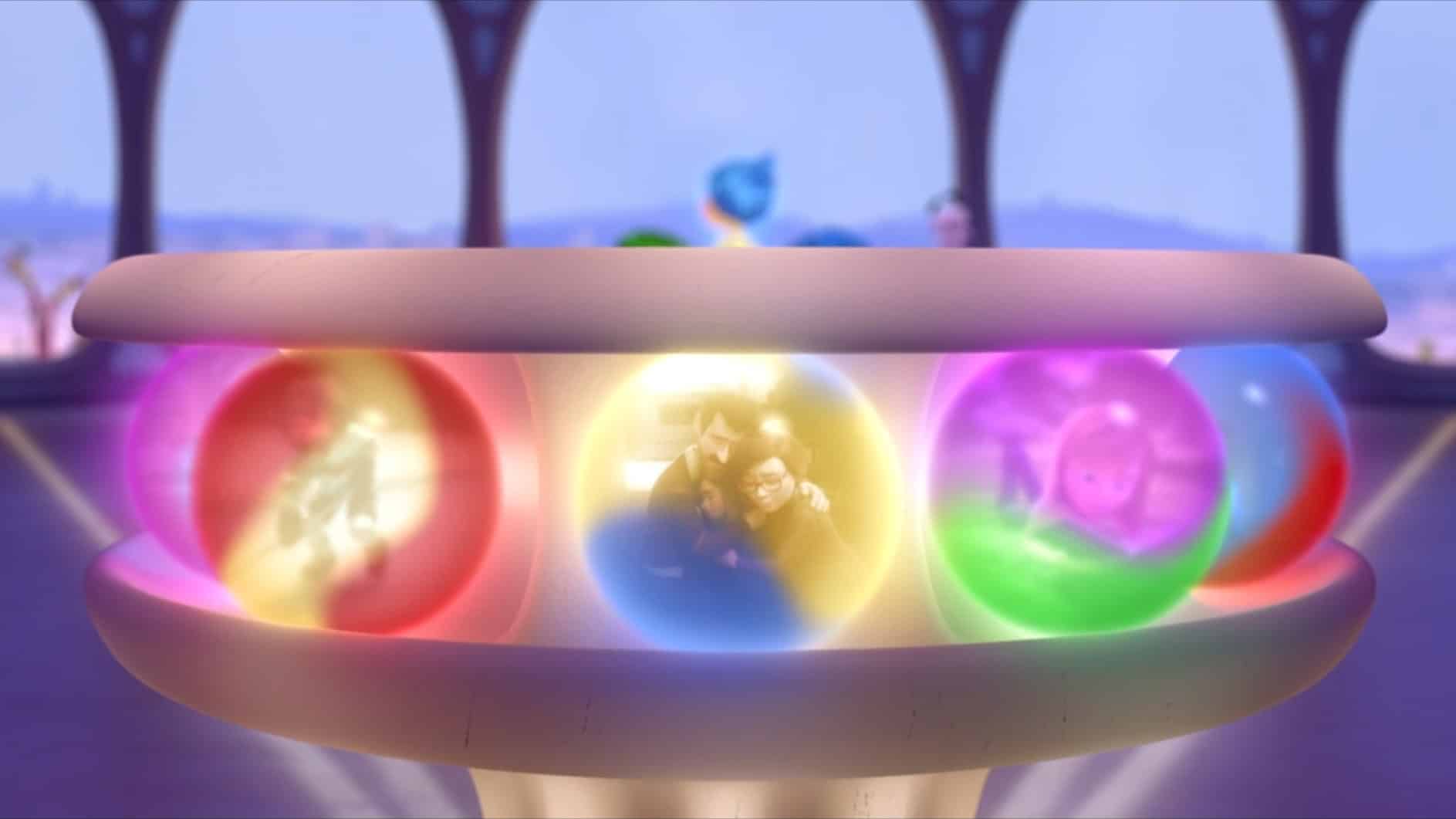
We could describe this as Riley’s emotions becoming more complex as she grows.
But I think it fits the film better to say that Riley has begun to understand that an event can have more than one meaning.
- It was happy, but it is also sad
- It was frightening, but now it feels like an important experience
- It made her angry, but afterward she can understand the other person’s feelings
Being able to feel several emotions about one event means being able to see it from several directions.
Her Perspective Becomes More Complex, Not Simply Her Emotions
After all, Joy, Sadness, Anger, Fear, and Disgust are present from the beginning. The ending does not suddenly add a new category of complex emotions to her mind.
What changes is the relationship between emotions that previously operated separately.
Joy may change most of all. Early on, she believes keeping Sadness away will keep Riley happy. At the end, she willingly hands the console over to Sadness.
I do not think she has simply learned that it is all right to be sad sometimes.
The joy of gaining something precious and the sadness of losing it were connected from the beginning.
By understanding Sadness, Joy also begins to understand what joy itself means.
By the end, no single emotion needs to claim an entire memory as its own.
The Islands of Personality Collapse as Riley Rebuilds Her Sense of Self
These changes do not stop inside Headquarters. The Islands of Personality, supported by Riley’s memories, also collapse. That suggests the transformation reaches her understanding of who she is.
Riley Is Reconsidering Her Memories, Not Losing Them
During the story, the islands that make up Riley’s personality crumble one after another. Family, friendship, hockey: the things that supported her seem to stop working. It can look as though Riley herself is falling apart.
Yet she has not lost all her memories of family and friends. She still remembers living with her family in Minnesota, playing with friends, and playing hockey.
The islands collapse anyway.
Could what is breaking down be her understanding of herself—the idea of what kind of person those memories make her—rather than the memories themselves?
For Riley in Minnesota, family meant happiness. So did friendship and hockey. Each set of memories could support its corresponding island in a straightforward way.
After the move, she loves her family but feels angry with her parents. Her friends matter but are far away. Even the hockey she loves is not going well.
- Family: Her parents matter to her, yet she is angry that they decided to move
- Friendship: Her friends matter to her, yet distance means those relationships cannot stay exactly the same
- Hockey: She loves it, yet it is not going well in her new surroundings
The old, simple explanations no longer make sense of how she feels.
Her Childhood Understanding of Herself No Longer Explains How She Feels
Her earlier world was never a utopia without anything unpleasant. Anger, Fear, and Disgust have been doing their jobs since she was born.
Even so, she could generally understand an event by assigning it one emotion.
As she grows, that becomes insufficient.
She can be angry with parents she loves. She can envy friends who matter to her. She can cry while remembering something happy.
In that situation, it would be stranger if Family Island, Friendship Island, and Hockey Island could stay exactly as they were.
I think we can read the islands’ collapse as Riley rebuilding her childhood understanding of herself, rather than losing her personality.
Building that new sense of self also requires Sadness, the emotion that recognizes what matters to her.
Sadness Helps Bing Bong Acknowledge That What He Lost Mattered
Bing Bong’s scenes offer a particularly clear demonstration of the role described so far. Joy and Sadness respond to the same person in completely different ways, making the contrast between the two emotions visible.
Joy Tries to Cheer Bing Bong Up; Sadness Listens to Why He Is Sad
Sadness’s role in the film is especially easy to see when Bing Bong becomes despondent.
After he loses his treasured rocket, Joy tries her usual cheerful encouragement. She attempts to distract him with something fun, but he does not recover.
Sadness sits beside him and listens.
- Joy: Tries to bring his sadness to an end
- Joy: Tries to lift his spirits by directing him toward something fun
- Sadness: Listens to why he is sad
- Sadness: Lets him talk about what he has lost
- Sadness: Acknowledges how much it mattered
Bing Bong is not sad simply because a physical object has disappeared.
That rocket holds the time he spent playing with Riley when she was little. He is losing a precious shared past.
Sadness does not try to make his sadness disappear. Instead, she helps him recognize what he has lost.
Rather than dismissing his grief, she acknowledges that what he lost mattered enough to be worth grieving.
Bing Bong Moves Forward by Accepting His Loss, Not by Recovering the Rocket
What matters in this scene is that Bing Bong recovers without getting anything back.
The rocket does not return. Nor can he go back to Riley’s early childhood and play with her again. In practical terms, his situation has not improved after Sadness arrives.
Yet after crying, he gets up of his own accord.
Through sadness, he can accept two things together: this mattered to him, and it is now gone.
- The rocket has not come back
- He cannot return to his past with Riley
- He can still acknowledge that it mattered
- That lets him move forward even though the loss remains
Here, grieving does not mean recovering what was lost. It means acknowledging how much it mattered.
That is why Bing Bong can move forward without reclaiming the past.
The pattern of moving forward after grief is then shown in reverse through Riley.
Riley Tries to Return to Minnesota Because She Cannot Mourn the Past She Has Lost
After showing Bing Bong accepting his loss through sadness, the film shows what happens when Riley cannot do the same. Her response is to try to return to Minnesota.
She Wants Her Life Before the Move Back, Not Just Minnesota
Late in the story, Riley takes her parents’ credit card and boards a bus to Minnesota.
The immediate reason is clear: life in San Francisco is going badly, and she wants to return to the place where she was happy.
But I do not think the geographical location of Minnesota is all she wants back.
She wants the life in which her friends were there, she enjoyed hockey, and things were going well with her family.
Rather than simply traveling to Minnesota, Riley is trying to return to who she was before the move.
- A life with her friends close by
- A life in which she enjoys the hockey she loves
- A life in which things are going well with her family
- Who she was before the move changed everything
Of course, that is impossible.
Even reaching Minnesota would not erase the move or everything she has experienced since. She cannot turn time back.
Without Sadness, Riley Cannot Acknowledge What She Can Never Get Back
Here, the difference from Bing Bong becomes clear.
After losing the rocket, Bing Bong could move forward by recognizing how much it had meant to him.
But Sadness is absent from Riley’s Headquarters at this point.
In this reading, she lacks the emotion that would let her accept that her Minnesota life is gone and that it mattered to her.
Without being able to acknowledge the loss, she sees no alternative to trying to recover what she has lost.
So she tries to go back to Minnesota.
I therefore read Riley’s attempt to run away as more than intensified homesickness. It is an attempt to reconstruct the past because she cannot yet grieve its loss.
Likewise, she does not abandon the plan merely because she comes to her senses and decides that running away is wrong.
She begins to acknowledge what she has lost and why she feels sad, rather than trying to recover something that cannot return.
Riley Can Cry Before Her Parents Once She Can Express What Matters to Her
Having given up the journey to Minnesota, Riley communicates her sadness to her parents instead of trying to undo her loss. What she feels privately becomes something she can share: an expression of what matters to her.
Anger’s Rejection Becomes an Expression of What She Values
Back at home, Riley admits to her parents that she misses Minnesota.
She misses her friends and the old house. She also wants her mother and father to miss Minnesota as she does.
At last, she can cry.
Riley has expressed dissatisfaction with the move from early in the story. At dinner, Anger takes over and she argues with her father. The ending is not the first time she has managed to express rejection.
But the rejection expressed through her earlier anger means something different from her final sadness.
- At the beginning: A reaction to the new house, the new school, and the move itself
- At the end: A recognition that the time she spent in Minnesota mattered to her
Disliking a new house, a new school, or the disruption of moving is something she can feel while those events are happening.
Recognizing how much her life in Minnesota meant to her, however, comes after losing it.
At the end, Riley is doing more than insisting that she dislikes something.
She is beginning to express her own values: this is what matters to the person I am.
Expressing Sadness Helps Riley Form Values of Her Own
To me, the final scene can therefore also be read as a change in the relationship between parents and child.
Until then, Riley has largely been the child receiving what her parents provide. They arrange her home, school, and everyday life, and she responds within that world with joy, anger, fear, and disgust.
Now she tells them that the move they decided upon has made her sad.
If this were simply about defying her parents, she had already done that at dinner. Understanding what mattered to her and then telling them carries a different significance.
She is beginning to form judgments of value that are distinct from her parents’.
That does not make an eleven-year-old fully independent in a single moment. Still, she has moved a little beyond simply receiving the world her parents arrange, toward understanding for herself what she values.
Her parents, too, finally recognize the sadness she has been feeling.
Perhaps this is one way parents come to notice that their child is growing up.
Growing Up in Inside Out Means Understanding What Our Feelings Mean
Taken together, I do not think Riley’s growth is simply a matter of gaining emotions or making them more complex. More important is the self-understanding that begins when she recognizes why she feels happy, angry, or sad.
Sadness Teaches Riley What Kind of Person She Is
Sadness is therefore more than one member of a group of five emotions. She helps Riley discover who she is.
Asking why Riley is sad leads to the question of what she has lost.
Asking why that loss hurts leads, in turn, to what she values.
- Family: How much these people matter to her
- Friends: How much the time they spent together meant
- Hockey: What she loves and what feels like part of who she is
- Life in Minnesota: What kind of time together she has valued
Sadness confronts her with that answer.
In that sense, I think we can call Sadness the emotion that recognizes what Riley values before Riley herself does.
Perhaps that is why she kept reaching for precious memories without understanding her own reasons.
Riley Has Learned What Matters, but She Has Not Finished Growing Up
But Riley has not understood everything by the end of the film.
What she has discovered, for now, is that her life in Minnesota mattered. That is already a considerable change. Understanding why that time mattered may take much longer.
Was it Minnesota itself? Her friends? Time with her family? Or a childhood she can never return to?
As Riley grows, the same memories will probably take on different meanings again and again.
Personally, I imagine one such turning point might come if Riley becomes a parent herself.
Watching a child experience something for the first time and delight in it, she might finally understand something about what others once gave her.
As a child, she simply felt happy.
As an adult, she might also recognize the people who made that happiness possible, and understand that the time they shared could not last forever.
Perhaps another color would then enter those old yellow memories.
That does not make the Joy who once knew nothing of sadness childish and worthless. Quite the opposite.
- Sadness reveals what mattered to Riley
- The memory remains, while its meaning changes as she grows
- Her growth is expressed through seeing one experience from several emotional perspectives
- By mourning a loss, she can move forward without recovering what she lost
- These experiences build her understanding of what kind of person she is and what she values
We felt joy because we had something precious, and sadness because we lost it. Through that sadness, we may finally recognize how much it meant.
What Riley learns at the end of Inside Out is not how to overcome sadness.
She learns to accept it as another emotion she needs in order to understand who she is.
The precious memories Joy fought so hard to protect do not break simply because Sadness touches them.
To me, it is precisely when Riley becomes able to grieve what she has lost that she finally recognizes how much those memories matter.




Reader Comments