
“I think I’m pregnant.” If you turned the mind of a man hearing those words into a film, the result might well be Exit 8. That is a deliberately blunt way of putting it, but the thought stayed with me throughout the film.
Suddenly told that he may become a father, a man considers every possible response. Perhaps this would work. Perhaps that would work. If he can help it, he would rather not settle on an answer yet. Show that endless thinking as an underground passageway that changes slightly with every return, and the game The Exit 8 can become the story of one man’s life.
By the end, though, I do not think the protagonist can be explained simply as a man fleeing the responsibility of fatherhood. At the beginning, he barely seems to possess the sense of self that would actively decide to escape. Avoiding involvement and leaving decisions unmade have become entirely ordinary to him.
Perhaps Exit 8 is less about a man who runs from fatherhood until he finally gives in and accepts responsibility than about someone who has treated the world as none of his concern. Choosing to become a father is what finally makes him begin to engage with that world and his own life.
*This is a translated version. The original (Japanese) is available here.
- The protagonist’s emptiness: In this reading, he is not underwritten. He is portrayed as someone moved by outside influences rather than his own decisions.
- Why the pregnancy matters: This is one event he cannot dismiss as having nothing to do with him.
- What the corridor represents: It is both his inner world and a reversal, enforced through the game’s rules, of a life spent avoiding decisions.
- Choosing to become a father: The decision itself brings him a sense of agency, rather than following from an agency he already possesses.
- The meaning of Exit 8: More than an exit from the passageway, it is a way out of the life he has been living.
On this pageContents
Is Exit 8 the Mind of a Man Who Has Just Heard About a Pregnancy?
The film adds one man’s story to the game. At its center is a protagonist whose girlfriend tells him she is pregnant. Yet seeing him only as a man troubled by the prospect of a child leaves the subway scenes at the beginning and end insufficiently explained.
Avoiding Involvement Has Become His Default
At the beginning, an office worker on the subway is shouting at a mother and her crying baby. The protagonist is there, but does nothing in particular. We could explain his behavior as ignoring the situation because he wants to avoid trouble.
What stays with me is how he is shown. Rather than placing him and the mother and child together in a shot to establish that he is watching, the film shows his face reflected in the train window. Other passengers overlap in the glass, while his expression remains clearly visible.

But I read his inaction a little differently. He does not seem to weigh up helping against staying out of it and then choose the latter. The possibility that he might do something scarcely occurs to him. Something is happening in front of him, but it belongs to someone else’s world. Passing by has become so ordinary that it hardly amounts to a conscious act of avoidance.
I imagine he has lived this way for some time. If something does not directly concern him, he stays out of it. He reacts to situations rather than deciding what he wants to do. The pattern is so habitual that he may not even recognize it as avoidance.
A Carefully Written Character Who Seems Empty
That makes his strangely empty quality interesting. What does he like? What matters to him? What sort of life does he want? The film gives us very little sense of those things.
I do not think this necessarily makes him an underdeveloped character. He seems empty because the film carefully portrays a person who acts on what comes from outside, rather than making decisions for himself.
That makes him an unexpectedly good fit for The Exit 8. A player character does not independently decide where to go. It moves in the direction the player supplies and acts within rules supplied by the game. The film’s protagonist resembles that arrangement.
Something happens, so he responds. Someone tells him to act, so he acts. Circumstances change, so he adjusts. At least initially, he does not take the initiative in shaping the world around him. His emptiness seems less a gap in the writing than a way of making a person who resembles a player character believable in the real world.
A Pregnancy Is One Thing He Cannot Treat as Someone Else’s Problem
Then this man is suddenly told about a pregnancy. That is harder to sidestep. He can pretend not to see a stranger shouting at a mother and child on a train. He can pass something happening in the street if he considers it none of his business.
His own child cannot be set aside in the same way. Ignoring the situation will not erase his connection to it. For the first time, treating something as having nothing to do with him no longer works.
The film does not explain his hesitation about fatherhood in detail. Perhaps he fears losing his freedom, lacks confidence, or has another reason altogether. We do not know, and I see no need to invent what the film leaves unsaid.
What matters is that a man who has lived without deciding now encounters something that demands his own answer. Put bluntly, the prospect of a baby arrives as a horror of the highest order for this particular man. That is where Exit 8 begins.
The Corridor Reverses His Life of Avoiding Decisions
Calling the passageway simply a world inside his head seems insufficient to me. It certainly resembles a mind circling the decision to become a father. But the game’s rules also turn his previous way of living upside down.
Both His Inner World and the Shape of His Life
Will he become a father? What happens next? How will his life change? Reluctant to answer, he keeps considering slightly different possibilities. He moves back and forth through subtly different corridors, thinks he has progressed, and finds himself back where he began. In that sense, the passageway is indeed his inner world.
At the same time, it is a world in which the game’s rules forcibly reverse his habit of living without making decisions.
I do not think those meanings need to be separated. A single underground passage can express both what is happening within him and the shape of the life he has led. It is his mind, and it is his life. Fiction can make both visible as one thing.
The Corridor Forces Him to Judge for Himself
Previously, he could witness an event without having to consider it his problem. Exit 8 does not permit that. Is there an anomaly or not? Should he go forward or turn back? Unless he observes and judges for himself, he will never leave.
- His earlier daily life: When something happens around him, he can pass by as though it has nothing to do with him.
- The corridor: He must observe what is happening and decide whether to continue or turn back.
The corridor repeatedly forces him to do what he has avoided. Yet this does not mean he has already gained a sense of agency. He makes judgments, but not because he has independently chosen to do so. The game obliges him to judge if he wants to get out.
An anomaly means turning back; no anomaly means continuing. He still follows rules imposed from outside, so in that respect he is not very different from the man at the beginning. To me, the corridor is less a place where he immediately acquires agency than the place where he is first compelled to face the act of deciding, something he has never properly confronted.
The Beach Offers His First Glimpse of a Future as a Father
During these loops, he glimpses a future in which he walks along a beach with his family. Fatherhood, which has so far felt like a problem bearing down on him, begins to look different.
He walks with a family, with someone beside him, and he belongs in that picture. For the first time, becoming a father appears as more than a frightening change. It might be a future worth having.
It is also an image he has lacked: a world in which he lives through relationships with others. Engaging with the world does not only mean getting dragged into difficulties. Some kinds of happiness are possible only through relationships with other people. Here, he glimpses that possibility.
Choosing Fatherhood Gives Him a Sense of Agency
What interests me most is that he does not first mature and then decide to become a father. We might expect a person who thinks and judges independently to make that decision as an extension of an existing sense of self. For this protagonist, the sequence runs the other way.
Deciding to Become a Father Means Choosing His Own Life
Ordinarily, we might imagine someone thinking things through, making a judgment, and choosing fatherhood. Becoming a parent is a major event, and it can change a person’s values or even their entire sense of who they are.
But the man in Exit 8 begins somewhere different. He has not been directing his life through his own decisions. He has lived by responding to whatever comes his way.
- The expected sequence: Think for himself → Make a decision → Choose to become a father
- This protagonist’s sequence: Choose to become a father → Take ownership of his life → Begin engaging with the world on his own initiative
He does not choose fatherhood because he already possesses a sense of agency. Choosing fatherhood is what gives this apparently empty man that sense of agency.
To me, this is why fatherhood matters to his story. The change is more than a newly awakened sense of responsibility. A man who has left his life undecided commits to becoming a father and, through that commitment, begins to accept his life as his own.
Recognizing That the World Concerns Him
For him, the decision means more than choosing to have a family. It also means willingly accepting his relationship with a world he had treated as unrelated to him.
He does not develop agency separately from deciding to become a father and then begin engaging with the world as a consequence. Choosing fatherhood, taking ownership of his life, and recognizing his connection to the world are portrayed as almost a single transformation.
Fatherhood becomes more than a major event in the plot. The decision is placed at the very moment when this empty man begins to become someone different. I think that is the film’s most effective choice.
Exit 8 Is a Way Out of the Life He Has Been Living
At the end, he returns to a subway scene much like the opening. Once again, an office worker is shouting at a mother and child. The man we first met would have done nothing. If it had nothing to do with him, he could simply let it pass.
This time, he moves to say something to the office worker. Initially captured as a face reflected in glass, he is now shown directly, in a frontal close-up.
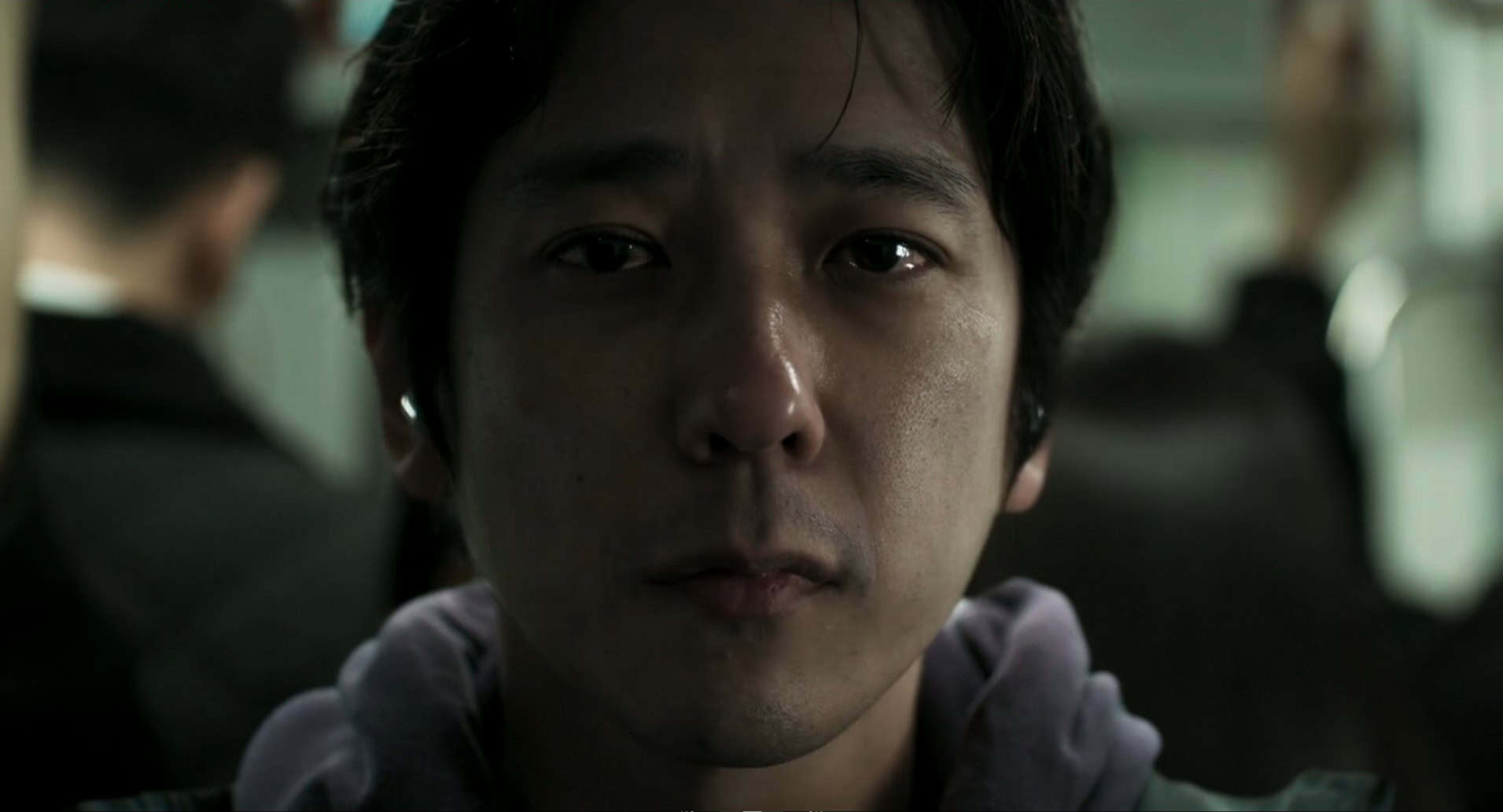
Describing this merely as becoming a man with a sense of justice seems too narrow. Something more fundamental has changed in how he relates to the world.
What happens in this world concerns him, too.
Choosing to become a father and choosing to intervene for the mother and child express the same change. He can no longer keep insisting that none of it concerns him. If he is here and something is happening before him, then he is part of that world as well.
The title Exit 8 looks a little different in that light. Within the story, it is of course the way out of the underground passage. But the passage is not the only thing he escapes.
He has spent his days reacting to what comes from outside and passing through a world he considers unrelated to him. Exit 8 is his way out of those very days.
What the Film Adaptation Found in the Game
Adding a story to the original game does, I think, weaken some of its impersonal eeriness. Something is lost in the move to film.
Even so, the adaptation interests me because it does more than force the game’s rules into a narrative. It finds a stretch of human experience that already has the same shape as The Exit 8.
A decision that could change a life is not always made immediately. We think again, try another possibility, return to the beginning, and eventually choose an answer. The film makes that time visible as a looping passageway. By making the answer a commitment to fatherhood, it lets finding the exit also mean a man taking ownership of his life.
Perhaps adapting a game does not require forcing drama into it. It may be enough to find a human experience with the same shape as the feelings and structure already present in the game.
The film finds The Exit 8 inside the mind of a man who has just learned that he may become a father.
For me, that is ultimately what makes the film adaptation so interesting.







Reader Comments