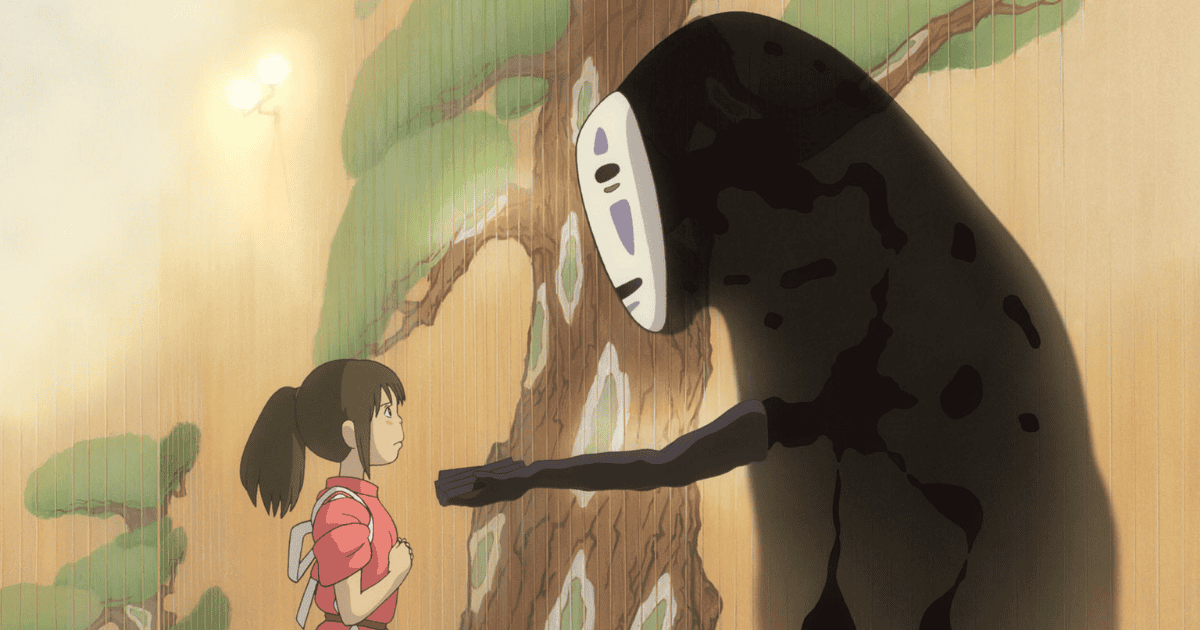
Spirited Away (Studio Ghibli Official) is a 2001 animated feature film written and directed by Hayao Miyazaki. It was released in Japan on July 20, 2001.
In this article, I have collected 15 of my favorite quotes and memorable lines from Spirited Away.
Movie dialogue often uses expressions that are quite different from ordinary conversation, so I have also been curious about how these lines are rendered in English. For each quote, I will therefore look at the original Japanese, romanization, the English subtitle, a literal translation, and what the line tells us about the characters and the story.
The film’s official English title is:
Spirited Away
The title is particularly clever because to spirit someone away means to take someone away suddenly, secretly, or mysteriously.
That makes it a remarkably good translation of the Japanese word kamikakushi (神隠し), literally something like “hidden away by the gods.”
When I first heard the phrase Spirited Away at the Academy Awards, I had no idea that the word spirit could even be used this way. I only knew its more familiar meanings such as “spirit,” “soul,” or even strong alcoholic liquor.
But as a verb, particularly in the expression spirit away, it can mean to remove someone or something secretly.
So the English title is not simply a poetic reference to spirits. It is also a fairly direct description of what happens to Chihiro.
Translation note: The English subtitle wording in this article is based on the commercially released Blu-ray available to the author. The English dub is also discussed where its wording creates an interesting difference. Subtitle and dub wording may vary between releases and territories.
▼ Read the full story and analysis behind these quotes
On this pageContents
Chihiro Ogino Quotes in Japanese and English

“Let me work here.”
ここで働かせてください!
Koko de hatarakasete kudasai!
Let me work here.
Please let me work here!
Read the Commentary and Analysis
Following Haku’s instructions, Chihiro simply keeps repeating the same request to Yubaba:
“Let me work here.”
There is something desperately earnest about watching this terrified little girl cling to the one instruction she has been given.
At the same time, the fact that she continues repeating the words despite Yubaba’s relentless attempts to frighten and humiliate her reveals something surprisingly powerful about Chihiro.
In that sense, the film depicts Chihiro as a child with a genuine instinct for survival from the very beginning.
She certainly grows throughout the story, but she is not transformed from a completely powerless child into a strong one. Some of that strength was already there.
The subtitle “Let me work here” is extremely simple and slightly blunt.
The dub instead uses:
“I was wondering if you could give me a job.”
This is a good example of a polite English request.
Rather than directly saying “Give me a job,” the speaker distances the request with “I was wondering if…”
As a translation of Chihiro’s desperate repetition, I personally think the bluntness of “Let me work here” fits the scene better.
But as an example of how politeness works in English, the dub is useful.
“I promise I’ll save you.”
お父さん、お母さん、きっと助けてあげるから、あんまり太っちゃ駄目だよ、食べられちゃうからね。
Otōsan, okāsan, kitto tasukete ageru kara, anmari futoccha dame da yo. Taberarechau kara ne.
Listen to me! I promise I’ll save you. Don’t get too fat or they’ll eat you.
Dad, Mom, I’ll definitely save you, so don’t get too fat. They’ll eat you if you do.
Read the Commentary and Analysis
Chihiro says this when Haku takes her to see the pigpen the morning after she successfully signs her employment contract with Yubaba.
On one level, it is simply a touching reminder that even in the middle of her own terrifying situation, Chihiro has not forgotten her parents.
But the scene can also be read as an early setup for the final test of the film.
What becomes important is how Chihiro’s perception of her parents changes over the course of the story.
- After Haku explains what happened, Chihiro accepts that the pigs greedily eating food are her parents.
- When Haku takes her to the pigpen, she can still identify exactly which pigs are her mother and father.
- After her successful encounter with the River Spirit, Chihiro dreams about her parents. She still assumes that they are somewhere among the pigs, but she can no longer identify which pigs they are.
- In Yubaba’s final test, she realizes that her parents are not among the pigs at all.
When these stages are placed side by side, the ending begins to look less like a completely unexplained miracle.
Something has gradually changed in the way Chihiro sees her parents—and perhaps in the way she understands herself.
I explore that question in detail here:
How did Chihiro know?
One possibility is that her growth changes how she sees her parents.
The gradual changes in those earlier scenes give that reading some grounding in the story.
There is nothing particularly unusual about the English sentence itself.
“You can’t give me what I want.”
私がほしいものは、あなたにはぜったい出せない。
Watashi ga hoshii mono wa, anata ni wa zettai dasenai.
You can’t give me what I want.
You can never produce the thing that I want.
Read the Commentary and Analysis
Chihiro says this when the rampaging No-Face attempts to win her over by producing an enormous amount of gold.
The encounter with the River Spirit had been an enormous success for Chihiro.
But No-Face had also played a small but important role in that success by helping her obtain the bath tokens she needed.
Perhaps that gave No-Face his own first meaningful experience of:
“Something I did made another person happy.”
In this reading, giving things to people becomes his only way of connecting with the world.
He produces gold.
People become delighted.
Perhaps he comes to believe that giving more will bring him closer to other people.
Chihiro’s response destroys that logic in a single sentence.
Giving someone something they do not actually want is ultimately an act of self-satisfaction.
And at this moment, what Chihiro wants is not an object anyway.
She wants to save Haku.
No-Face cannot simply manufacture that for her.
I can only hope that his life with Zeniba eventually teaches him how to stay beside another person without constantly trying to purchase their affection.
Although that raises another question.
Do gods actually “grow” as people do?
The English subtitle is extremely direct.
Interestingly, in the English dub I heard, the sentence corresponding directly to this line appears to have been omitted.
Looking again at the surrounding Japanese dialogue, the line itself is inserted into a slightly unusual sequence:
Chihiro asks where No-Face came from, tells him that she has somewhere she must go immediately, tells him that he should return to where he came from, says that he cannot give her what she wants, and then asks where his home is.
The dub may have removed the sentence simply to make the conversation flow more naturally in English.
▼ Read more about Chihiro, her growth, and the mystery of the final test
Haku Quotes in Japanese and English

“Don’t be afraid. I’m a friend.”
怖がるな。私はそなたの味方だ。
Kowagaru na. Watashi wa sonata no mikata da.
Don’t be afraid. I’m a friend.
Do not be afraid. I am on your side.
Read the Commentary and Analysis
Haku says this near the beginning of the film when Chihiro is completely overwhelmed by a world she does not understand.
When you stop and think about it, there is absolutely no reason Chihiro should expect to have an ally waiting for her in this bizarre supernatural realm.
Yet we accept Haku almost immediately.
Several things probably make this possible:
- The audience desperately wants someone to help Chihiro.
- Stories have trained us to expect a rescuer to appear when a young protagonist is trapped in danger.
- Haku’s appearance immediately releases some of the tension that has been building since Chihiro entered the spirit world.
Once we accept the idea that Haku is helping her, we barely question his behavior afterward.
But eventually, the story does provide an answer.
Haku is the spirit of the river Chihiro fell into when she was very young.
He had already encountered her long before she consciously remembered him.
That revelation initially made me think:
“Ah, of course. That explains everything.”
But the more I thought about Haku, the less convinced I became that the question of his identity ends there.
I explore that problem here:
Who exactly was Haku?
The English subtitle uses “I’m a friend” for the Japanese mikata.
For Japanese speakers, translating mikata as “friend” may not be the first idea that comes to mind. Its direct meaning is closer to “ally” or “someone on your side.”
But “friend” can also be used in English to mean someone who supports you rather than an enemy.
The dub avoids the issue entirely:
“Don’t be afraid. I just want to help you.”
By replacing “I am your ally” with a statement of intention, the dub expresses essentially the same practical meaning.
“Without your real name, you’ll never find your way home.”
名を奪われると、帰り道が分からなくなるんだよ。私はどうしても思い出せないんだ。
Na o ubawareru to, kaerimichi ga wakaranaku naru n da yo. Watashi wa dōshite mo omoidasenai n da.
Without your real name, you’ll never find your way home. I no longer remember mine.
When your name is taken away, you lose the way home. No matter what I do, I cannot remember mine.
Read the Commentary and Analysis
Haku says this almost casually, but when we look at the story as a whole, it becomes an unexpectedly sad line.
On the surface, his message is simple:
Never forget that your real name is Chihiro, or you will lose the path back to your own world.
But there is another implication.
Haku himself seems to believe that if he could only recover his true name, he too might be able to find his way home.
The tragedy is that this is not true.
Near the end of the film, Haku remembers the name Nigihayami Kohakunushi.
But his home no longer exists.
He is the spirit of a river that has already been filled in and built over.
Recovering his name does not restore the river.
So where exactly is Haku supposed to return?
I discuss a more hopeful possibility for his future here:
I tried to give that interpretation at least some evidence rather than relying entirely on wishful thinking.
But I would certainly like Haku to find somewhere that can become “home” again.
The English subtitle is direct.
The dub expands Haku’s struggle slightly:
“If you completely forget it, you’ll never find your way home. I have tried everything to remember it.”
That version emphasizes that he has actively spent a long time trying and failing to recover his identity.
“I put a spell on them to give you back your strength.”
元気が出るようにまじないをかけて作ったんだ。
Genki ga deru yō ni majinai o kakete tsukutta n da.
I put a spell on them to give you back your strength.
I made them with a charm so that they would restore your strength.
Read the Commentary and Analysis
This is not necessarily the kind of line that makes you immediately shout, “What an incredible quote!”
But for me, it gets at something fundamental about food:
Food is something we make for other people.
I have lived alone for a long time and have spent years preparing food entirely for myself.
It is a life in which I am free to be wonderfully irresponsible.
There is also the occasional moment when I stare at what I am doing and wonder:
“What exactly am I doing with my life?”
In other words, when I cook food for myself, I do not magically become cheerful and full of energy.
Perhaps one day I will have someone else to cook for.
I would like to believe that.
Reality is cruel.
But I will continue dreaming.
The useful English expression is “put a spell on.”
To put a spell on someone or something means to enchant it or place it under magical influence.
The dub uses almost the same expression.
▼ Read more about Haku, his true identity, and what happened to the Kohaku River
Yubaba Quote in Japanese and English

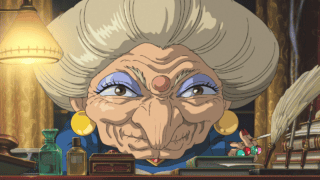
“Sen, you’re a wonder! You made us a fortune.”
千! よくやったね、大儲けだよ! ありゃあ名のある河の主だよ。みんなも千を見習いな!
Sen! Yoku yatta ne, ōmōke da yo! Aryā na no aru kawa no nushi da yo. Minna mo Sen o minaraina!
Sen, you’re a wonder! You made us a fortune. That was the guardian of a great river. Everyone, learn from Sen!
Sen! Well done! We made a huge profit! That was a renowned river spirit. Everyone, follow Sen’s example!
Read the Commentary and Analysis
Yubaba says this immediately after Chihiro successfully takes care of the mysterious guest everyone had assumed was a Stink Spirit.
It is difficult to believe that this is the same Yubaba who displayed almost infinite hostility when Chihiro first asked for a job.
But if we think about the situation from the perspective of a business owner, there is nothing mysterious about the change at all.
An employee who generates profit is an employee management appreciates.
It is a rather clean expression of one basic principle of capitalism.
It may also reflect the frustration of anyone who has had to evaluate people through applications and interviews.
Ultimately, you never really know until someone starts doing the job.
That is the uncomfortable answer.
So when someone you hired does well, it feels wonderful.
Your decision has been validated.
From the employee’s side, of course, that means surviving in an organization comes down to keeping the people above you happy.
What an exhausting arrangement.
The most interesting translation problem here is kawa no nushi.
The subtitle calls the being “the guardian of a great river.”
I am not completely satisfied with “guardian.”
The Japanese concept of a nushi is closer to a powerful master, lord, or supernatural presence associated with the place itself.
To me, he seems more like the river itself than a guardian or manager who looks after it.
The dub simply refers to him as a powerful spirit.
Perhaps there simply is no English word that reproduces exactly what a Japanese speaker feels from the expression kawa no nushi.
Or perhaps my understanding is wrong.
Translation is difficult enough; it becomes even harder when a term carries associations rooted in folklore and custom. Perhaps I should not complain too much about “guardian.”
▼ Read more about Yubaba, the bathhouse, and why she steals names
Kamaji Quotes in Japanese and English

“Finish what you started.”
手ぇ出すならしまいまでやれ!
Tē dasu nara shimai made yare!
Finish what you started.
If you’re going to interfere, see it through to the end!
Read the Commentary and Analysis
Kamaji says this after Chihiro rescues one of the soot sprites when it is crushed beneath a piece of coal.
He sounds rough.
But what he is really saying is:
“Fine. You can help.”
The line also gives the audience an important sense of relief.
Haku is not the only person in this terrifying world who might be willing to protect Chihiro.
And as the story continues, Kamaji proves to be an extremely good person indeed.
The English expression “Finish what you started” is a standard phrase meaning that once you begin something, you should take responsibility for completing it.
The dub adds “human” at the end:
“Finish what you started, human.”
“She’s my granddaughter.”
わしの……孫だ。
Washi no… mago da.
She’s my granddaughter.
She is… my granddaughter.
Read the Commentary and Analysis
Kamaji tells this lie when Lin arrives with food and discovers Chihiro in the boiler room.
There is something wonderfully charming about the absolute calm with which he lies.
It combines Kamaji’s willingness to protect a child with a kind of admirable shamelessness.
Lin immediately understands what he is doing and plays along.
It becomes a beautiful little relay between two adults:
Kamaji has protected Chihiro this far.
Now he quietly passes responsibility to Lin.
The English translation is completely straightforward.
The dub uses the same wording.
“We have to purge the spell.”
えーんがちょ、せい! えーんがちょ!!
Ēngacho, sei! Ēngacho!!
Sen, we have to purge the spell.
Engacho! Break it! Engacho!
Read the Commentary and Analysis
I never personally used the word engacho when I was a child.
It is part of a Japanese children’s custom associated with cutting oneself off from contamination after someone has touched something dirty or disgusting.
I did not use this exact expression, but I certainly remember children using other expressions to attack one another in essentially the same way.
I have been on the receiving end.
And I have done it to other children, too.
Children are remarkably cruel creatures.
There is no realistic direct English translation for engacho.
So the subtitle abandons the children’s ritual itself and explains what Kamaji is trying to accomplish:
“We have to purge the spell.”
Purge means to remove, cleanse, or eliminate something unwanted.
The dub handles the problem differently and says something close to:
“All right, before it rubs off on you.”
Rub off on can mean for a substance—or figuratively a behavior or influence—to transfer from one person or thing to another.
Both translations are essentially escape routes around a culturally specific expression that has no neat English equivalent.
▼ Read more about Kamaji and the other characters who protect Chihiro
Lin Quote in Japanese and English

“If you need anything, ask me.”
おまえトロイからさ、心配してたんだ。油断するなよ、わかんないことはおれに聞け。な?
Omae toroi kara sa, shinpai shiteta n da. Yudan suru na yo. Wakannai koto wa ore ni kike. Na?
You pulled it off! You’re so thick, I was worried. Keep your wits about you. If you need anything, ask me.
You’re so slow that I was worried about you. Don’t let your guard down. If there’s anything you don’t understand, ask me. Okay?
Read the Commentary and Analysis
Lin says this after Chihiro finally gets permission to work at the bathhouse, even though Yubaba has taken her name.
Until this moment, Lin occupies an interestingly ambiguous position.
She is helping Chihiro, but she is also impatient, sharp-tongued, and clearly annoyed by the entire situation.
This line finally confirms:
Lin is someone we are allowed to trust.
Thinking back over the entire film, Chihiro survives while being protected by a remarkable number of people:
Haku.
Kamaji.
Lin.
Zeniba.
Even Yubaba, in a sense, protects her by employing her.
One could dismiss this as narrative convenience.
But it is also simply true that children cannot grow without help from adults and older people around them.
When I watch Spirited Away now that I am older, perhaps the most important question is no longer:
“Could I have been as brave as Chihiro?”
It is:
“Am I capable of being one of the people who helps someone like Chihiro?”
As for my own answer…
I can only stare at the heavens.
There are several useful English expressions in the subtitle.
Pull it off means to successfully accomplish something difficult.
Thick normally means physically thick, but in informal British-influenced English it can also mean stupid or slow-witted. It is not something I would recommend calling anyone unless you know them extremely well.
Keep your wits about you means to remain alert and not lose your judgment.
The dub instead says:
“I can’t believe you pulled it off. You’re such a dope. I was really worried. Keep on your toes and if you need anything, ask me, okay?”
Dope here means something like “idiot” or “dummy.”
Keep on your toes, like keep your wits about you, means to stay alert and prepared.
▼ Read more about Lin and her role as Chihiro’s protective senior at the bathhouse
Zeniba Quotes in Japanese and English

“Everything that happens stays inside you.”
一度あったことは忘れないものさ……想い出せないだけで。
Ichido atta koto wa wasurenai mono sa… omoidasenai dake de.
Everything that happens stays inside you… even if you can’t remember it.
You never truly forget something that happened once. You simply cannot remember it.
Read the Commentary and Analysis
This is a beautiful line on its own.
But it also quietly tells us what Chihiro’s experiences in the spirit world will become after she returns home.
After Chihiro leaves the tunnel, I read her as no longer able to recall what happened in the spirit world.
The storyboards shown here are the basis for that reading.
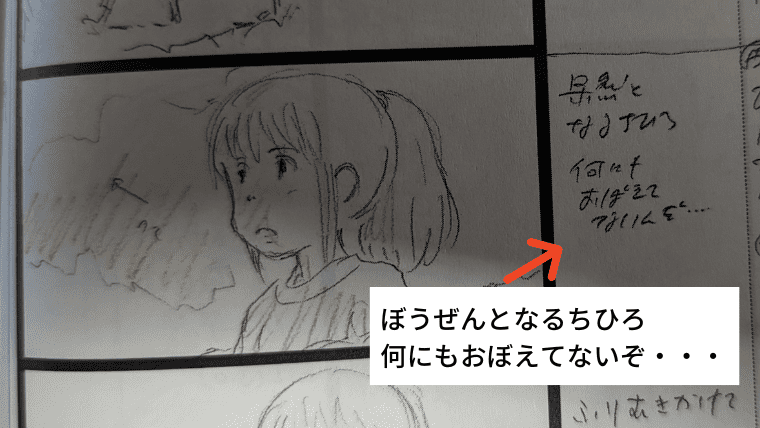
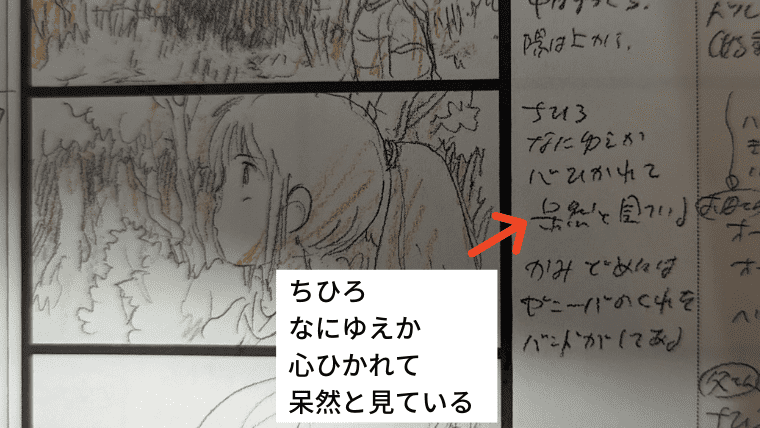
The first storyboard image corresponds to Chihiro reuniting with her parents after saying goodbye to Haku.
The second corresponds to the moment immediately after she leaves the tunnel.
It is sad to think that she cannot consciously recall those experiences.
But Zeniba’s line tells us something important:
Chihiro has not truly lost those days.
The girl who leaves the tunnel is no longer the sulking child who sat in the back of the car at the beginning.
She may not remember Haku, Lin, Kamaji, or the bathhouse in a way she can put into words.
But the human growth produced by those experiences remains inside her.
That is how Spirited Away ends.
I also think this idea connects beautifully with another Miyazaki film:
The dub uses a slightly different formulation:
“Once you’ve met someone, you never really forget them. It just takes a while for your memories to return.”
The Japanese is broader.
It refers not merely to people one has met but to anything that has happened.
That makes the original line, at least to me, even more powerful.
“It’s not the same when you use magic.”
魔法で作ったんじゃ何にもならないからねぇ。
Mahō de tsukutta n ja nan ni mo naranai kara nē.
It’s not the same when you use magic.
There’s no point if you make it with magic.
Read the Commentary and Analysis
Zeniba says this while making a handmade hair tie with Chihiro and the others at her cottage.
I understand what she means.
But to be completely honest, making something with magic still sounds extremely impressive to me.
Presumably magical ability is not something one acquires overnight.
If someone can master that power and use it to make things, I find it hard to call the result “meaningless.”
Thinking about it this way makes me suspect that the line is ultimately an expression of Hayao Miyazaki’s own feelings.
Animation had historically been created through enormous amounts of hand-drawn work.
Digital techniques gradually entered the production process, and today it is difficult to imagine commercial animation that involves absolutely no digital processing.
Studio Ghibli itself began incorporating more computer-assisted techniques around the era of Princess Mononoke.
Personally, I tend to think:
“If a tool works, why not use it?”
But Miyazaki has spent his life drawing on paper.
It would hardly be surprising if he felt some resistance toward a world in which the physical act of drawing was increasingly mediated by technology.
I do not think the line necessarily means that “handmade is morally good and digital is morally bad.”
Perhaps it simply expresses a desire not to surrender something important without resistance.
The subtitle softens the Japanese considerably.
Instead of saying that making it with magic would be pointless, it says:
“It’s not the same when you use magic.”
That is much less absolute.
The dub shifts attention away from the contrast with magic and emphasizes the act of making something together by hand.
“Chihiro? What a nice name. Take good care of it.”
ちひろ。いい名だね。自分の名前を大事にね。
Chihiro. Ii na da ne. Jibun no namae o daiji ni ne.
Chihiro? What a nice name. Take good care of it.
Chihiro. That is a good name. Treasure your own name.
Read the Commentary and Analysis
A name is not something we create ourselves.
Usually, it is something given to us by our parents.
And yet when someone tells us:
“That’s a nice name,”
we somehow feel personally pleased.
Strictly speaking, the person who deserves praise for choosing the name is whoever named us.
But emotionally, that does not matter.
The name has already become part of our identity.
The particular sounds by which other people call us gradually become part of our sense of self.
That is why Yubaba’s act of taking names is so powerful.
Controlling what someone is called can become a method of controlling who that person understands themselves to be.
I explore the idea in detail here:
Structurally, there is also a beautiful contrast between the twin witches.
Yubaba looks at the name “Chihiro” and dismisses it as extravagant before taking most of it away.
Zeniba looks at exactly the same name and says:
“What a nice name.”
Yubaba diminishes the name.
Zeniba returns its value.
One could even read this as a kind of confession from Miyazaki, who, as a powerful figure within Studio Ghibli, is himself in a position to give people nicknames.
Whether or not that interpretation is correct, there is a simple lesson here:
We should probably be careful when deciding what names or nicknames to impose on other people.
The English itself is not complicated, but “What a nice name” is such a warm expression that it may simply be worth remembering as it is.
The dub says:
“What a pretty name.”
▼ Read more about Zeniba, Yubaba, and the meaning of names in Spirited Away
Akio Ogino Quote in Japanese and English

“Don’t worry, we’ve got 4-wheel drive.”
任せとけ、この車は四駆だぞ!
Makasetoke, kono kuruma wa yonku da zo!
Don’t worry, we’ve got 4-wheel drive.
Leave it to me. This car has four-wheel drive!
Read the Commentary and Analysis
Chihiro asks whether everything is really okay as her father charges deeper and deeper down an increasingly suspicious dirt road.
His answer is:
“Don’t worry. We’ve got four-wheel drive.”
I imagine viewers everywhere responding internally with some variation of:
“That is not the problem!”
The fact that the car has four-wheel drive does absolutely nothing to answer Chihiro’s actual concern.
But there is something strangely lovable about her father’s completely carefree confidence.
After all, Spirited Away could not exist without Akio’s reckless behavior.
If he had calmly looked at the road and said:
“This seems unsafe. Let’s turn around,”
there would have been no story.
So perhaps we should give him some credit.
Well done, Akio.
The useful English expression is simply “4-wheel drive.”
The familiar abbreviation “4WD” stands for “four-wheel drive,” although I suspect many people use the abbreviation without thinking about what the letters actually mean.
The dub is almost identical:
“We’re fine. I’ve got four-wheel drive.”
▼ Read more about Akio Ogino and the rest of Chihiro’s family
What These Spirited Away Quotes Reveal About the Film
Looking at these 15 lines together, one thing becomes especially clear: Spirited Away is a story about how a person is formed through relationships with other people.
Chihiro survives because Haku tells her what to do.
Kamaji lies to protect her.
Lin teaches her how to survive at work.
Zeniba gives her a place to rest and reminds her to treasure her name.
Even Yubaba, despite being terrifying and exploitative, gives Chihiro the job that makes survival possible.
Chihiro certainly becomes stronger.
But she does not become strong because she learns that she needs nobody.
She becomes strong because she receives help, learns from it, acts for herself, and eventually becomes capable of helping other people in return.
That may also explain why Zeniba’s line—“Everything that happens stays inside you… even if you can’t remember it”—feels so central to the entire film.
Growing up does not mean consciously remembering every person who helped us or every experience that changed us.
Much of it disappears from memory.
But some part of it remains in the person we became.
Perhaps that is the real meaning of Chihiro’s journey.
The images used in this article are from the Studio Ghibli Works Still Image Collection.
Can you name the movie before the scene comes into focus?
Put your visual memory to the test with a blurred Studio Ghibli scene.
Reader Comments