
March 8, 2021 was the day Evangelion ended. Since the TV series first aired, it had fascinated, delighted, and bewildered us. With Thrice Upon a Time, it finally came to a close.
I saw it on opening day and wrote down my impressions that same day. You can read them in my opening-day review.

Building on those first impressions, I want to consider what Evangelion: 3.0+1.0 Thrice Upon a Time was ultimately about. To do that, let us revisit three points in the film.
For the events in Village 3 and the characters’ endings, see our synopsis and basic information.
*This is a translated version. The original (Japanese) is available here.
- Dismantling Fiction and Returning to Reality
I read the pilots’ “tuning,” the tokusatsu set, and the live-action-like ending as steps that draw the audience out of the fiction and back toward reality. - The Creator’s Responsibility
Perhaps Anno recognizes his part in creating a world that held people captive. By “killing” Eva himself, he takes responsibility for the fiction he created. - Continuing to Tell “Little Lies”
Mari’s role and the “Service, service!” sign-off suggest a declaration that Anno will keep making fiction even after Eva ends. - Leaving Eva and Looking Ahead
Shinji’s “Goodbye” and the “Farewell” on the posters carry both a sense of release from Eva and hope for what Anno will create next.
On this pageContents
Three Points to Consider in Evangelion: 3.0+1.0
Point 1: Ayanami, Shikinami, and Asuka’s Question
One important change in the Rebuild of Evangelion series is Asuka’s name: Asuka Langley Soryu becomes Asuka Langley Shikinami. The finale reveals Shikinami as a clone, like Ayanami. The idea that the pilots were “tuned” to feel affection for the Third Child, Shinji Ikari is central to my reading here. Later, I will argue that Makinami’s matching name invites us to extend that reading to her as well.
In this reading, the matching names point to a shared nature.
If Mari Makinami has been tuned like Rei and Asuka, her affection for Shinji would follow from that. So that would explain her sniffing at “Puppy Boy,” then!
The important idea here is that they were “tuned.”
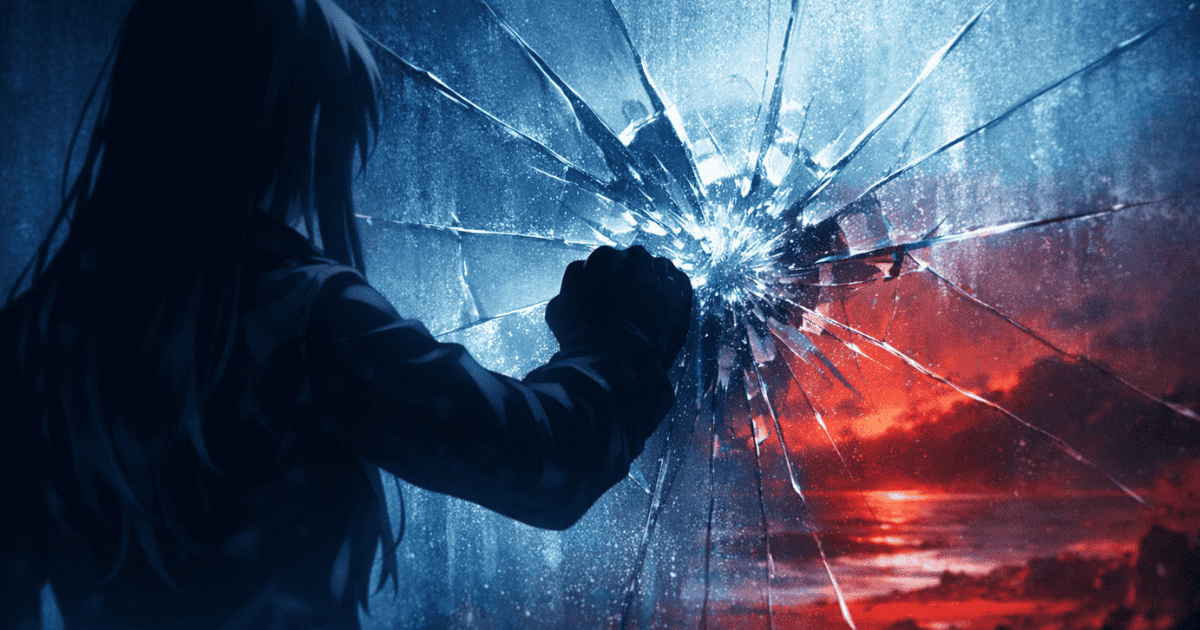
There is another point. Shinji is asked why Asuka tried to punch him through the glass in Evangelion: 3.0 You Can (Not) Redo, and he answers. But why did this scene need to be here?
Point 2: Shinji and Gendo Fight on a Set
Near the end, Shinji and Gendo reach Golgotha in the “Minus Universe” and can finally have their father-son fight. But the place where their Evas fight turns out to be a tokusatsu set.
Surely there must be some intention behind this.
What might that intention be?
Point 3: The Live-Action Feel of the Ending
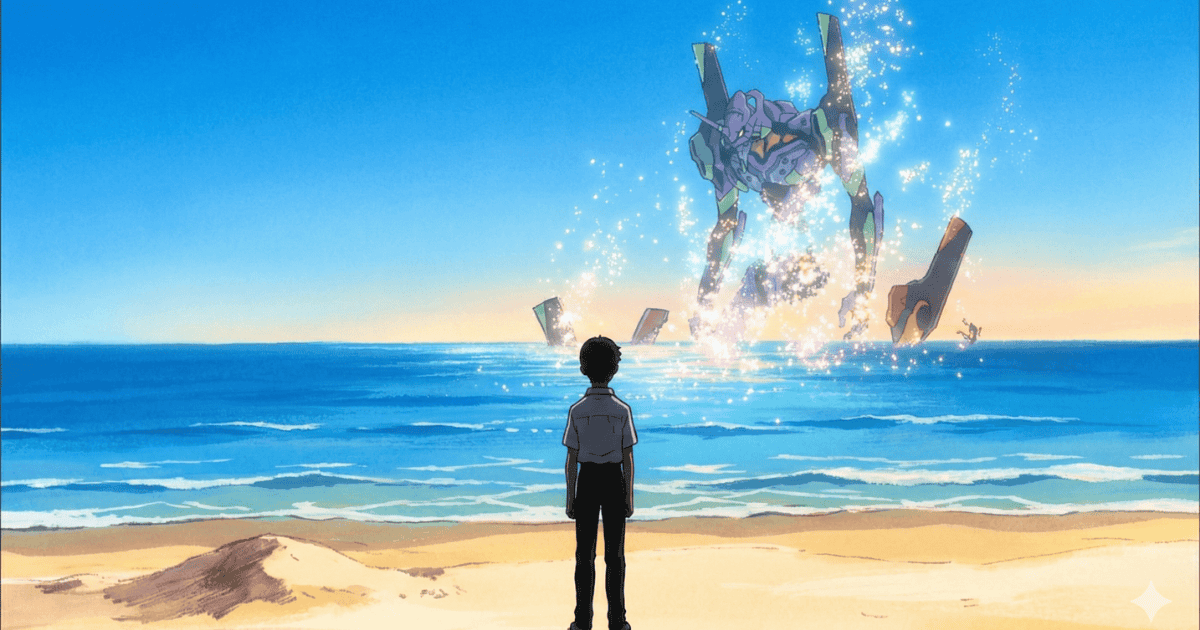
At the end, Shinji and Mari run out of the station together. The camera then pans upward to show the surrounding town.
The town appears in live-action—or at least live-action-like—footage.
Why end an animated work that took twenty-five years to conclude with live-action imagery?
Live action brings the ending of The End of Evangelion to mind. Could there be a connection?
A Story That Dismantles Fiction
Dismantling Fiction and Returning to Reality
The three points above form steps that lead us gradually out of the fictional world and back into reality.
The revelation that Ayanami and Shikinami were tuned explains the convenient arrangements of anime and fiction while also undercutting the affection we thought Asuka and Rei felt for Shinji. In effect, I hear the film saying, “Why would the women around an introverted, indecisive guy who makes excuses, runs away, and then comes back all conveniently fall for him? They wouldn’t. It was arranged that way.”
That leaves a fan with complicated feelings. But perhaps Anno is offering us—the viewers, or those of us caught up in Evangelion—the first step toward breaking the spell of fiction.
The second step is the tokusatsu scene. By staging special effects inside an animated film, it makes plain that what we are watching is fiction.
The third step shows a real town: the place where we, the viewers caught up in Eva, must return when we leave the cinema. In short, it feels as though we are being told, “Go back to reality!”
It sounds preachy, and I think it is a sermon. In that respect, it is not so different from The End of Evangelion.
Fair enough. We cannot keep going on about Eva forever.
But perhaps the sermon is not directed only at us.
The Guilt of Creating Fiction
Being told to return to reality makes me want to retort, “You’re the one who made this!” Anno must know that too. Viewed in that light, the revelation that the pilots were tuned can look like a confession: “I did it.”
Perhaps this, too, is not so different from The End of Evangelion.
I take the final “Disgusting” in the 1997 film as a message to us: “You’re disgusting—go home already!” But perhaps it was also a confession of self-disgust: “What does it say about me that I make anime like this?” After all, Shinji, the one being called disgusting, is Anno’s stand-in in this reading.
In Thrice Upon a Time, I see Anno using Shinji to dismantle the fictional world he created and taking responsibility by “killing Eva.” It seems to say, “There. That’s good enough, right? I’ve taken responsibility.”
When Asuka asks whether Shinji understands why she tried to hit him, he answers that he had not decided for himself whether to let her live or kill her. That, too, looks like Anno’s confession to me. Perhaps he had struggled with how to handle Evangelion as a franchise. This time, I think, he chose to kill it properly.
Golgotha in the “Minus Universe” may represent Anno’s mind, or the place where the anime was made. You can dismantle Eva only where it was created. After making and breaking it again and again, he finally arrives at a world without Evas.
It is a sad thought, and perhaps Anno himself feels that sadness most keenly. I cannot help hearing it in Shinji’s “Goodbye, all of Evangelion.”
After all that effort to dismantle Eva, I feel that even if I miraculously met Director Anno, I ought not utter the sound “Eva” in front of him.
The “Little Lie” He Still Tells
Thrice Upon a Time dismantles the fiction that is Eva, but does that mean Anno will stop making fiction? I do not think so. To me, Mari Makinami expresses precisely that.
If Ayanami and Shikinami were tuned to feel affection for Shinji, I suspect Makinami, whose name was deliberately made to match theirs, was too.
That would make her affection for Shinji another convenient fictional arrangement. Being beautiful is already convenient enough!
This time, though, Shinji has worked hard to create a world without Evas, and has succeeded. Unlike a heroine who loves the protagonist for no apparent reason, Mari’s affection can at least be given a reason.
Her beauty remains convenient, but perhaps Mari expresses an artist’s declaration: “I’ll keep telling little lies like this.”
At the very end, we still get a “Service, service!”
In response, surely we should enjoy Anno’s future work while keeping an appropriate distance from it, and do our best to live our ordinary lives.
Ordinary life can be hard, though.
For my first response to this ending, see my opening-day review.
So What Was It Ultimately About?
To bring all of these complex threads together:
I read Evangelion: 3.0+1.0 Thrice Upon a Time as a story that dismantles fiction. The pilots’ tuning, the tokusatsu set, and the live-action-like ending lead us back toward reality. At the same time, Anno seems to take responsibility for the world he created by “killing Eva” himself. Yet Mari suggests that, even after Eva, he will keep telling the little lies of fiction.
That, at least, is how I see it.
Of course, I do not know what Anno really feels. Shinji’s “Goodbye” (sayonara) sounds sad, while the “Farewell” (saraba) on the posters feels brisk and refreshing. Taking the latter view, perhaps Anno’s feeling is closer to, “Ah, it’s over at last! No more Eva—I’m going to do something new, so stick with me!”
Ultimately, I do not know his feelings. What matters is that the film looked to me like the work I have described in this article.
What will Hideaki Anno make next? Will he make anime again? Well, we waited nine years for this film; nothing can defeat us now. We will wait as long as it takes!
For more on my reading of Mari’s role, see How Shinji Finally Found Mari.




Reader Comments