
In our previous deep dive, we explored the forgotten, tragic history of the “Weather Maidens” and concluded that Makoto Shinkai’s Weathering with You (Official Website) is ultimately a magnificent cinematic rebellion—a story that celebrates the “beauty of falling out of line.”
Read the first part of the analysis here:
Weathering with You: The True Role of the “Weather Maiden” and the Movie’s Hidden Message
In this article, we will unpack the film’s controversial, emotionally explosive final line: “I’m sure… we’re gonna be OK!” To fully understand the immense psychological weight of this declaration, we must first trace Hodaka’s emotional journey from the moment he returns to a flooded Tokyo, right up to the final frame.
(Note: For a comprehensive breakdown of the plot, character maps, and the mystery of Hodaka’s facial scars, please refer to our full guide:
“Weathering with You: Synopsis & Analysis Summary“)
*This is a translated version. The original (Japanese) is available here.
- Self-Affirmation Through “Seizing” Destiny
The realization that Hodaka actively chose to save Hina becomes the foundational pillar of his self-worth. It transforms into a fierce determination to break free from his lifelong chain of self-denial and victimhood. - The Flooded World as a Message to Youth
Shinkai uses this extreme, apocalyptic setting to deliver a profound message to young people: “If these two can fiercely affirm a choice that literally drowned a city, you must aggressively affirm your own small, personal choices and decisions in your daily life.” - Hina’s Final Prayer is “Please, Don’t Stop Raining”
When Hodaka finds Hina praying in the climax, she has already lost her supernatural powers. We theorize her prayer is the exact antithesis of a “Sunshine Girl”—she is praying for the rain to continue, because the rain is the physical proof that Hodaka chose her. - Hodaka’s “We’re gonna be OK” is Makoto Shinkai’s Manifesto
Following the colossal, unprecedented success of Your Name., Shinkai faced immense pressure and intense criticism. Hodaka’s hesitation—and ultimate, defiant resolution—mirrors Shinkai’s own artistic journey. The final line can be read as the director’s bold manifesto: “I will keep making the art I believe in, no matter the pushback.”
On this pageContents
Weathering with You (2019): Unpacking the Ending and the Meaning of “We’re gonna be OK!”
The Emotional Disconnect of the Climax
Three years after his desperate, world-altering choice, Hodaka finally returns to a Tokyo that is now permanently submerged underwater. Upon his arrival, the adults in his life attempt to comfort him with cynical rationalizations: “The world has been crazy from the start,” or “This area of Tokyo used to be the ocean anyway, it just went back to normal.”
Hodaka tries to internalize these words. He tries to convince himself that his decision “was for the best” and that he didn’t actually ruin anything. But it doesn’t sit right with him. Why? Because accepting those adult rationalizations feels like making a cowardly “excuse” for the most important choice of his life.
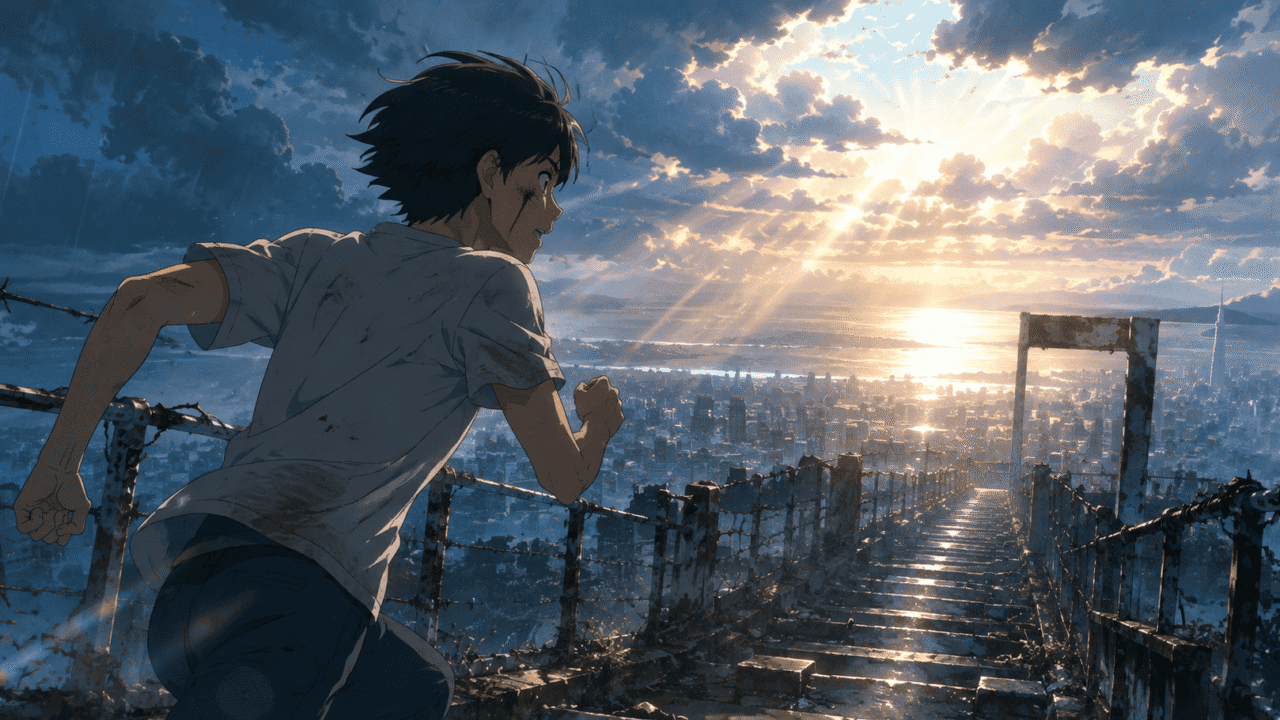
Deep down, Hodaka doesn’t believe he needs an excuse, nor does he want one. Finally, when he spots Hina standing on the flooded street, passionately praying in the rain, a massive psychological breakthrough occurs. He violently rejects the adults’ comforting lies: “No, that’s not it. Back then, I… we definitely changed the world!”
When he finally reaches Hina, she looks at him with vulnerability and asks, “Am I okay?” (or “Is this okay?”). Hodaka, filled with absolute, defiant conviction, replies: “Yeah, Hina-san! I’m sure… we’re gonna be OK.”
The cinematic impact of this moment is staggering. The realization that Hina has been quietly praying in the rain for three years gave me absolute goosebumps. Pushed by the sheer, emotional momentum of the RADWIMPS soundtrack and the stunning visuals, the audience is swept up in the feeling of “Yes, this is fine!”
But when the adrenaline fades and you attempt to logically articulate why and how things are “OK,” the narrative becomes incredibly complex.
In fact, there is a massive, jarring psychological gap between Hodaka realizing “I definitely changed the world (for the worse)” and confidently declaring “we’re gonna be OK.” Bridging this gap is the core purpose of this analysis. But first, we must define what it would mean if they were not OK.
The Difference Between Being “OK” and “Not OK”
To understand the triumph of the ending, we must examine the alternative. The film actually provides a clear blueprint for what “Not OK” looks like: it is simply “who they were before they changed the world.”
Before the climax, both Hodaka and Hina were entirely defined by their desperation to escape. Hodaka ran away from his suffocating island hometown to Tokyo, chasing a vague beam of light. Hina was crushed by poverty and societal expectations, wishing to escape a world that wouldn’t let her just be a kid.
Therefore, if they were “Not OK” in the final scene, it would mean their internal trauma hadn’t healed. They would simply resume their endless, exhausting journey to find “somewhere that isn’t here,” perpetually running away from reality.
Conversely, the fact that they are “OK” signifies that their frantic escape has permanently ended. They have finally established the absolute conviction that “we have the right to exist right here.” It is the exact same psychological breakthrough Shinji Ikari achieves in the final episode of Neon Genesis Evangelion (“It’s okay for me to be here!”).
So, we’ve defined “OK” as achieving the “conviction to exist.” But the central mystery remains: why does acknowledging “I caused this apocalyptic flood” lead directly to the “conviction that I have the right to exist”?
Logically, you would assume the opposite: “Because I caused this disaster, I deserve to be punished, and I have no right to live here.” After all, their choice caused massive economic devastation, displaced millions, and realistically (though the film avoids showing it), cost lives.
Let’s bridge this gap by exploring the concept of self-esteem.
Self-Affirmation Through “Seizing” Destiny
A Necessary Digression to Evangelion: 2.0
To fully grasp Hodaka’s psychology, let’s briefly look at another iconic anime protagonist who shattered the world through a selfish, desperate choice: Shinji Ikari in Evangelion: 2.0 You Can (Not) Advance.
In the climax of 2.0, Shinji bets everything—his humanity, the fate of the planet—to save Rei Ayanami. And for a brief, glorious moment, it appears he succeeded. However, when Shinji wakes up in Evangelion: 3.0, the world is a blood-red, apocalyptic wasteland. Worse, the Rei Ayanami he sacrificed everything to save is completely missing (or rather, the version he saved is gone).
In this devastated world, Kaworu kindly informs Shinji, “This apocalypse is your fault.” Naturally, Shinji’s psyche shatters. He didn’t want to destroy the world; he simply, desperately wanted to save Rei.
But consider a crucial hypothetical: What if the world was devastated, but the Rei Ayanami he saved was sitting right next to him?
The narrative would have fundamentally shifted into a story of raw self-affirmation: “Yes, the world is broken, but I actually saved her!” For a character like Shinji, whose self-esteem is essentially negative infinity, the physical proof that he “seized what he desired with his own two hands” would have been infinitely more vital to his soul than the fate of the planet.
Looking at it in reverse, a ruined world without Ayanami was the absolute, ultimate hell for Shinji, because his sacrifice yielded nothing.
Hodaka Also “Seized” His Destiny
I bring up Evangelion because Hodaka and Hina operate from the exact same psychological baseline as Shinji: they possess absolutely zero “self-esteem.” Prior to the climax, neither of them had ever experienced the sensation of “seizing control of their own lives.” They were constantly buffeted by the whims of abusive parents, poverty, and uncaring adults. That is why they constantly sought to escape to “somewhere that isn’t here”—they were desperately trying to seize something they could call their own.
Viewing the film through this psychological lens, the most important part of Hodaka’s final monologue isn’t the realization that “we changed the world.” The emotional core is what he says next: “I chose! I chose that person, I chose this world, and I chose to live here!“
When Hodaka first returns to Tokyo after three years of probation in his hometown, his mental state is vague, incoherent, and dangerously close to Shinji in Eva 3.0. He was supposed to have saved Hina, but after three years apart, he couldn’t feel the reality of his choice. He was losing his grip on his own agency.
However, unlike Shinji’s tragic fate, Hina was waiting for Hodaka. The moment he sees her, the reality of his choice violently snaps back into focus. He finally reclaims the self-esteem of knowing, “I fought the entire world, and I definitely saved this person.” With that absolute proof standing in front of him, he finally resolves to end his endless, exhausting escape. It was a psychological necessity for him to fiercely claim ownership of his actions, rather than hiding behind the adults’ excuses.
Therefore, we can finally define exactly how things are “OK”:
Hodaka, a boy crippled by a lack of self-worth, had nowhere to belong. He should have achieved ultimate self-affirmation the moment he pulled Hina from the sky, but three years of isolation eroded that reality. However, by returning to Tokyo and looking into Hina’s eyes, he secured the undeniable proof of his own agency. He seized his own destiny. Because he is finally anchored by his own self-worth, he no longer needs to run. Therefore, he is “OK.”
While this is a beautiful, gospel-like revelation for Hodaka’s character, as an objective viewer, it is admittedly difficult to swallow the reality of a “three-year, city-drowning flood.” It feels inherently wrong to declare everything is “OK” after causing such widespread devastation.
However, I firmly believe this extreme, apocalyptic setting was specifically engineered to deliver a vital, radical message from Director Shinkai to the youth of today.
Makoto Shinkai’s Radical Message to the Youth
If we distill Shinkai’s cinematic intent, it reads as a fierce battle cry:
“If Hodaka and Hina are allowed to fiercely affirm a choice that literally drowned a major metropolis, then you—who are not destroying the world—are absolutely allowed to fiercely affirm your own choices! No matter what you choose, you have the right to claim it. Stop worrying about ‘what society thinks’ or ‘the state of the world.’ Just seize your own life!”
Drowning Tokyo is, objectively, a massive nuisance for the people living there. But utilizing extreme, impossible scenarios to highlight raw, human emotion is the ultimate brilliance of fiction. If drowning a fictional city is the narrative price required to effectively cheer on a suffocated, anxious generation of youth, isn’t that a cinematic choice we should totally affirm?
In that context, it is a magnificent, triumphant ending.
Want to read more about the tragic lore of the Weather Maidens? Check out our previous analysis:
Weathering with You: The True Role of the “Weather Maiden” and the Joy of Falling
Appendix: The Mystery of Hina’s Final Prayer
What Exactly Was Hina Praying For?
When watching the emotional climax of Weathering with You, a massive, lingering question naturally arises: “If Hina lost her powers three years ago, what exactly has she been praying for all this time?”
Because the film leaves it ambiguous, we are forced to theorize. However, from a thematic standpoint, I strongly push for the theory that she is praying: “Please, don’t let the rain stop.”
A cynical viewer might argue that she is consumed by survivor’s guilt. They might assume she is looking at the drowned city, deeply regretting choosing her own life over the stability of the world, and hopelessly praying, “Rain, please stop,” wishing she could return to being the “Sunshine Girl.”
While that makes for a heartbreakingly realistic tragedy, it fundamentally betrays the fierce, rebellious narrative soul of Weathering with You.
If the rain were to magically stop, the physical proof of her ultimate, selfish choice—”my life, which I chose despite the consequences”—would evaporate. It would invalidate her agency. For Hodaka, Hina’s physical presence is the undeniable proof that he “seized his destiny.” But for Hina, the “relentless, unending rain” serves as that exact same proof.
It is a highly sentimental, romantic reading, but it perfectly aligns with the film’s themes. Therefore, I cast my definitive vote for: “She was praying for the rain to never stop.”
Makoto Shinkai “Changed the World” Three Years Prior
The ending of Weathering with You features two battered youths fiercely affirming a controversial choice they made three years ago. From a meta-narrative perspective, it is impossible to ignore what Makoto Shinkai did exactly three years prior to this film’s release: he unleashed Your Name. onto the world.
Personally, I adore Your Name., and objectively, it was an unprecedented, industry-shattering global phenomenon.
However, with that staggering success came intense, vitriolic “criticism” from various corners of the internet and the industry. I vividly remember several prominent creators issuing highly cynical, critical remarks about the film’s structure and commercial appeal. While there is a known phenomenon where “creators feel the need to tear down anything wildly successful to maintain their own edge,” I remember thinking, “It takes a special kind of cynicism to aggressively attack a movie that makes audiences feel so genuinely good.”
When Hodaka returns to Tokyo, he is adrift, lost, and questioning if his massive, world-altering action was a mistake. This emotional state almost certainly mirrors Director Shinkai’s own psychological exhaustion and self-doubt following the blinding spotlight and intense backlash of Your Name.
Viewed through this autobiographical lens, Hodaka’s triumphant, tearful scream of “I’m sure… we’re gonna be OK!” takes on a profound, meta-textual meaning. It is highly likely that this final line is Makoto Shinkai’s personal manifesto to his critics: “I am going to stay exactly who I am, and I will keep making the art I believe in, regardless of what the world thinks!”
And honestly, that makes the ending even better.


Reader Comments