
When I first heard that Hideaki Anno was making a Godzilla film, I felt a little disappointed: I had been eagerly awaiting the final Evangelion film. Still, the prospect of “Hideaki Anno doing Godzilla” was far more enticing. Shin Godzilla(Official) was released in 2016, with Anno as chief director and Shinji Higuchi as co-director. Once it opened, plenty of people around me went to see it. I remember how much fun we had talking about familiar locations, trains, and, of course, TV Tokyo.
Here, I want to consider why Godzilla couldn’t be killed in Shin Godzilla. But first, we need to ask: why does Godzilla come to Japan?
*This is a translated version. The original (Japanese) is available here.
- Godzilla as the Uncontrollable and the Absurd
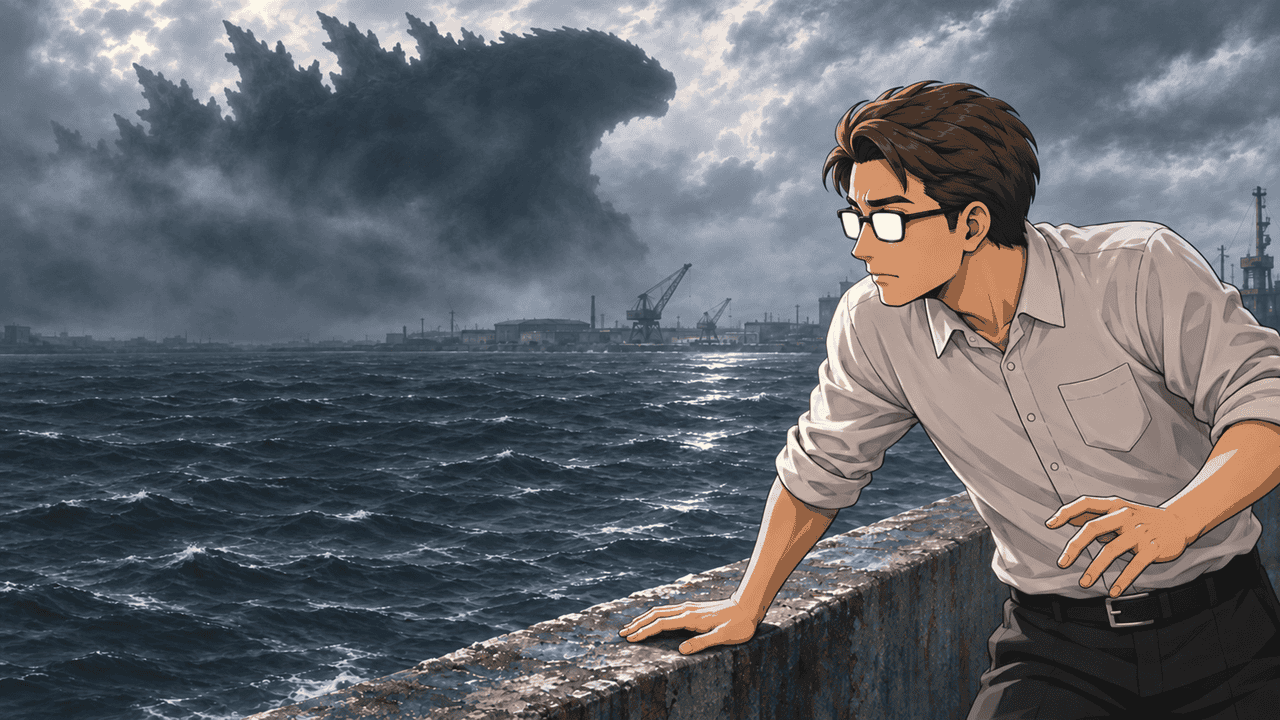
Godzilla symbolizes disasters we cannot control, such as typhoons and earthquakes. His arrival in Japan is absurd: it defies any explanation that might make sense to those affected. Even though Shin Godzilla offers a reason for his appearance, that does not make the devastation any less absurd or the problem any easier to solve. - Godzilla as a Symbol of Problems We Cannot Solve
The ending leaves us living with the problem Godzilla represents. I read this as a theme that extends beyond nuclear power plants: Godzilla embodies the problems of the modern world that we still cannot solve.
On this pageContents
Why Does Godzilla Come to Japan?
One important question when discussing Godzilla is why he comes to Japan. Of course, the obvious answer is that these are Japanese films. But there is another way of looking at it.
Perhaps the question itself is wrong. Godzilla’s arrival is more like a typhoon or an earthquake. Rather than asking why typhoons come to Japan, it makes more sense to say that we live where typhoons occur, and happen to call that place Japan. The same goes for earthquakes. I think we should take much the same approach to Godzilla: we live where Godzilla appears, and we call that place Japan.
Godzilla as a Symbol of the Uncontrollable
I see Godzilla less as a giant creature than as a symbol of disasters that befall us and leave us powerless. The Tatari-gami (Cursed God) at the beginning of Hayao Miyazaki’s Princess Mononoke works in much the same way. Asking why it came to that village, or why Ashitaka was cursed, gets us nowhere. For reasons beyond their control, the village is attacked and Ashitaka is cursed. (For a related discussion, see our analysis of the ending of Princess Mononoke.)
We still cannot control typhoons or earthquakes. All we can do is plead, ‘Be still, be still,’ and wait for the disaster to pass. In the original 1954 film, ordinary weapons are powerless against Godzilla. Stopping him requires the Oxygen Destroyer, developed by the brilliant Dr. Serizawa: something beyond ordinary human capabilities. And if Godzilla emerged because of hydrogen bomb tests, surely America should have been his destination. But Godzilla is not a creature that obeys that sort of logic. He comes to Japan, absurdly.
In this sense, perhaps Godzilla is both a symbol of what we cannot control and a symbol of the absurd. Seen this way, the Tatari-gami really does seem to be Godzilla.
To return, at last, to Shin Godzilla: here, there is a reason for Godzilla’s arrival in Japan. My reading, put bluntly, is that Dr. Goro Maki transformed into Godzilla and attacked Japan to take revenge. ‘Transformed’ may be going too far, but I think it is fair to say that he used his research to help the creature, already enlarged by exposure to nuclear waste, evolve. Personally, I believe he really did transform into it. This, I think, is what his declaration that he ‘did as he pleased’ amounts to. Does having a reason make the disaster any less absurd? Quite the opposite. For those harmed by Godzilla, Maki’s motives are no consolation; for those who died, the catastrophe is absurdity itself.
For the reasons I have outlined, Godzilla is something we cannot kill. Personally, I think even a nuclear attack by UN forces would have failed to kill him. But I also think his survival in this film means something beyond what we have discussed so far. After all, Hideaki Anno was in charge.
What Does Godzilla Symbolize?
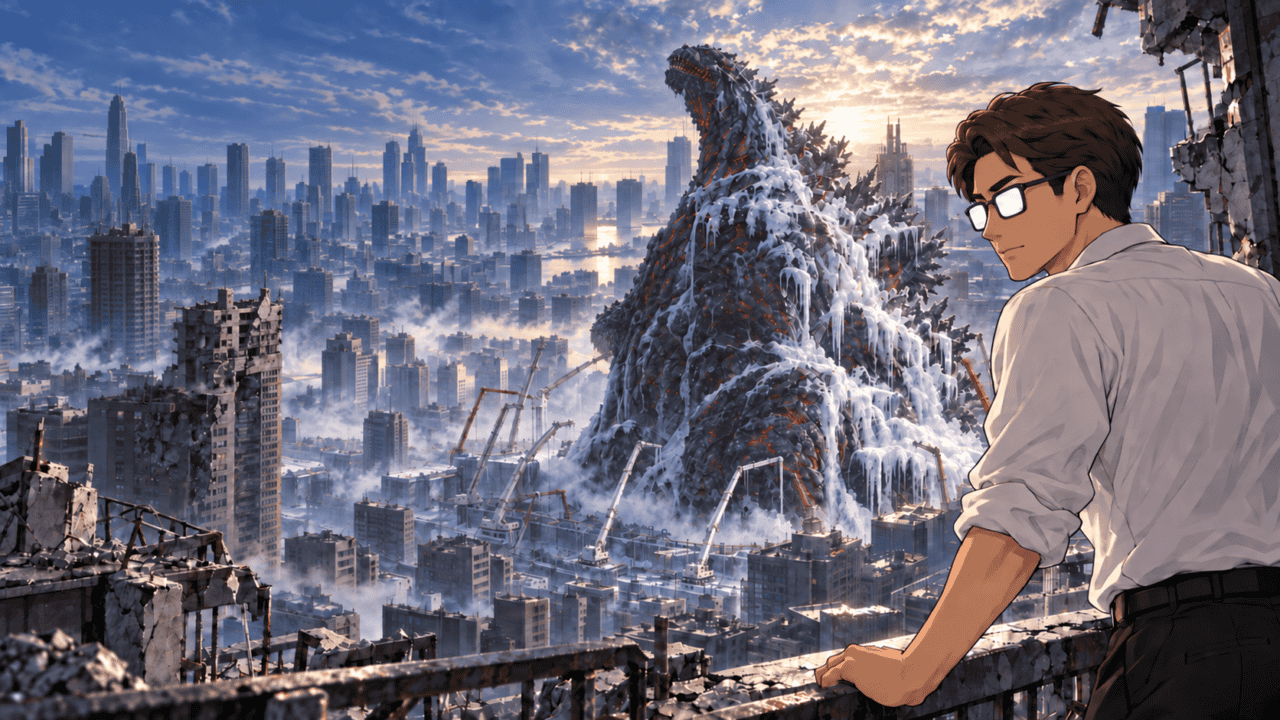
To understand why Godzilla couldn’t be killed, it helps to imagine what the story would have meant if he had been. Made after the Great East Japan Earthquake, the film bears its influence in various ways. I think we can read Godzilla’s final, motionless form as a symbol of a nuclear power plant. In 2016, a story in which everyone made sacrifices but ultimately gave Godzilla a good kicking would have amounted to an utterly irresponsible fantasy: ‘If we all work together, we can sort out the nuclear power problem too!’
That is why I think Shin Godzilla could only end by saying: ‘We will go on living, even as we carry the problem Godzilla represents.’
Seen this way, Godzilla represents something broader than the specific problem of nuclear power plants. He becomes a symbol of problems we cannot currently solve. This is also a theme of Anno’s television series Evangelion and Miyazaki’s Princess Mononoke. (For another discussion of this theme, see our comparison of the final episodes of Evangelion and Gundam.)
To sum up, my answer to why Godzilla couldn’t be killed in this film is that we live with problems that cannot be solved even if we join forces and fight with everything we have. Offering a comforting fantasy ending might have been one option, but I don’t think it was possible in 2016. Still, for all this rather involved analysis, when that familiar music started playing over the end credits, I thought, ‘Ah! We’ve just watched a Godzilla film!’ What a thrill.
Appendix: The Nightmare at the Tip of the Tail
And then there is that final shot of Godzilla’s tail in Shin Godzilla. It looks as though a whole lot of alien-like creatures are emerging from its tip. End the film there, and a first-time viewer is left thinking, ‘What on earth was that?’ Enough to keep you awake at night.
But there is no need to agonize over it: the film explains it, in dialogue. Around the 1 hour and 17-minute mark, members of the Giant Unidentified Lifeform Disaster Response Team discuss the following possibility:
‘We have assessed the possibility of Godzilla reproducing asexually by comparing events observed in various places with data from Tsukuba. We predict that the number of individuals will grow exponentially around the world.’
“From an evolutionary standpoint, it’s possible they won’t just become smaller, but could also become winged and fly between continents!”
In other words, I read the ending as a very narrow escape: had they been a little later, Godzilla could have become smaller, grown wings, reproduced on his own, and spread around the world. That final shot says, ‘We made it just in time.’ But it also tells us that we cannot leave the problem unattended any longer. This is not straightforward entertainment that lets us walk out of the cinema beaming and saying, ‘Well, that was fun!’
Your Take: Shin Godzilla’s Ending
Operation Yashiori stops Godzilla, but leaves him frozen in the city. What does that ending mean to you?
Poll results
What does Shin Godzilla’s ending mean to you?
- A hard-won victory through cooperation.0%
- A temporary escape from an even greater disaster.0%
- Living with a problem that cannot be fully solved.0%
- Several of these meanings at once.0%
- Something else.0%
- I’m not sure.0%
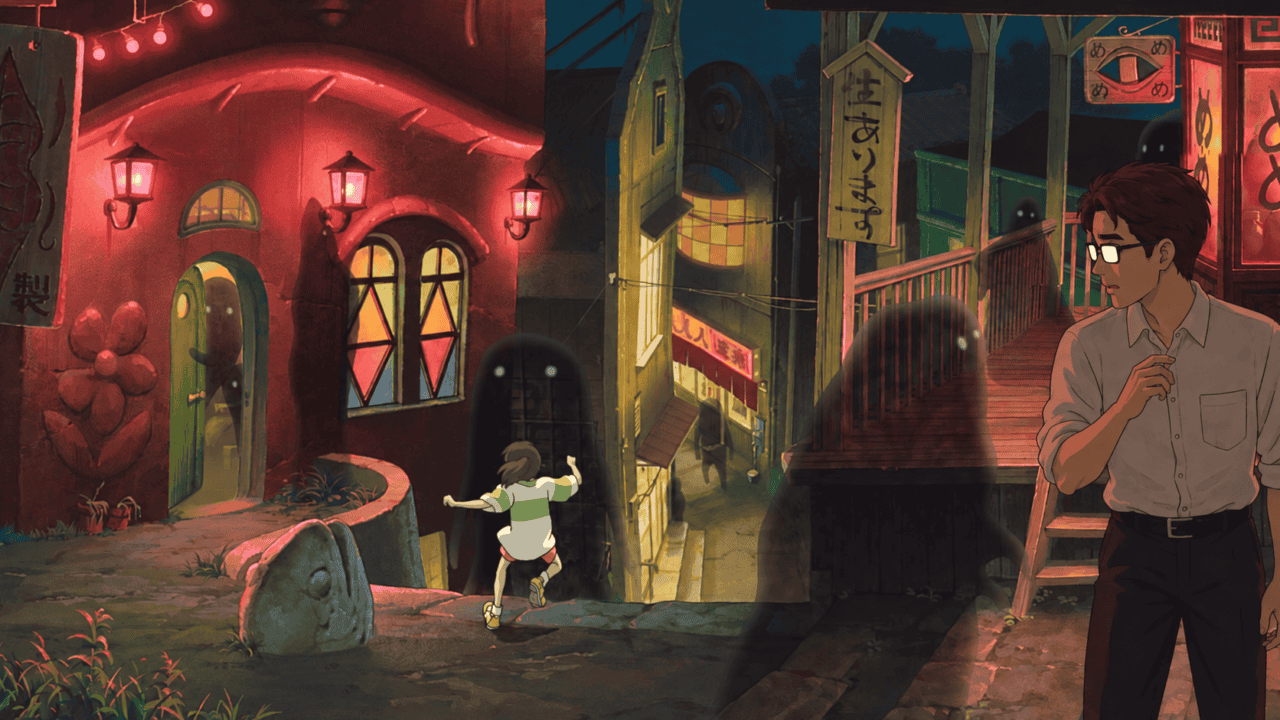
The images used in this article are from the official Shin Godzilla promotional materials and the “Studio Ghibli Still Images” collection.

Reader Comments
Have a thought or interpretation? Leave a comment