
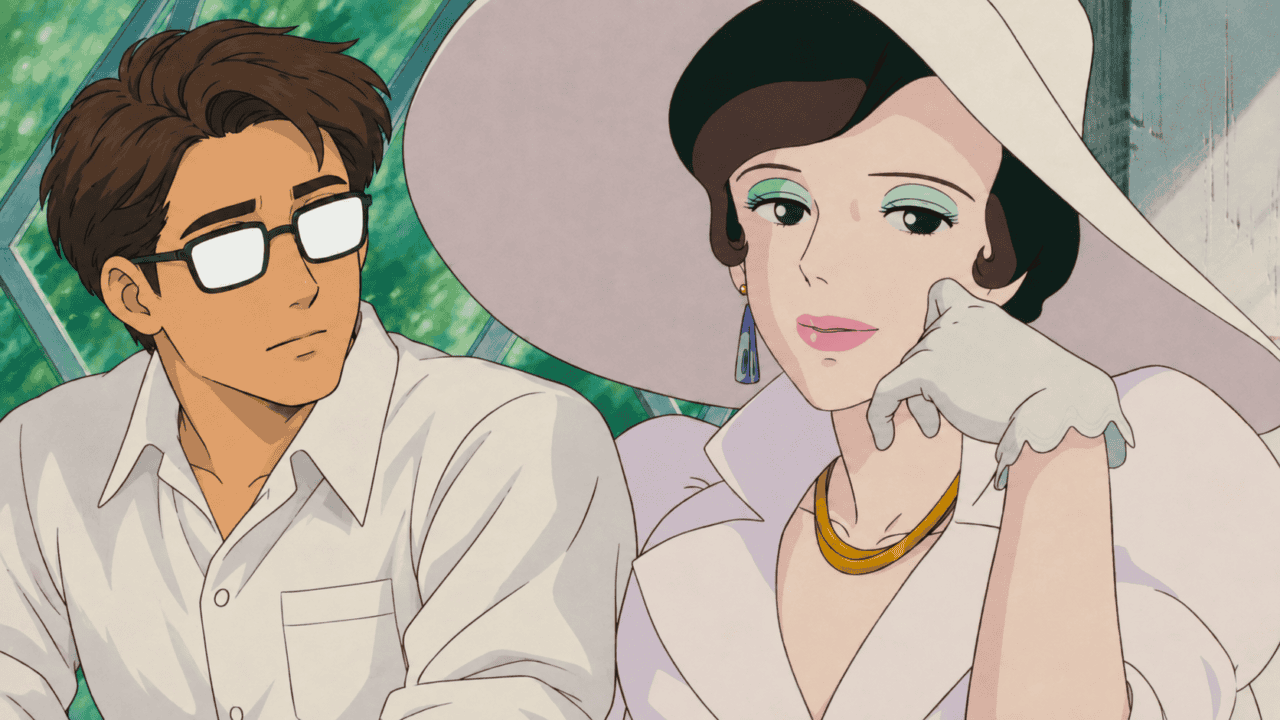
Hayao Miyazaki’s Porco Rosso(Studio Ghibli Official) was released in 1992.
I have watched it many times since childhood, finding something new with each viewing. This time, I want to focus on Madame Gina.
At one point, Gina says:
“I’ve already lost three pilot husbands. One in the war, one in the Atlantic, and the last one died in Asia.”
(Original Text, in Japanese)
「私は三回飛行艇乗りと結婚したけど、一人は戦争で、一人は大西洋で、最後の一人はアジアで死んだって。」
The English subtitle reveals immediately that Gina has already lost all three husbands, while the Japanese delays the confirmation of the third man’s death until the end of the sentence. Compare the original Japanese, romanization, subtitle, literal translation, and dub in our detailed analysis of Gina’s devastating line.
The air pirates’ and Curtis’s behavior makes it clear how popular Gina is. With seaplane pilots around her from a young age, it is understandable that she married men who flew them.
What interests me, though, is the order. Porco Rosso—or Marco Pagot, to be precise—is a war hero. Why is he the fourth man she chooses?
He appears as a stout pig now, but was handsome when young. There seems to be no obvious reason to leave him until fourth. And if Gina thought of him as merely the fourth man in line, why turn down Curtis’s passionate proposal?
Watching casually, we might never question Gina’s judgment. But repeated viewings lead me to wonder about some peculiar things.
I want to put her reasons for turning Curtis down into words and explore her inner life. Why does she choose Porco only after three other men, yet reject Curtis? First, let us consider her earlier marriages.
*This is a translated version. The original (Japanese) is available here.
- Gina’s Husbands: The Men She Could Manage
My theory is that these seaplane pilots are rogues, but Gina chooses her childhood friends in order of how likely they are to listen to her. Their long history of admiring her gives her something to rely on. - Curtis and Porco: Similarities and Differences
In this reading, Curtis is a skilled but unmanageable rogue, without the shared past that binds Gina’s childhood friends to her. Porco is the hardest of those friends to manage, yet has admired her for years. He becomes her final bet. - Saint-Exupéry, the Atlantic, and Asia
Her two husbands who die after the war may have been airmail pilots. Considering historical mail routes, I suggest that their deaths in the Atlantic and Asia may echo the life of Saint-Exupéry, whom Miyazaki admired.
On this pageContents
Why Gina Turns Curtis Down and Chooses Porco Last
Gina’s past marriages and her exchanges with Curtis put her choices in perspective. They also complicate the idea that she is simply waiting passively for Porco.
Who Were Her Three Husbands—and Whom Did She Marry First?
The film does not explicitly identify all three husbands. But taking the number three as a clue, I think they may be the men in the photograph where Marco’s face has been obscured.
On that assumption, we might infer the following:
- Gina, Marco, and the three men were childhood friends.
- The men had been in love with Gina since they first knew her.
- All three became seaplane pilots, though Marco was the more skilled.
- They were all “good guys.”
That last point finds a little support in Porco’s line:
“All the good guys are dead.”
(Original Text, in Japanese)
「いいやつは皆しんだ。」
He may also mean those killed in the war. But he says it immediately after Gina tells him of her third husband’s death, so it seems natural to think he has those three men particularly in mind. Then he raises a glass with her: “To friends.”
If we take this view, the central question is the order in which she married them.
Marrying the “Good Guys,” Stage One
To infer that order, consider Porco, chosen fourth; the air pirates, treated as customers; and Curtis, whose ardent proposal she rejects.
What sort of men are they, really?
The First World War is over, and the world faces renewed turmoil around the Depression. Most people struggle to live within those conditions. Men like Porco, the pirates, and Curtis seem instead to have escaped them. From outside, they look like rogues.
We should not forget the damage done by the First World War. The pirates, too, may have been men called up to fight. It would be understandable for them to feel they wanted no part of this world. Those who did not become rogues may have felt much the same.
Such men might be fine for a romance, but marriage is another matter. They may seldom come home, take up with someone else, and feel no shame about it.
Conversely, the men Gina found marriageable may have been those who seemed capable of sustaining a marriage. Perhaps she married them in that order. Obvious enough, you might say—but it makes the fate of her second and third husbands worth considering.
The Better Pilots May Be the Greater Rogues
Gina says her first husband died in the war. That suggests the other two survived it.
Perhaps, then, they had enough skill to survive, even if they were not Porco’s equals. My assumption is that pilots who could fly would have been called up; the film does not give us their full service histories.
I think she married the “good guys” first. The later husbands’ jobs are not specified, but perhaps they died in the Atlantic and Asia because they never stopped flying.
I will consider their work in the Saint-Exupéry section below. My suggestion is that they were airmail pilots.
In this reading, they survived a terrible war, yet still could not leave their seaplanes behind. Such may be the hold that flying has over an aviator.
But the question here is marriage.
A wife might wish her husband would stop flying. Two of Gina’s husbands appear to have died in flying accidents, after all. Yet they continued to live as they pleased. In that sense, they too were rogues. Perhaps that temperament and their skill as pilots were two sides of the same thing.
Thinking this far, we want to say: then don’t marry seaplane pilots! The husbands who died after the war begin to seem rather less like “good guys,” too. Perhaps Gina’s wishes were a little more complicated.
Marrying the “Good Guys,” Stage Two: A Rogue She Can Control
Across times and places, many men have lamented that bad boys are popular. There may be many reasons for it. For this argument, what matters is that familiar, rather dispiriting observation.
Gina seems no exception. She is not depicted as someone likely to fall for a man whose life is entirely safe and uneventful.
When it comes to marriage, her ideal may be a popular rogue who somehow has eyes only for her—and listens to her. Rather like the man who falls for the heroine of a girls’ romance manga. I suspect rather a lot of women might recognize the appeal.
Why might her childhood friends have seemed to fit that ideal?
- They had admired her since they were young.
- They were skilled pilots.
- They were popular with others, too.
- They had the dangerous air of men who might disappear somewhere.
Perhaps that last quality matters most. They seem liable to disappear, yet somehow likely to stay near her. Their history of admiring her as childhood friends may have been the basis for that belief.
Gina is surrounded by pilots in the film, so she seems to have had choices beyond these four men. But she had known them since they were young, and her experience of them listening to her may have mattered a great deal.
Perhaps she married them in the order in which they seemed likely to listen to her. Put differently, she chose the rogues she could control first. That reading also suggests why she turns Curtis down.
Why Does Gina Turn Curtis Down?
Curtis is a pilot skilled enough to rival Porco. His later success as an actor also suggests that he is attractive and popular, though the film may not make that immediately obvious.
If greater skill goes with a more unruly temperament, then Curtis may be more than Gina can handle.
On screen, Gina seems the more mature and practiced of the two, neatly deflecting his advances. That is one straightforward way to see it. But if we begin with the idea that she has only chosen men who have admired her since they were young, perhaps Curtis fails to appeal because she cannot control him.
The same reading brings us to why Marco comes last.
Why Porco—Marco—Comes Fourth
By this point, a possible answer begins to emerge. Gina says this to Curtis:
“I’m making a bet: if he visits while I’m here in this garden, this time I’ll love him.”
(Original Text, in Japanese)
「私がこの庭にいるときにその人が訪ねて来たら、今度こそ愛そうってカケしているの」
It is a rather high-handed remark. Given the argument so far, I think Porco comes last because of the men she had known for years, who had always admired her, he was the hardest to control.
On this reading, it is neither his pig’s face nor a lack of admirers that puts him last.
She chooses the easier men first, leaving the most unmanageable one for her final bet.
The film tells us relatively little about Gina’s inner life, so her choices allow for different interpretations. This is one way I think they can be understood.
Saint-Exupéry and Miyazaki: What Might the Two Husbands Have Done?
Miyazaki’s admiration for Antoine de Saint-Exupéry is hard to leave out of a discussion of Porco Rosso.
His feelings towards the author of The Little Prince appear in the 1998 NHK program Journey of the Heart: Saint-Exupéry, a Dream of the Great Sky (世界・わが心の旅 サンテグジュペリ 大空への夢).
The documentary follows Miyazaki as he traces Saint-Exupéry’s life. It shows how strongly the writer influenced him. Towards the end, with tears in his eyes, Miyazaki says:
“In the end, it was Saint-Exupéry who influenced me the most.”
(Original Text, in Japanese)
「サンテグジュペリに一番影響を受けたんですよ僕は。結局。」
Here is a great filmmaker saying that Saint-Exupéry influenced him more than anyone else.
Saint-Exupéry’s life is fascinating. Here is a brief outline:
| June 29, 1900 | Born in Lyon, France, to an aristocratic family. He showed an early interest in literature and machinery. |
|---|---|
| 1921 | Joined the French Air Force for military service. While stationed in Morocco, he began flight training and qualified as a pilot. |
| 1926 | Began work as an airmail pilot for Aéropostale. He flew mail between France and Africa, gaining experience in difficult conditions. |
| 1929 | Moved to Argentina and took charge of the Buenos Aires operation. His experiences as a pilot also informed his emerging work as a writer. |
| 1931 | Published Night Flight to considerable acclaim. His later works included Wind, Sand and Stars and The Little Prince. |
| 1939 | With the outbreak of the Second World War, he volunteered for reconnaissance flights. After France’s surrender, he continued writing in exile in America and elsewhere. |
| 1943 | Rejoined a reconnaissance unit in North Africa. Though age and health would normally have disqualified him, he received special permission to fly. |
| July 31, 1944 | Disappeared on a reconnaissance flight from a base in Corsica. Wreckage of his aircraft was later found off Marseille. |
What matters for this discussion is his work as an airmail pilot.
As the name suggests, airmail pilots carried mail by air. Given the aircraft technology of the time, it was demanding and dangerous work. Many risked their lives, with a crash always a possibility.
Might Gina’s two husbands who died after the war have been airmail pilots? The location that particularly catches my attention is Asia.
With a film set in Italy, a death in the Atlantic does not strike me as especially strange. Asia is another matter. But if the men flew mail routes, it begins to make sense.
That is the possibility I want to explore.
Before the Second World War, airlines in France, Britain, and Germany carried mail by air. Latécoère’s Atlantic route ran from Dakar through Natal to Rio de Janeiro; Imperial Airways connected London, Singapore, and Australia; and Deutsche Luft Hansa had an Asian route linking Berlin, Bangkok, Hanoi, and Taipei. Each also operated other routes.
In other words, the deaths of Gina’s two husbands become plausible if we imagine them as airmail pilots.
Perhaps the references to the Atlantic and Asia contain something of Miyazaki’s affection for Saint-Exupéry.
Historical Context Note: The real-world airmail routes referenced in this analysis were operated by pioneer aviation companies such as Aéropostale (Latécoère), Imperial Airways, and Deutsche Luft Hansa.
Your Take
What is your view? Choose the answer that comes closest to your own response.
Reader poll
Can you name the movie before the scene comes into focus?
Put your visual memory to the test with a blurred Studio Ghibli scene.




Reader Comments
Have a thought or interpretation? Leave a comment