
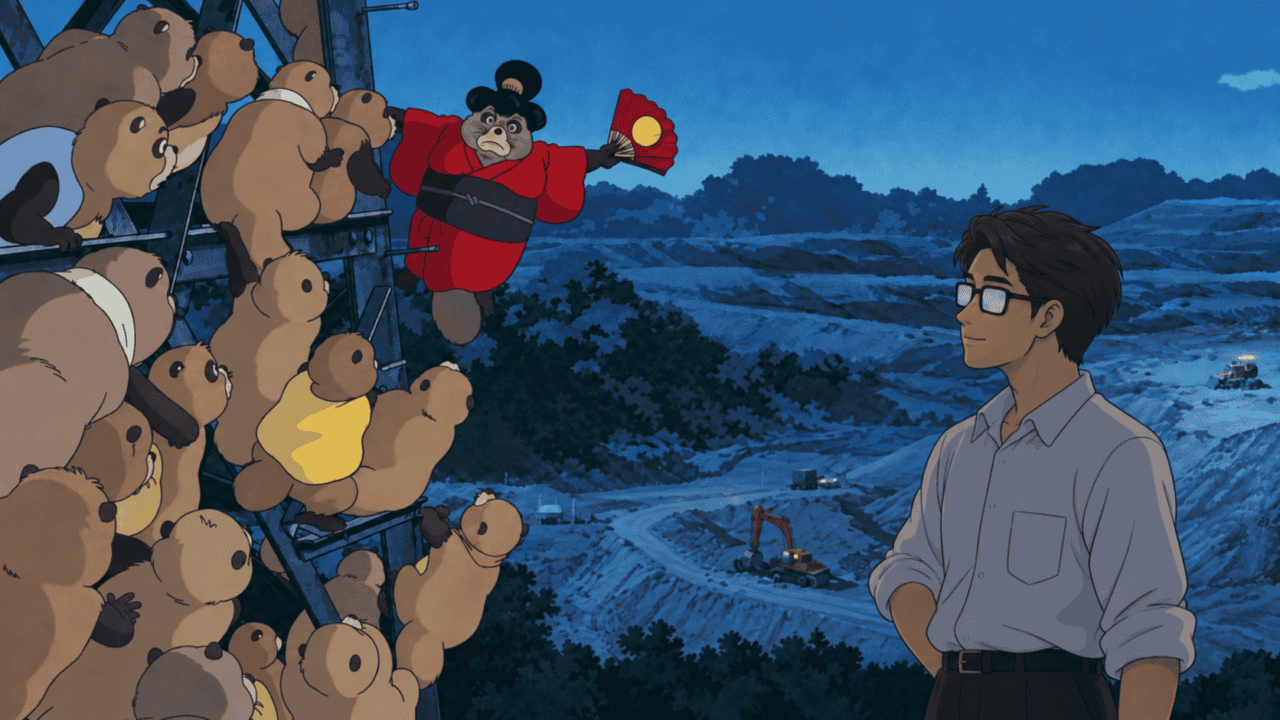
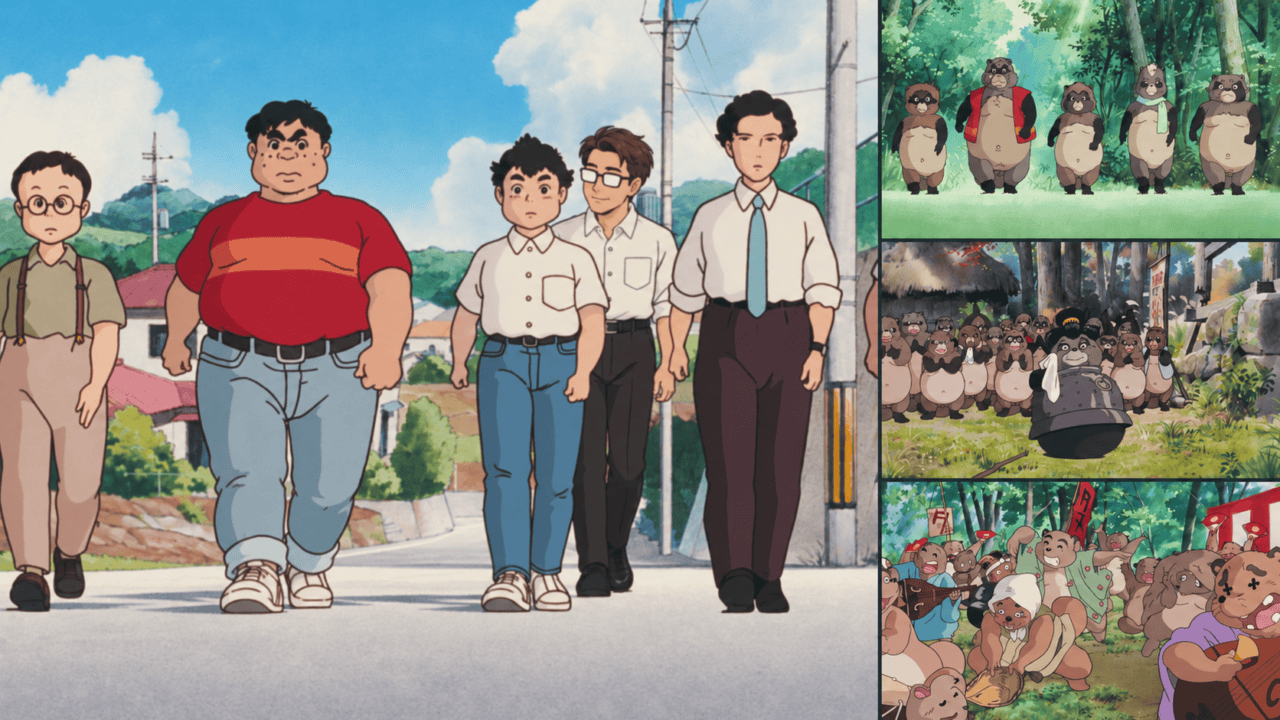
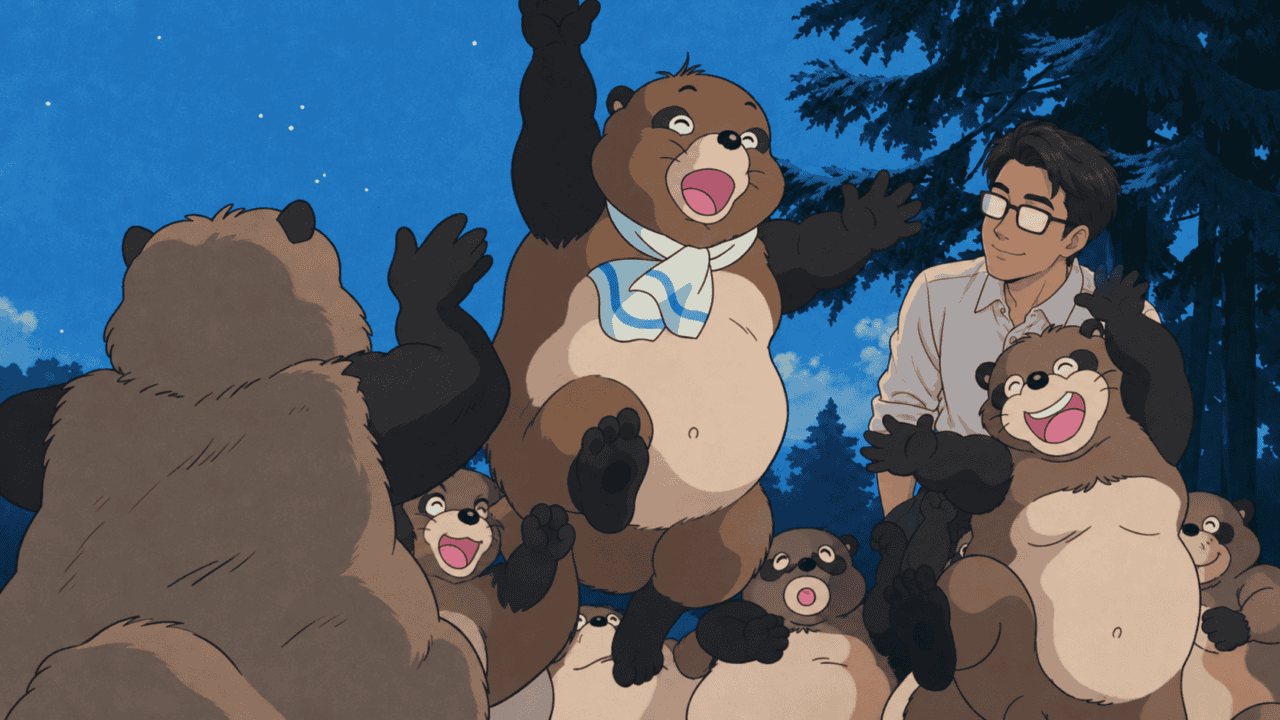
Pom Poko(Studio Ghibli Official) is Isao Takahata’s 1994 animated film about shape-shifting tanuki, or Japanese raccoon dogs. Here, I want to consider what makes its opening so interesting—and end with a rather less respectable theory of my own.
Early in the film, Oroku breaks up the fighting between the tanuki and tells them this is no time to fight among themselves. Her intervention sets the story on its course: without it, the film would go nowhere. But I think her words have another meaning, too. After exploring that, I will turn to my own idea about the secret art she teaches the young tanuki.
*This is a translated version. The original (Japanese) is available here.
- Oroku’s Intervention as a Critique of Miyazaki’s Proposal
I read Oroku’s interruption of the tanuki fighting as Takahata’s response to the proposed adaptation of Happyakuya-danuki: “Is this really the sort of film we should be making now?” - The Secret Art: A Bawdy Theory
My admittedly unsupported theory is that the secret art means wrapping yourself in your own scrotum so that humans will not recognize your body as a dead tanuki. - Gonta and the Absurdity of Being Serious
If the other tanuki’s raincoats were their transformed scrotums, while Gonta refused to use the technique, the scene would combine tragedy with the kind of absurd comedy that runs through Pom Poko. That is my interpretation, not a confirmed explanation.
On this pageContents
Pom Poko: Oroku’s Words and the Secret Art
Oroku’s intervention brings the tanuki’s comic behavior and their struggle to survive together. The wording and the secret art matter to how those two sides connect.
Why Did Oroku Stop the Tanuki Infighting?
To explore why Oroku stops the fighting, I need to begin with a story about the making of Pom Poko.
The Pitch for Shigeru Sugiura’s Happyakuya-danuki
Toshio Suzuki’s account in Ghibli Textbook 8: Pom Poko (ジブリの教科書8:平成狸合戦ぽんぽこ, in Japanese) traces the film’s beginnings to a remark Miyazaki made after completing Porco Rosso, to the effect that: “Since I did a pig, Takahata-san should do a tanuki.“
My reading is that Miyazaki wanted Takahata to expose something of himself, as Miyazaki had done in Porco Rosso, a kind of autobiographical fiction. Of course, I doubt it was quite that simple, but perhaps that was what he hoped the film would be. Suzuki was enthusiastic, too.
What direction, then, could a tanuki film take? Miyazaki and Suzuki proposed using Shigeru Sugiura’s manga Happyakuya-danuki as a starting point.
I bought the manga on Amazon and read it. It has Sugiura’s characteristic fun and charm, but it is nothing like Pom Poko. It is essentially a tale in which good is rewarded, evil is punished, and the mischievous tanuki get their comeuppance. It is inexpensive enough that I would recommend reading it.
Takahata apparently could not find a way to make Happyakuya-danuki interesting. He looked for another approach, spoke with Hisashi Inoue, and researched what tanuki meant in Japan and to the Japanese before creating Pom Poko.
The resulting film begins with Oroku putting a stop to the fighting among the tanuki.
Reading Another Meaning in Oroku’s Words
With that background in mind, I think the scene’s meaning becomes clearer. It is as though Takahata were saying:
“Adapt Happyakuya-danuki today, and this is what you would get. Do you really think this is the film we should be making?”
To spell out my reading a little more: “This is the project you proposed. Should we really be making this kind of film now? Of course not. Right, let me show you what sort of film we should make!” I suspect that is the thought behind Oroku’s intervention.
It is beautifully done.
The scene tells us what is at stake for the tanuki—”Humans are taking our territory; this is no time to fight among ourselves!”—and, in my reading, also offers a final answer to Miyazaki and Suzuki’s proposal.
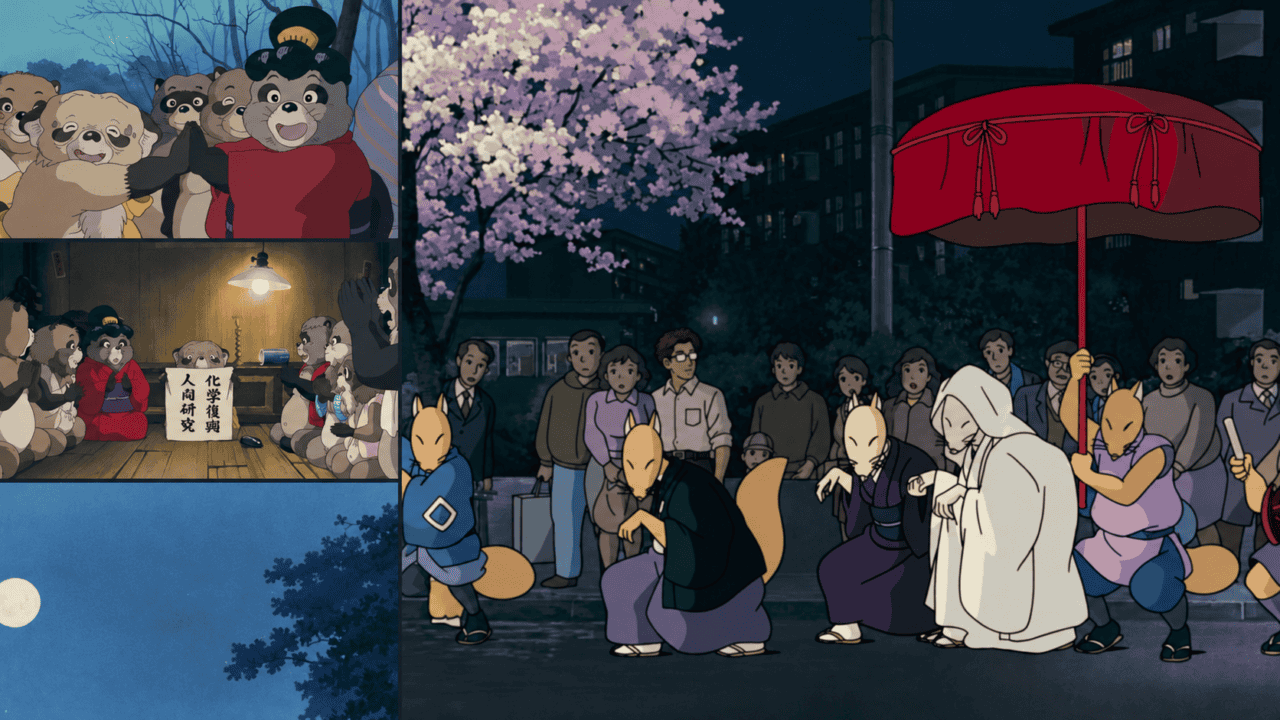
I think that same critical spirit finds visual expression in the Yokai Grand Operation parade. That deserves a discussion of its own.
But we should not forget that the people most sharply criticized here are us—the people who consume animation.
If we animation fans kept a sense of proportion, enjoyed anime as anime, took even a little nourishment for tomorrow from it, and kept struggling through our seemingly unchanging daily lives, perhaps Takahata might have made Happyakuya-danuki.
Instead, we can lose ourselves in animation and use it to escape reality. I think that was what worried Takahata most. To me, it has the same structure as the ending of The End of Evangelion, or Evangelion: 3.0+1.0: “Get back to your everyday lives!”
I read Oroku’s “This is no time for this!” as a combination of criticism of animation fans and Takahata’s own self-reproach at making a living by creating fiction.
Now, on to the secret art Oroku teaches.
What Was Oroku’s Secret Art?
I have been sounding rather superior up to this point. From here on, the discussion becomes a little more of a joke. What was the secret art Oroku taught? First, let us remember who received the lesson.
To prepare for the struggle with humans, the Tama tanuki educate their young, with Shokichi and Gonta among the first graduates. The hot-blooded Gonta soon proposes a plan to wipe out humanity. Oroku and the other elders oppose it, as you would expect, but youthful enthusiasm is hard to stop. Even Shokichi goes along with Gonta.
The real problem occurs next.
What the elders most fear is that the tanuki’s true nature will be exposed. We humans know there is no such danger, but to them it is a pressing concern. As a precaution, Oroku teaches the young tanuki a secret art with a remarkable effect. It will make them:
Look like dead foxes for five days.
Yet, judging from what we see in Pom Poko, a transformation cannot last after death. When Gonta’s group launches its final attack, their transformations break even when they are struck with police batons. The tanuki hit by cars also return to their true forms. How, then, could this technique keep working after death?
I decided to approach this puzzle through a little wordplay.
Foxes, Inari, and…
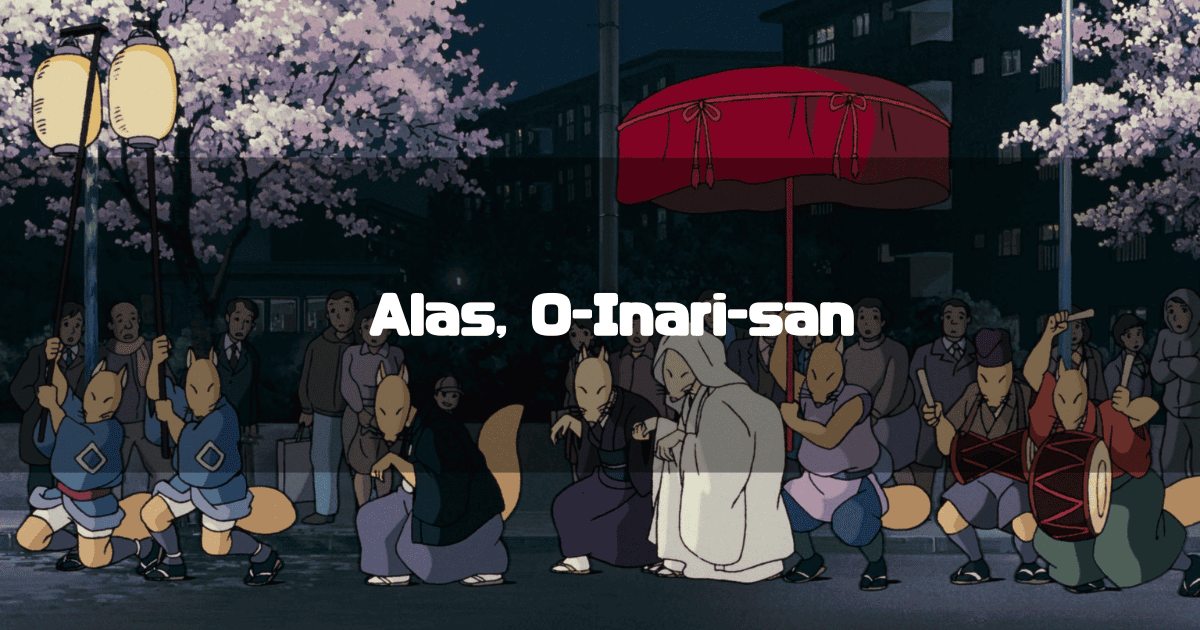
Oroku says “dead foxes.” Foxes bring Inari to mind; Inari brings us to “o-inari-san.” And what does that mean? I hesitate to say it, but in the joke I have in mind, it means balls.
(For the connections behind this wordplay, see the cultural appendix below.)
Some readers may be offended, but I cannot think of another way to explain Oroku’s secret art.
My idea is that Oroku’s instruction amounted to: “Wrap yourself in your own scrotum!“
Here is how I imagine it working. A tanuki wraps himself in his scrotum before the battle. If he loses consciousness or dies, the sack shrinks and conceals his body, leaving a wrinkled, bag-like object whose identity is not obvious at a glance. An o-inari-san, indeed!
Open the sack, of course, and you would find a dead tanuki. Perhaps the five days were meant to be the time humans would spend puzzling over it without touching it. Even that seems optimistic. They would probably identify the body the same day and record it in human history as an unknown aspect of tanuki biology.
Seen this way, the imagery of Gonta’s operation becomes funny, too.
It was raining that night, and the tanuki were wearing raincoats—kappa in Japanese. What were those coats? Scrotums, naturally. In my reading, everyone except Gonta had followed Oroku’s instruction and wrapped himself in his own scrotum, transformed into a raincoat.
Gonta, I imagine, thought, “There is no way I’ll fail!” and would not do anything so undignified. That would explain why he was the only one in his untransformed form.
Of course, this is only my imagination. I have no evidence for it. But it would fit the later scenes and the Pom Poko brand of comedy that reminds me of rakugo. A tanuki wrapping himself in his scrotum would be utterly serious, as would Oroku when teaching him to do it. What they were actually doing, though, would be ridiculous.
That combination of meaning and absurdity is what I find so interesting about Oroku’s words and actions in the opening of Pom Poko.
Cultural Appendix: Foxes, O-inari-san, and the Wordplay
The cultural associations around foxes, Inari, and wordplay add another layer to the scene. This appendix explains the references needed for that reading.
1. Fox (狐, Kitsune) and Inari Shrine (稲荷神社, Inari Jinja)
The wordplay depends on an association familiar in Japan: foxes and Inari shrines.
Inari Ōkami (稲荷大神): Inari is a Japanese kami associated with rice, agriculture, and prosperity. Inari shrines are found throughout Japan; Fushimi Inari in Kyoto is a well-known example.
Foxes as Messengers: Foxes (kitsune) are regarded as Inari’s messengers, not simply as the deity itself. Their role as messengers (tsukai) helps explain the fox imagery at Inari shrines.
Why Foxes?: Foxes and rice fields have a long association in Japanese belief. For this joke, the important connection is that the fox brings to mind Inari, a deity associated with rice.
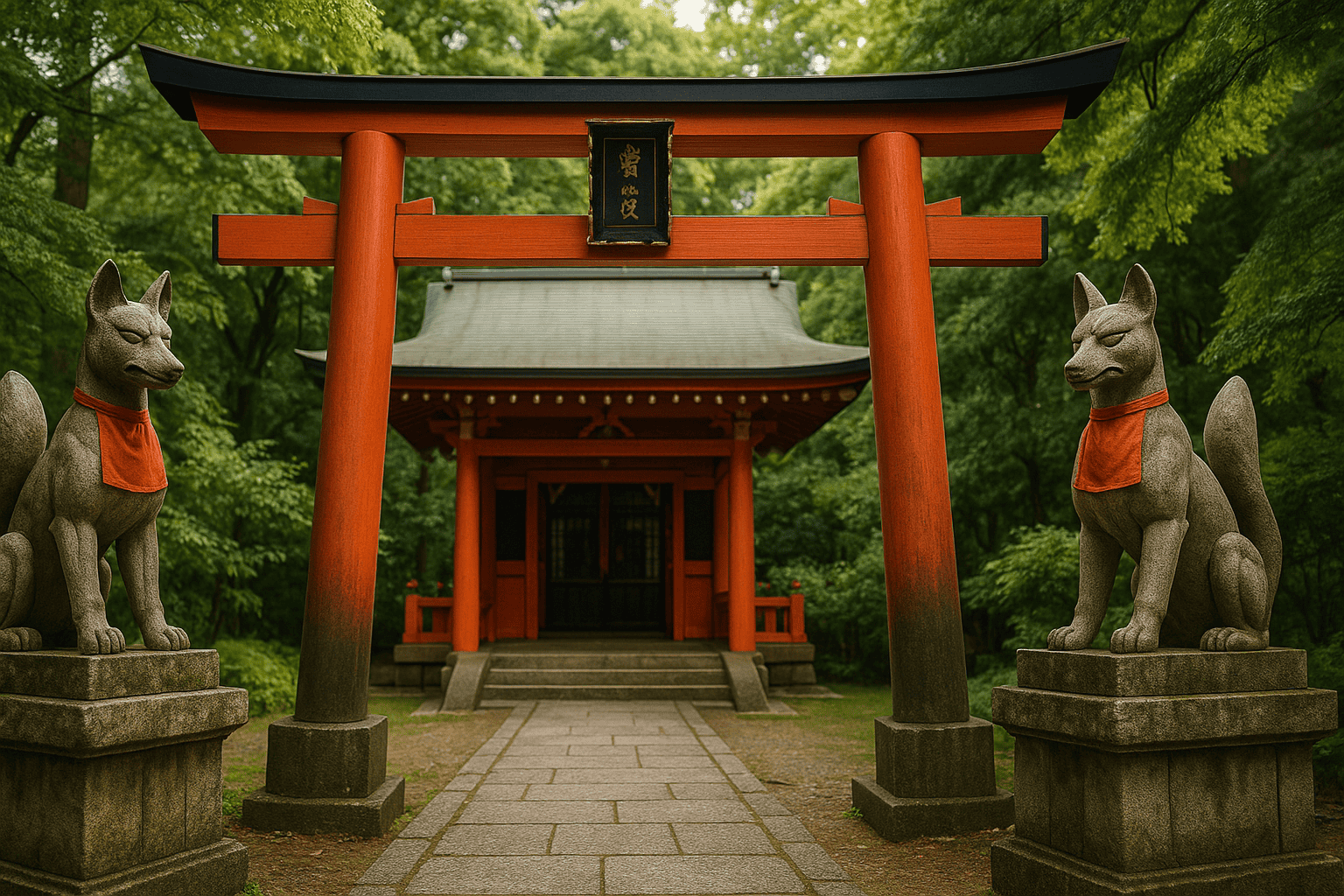
Fox statues are familiar features of Inari shrines, often appearing in pairs and carrying such objects as keys, jewels, or scrolls. Fried tofu, aburaage, is associated with foxes and offered at these shrines.
2. Inari (稲荷) and “O-inari-san” (お稲荷さん)
This is where linguistics and culinary traditions overlap.
Honorifics: Japanese “お” (o-) is a polite prefix, and “さん” (-san) an honorific suffix. Together they give us “o-inari-san,” a respectful or familiar way of referring to Inari.
The Food Connection—Inarizushi: “O-inari-san” can also refer to inarizushi (いなり寿司), sushi rice in a seasoned fried-tofu pouch (aburaage).
The Link: The association of foxes (kitsune) with Inari and fried tofu connects the name of the deity with inarizushi, or o-inari-san. That gives the wordplay another route from fox to pouch.
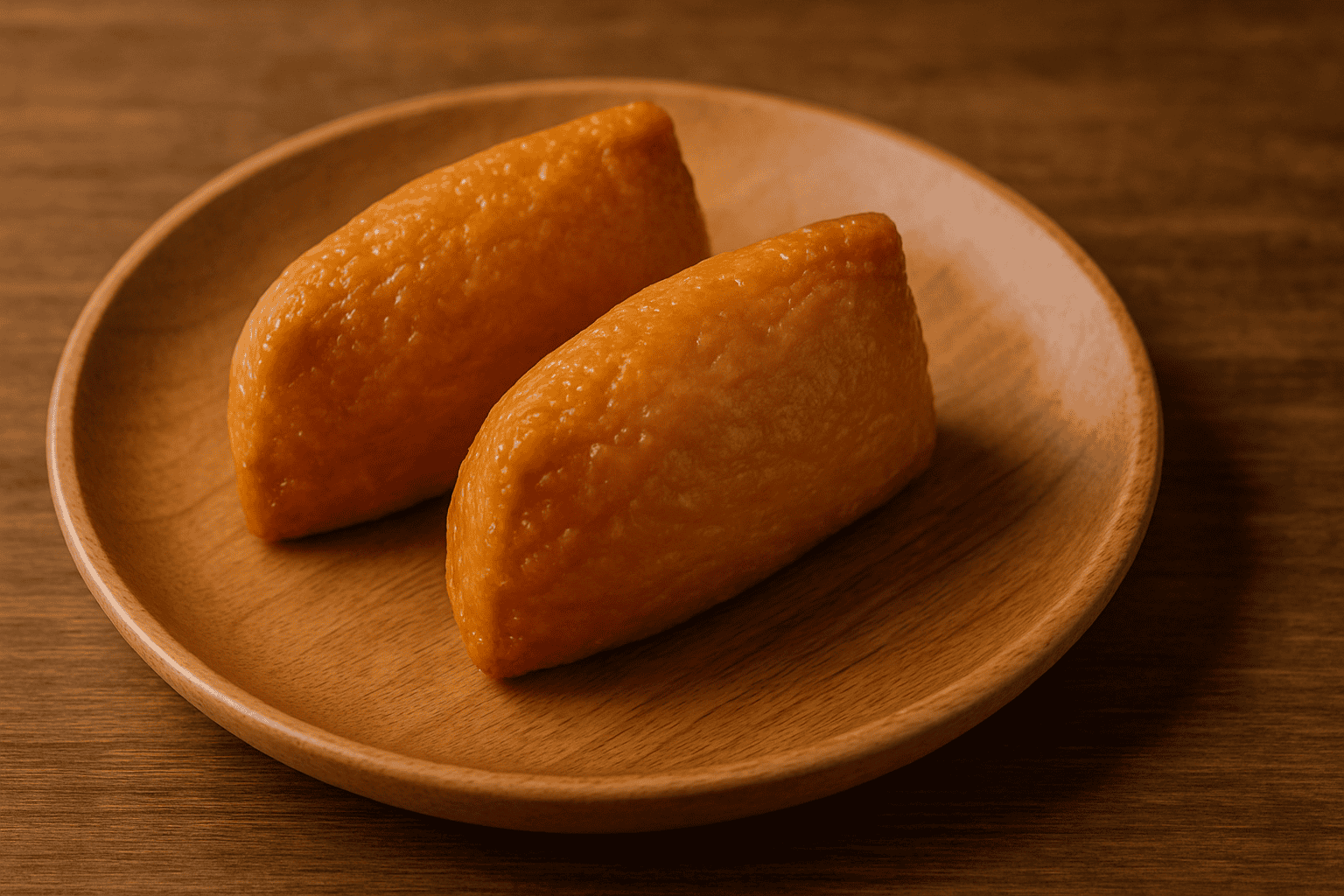
Depending on context, “o-inari-san” can refer to:
- The sacred Inari deity or shrine.
- Inarizushi, sushi rice in a fried-tofu pouch.
3. O-inari-san (お稲荷さん) and Testicles (睾丸, Kōgan)
The final step is a bawdy joke about anatomy, rather than an explanation of religious belief.
Visual Similarity: The wrinkled pouch of inarizushi offers a visual association with the scrotum. In my reading of the film, that resemblance brings the wordplay back to the tanuki’s body.
The Bawdy Meaning: Here, “o-inari-san” takes on its joking sense of balls. A name that can refer respectfully to a deity or familiarly to food also lends itself to a rather less dignified association.
The point is the absurdity: the tanuki and Oroku would take the technique entirely seriously, while the act itself would be laughable. That contrast is what makes the theory feel in keeping with the rakugo-like comedy of Pom Poko.
Your Take
What is your view? Choose the answer that comes closest to your own response.
Poll results
How do Oroku’s words about the tanuki’s secret art strike you?
- Above all, they are funny.0%
- They express a defiant determination to survive.0%
- There is sadness beneath the joke.0%
- Several of these at once.0%
- I see the scene differently.0%
- I’m not sure.0%
The images used in this article are from Studio Ghibli Works Still Images.
Can you name the movie before the scene comes into focus?
Put your visual memory to the test with a blurred Studio Ghibli scene.


Reader Comments
Have a thought or interpretation? Leave a comment