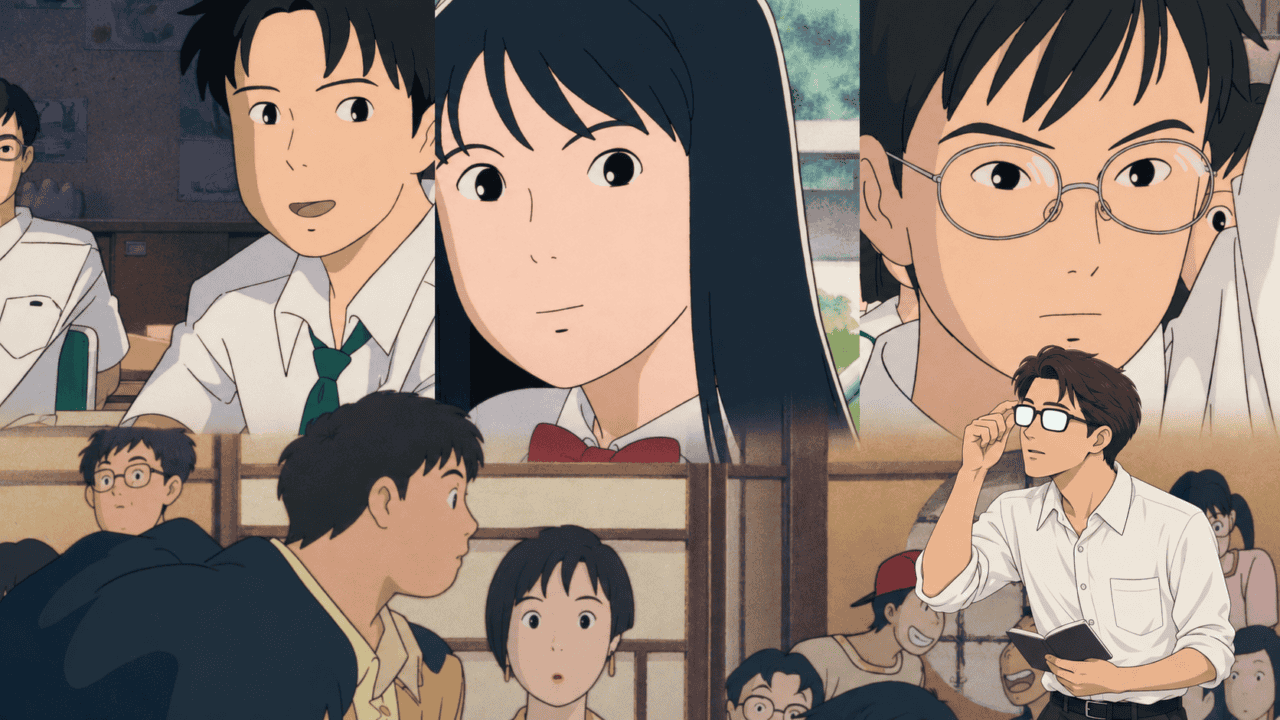
Ocean Waves(Studio Ghibli Official) is an animated film first broadcast in a 90-minute slot on the Nippon TV network on May 5, 1993.
Here, I revisit the characters and voice actors of Ocean Waves, considering what makes each character distinctive and how they contribute to the story. What sort of people inhabit this film?
The discussion below contains major spoilers, so please read with that in mind.
*This is a translated version. The original (Japanese) is available here.
On this pageContents
Ocean Waves (1993) Main Characters & Voice Actors List
The list below introduces the central students and the Japanese actors who voice them.
| Name | Age | Voice Actor (Japanese dub) |
|---|---|---|
 Taku Morisaki | 2nd year high school to 1st year university | Nobuo Tobita |
 Rikako Muto | 2nd year high school to 1st year university | Yōko Sakamoto |
 Yutaka Matsuno | 2nd year high school to 1st year university | Toshihiko Seki |
 Yumi Kohama | 2nd year high school to 1st year university | Kae Araki |
 Tadashi Yamao | 2nd year high school to 1st year university | Hikaru Midorikawa |
 Akiko Shimizu | 2nd year high school to 1st year university | Yuri Amano |
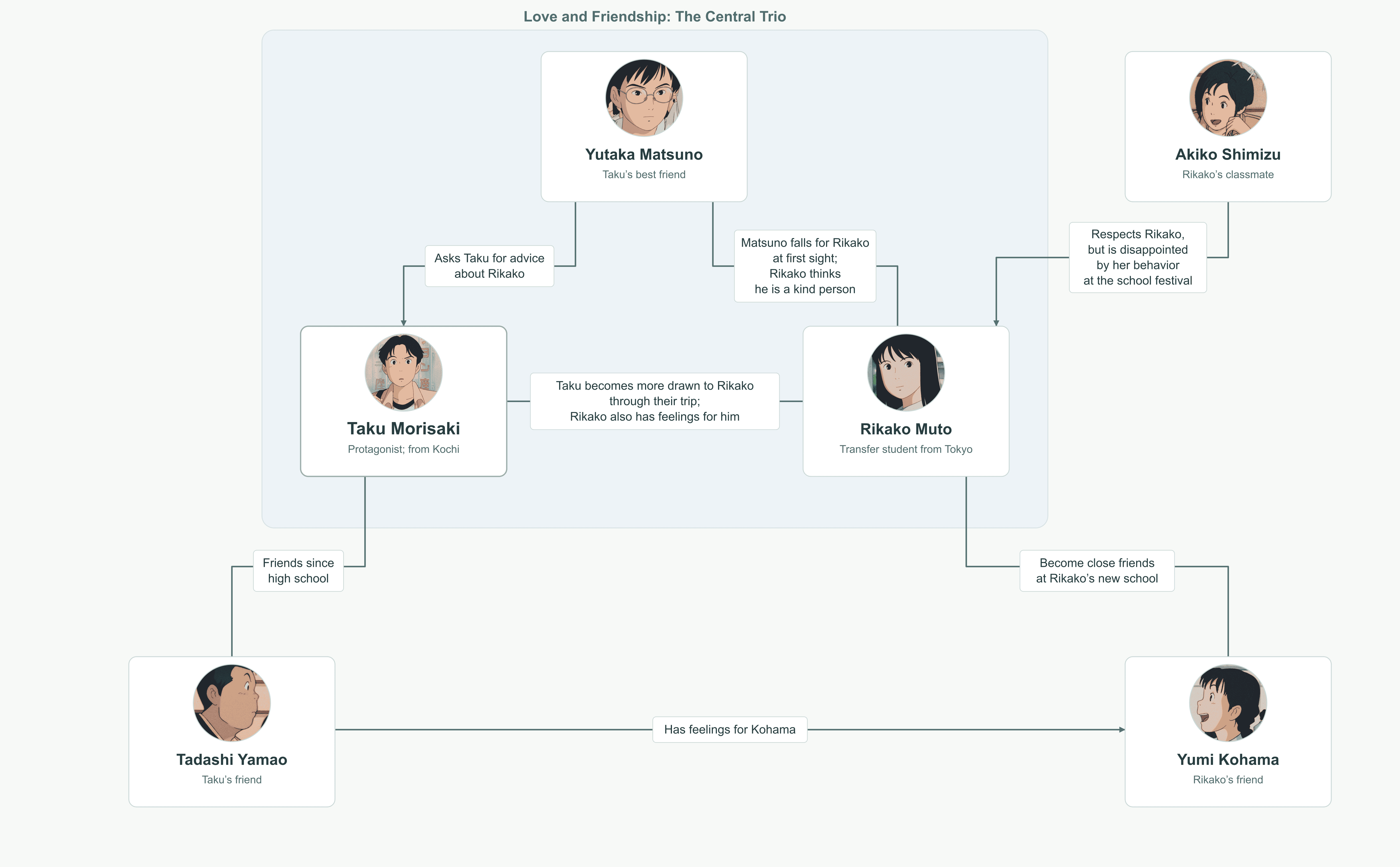
Ocean Waves (1993) Character Map
Taku’s friendships and Rikako’s arrival connect the characters in overlapping ways. The map outlines those relationships.
Ocean Waves (1993) Character Profiles and Analysis
The characters’ feelings and misunderstandings often look different when seen through Taku’s memories. These profiles consider their roles, relationships, and performances.
Taku Morisaki | Voiced by: Nobuo Tobita
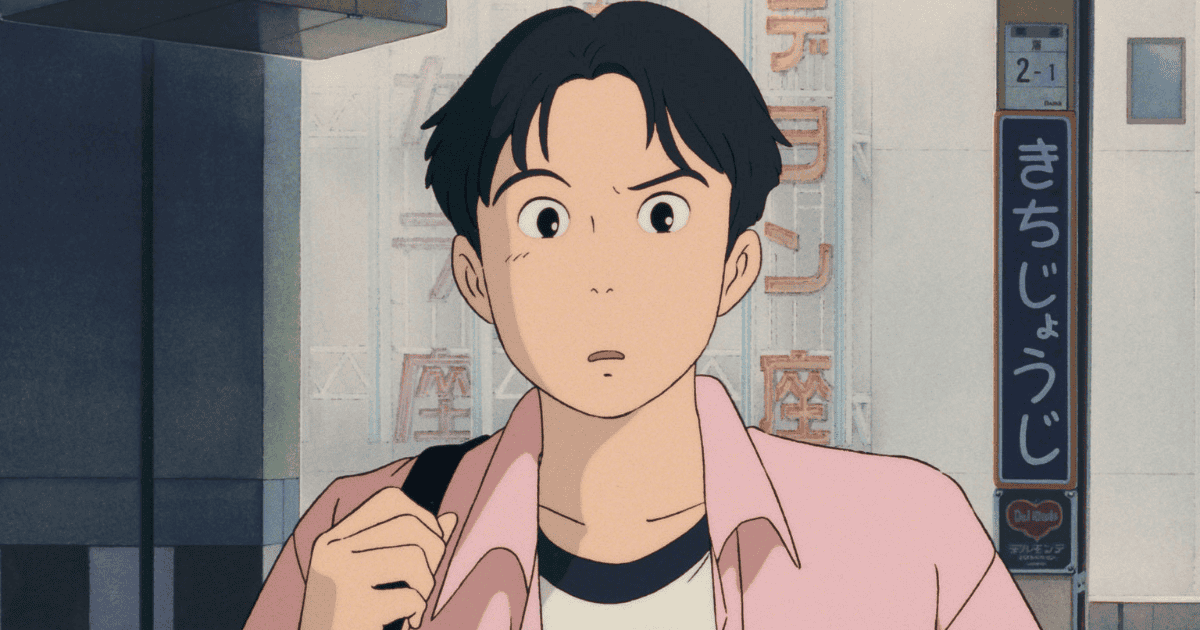
The Unreliable Narrator
The protagonist is a first-year university student from Kochi who now lives in Tokyo. Ocean Waves unfolds largely through his memories as he travels home for his high school reunion.
Although Taku is a character within the story, the story itself is his recollection. We experience it from his perspective, as the narration and internal monologues are all in his voice.
There is therefore no objective viewpoint: everything is filtered through what Taku saw, experienced, and felt. The other characters appear only as he saw them. One of the pleasures of Ocean Waves is using his perspective to imagine what may be going on inside everyone else.
And yet… that does not mean every one of his internal monologues tells the “truth.”
We do much the same ourselves. Think back to your school days: when you stood in front of someone you had a crush on, were you really thinking, “I love you, I love you, love you, love you!”? Perhaps some people were. But didn’t you somehow suppress those feelings—even though nobody could hear them?
The same thing happens in Ocean Waves: Taku deftly conceals his true feelings. Only at the end does it become clear that this was concealment all along.
Of course, we can already see what he is hiding. Enjoying these subtleties of youth is one way to appreciate Ocean Waves.
I explore this further in the article below:
Read the full analysis: Ocean Waves: A Story of Self-Deception
About the Voice Actor, Nobuo Tobita
Taku is voiced by Nobuo Tobita, whose many roles include Kamille Bidan in Mobile Suit Zeta Gundam. Once someone points it out, I can hear that it is the same actor—but I hadn’t really thought about it until I looked him up.
More surprisingly, Tobita also voices Maruo in Chibi Maruko-chan. I can hear something of both Kamille and Taku in that voice, but this, too, was something I noticed only after looking him up.
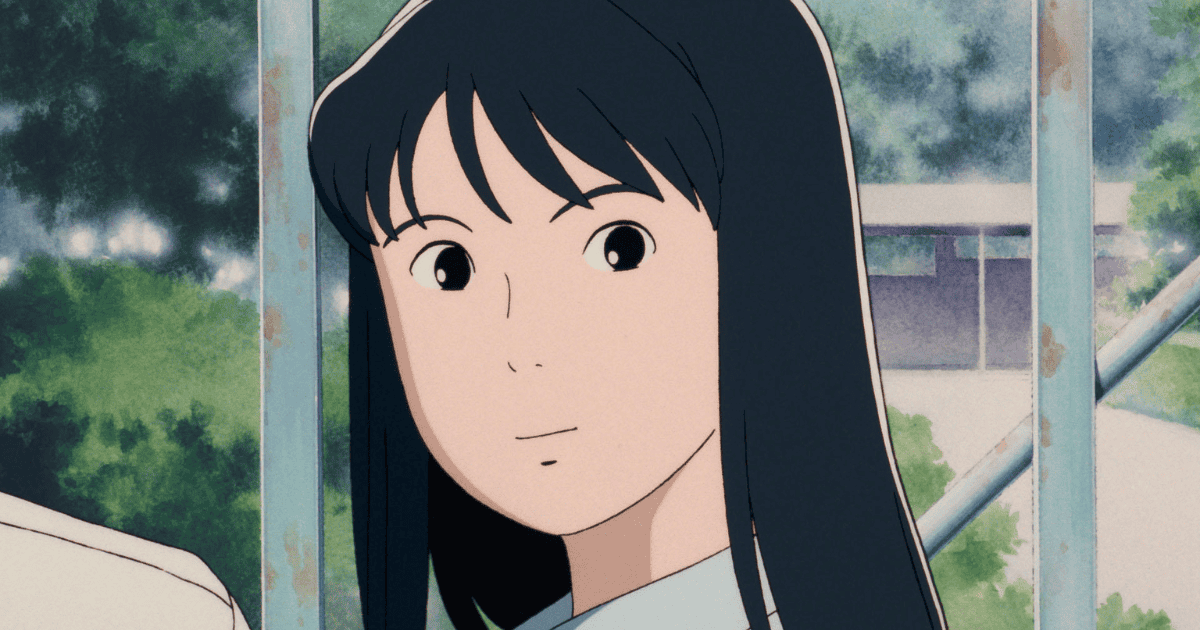
Rikako Muto | Voiced by: Yōko Sakamoto
The Disruptive Force of Tokyo
The other protagonist is in the same year as Taku: she, too, is now a first-year university student.
The story begins when Rikako moves from Tokyo to a high school in Kochi, bringing a gust of “Tokyo air” into two boys’ lives. More precisely, Taku and his best friend Matsuno are knocked sideways by it without her necessarily intending anything of the sort.
Had the story been set in Tokyo, it might have become Tokyo Love Story, ending with a line like, “Rikako Muto was Tokyo itself to me.” Its setting in Kochi, and the fact that the characters are still in high school, take it in another direction.
This is an entirely personal view, but wouldn’t a male viewer find Ocean Waves more interesting than Tokyo Love Story? I am happy to hear arguments to the contrary.
Rikako does more than knock the boys off balance: she also grows over the course of the story. Away from Tokyo, she encounters different relationships and values, comes to recognize how one-sided her outlook has been, and becomes a little more adult.
That may look a little too convenient, but isn’t that how life goes? People can grow—or go downhill—in an instant. Meeting other people really does matter.
About the Voice Actor, Yōko Sakamoto
Rikako is voiced by stage actress Yōko Sakamoto. Her other anime work includes Sakura Kozakai in episode 6 of the television series Shinigami no Ballad, directed by Tomomi Mochizuki, who also directed Ocean Waves.
She also sings the film’s ending theme, Umi ni Naretara (If I Could Be the Sea).
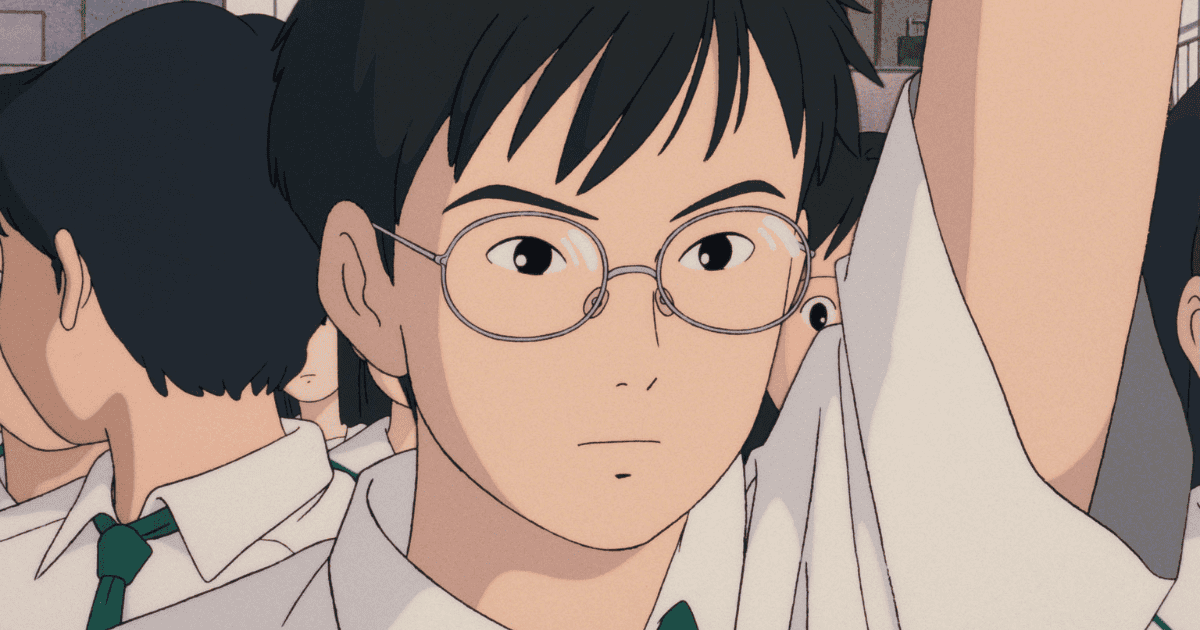
Yutaka Matsuno | Voiced by: Toshihiko Seki
The Tragic Best Friend
The story’s “shadow protagonist,” and a left-hander, is Taku’s best friend and the unhappy loser of this love triangle. His feelings for Rikako are crushed at the hands of his own best friend.
Matsuno is bright and probably went on to Kyoto University, but he is more than someone who does well at school: he has firm convictions, too. Frankly, if we were shopping for a boyfriend, surely Matsuno would be the better buy. But life is absurd.
Still, it takes quite a heart to keep going to school after the girl you love calls you “creepy.” Perhaps Matsuno’s heart of steel is what holds this story together.
I can only wish him happiness in the years ahead.
About the Voice Actor, Toshihiko Seki
He is voiced by Toshihiko Seki, who has appeared in so many works that growing up without hearing his voice would have been quite a challenge.
Among the roles I remember most fondly are Sakamoto Ryōma in O~i! Ryōma, Dew in Hakugei: Legend of the Moby Dick, and Doi-sensei in Nintama Rantarō.
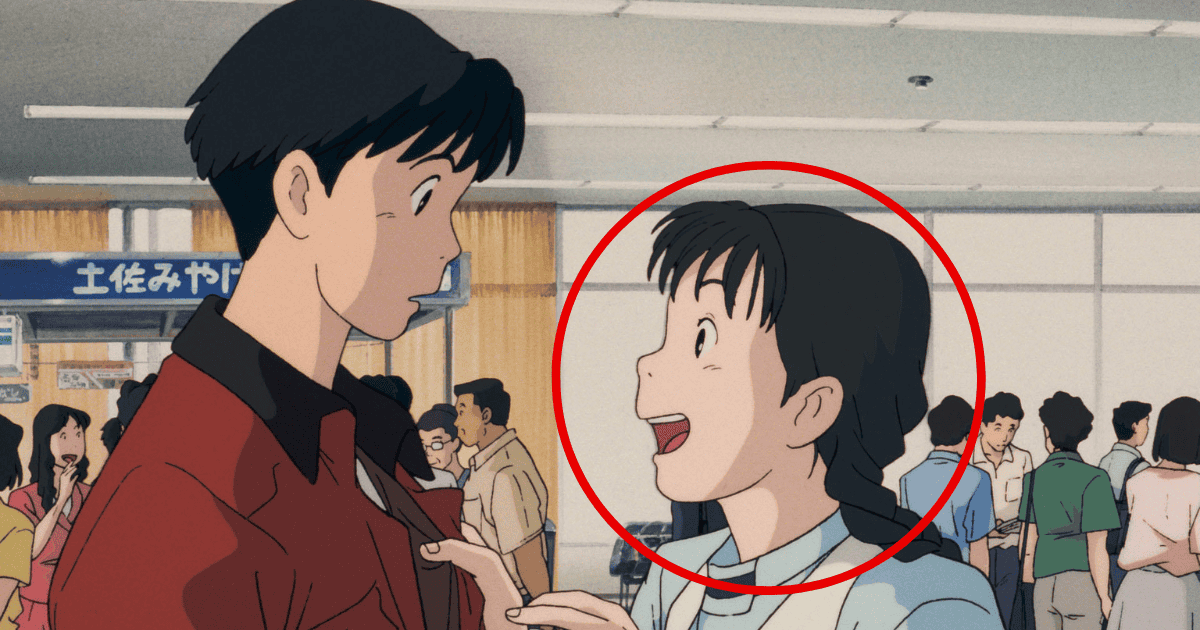
Yumi Kohama | Voiced by: Kae Araki
The Unwitting Catalyst
Rikako’s only friend at the Kochi school where she struggles to fit in—perhaps her best friend. Without Yumi, her high school life would surely have been very different.
Her biggest contribution to the plot is probably “passing the baton” to Taku for Rikako’s planned trip to Tokyo. Matsuno must have cursed her: “Why didn’t she call me?!”
A more cynical reading, though, is that until the trip ends, Yumi is simply a means for Rikako to put her plan into action. Rikako shows no particular attachment to having Yumi with her: Taku agrees to accompany her, and off they go.
For the Rikako who grows so much during that trip, however, Yumi probably becomes an irreplaceable friend.
Either way, she did a good job. For Taku, at least.
About the Voice Actor, Kae Araki
She is voiced by Kae Araki, whose many roles include Chibiusa in Sailor Moon, Hikari Yagami—known as Kari Kamiya in the English dub—in Digimon Adventure, and Hilde Schbeiker in Mobile Suit Gundam Wing.
Tadashi Yamao | Voiced by: Hikaru Midorikawa

The Background Friend
A friend of Taku’s who appears now and then. Was he really necessary? To me, he seems to be there so that Taku’s circle of friends does not look quite so narrow.
What we know about him is that he apparently likes Yumi and, emboldened by alcohol, blurts it out at the reunion.
No more, no less.
About the Voice Actor, Hikaru Midorikawa
He is voiced by Hikaru Midorikawa. For my generation, his best-known role may be Kaede Rukawa in Slam Dunk. His many other roles include Heero Yuy in Mobile Suit Gundam Wing, Seto Kaiba in the original Yu-Gi-Oh! anime, and Shintaro in Nangoku Shōnen Papuwa-kun.
Akiko Shimizu | Voiced by: Yuri Amano

Akiko’s Role in the Story
Akiko lectures Rikako for not helping with preparations for the cultural festival. She may have meant well, but few things are more infuriating than a lecture from someone your own age.
In the end, she confronts Rikako with a group of other girls, so she is hardly especially grown-up herself. At the reunion she laughs it off: “We were children.” But she can look back so lightly only because Rikako has a heart of steel. Had Rikako been a little more vulnerable, “we were children” might not have been enough to excuse what happened.
I was enthusiastic about my own high school festivals, too, but not every classmate shared that enthusiasm. The experience must have been painful for some of them. Living in the closed world of a school demands that we learn to tolerate people unlike ourselves; we call those who have not learned to do so “children.”
What a tangle of contradictions. What are we supposed to do with it?
About the Voice Actor, Yuri Amano
She is voiced by Yuri Amano, who also plays Keiko Yukimura, the heroine of Yu Yu Hakusho. For me, though, her voice is more closely associated with Rain Mikamura in Mobile Fighter G Gundam.
Other Characters
The Principal | Voiced by: Takeshi Watabe
The principal announces the cancellation of Taku’s school trip in his final year of junior high. “Thanks” to that decision, Taku meets Matsuno, so perhaps the principal did a good job after all.
Then again, since poor results in university admissions caused the cancellation, perhaps the older students who neglected their studies deserve most of the credit.
Kawamura | Voiced by: Kan Tokumaru
When Taku and his classmates protest the cancellation, this teacher throws out a discriminatory remark as casually as taking a breath: “You’re looking down on her because she’s a woman, aren’t you?” I doubt the day will ever come when he recognizes his own prejudice.
I would like to believe he simply lost his composure after being outargued just before this. Even so, I don’t want to become that sort of adult.
Rikako’s Father | Voiced by: Kinryu Arimoto
Had he been a man of upright conduct, Ocean Waves would never have happened. Perhaps he deserves more credit for the story than anyone else.
Rikako’s unexpected visit leaves him flustered, but he will probably manage to get along with his mistress somehow. I wonder whether they had a fight after Rikako left.
Okada | Voiced by: Jun’ichi Kanemaru
Rikako’s former boyfriend, the very embodiment of “unlikable.” It is probably during the conversation between him, Rikako, and Taku that Taku becomes someone special to her.
Okada and Rikako talk like the high school students they are. But Taku, having just heard his mother’s speech about a parent’s feelings, dismisses them both as “children.”
Had Taku not heard that speech, Ocean Waves would have been a very different story.
Taku Morisaki’s Mother | Voiced by: Ai Satou
As mentioned above, Taku’s mother unwittingly makes a “nice pass” to her son, giving him something that will matter in his conversation with Rikako and Okada.
Her speech in Japanese has nuances that the concise English subtitle does not fully convey, including its Kochi dialect and insistence on what a mother would naturally do for her child. The Japanese wording and translation are compared in our analysis of Taku’s mother’s speech.
For the romanization, subtitle, and literal translation side by side, see the detailed comparison of that speech.
Whether Taku realizes any of this is another question. If he does, he will never be able to thank his mother enough.
The Proprietress | Voiced by: Reiko Suzuki
The woman who runs the restaurant where Taku works part-time and tells him, “Taku, phone call for you.”
The Apprentice | Voiced by: Tomokazu Seki
The apprentice chef at Taku’s part-time workplace.
Your Take: Teenage Life in Ocean Waves
Friendships, first feelings, and the awkwardness of looking back all shape Ocean Waves. Which part feels most familiar to you?
Poll results
Which part of Ocean Waves feels most true to teenage life?
- Struggling to admit your feelings.0%
- Friendships becoming complicated by romance.0%
- Feeling out of place at school.0%
- Looking back and recognizing your own immaturity.0%
- Several of these equally.0%
- I see it differently.0%
The images used in this article are from Studio Ghibli Still Images.
Can you name the movie before the scene comes into focus?
Put your visual memory to the test with a blurred Studio Ghibli scene.
Reader Comments
Have a thought or interpretation? Leave a comment