
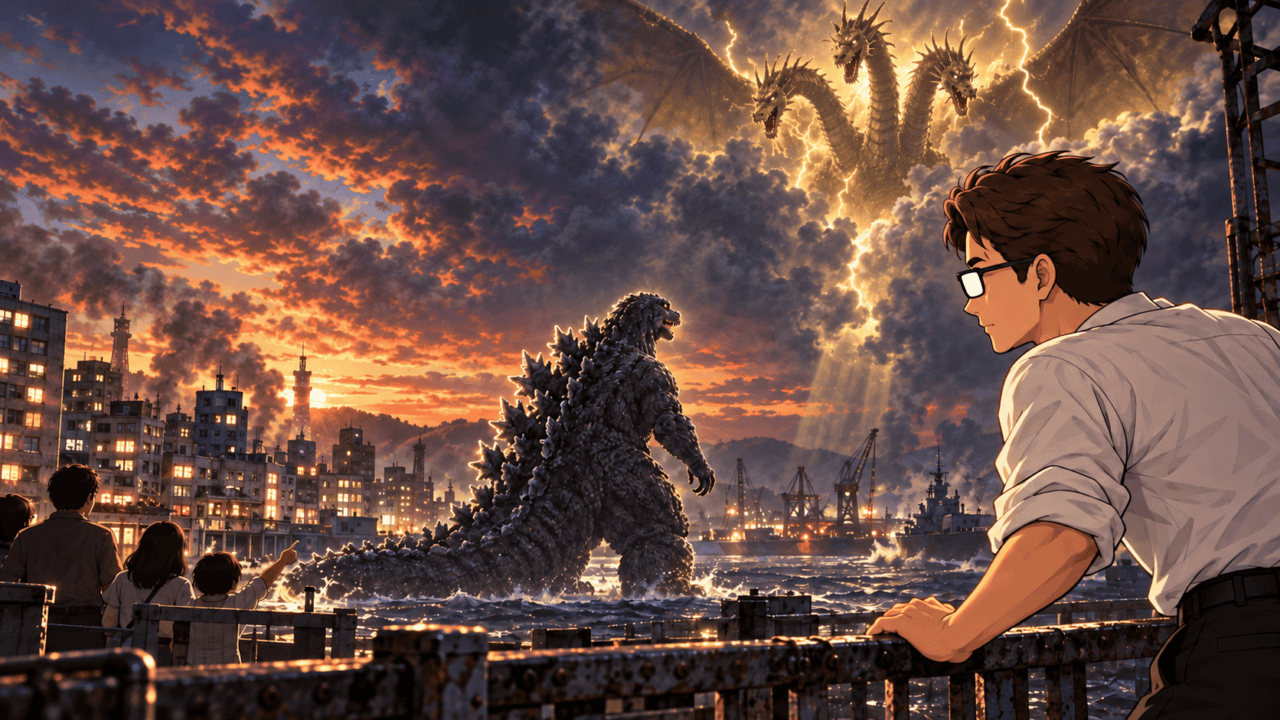
Released in 1954, the original Godzilla went beyond the boundaries of a monster movie. It carried a powerful message that struck deep into postwar Japanese society.
Awakened from its peaceful existence by hydrogen bomb tests, Godzilla comes ashore in Tokyo in a form that recalls the Daigo Fukuryū Maru (Lucky Dragon No. 5) tragedy. I see the monster as an embodiment of human wrongdoing: the memory of war and the fear of nuclear weapons given physical form.
I love the first Godzilla. Yet as the series continues, this king of terror gradually becomes a champion of justice, cheered on by children.
Here, I consider how that transformation happened, looking back over all 15 films in the Shōwa Godzilla series, from the 1954 Godzilla to the 1975 Terror of Mechagodzilla. (The 1984 film, The Return of Godzilla, is not usually included in this grouping.)
*This is a translated version. The original (Japanese) is available here.
- From a Symbol of Fear to a Fighting Monster
The 1954 original presents Godzilla as a terrifying embodiment of the consequences of nuclear tests. With the arrival of Anguirus in Godzilla Raids Again, the story shifts toward monster battles as entertainment. I see this as an important first step toward his later heroism. - A Defender of Earth: The Arrival of a Common Enemy
In Mothra, Godzilla encounters a monster capable of communication. King Ghidorah then arrives as a common enemy, prompting Earth’s monsters to join forces. Their alliance gives us a clear prototype of Godzilla fighting to defend the planet. - A Children’s Hero—and What Follows
I see Godzilla as effectively becoming a hero in Godzilla vs. Hedorah, then a hero in name as well in Godzilla vs. Gigan, whose theme song calls him “our Godzilla.” Once that role is established, however, he increasingly becomes a device for moving the plot forward, with a less commanding presence.
On this pageContents
Phase 1: The Symbol of Fear and Destruction
The early films establish Godzilla primarily through fear and destruction. That starting point makes his later heroic role all the more striking.
Godzilla (1954): Terror Born from Human Wrongdoing
In the film that begins the series, Godzilla is an object of pure terror. The premise of an ancient creature altered by hydrogen bomb tests is closely tied to the Daigo Fukuryū Maru incident, a reality the audience of the time had just confronted.
Radioactive black rain and a burning, devastated Tokyo may have vividly recalled the horrors of war for those viewers. Godzilla embodies uncontrollable violence that humanity has brought into being. His destruction involves neither hesitation nor sentimentality; one could say he is simply living. It is as merciless as a natural disaster, yet also looks like punishment directed at humanity.
Part of the film’s depth is that the means of defeating Godzilla is itself steeped in human wrongdoing.
Dr. Serizawa’s Oxygen Destroyer is the only hope of killing Godzilla, but it is also a terrible weapon that could surpass even the hydrogen bomb. Fearing its misuse, Serizawa chooses to die with the monster and take the invention’s secret with him.
Scientific progress has both light and shadow. Here, ending the consequences of one wrong seems to require committing another. Through Godzilla, the original Godzilla becomes a social drama that confronts humanity’s underlying contradictions and guilt.
Of course, there is no trace of Godzilla as a hero in this first film.
More on the 1954 film:
Godzilla (1954): Dr. Yamane, Dr. Serizawa, Guilt, and Destruction
More on Dr. Serizawa:
Dr. Serizawa’s Love and His Decision to Die with the Monster
Godzilla Raids Again (1955): The First Opponent and a Shift in Narrative Structure
The second film appeared just six months after its predecessor’s success. Looking at what followed, I think it is fair to say that this film set the direction for the series, giving it a new path to follow.
The biggest change is the arrival of another monster, Anguirus. The simple structure of Godzilla versus humanity becomes a story centered on Godzilla versus Anguirus. Until the 1984 The Return of Godzilla, there would be no further film featuring Godzilla without another monster.
Once Godzilla has an opponent, urban destruction acquires another meaning: it becomes the aftermath of a fierce monster battle rather than a one-sided rampage. We might see this as the beginning of the monster-wrestling entertainment later exemplified by Ultraman. Humanity can only flee as the two monsters fight. Their confrontation makes Godzilla a less singular threat.
At this point, though, there is still no hint of heroism. Both Godzilla and Anguirus are creatures awakened by hydrogen bomb tests, equally threatening to humanity. The film retains its predecessor’s basic view of monsters, and burying Godzilla under a snowy mountain is only a temporary solution.
Still, the format of another monster opposing Godzilla is an important first step toward the heroic role he will later assume.
Phase 2: The Path to Heroism
Godzilla’s place in the story begins to change as the series finds new opponents and audiences. The films below show steps toward a protective role.
King Kong vs. Godzilla (1962): A Turn toward Entertainment
After seven years, the series returns with its first color film. The premise of a battle between Japan’s and America’s monster stars clearly shifts the emphasis from the wounds of war and the nuclear threat to popular entertainment. There is nothing wrong with that in itself.
This King Kong is a giant ape from a South Seas island, with no connection to nuclear weapons. A monster that is not a product of atomic power loosens the association between monsters and the nuclear threat: a monster no longer has to have a nuclear origin. In that sense, this is a major turning point for the Shōwa series.
The association between Godzilla and nuclear power remains—for example, in the Cherenkov glow as he emerges from an Arctic iceberg. But the story’s focus is the wrestling match between the two monsters, and the first film’s oppressive atmosphere has faded.
The human characters, including Osamu Sakurai, played by Tadao Takashima, are comic figures, giving the film a lighter tone. Godzilla is beginning to function as a compelling entertainment character rather than necessarily carrying a social message.
From this film onward, Godzilla is no longer clearly defeated. The endings become more ambiguous, with him returning to the sea after a battle. This may have been a commercial decision to make sequels easier, but we could also see a shift from an absolute evil that must be destroyed to a natural phenomenon that is always there.
Mothra vs. Godzilla (1964) & Ghidorah, the Three-Headed Monster (1964): The Emergence of Empathy and a Common Enemy
These two films are crucial to Godzilla’s development as a hero for two reasons:
- The Emergence of Personality: In Mothra vs. Godzilla, Godzilla encounters a monster capable of communicating with humans. Through Infant Island’s twin fairies, Mothra expresses a clear will and can converse with people. Her fight to protect her egg contrasts with Godzilla, who until now has seemed driven solely by destructive instinct. Giving a monster a personality lays the groundwork for Godzilla to acquire more complex emotions and roles.
- The Arrival of a Common Enemy: In Ghidorah, the Three-Headed Monster, King Ghidorah arrives from space as a threat to the whole Earth. This extraterrestrial invader is an important new idea for the series. He is a common enemy of humanity, Godzilla, and Rodan alike. Mothra persuades the latter two to cooperate in a scene that is astonishing—or, depending on how you look at it, rather funny. Their alliance against King Ghidorah suggests the possibility of a complete reversal in Godzilla’s role.
A creature that threatens humanity ends up defending Earth against a stronger outside enemy. Here, the outline of Godzilla as a hero becomes clear.
He is not yet humanity’s ally. Still, this is a major step toward a more complex character who is more than a god of destruction.
Phase 3: The Search for and Establishment of Heroism
As Godzilla becomes a recurring defender, the films test what sort of hero he can be. His relationships with other monsters and with people shape that role.
Invasion of Astro-Monster (1965): A Cosmic Drama and a Manipulated Godzilla
This film gives Godzilla a somewhat unusual position. The story extends to Planet X near Jupiter, while humanity has acquired the technology to travel freely by spacecraft.
Godzilla and Rodan are “lent” to the Xiliens, who ask for help against King Ghidorah. But the request is a trap, part of their plan to invade Earth.
Godzilla loses his agency here, becoming a weapon—or a victim—used to suit the Xiliens’ purposes. The drama of humans and aliens takes center stage, and Godzilla himself has very little screen time.
Yet the story also places Godzilla in a cosmic rather than merely terrestrial context. In that sense, it becomes a starting point for his later role as Earth’s guardian against invaders from space.
His “Shē” pose on Planet X, a comic gesture popular in Japan at the time, can also be seen as a sign of his growing humanization. Personally, I love the scene—even though I think it denies what makes Godzilla Godzilla.
Apart from the 1954 original, Invasion of Astro-Monster is my favorite film in the Shōwa series.
To modern eyes, the Xiliens look ridiculous and funny—so much so that the effect becomes almost avant-garde. You need to prepare yourself mentally before watching.
But I think their strategy is well conceived: use Godzilla and Rodan to invade Earth while keeping their own losses to a minimum. It allows aliens and Godzilla to coexist naturally within the story.
The romance between Glenn and Namikawa also neatly shows why the Xiliens, who make decisions through electronic computers—perhaps we would call it AI today—are bound to lose. In other words, the power of love!
Ebirah, Horror of the Deep (1966): Striking Down Evil
This film and its successor, Son of Godzilla, place the action on remote islands, separating Godzilla from the destruction of human society. Perhaps audiences had already come to take that destruction for granted. I think this separation greatly advanced his heroism, probably without anyone intending it.
In Ebirah, Horror of the Deep, Godzilla’s opponent is not only Ebirah. The true enemy is Red Bamboo, a secret organization manufacturing nuclear weapons at its island base. It is striking that the nuclear power responsible for creating the original Godzilla now becomes an evil for him to destroy.
Godzilla punishes humans who misuse nuclear power and, in doing so, saves the protagonists. He is no longer humanity’s general enemy, but an enemy of particular wrongdoers and a dependable ally to ordinary people.
Son of Godzilla (1967): Human Wrongdoing and Fatherhood
A global food crisis provides the background for a weather-control experiment, introducing a new form of human wrongdoing. When the experiment fails, giant insects and a spider threaten the island’s ecology. The series moves beyond the original nuclear theme toward a broader critique of civilization.
The defining feature is the arrival of Godzilla’s son, Minilla. Godzilla shows a paternal side, protecting him and teaching him how to fight.
He becomes more than a fighting creature: he displays affection and a desire to protect. Perhaps this makes him easier for audiences, especially children, to identify with.
By protecting his child during a crisis brought about by humanity’s weather experiment, Godzilla also ends up helping the humans. His image as a guardian grows stronger.
Destroy All Monsters (1968): Managed Monsters and Earth’s Defenders
This film can be seen as a culmination of the Shōwa series. Set near the end of the twentieth century, it presents a future in which science has advanced dramatically. Godzilla and the other monsters are managed and studied on Monsterland in the Ogasawara Islands. Godzilla is no longer presented as a threat to humanity.
The Kilaaks, aliens planning to invade Earth, take control of the monsters and send them to attack cities around the world. Humanity breaks that control and fights back with the monsters as allies. Godzilla leads Earth’s monsters into the final battle against King Ghidorah.
He has now become a member of a league of heroes defending Earth. Humans and monsters fighting together against space invaders is a structure so far removed from the original that it is hard to find its traces.
Phase 4: Heroism Established—and a Loss of Direction
Once heroism becomes familiar, the series faces a new question: what stories can keep that role compelling? The later films show the appeal and limits of the established image.
A Key Psychological Transition: All Monsters Attack (1969)
There is a striking change in Godzilla’s portrayal between Destroy All Monsters and Godzilla vs. Hedorah. This unusual film represents that transition. Its real-world Japan is separate from the world of the monsters: Godzilla and Minilla appear in the dreams of Ichirō, a bullied boy who admires them.
In those dreams, Godzilla is an ideal hero who gives Ichirō courage and shows him how to resist bullying. Minilla appears as a friend with the same troubles. By making Godzilla a figure in a boy’s imagination, the film removes the negative association with destruction.
We might see this portrayal of Godzilla as an admired champion of justice as psychological preparation for presenting him as a hero in the real world of later films. I doubt anyone actually set out to provide that preparation, though.
Godzilla vs. Hedorah (1971): A Hero in Practice
This is the film in which I think Godzilla effectively becomes a hero. Hedorah is a pollution monster formed when material from space absorbs the waste humans discharge into the environment. Its very existence embodies the dark legacy of Japan’s rapid economic growth—human wrongdoing in monstrous form. The sad reality behind the nostalgic world of Always: Sunset on Third Street!
Godzilla has neither an obligation nor an obvious reason to fight a monster humanity has brought upon itself. Yet he suddenly emerges from the sea and fights Hedorah on humanity’s behalf. His entrance is symbolic: he looks like a guardian deity appearing in answer to people’s suffering and wishes.
Although the action takes place on the Japanese mainland, we see little destruction of cities by Godzilla. His relentless pursuit of Hedorah makes him look like an enforcer of justice. As a being who cleanses the consequences of human folly, his heroism becomes decisive here.
Godzilla vs. Gigan (1972): A Hero in Name and Substance
The previous film makes Godzilla a hero in practice; Godzilla vs. Gigan makes that status unmistakable. Godzilla and Anguirus face Gigan and King Ghidorah, sent by invaders from the M Space Hunter Nebula who disguise their plans for conquest as a mission of peace.
Two details stand out. First, Godzilla and Anguirus converse through comic-book speech bubbles. This is humanization taken to its limit: Godzilla has become a character on the children’s own level.
The other is the ending song, “Godzilla March.” It explicitly cheers for “our Godzilla”. We could call this the filmmakers’ public declaration that he is a children’s hero. He has become a hero in name as well as in practice.
A Hero Losing His Purpose: From Godzilla vs. Megalon (1973) to Terror of Mechagodzilla (1975)
With his heroic role established, Godzilla enters a period in which the series seems to struggle to find a purpose for him.
- Godzilla vs. Megalon (1973): He teams up with Jet Jaguar, an electronic robot whose heroism is more immediately recognizable. Godzilla becomes a helper who arrives when Jet Jaguar is in trouble, and his presence feels less substantial.
- Godzilla vs. Mechagodzilla (1974): Mechagodzilla is a robot disguised as Godzilla. The real Godzilla joins the legendary King Caesar to fight it, but loses their first encounter, weakening his image of absolute strength. To me, King Caesar is closer to the story’s central figure; Godzilla is one hero in a joint effort.
- Terror of Mechagodzilla (1975): The rematch focuses on the tragic drama of Dr. Mafune and his daughter Katsura. Godzilla serves mainly as a device for destroying the invaders’ weapons. Katsura’s transformation into a cyborg brings back the theme of science’s dark consequences, but it does not connect with Godzilla. His presence no longer feels necessary to that particular story.
Having become a complete hero, Godzilla turns into a convenient device for moving the story forward, losing the overwhelming presence and charisma of the original. Perhaps the end of the Shōwa series reflects a fate waiting at the end of this heroic transformation.
Conclusion: What Happens in the Later Godzilla Series?
Godzilla begins as a symbol of human wrongdoing in 1954. Once he gains an opponent in Godzilla Raids Again, his role starts changing. His enemies shift from terrestrial threats to invaders from space and monsters born of pollution. Along the way, he gradually develops a personality and begins fighting to protect Earth as a shared home.
Dialogue with Mothra and the fight against a common enemy, King Ghidorah, show that Godzilla is more than a god of destruction. In Godzilla vs. Hedorah, I see him establishing an identity as a hero who protects humanity. Then Godzilla vs. Gigan, with its song celebrating “our Godzilla,” makes that heroic image explicit.
The Shōwa series follows a creature whose meaning shifts from terror to justice, reflecting the atmosphere of its times. That movement pauses with Terror of Mechagodzilla.
About ten years later, Godzilla returns as a king of terror in the 1984 The Return of Godzilla, then follows a broadly similar path in the Heisei series, though the change is much less blatant than in the Shōwa films.
The Hollywood films have also followed this pattern. I think Gareth Edwards’ 2014 GODZILLA gives ample expression to the monster’s destructive side. By 2024’s Godzilla x Kong: The New Empire, however, Godzilla seems to have developed a personality, with plenty of comic moments, and fights alongside Kong against humanity’s enemies.
Seen in this light, the Millennium series stands apart within the Godzilla franchise. I may return to that another time.
If you want something of the original Godzilla’s character, Shin Godzilla and Godzilla Minus One belong firmly in that lineage. The 1984 film does too.
Personally, the original Godzilla is my favorite, and I do not particularly feel a need for new films. Yet I have watched every Godzilla film, and I like them all. Somewhere within me, I am also waiting eagerly for the next one. It is a rather contradictory feeling.
Perhaps continuing to make films helps keep Godzilla from being forgotten. New releases may therefore matter as a way of keeping the original 1954 Godzilla alive in our memories—even when they feature Godzilla as a hero.
Those are my thoughts on Godzilla’s transformation through the Shōwa series. There will certainly be other views, but I think this is broadly how he became a hero.
As I have said, the first Godzilla shines brightest for me. But I like the whole series; there is not a film in it that I dislike.
If you like, tell me your favorite Shōwa Godzilla film in the poll below.
Appendix: Shōwa Godzilla Films—Release Dates, Lead Actors, and Directors
*The links below lead to Wikipedia articles.
| Film Title | Release Date | Lead Actor | Director |
|---|---|---|---|
| Godzilla | November 3, 1954 | Akira Takarada | Ishirō Honda |
| Godzilla Raids Again | April 24, 1955 | Hiroshi Koizumi | Motoyoshi Oda |
| King Kong vs. Godzilla | August 11, 1962 | Tadao Takashima | Ishirō Honda |
| Mothra vs. Godzilla | April 29, 1964 | Akira Takarada | Ishirō Honda |
| Ghidorah, the Three-Headed Monster | December 20, 1964 | Yosuke Natsuki | Ishirō Honda |
| Invasion of Astro-Monster | December 19, 1965 | Akira Takarada | Ishirō Honda |
| Ebirah, Horror of the Deep | December 17, 1966 | Akira Takarada | Jun Fukuda |
| Son of Godzilla | December 16, 1967 | Tadao Takashima | Jun Fukuda |
| Destroy All Monsters | August 1, 1968 | Akira Kubo | Ishirō Honda |
| All Monsters Attack | December 20, 1969 | Kenji Sahara[1] | Ishirō Honda |
| Godzilla vs. Hedorah | July 24, 1971 | Akira Yamauchi, in Japanese | Yoshimitsu Banno |
| Godzilla vs. Gigan | March 12, 1972 | Hiroshi Ishikawa, in Japanese | Jun Fukuda |
| Godzilla vs. Megalon | March 17, 1973 | Katsuhiko Sasaki | Jun Fukuda |
| Godzilla vs. Mechagodzilla | March 21, 1974 | Masaaki Daimon | Jun Fukuda |
| Terror of Mechagodzilla | March 15, 1975 | Katsuhiko Sasaki | Ishirō Honda |
- [1]
- Kenji Sahara is listed based on the order in the opening credits, but he played the father of the bullied boy, Ichirō Miki. Ichirō was played by Tomonori Yazaki.
Your Take
What is your view? Choose the answer that comes closest to your own response.
Poll results
Which side of Shōwa Godzilla would you most like to revisit?
- The terrifying force of destruction.0%
- The defender facing a greater threat.0%
- The playful monster hero.0%
- I enjoy the full range.0%
- I prefer another side of Godzilla.0%
- I’m not sure.0%

Reader Comments
Have a thought or interpretation? Leave a comment