My Neighbor Totoro (Studio Ghibli Official) is a 1988 animated feature film written and directed by Hayao Miyazaki. It was released in Japan on April 16, 1988.
In this article, I have selected 14 of my favorite quotes from the film.
The dialogue in My Neighbor Totoro often becomes even more interesting when the original Japanese is compared with its English translation. For each quote, I will look at the Japanese line, its romanization, the English subtitle, a literal translation, and what the dialogue tells us about the characters and the story.
These are not necessarily the 14 most objectively famous lines in the film. This is a personal selection, and several of them are included simply because they have remained strangely fixed in my memory for years.
The film’s official English title is:
My Neighbor Totoro
Translation note: The English subtitle wording in this article is based on the commercially released Blu-ray available to the author. The English dub is also discussed where its wording creates a meaningful difference. Subtitle and dub wording may vary between releases and territories.
▼ Read the full story and analysis behind these quotes
On this pageContents
Satsuki Quotes in Japanese and English
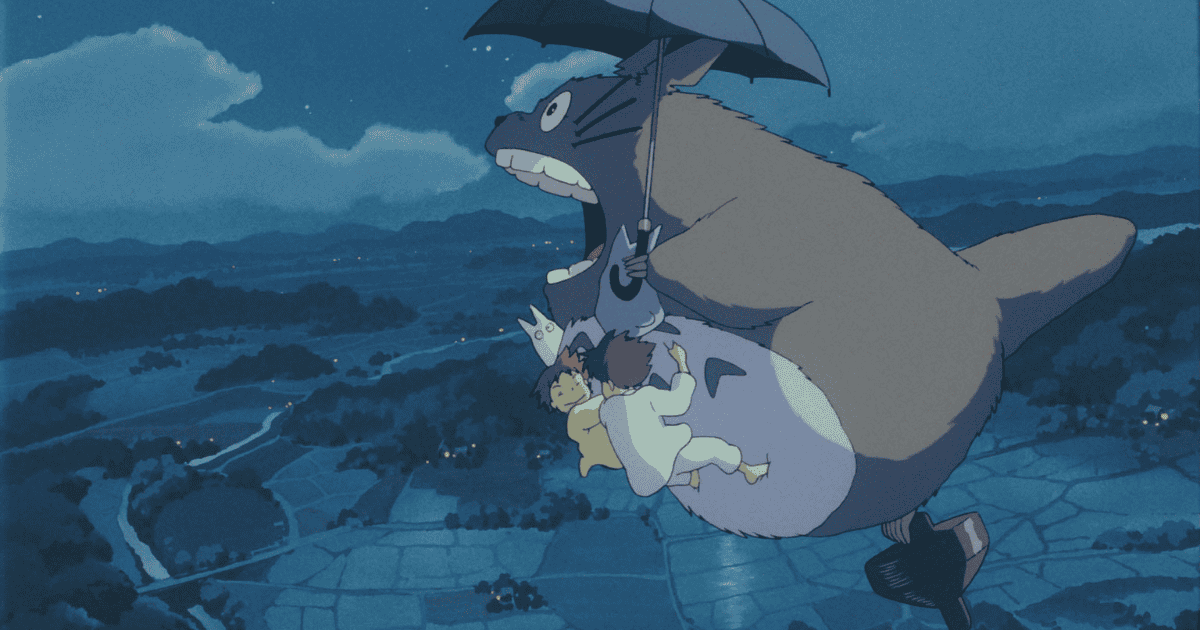
“Mei! We’re the wind!”
メイ、私たち、風になってる!
Mei, watashitachi, kaze ni natteru!
Mei! We’re the wind!
Mei, we’ve become the wind!
Read the Commentary and Analysis
This line reveals that the sudden gust of wind that swept past Satsuki while she was gathering firewood had been caused by Totoro—although I suppose it might possibly have been the Catbus.
Even now, whenever a powerful wind begins blowing late at night, my immediate reaction is still, “Totoro is here!”
At this point, it is practically a Pavlovian response.
Yet perhaps that is one of the remarkable achievements of My Neighbor Totoro. The film planted this sensation inside generations of viewers: that an unexplained gust moving through the darkness might be something alive.
The subtitle follows the Japanese directly, and the dub uses essentially the same expression.
“Stop being silly! I’m going.”
メイのバカ! もう知らない!
Mei no baka! Mō shiranai!
Stop being silly! I’m going.
Mei, you idiot! I don’t care anymore!
Read the Commentary and Analysis
Satsuki says this after telling Mei that their mother’s temporary return home has been postponed. Mei refuses to accept the news and repeatedly answers with nothing but “No.”
Satsuki finally loses control of her emotions and shouts the line.
Shortly afterward, she breaks down crying and says that their mother might die. Only then do we finally recognize how tightly Satsuki has been holding herself together throughout the film.
I discuss the emotional burden behind her tears in a separate article:
I consider this one of the most important scenes in My Neighbor Totoro.
The subtitle softens the harshness of the Japanese. Mei no baka literally means something closer to “Mei, you idiot,” while mō shiranai expresses emotional rejection: “I don’t care anymore” or “Do whatever you want.”
The dub goes further and uses: “You’re such a baby. Just grow up!” That version is less literal, but it clearly expresses Satsuki’s frustration with Mei’s childishness.
“Mei is lost and we can’t find her!”
トトロ、メイが迷子になっちゃったの。探したけど見つからないの。お願い、メイを探して! 今頃きっとどこかで泣いてるわ。
Totoro, Mei ga maigo ni nacchatta no. Sagashita kedo mitsukaranai no. Onegai, Mei o sagashite! Imagoro kitto dokoka de naiteru wa.
Mei is lost and we can’t find her! She must be scared, please help me find her.
Totoro, Mei has gotten lost. We searched, but we can’t find her. Please find Mei! She must be crying somewhere by now.
Read the Commentary and Analysis
Because Mei disappears immediately after their argument, Satsuki must have been desperate enough to grasp at anything that might help.
That is certainly true. Even so, one question has always remained with me:
Why did Satsuki decide to ask Totoro for help?
The development feels completely natural while watching the film, and most viewers accept it without hesitation. Yet when I try to explain the precise chain of reasoning behind Satsuki’s decision, I still cannot find a completely satisfying answer.
Perhaps there does not need to be one.
Satsuki has exhausted every ordinary possibility. In that moment, she remembers that something extraordinary exists in the forest and runs toward it.
The subtitle condenses the full Japanese speech. The original specifically imagines Mei crying somewhere alone, making Satsuki’s fear more concrete and painful.
▼ Read more about Satsuki’s age, voice actor, background, and character analysis
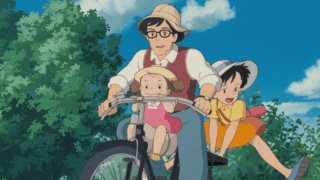
Mei Quotes in Japanese and English
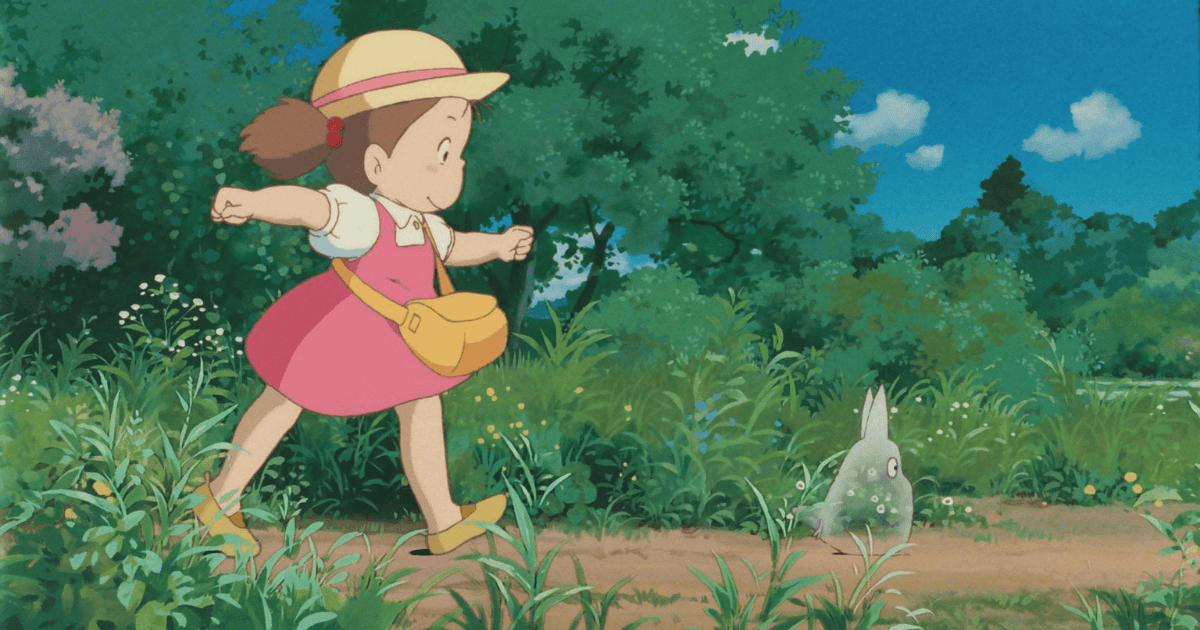
“Soon? Like tomorrow?”
もう少しって、あした?
Mō sukoshi tte, ashita?
Soon? Like tomorrow?
When you say “a little longer,” do you mean tomorrow?
Read the Commentary and Analysis
Few expressions are less trustworthy than a parent telling a child, “Just a little longer.”
In retrospect, the hope created by those words helps cause Mei’s disappearance near the end of the film.
Adults should be careful when giving children vague expectations. Children can take hope, turn it into certainty, and then charge forward with it at full speed.
The subtitle is direct and natural.
The dub uses wording closer to: “Soon should be tomorrow?” The use of “should” is difficult to reproduce naturally from a Japanese learner’s perspective. It makes the question feel less like a neutral request for information and more like Mei insisting, “That means tomorrow, right?”
“To-to-ro? You’re Totoro!”
あなた、トトロっていうのね!
Anata, Totoro tte iu no ne!
To-to-ro? You’re Totoro!
So your name is Totoro!
Read the Commentary and Analysis
Mei confidently decides that the creature has said “Totoro,” but in reality, Totoro has done little more than produce a deep roar.
Anyone other than Mei might have heard an entirely different sound.
What, then, was the creature’s real name?
The film never answers. “Totoro” may simply be the name created by Mei’s ears and imagination, which the rest of the story then accepts.
The dub makes the uncertainty more explicit with wording similar to: “Totoro? Is that what your name is?”
“But it’s true! Totoro was here. I’m not lying.”
ほんとだもん! ほんとにトトロいたんだもん! うそじゃないもん!
Honto da mon! Honto ni Totoro ita n da mon! Uso janai mon!
But it’s true! Totoro was here. I’m not lying.
It’s true! Totoro really was there! I’m not lying!
Read the Commentary and Analysis
As a child, I once experienced the humiliation of telling my family something that was absolutely true and not being believed.
Many people may carry a similar memory.
That is why Mei’s repeated insistence feels so recognizable. She is not merely reporting what happened. She is defending her own reality against the calm skepticism of adults.
Her father’s response is excellent. Rather than simply agreeing or dismissing the story, he takes the children to the shrine and thanks the master of the forest.
He cannot confirm exactly what Mei saw, but he can still respect the experience.
The subtitle follows the Japanese closely. The dub’s “I really did see Totoro” places slightly more emphasis on the act of seeing him and may therefore capture Mei’s insistence even more directly.
▼ Read more about Mei’s age, voice actor, background, and character analysis
Satsuki and Mei Quotes in Japanese and English
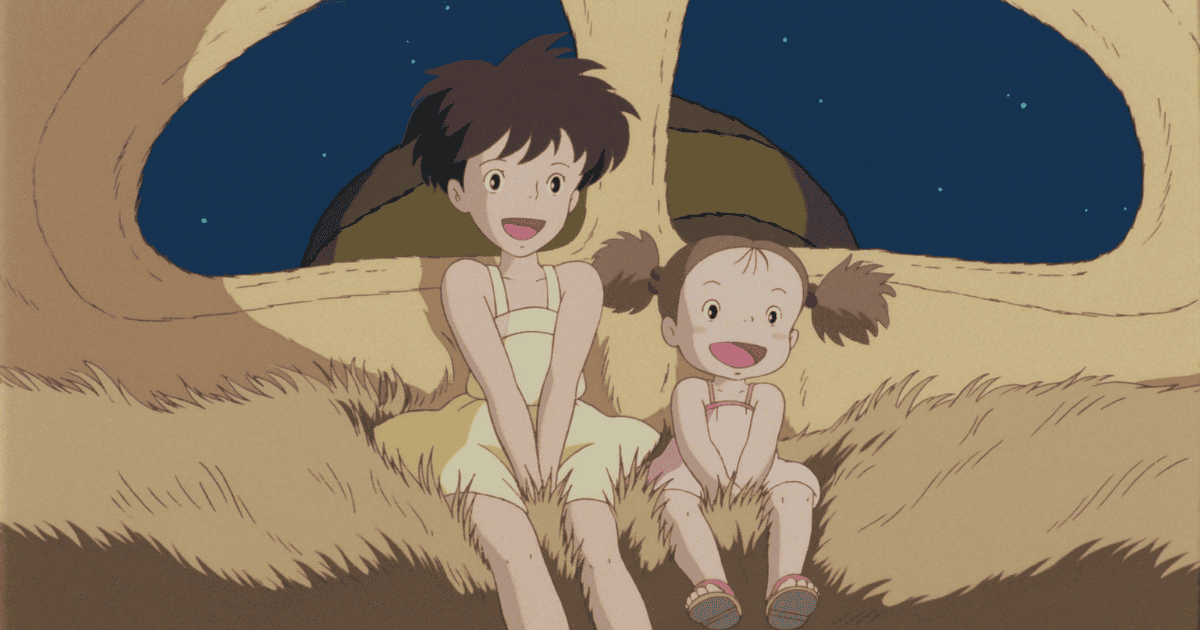
“Come here, dustbunnies. Come out, come out, wherever you are!”
まっくろくろすけ出ておいで。出ないと目玉をほじくるぞ!
Makkuro Kurosuke dete oide. Denai to medama o hojikuru zo!
Come here, dustbunnies. Come out, come out, wherever you are!
Come out, Makkuro Kurosuke. If you don’t, we’ll gouge out your eyeballs!
Read the Commentary and Analysis
The girls say something genuinely horrible while wearing enormous smiles.
Even better is the magnificent contradiction racing at full speed through the threat.
If the creatures do not come out, the girls cannot gouge out their eyes. The statement therefore seems to mean: “Come out, because one way or another, we intend to gouge out your eyes.”
Perhaps only children possess the freedom to say something so grotesque with such complete innocence.
The English subtitle removes the eye-gouging threat entirely and replaces it with the familiar rhyme “Come out, come out, wherever you are.”
There may be no natural way to preserve the original rhythm and humor. It is also understandable that an English-language version of a children’s film might hesitate to include a cheerful threat of ocular mutilation.
The dub simplifies the line even further by repeating: “Come on, come on, wherever you are.”
“It was a dream. But it wasn’t a dream.”
夢だけど、夢じゃなかった!
Yume dakedo, yume janakatta!
It was a dream. But it wasn’t a dream.
It was a dream, but it wasn’t a dream!
Read the Commentary and Analysis
This may be the line that has remained with me most strongly from the entire film.
Personally, I think only two truly inexplicable events occur in My Neighbor Totoro:
- After Mei first encounters Totoro and falls asleep, she wakes up in a different place.
- The enormous tree that the girls grow with Totoro during the night is gone the next morning.
In the first case, it seems unlikely that the Totoros physically carried the sleeping Mei back through the forest. Yet that does not mean she never encountered Totoro.
In the second case, it also seems unlikely that the Totoros used another supernatural power to shrink the giant tree back into the ground. Yet that does not mean the event simply failed to happen.
What occurred was precisely something that was a dream and was not a dream.
For me, this line expresses the nature of the entire film.
The English subtitle is almost a perfect word-for-word translation. Its grammar is simple enough for a beginner, but the idea it expresses is anything but simple.
Tatsuo Kusakabe Quote in Japanese and English
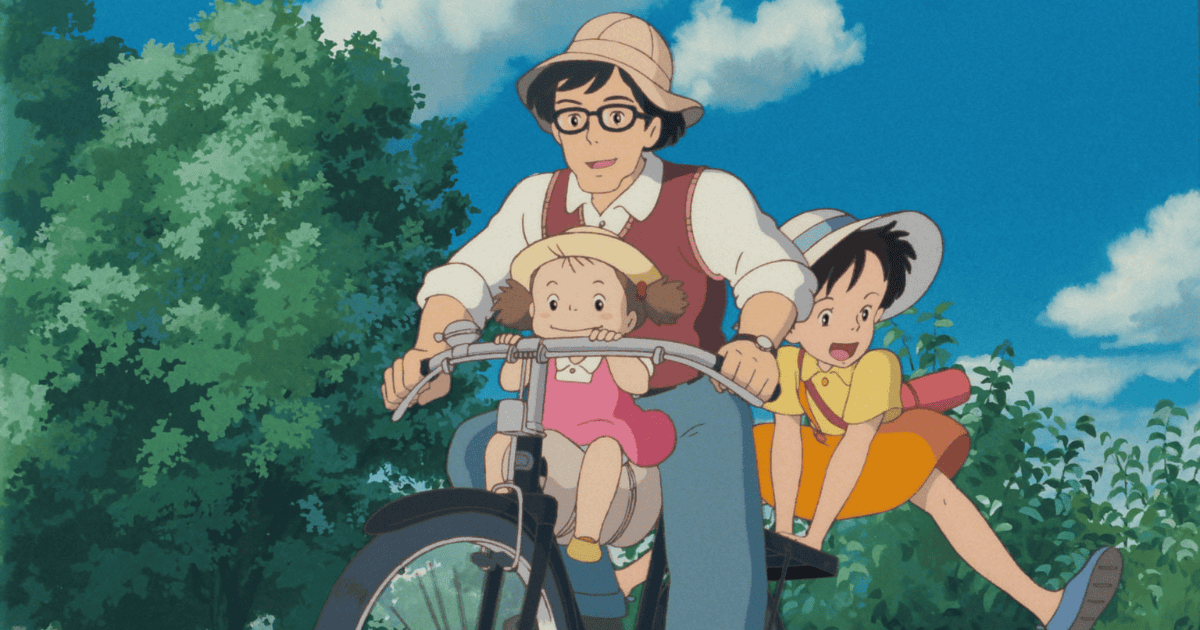
“When you walk into a dark room from outside, your eyes dim and so the dustbunnies come out.”
明るい所から、急に暗い所に入ると、目が眩んで、マックロクロスケが出るのさ。
Akarui tokoro kara, kyū ni kurai tokoro ni hairu to, me ga kurande, Makkuro Kurosuke ga deru no sa.
When you walk into a dark room from outside, your eyes dim and so the dustbunnies come out.
When you suddenly enter a dark place from somewhere bright, your eyes become dazzled, and that is when Makkuro Kurosuke appears.
Read the Commentary and Analysis
Later, when his daughters suggest that the house may actually contain ghosts, their father responds enthusiastically:
“That would be wonderful! I’ve dreamed of living in a haunted house since I was a child.”
Yet when the soot creatures are first mentioned, he gives an extremely realistic explanation.
Once we notice this, even the truth of his supposed lifelong dream becomes questionable.
Thinking back to the scene, he is carrying heavy luggage and does not appear to have the time or mental space to investigate every detail of his daughters’ story.
This is an entirely personal interpretation, but I suspect that he had never once dreamed of living in a haunted house.
The man who dismisses Makkuro Kurosuke as a momentary failure of vision is probably the more authentic version of Tatsuo.
The contrast with Granny, who warmly tells the girls about soot sprites, is wonderful.
Still, now that I have become an adult myself, I feel increasingly inclined to defend him. A busy parent is still a parent. He is not necessarily ignoring his children; sometimes he simply responds with a quick joke because he is occupied.
The subtitle’s two notable words are “dim” and “dustbunnies.”
As a verb, “dim” can mean to become less bright or less clear. “Dust bunny” is an ordinary English expression for a clump of dust that gathers beneath furniture. It is therefore an understandable translation for Makkuro Kurosuke, even though the literal image of a “dust rabbit” sounds quite different.
The English dub also uses “soot gremlin,” which feels closer to the Japanese idea of a small supernatural creature made from soot.
Granny’s word susuwatari has also been translated as “soot spreaders” in subtitles and “soot sprites” in the dub. “Spreader” describes what they do, while “sprite” describes what they are. Personally, “sprite” feels right for Makkuro Kurosuke, while “spreader” suits the name Susuwatari surprisingly well.
▼ Read more about Tatsuo’s age, voice actor, background, and character analysis
Yasuko Kusakabe Quotes in Japanese and English
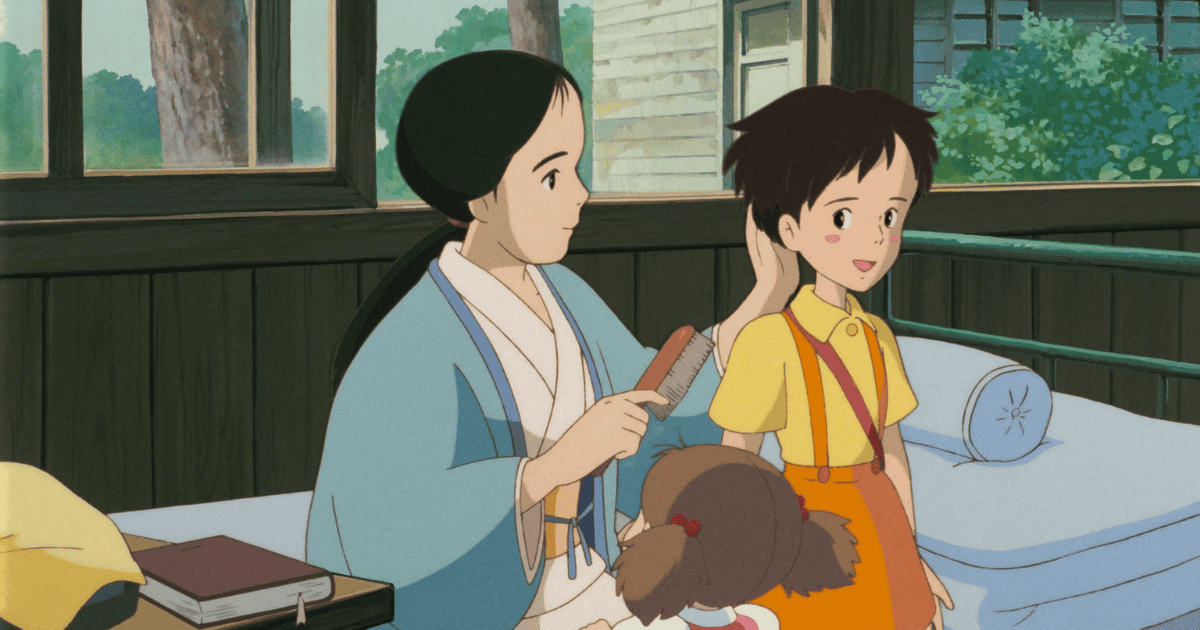
“Wavy hair, just like mine when I was your age.”
相変わらずのくせっけねー。あたしの子供の頃とそっくり。
Aikawarazu no kusekke nē. Atashi no kodomo no koro to sokkuri.
Wavy hair, just like mine when I was your age.
Your hair is as unruly as ever. It is exactly like mine when I was a child.
Read the Commentary and Analysis
The scene in which Yasuko combs Satsuki’s hair while saying this is one of the most beautiful moments in My Neighbor Totoro.
And yet…
I cannot stop myself from thinking that the mother is lying.
I explain that theory in a separate article:
It may be an interpretation that goes slightly too far, but it is an honest account of what I see in the scene.
The subtitle translates kusekke as “wavy hair.” That communicates the general idea, but Satsuki’s hair does not strike me as especially wavy.
The dub uses wording closer to “Your hair never cooperates,” meaning that it refuses to stay neat or behave properly. That seems to capture the actual appearance of Satsuki’s hair more successfully.
“I’m going to spoil them for a while when I come home.”
退院したら、今度はあの子たちにうんとワガママをさせてあげるつもりよ。
Taiin shitara, kondo wa ano ko-tachi ni unto wagamama o sasete ageru tsumori yo.
I’m going to spoil them for a while when I come home.
When I leave the hospital, I intend to let those girls be as selfish as they want for a while.
Read the Commentary and Analysis
Yasuko refers to both daughters, but I suspect the emotional center of the statement is Satsuki.
Her illness is not her fault. Even so, it is natural that she feels as though she has left her children alone—especially as their mother.
The ending illustrations show that she eventually fulfills this promise completely.
There, Satsuki is finally able to become a child again, and the audience can relax.
We should not forget that My Neighbor Totoro is a story with a happy ending.
The important English word is “spoil.” It can mean to ruin, rot, or indulge someone excessively, so it does not usually sound entirely positive.
Here, however, that slight excess is the point. Yasuko is not promising merely to be kind. She intends to indulge her daughters so thoroughly that it might almost be bad for them.
Japanese could also express her intention with a gentler word meaning “to shower them with affection.” Yet once she actually returns home, the practical result will probably still be that she spoils them.
“I could swear I just saw Satsuki and Mei laughing up in that tree.”
今、そこの松の木でサツキとメイが笑ったように見えたの。
Ima, soko no matsu no ki de Satsuki to Mei ga waratta yō ni mieta no.
I could swear I just saw Satsuki and Mei laughing up in that tree.
Just now, it looked as though Satsuki and Mei were laughing in that pine tree.
Read the Commentary and Analysis
This line is still used as evidence by people defending the darker urban legends surrounding My Neighbor Totoro.
The more fundamental mystery, however, is the ear of corn marked “For Mom” that appears immediately afterward.
How did Satsuki and Mei place it beside the hospital window? And why did their parents accept such an inexplicable situation?
At least the parents’ reaction can be explained.
Yasuko is not the only mother in that hospital room. When adults discover an ear of corn marked simply “For Mom,” the most natural assumption is that one of the other patients’ children left it there.
After all, Satsuki and Mei cannot possibly be standing outside the hospital.
Tatsuo’s response—“Perhaps they really were there”—is therefore surprisingly romantic by his standards.
The final question remains: why can the parents not see Satsuki and Mei looking down at them from the tree?
Did Yasuko merely feel as though she saw them?
There is one important fact to remember: at that moment, the parents do not know that Mei has disappeared.
In other words, they believe they are enjoying a quiet moment together as husband and wife.
One could even interpret Yasuko’s sudden reference to the children as a deliberate interruption of an atmosphere that had become slightly too intimate.
And by coincidence—or by the logic of this film—the girls really are there.
Perhaps that still does not explain why the parents cannot clearly see them. Yet that is simply the kind of world this is.
My Neighbor Totoro is a story about things that were dreams and were not dreams. Usually, only children are allowed to experience that world. In this moment, however, Yasuko briefly experiences it too.
She sees something that is a dream but is not a dream.
I think that explanation is enough.
The subtitle’s use of “swear” is especially interesting. To swear is to insist strongly that something is true, which sounds almost opposite to the uncertainty of the Japanese phrase “it looked as though.”
Yet perhaps the English is more accurate psychologically. Yasuko did see them. She softens the experience only when describing it aloud.
The dub is similarly direct, using wording closer to “I found Satsuki and Mei laughing,” with no expression that seriously weakens the certainty.
Kanta Quotes in Japanese and English
“Huh… my mom… for Granny.”
カアちゃんが、ばあちゃんに……ん! ん!!!
Kāchan ga, bāchan ni… n! N!!!
Huh… my mom… for Granny.
My mom said… for Granny… here! Here!
Read the Commentary and Analysis
This line and the scene around it give Kanta the innocence of a boy who has just discovered that beings other than “men” exist in the world.
Immediately before this moment, he sees Satsuki from a distance.
She may have been the first beautiful person he had ever encountered.
Everything Kanta does afterward adds a remarkably delicate layer to My Neighbor Totoro.
It might not be unreasonable to call him the film’s hidden protagonist.
The subtitle uses “Granny,” an informal word for grandmother. Depending on context, it can sound affectionate, rustic, or slightly disrespectful, which fits the rough familiarity of the Japanese bāchan.
The dub turns the fragment into a more complete sentence: “My mom said to give it to Grandma.” That is clearer English, but the subtitle better preserves Kanta’s inability to form words in front of Satsuki.
“You live in a haunted house!”
やーい、おまえんちオバケやしき!
Yāi, omaenchi obake yashiki!
You live in a haunted house!
Hey! Your house is a haunted house!
Read the Commentary and Analysis
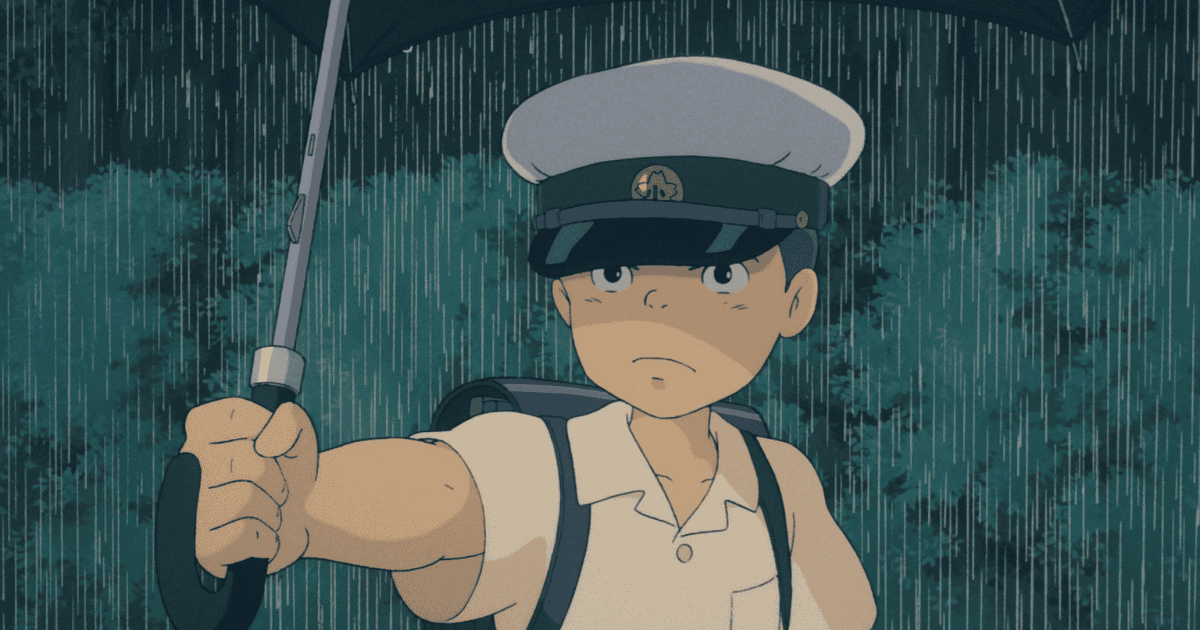
I do not remember ever teasing a girl simply because I liked her, but Kanta’s insult is surely an attempt to conceal his first love.
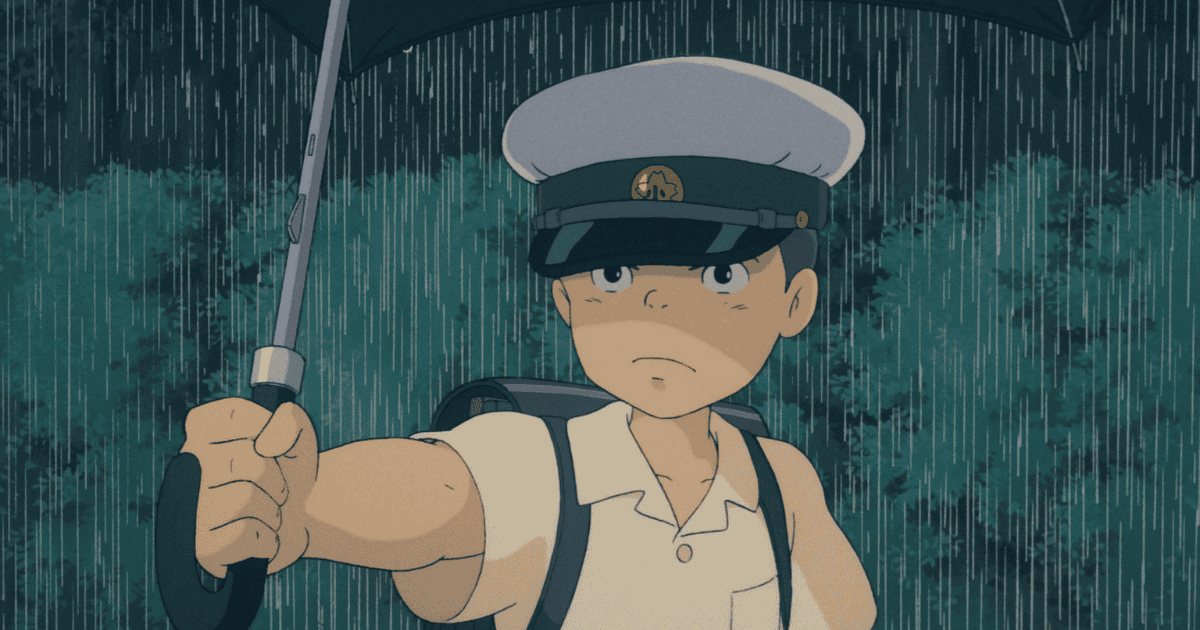
Seen in that light, the later scene in which he silently thrusts his umbrella toward Satsuki can be interpreted as the moment when he finally acknowledges those feelings.
In both scenes, Kanta is still largely intoxicated by his own emotions.
Near the end of the film, however, he works desperately to find the missing Mei. That effort may represent genuine growth in the boy Miyazaki has drawn.
Unfortunately, I have a rather pessimistic theory about the future of Kanta’s love, and I went so far as to write an entire article about it:
Whatever becomes of his feelings, I remain on Kanta’s side.
The subtitle is simple and requires little explanation. The dub’s fuller version—“Hey! You live in there. Your house is haunted!”—more clearly preserves the taunting rhythm of the Japanese.
▼ Read more about Kanta’s age, voice actor, background, and character analysis
The images used in this article are from the Studio Ghibli Works Still Image Collection.
Can you name the movie before the scene comes into focus?
Put your visual memory to the test with a blurred Studio Ghibli scene.

Reader Comments