
Isao Takahata’s Grave of the Fireflies(Official Studio Ghibli) was released on April 16, 1988. It is based on Akiyuki Nosaka’s novel of the same name.
I cannot remember exactly when I first saw it, but I think it was a television broadcast when I was in elementary school. At the time, the film did not affect me as deeply as I might have expected; what shocked me most was the sight of Seita and Setsuko’s mother covered in bandages. That was not simply a matter of age, though. It was something about me: friends and acquaintances found the film too painful to watch.
Here, I want to revisit the story and bring together some questions worth thinking about. This is a film that has left something with so many viewers. What should we have been looking at?
*This is a translated version. The original (Japanese) is available here.
- Detailed Synopsis and Character Map
Fourteen-year-old Seita loses his mother in the Kobe air raid of June 5, 1945. He and his four-year-old sister, Setsuko, move in with an aunt, but their relationship deteriorates and he chooses to take his sister to a dugout shelter. Setsuko grows malnourished and dies; a month later, Seita dies in a station. Below are a more detailed synopsis, a character map, and discussion of the story. - Questions for Further Analysis
Why do Seita and his aunt come into conflict? Why do the children have to die? Why does Seita die in a station, and why do the siblings remain as ghosts? This article introduces these questions and links to more detailed discussions.
On this pageContents
Grave of the Fireflies (1988): Synopsis (Spoilers)
Synopsis: Five Main Points
Here are the main events in Grave of the Fireflies:
-
The Beginning of the Tragedy
An air raid kills the children’s mother and brings their peaceful family life to an abrupt end. -
Isolation
With their father away at war and their mother gone, Seita and Setsuko are left without the family support they had known. -
Temporary Refuge
The children stay with an aunt, but face the hardships of wartime and increasingly cold treatment. -
The Struggle to Survive
Seita chooses to live alone with his sister in a dugout shelter, trying to protect her and find enough food to keep them alive. -
The Tragic End
The siblings suffer from hunger and isolation, and both eventually die.
Character Map
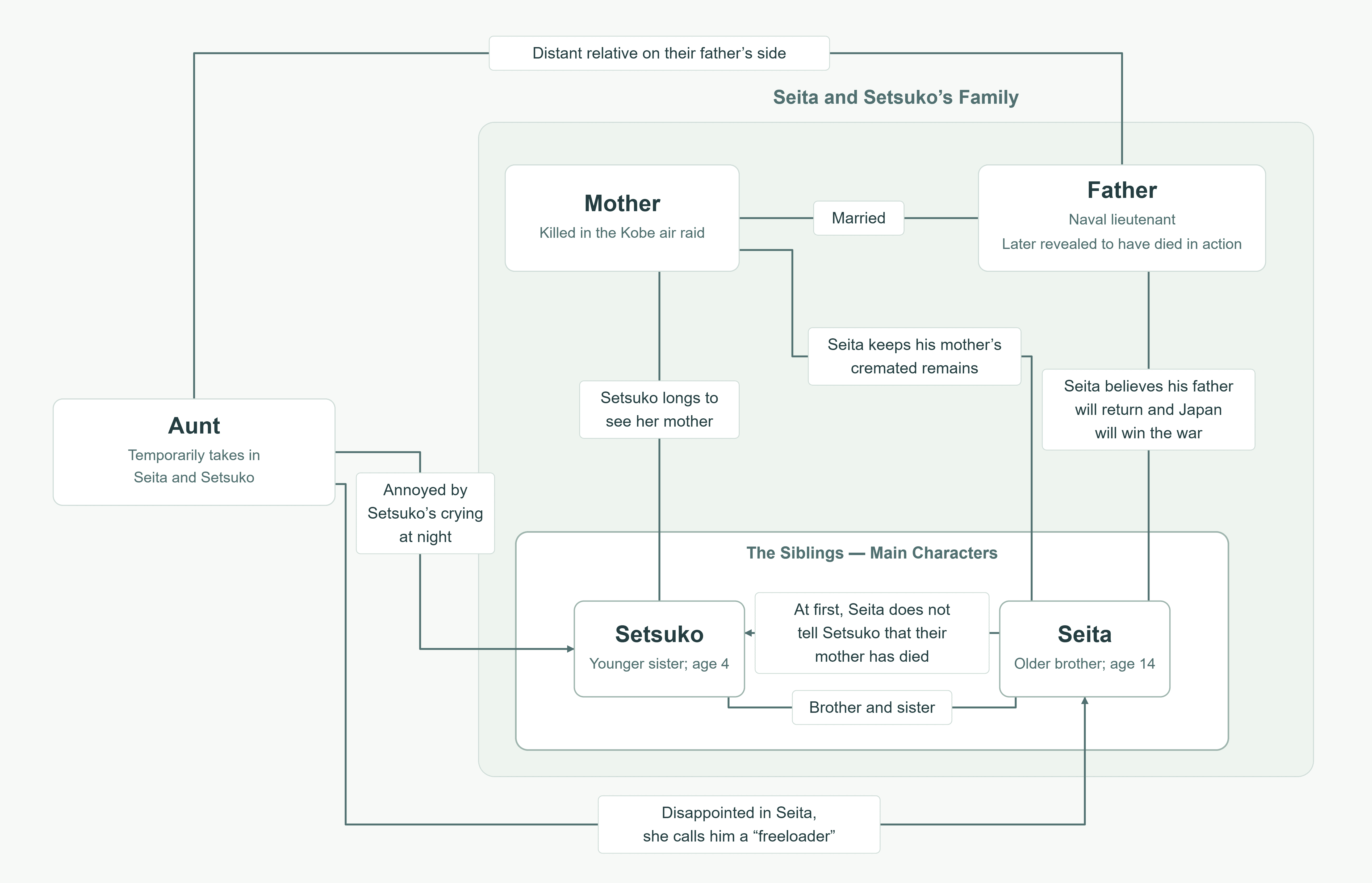
Questions Raised by the Story
Grave of the Fireflies follows two children whose ordinary lives are destroyed by war. After leaving their aunt, they become isolated from food supplies and information alike. The synopsis traces their lives from the air raid to Seita’s final moments.
One central question is the conflict between Seita and his aunt. Was leaving her house simply an act of selfishness, or does that judgment overlook what he had been through?
In an interview included on the Blu-ray, Takahata says many viewers were sympathetic to Seita when the film was released. That response surprised him. I suspect many viewers today would be quicker to sympathize with the aunt and blame Seita; I find myself doing that too.
With those questions in mind, let’s follow the story through to its ending.
Detailed Synopsis: From the Air Raid to the Ending
Part 1: The Kobe Air Raid and the Mother’s Death
The central character is fourteen-year-old Seita. His father is a naval lieutenant, and he lives in Kobe with his mother and four-year-old sister, Setsuko.
On June 5, 1945, Kobe comes under attack from B-29 bombers.
The family begins to evacuate, but the mother, who has gone ahead, suffers fatal burns. Seita and Setsuko survive the raid and are left orphaned.
Following an arrangement made for such an emergency, the children go to their aunt’s house in Nishinomiya. But Seita cannot bring himself to tell Setsuko that their mother has died.
Part 2: Conflict with the Aunt
The aunt’s husband has died. She lives with her daughter and a young boarder engaged in wartime labor.
Things go well at first, but relations gradually worsen. Seita neither attends school nor works, and the aunt grows increasingly resentful.
When the rice and other provisions Seita had stored in the family garden become shared supplies in the aunt’s household, he begins living separately within the same house. He uses the 7,000 yen his mother had saved for emergencies to support himself and Setsuko.
One day, Seita plays the organ to entertain Setsuko. The aunt scolds him: people in the neighborhood will criticize them for playing music in wartime.
She finally says that a “plague god” has come into her home.
After this, Seita makes a decision.
Seita may have contributed to the conflict, but losing both his home and his mother in an air raid might make his behavior understandable. The aunt, too, may simply have gone too far in the heat of the moment when she called the children a “plague god.”
Part 3: Life in the Dugout Shelter
Seita takes Setsuko away from the aunt’s house and begins living in a nearby dugout shelter. It is uncomfortable, but there they have the freedom to live without anyone interfering.
Seita then learns that the aunt has already told Setsuko about their mother’s death. Perhaps her restless nights were caused not only by fear of the air raid, but also by grief for her mother.
The children try to survive on their own, and Seita steals food from fields and houses during air raids. But Setsuko’s condition continues to worsen.
Setsuko has already shown signs of malnutrition, and these grow worse. When Seita takes her to a doctor, he is told only that she needs nourishment; the doctor offers no further help.
Part 4: Setsuko’s Death and Seita’s Final Days
Having cut himself off from other people, Seita is also cut off from information. He learns of the war’s end and Japan’s defeat only by chance, when he goes to the bank to withdraw money.
He buys food and returns to Setsuko, but she has reached her limit.
Setsuko takes a bite of the watermelon he brings her. She never wakes again.
Seita cremates his sister’s body himself, with care, and places some of her bones in the tin that once held her favorite fruit drops.
On September 21, 1945, Seita dies in the station, dressed in rags and leaning against a pillar.
▼ Explore the film’s memorable dialogue in Japanese and English
The film’s dialogue includes Seita’s announcement of his death, his question about where he can find nourishment, and Setsuko’s question about why fireflies die so quickly. For the Japanese wording, romanization, English subtitles, literal translations, and commentary, see 7 Grave of the Fireflies Quotes in Japanese and English, Explained.
Grave of the Fireflies (1988): Analysis and Questions
The children’s tragedy cannot, I think, be dismissed simply as the result of Seita’s selfishness. His life before the raid, his final month, the siblings’ smiling ghosts, and the burning bombs all raise questions. My fuller discussion is linked below.
Read the full analysis: Why Did Seita and Setsuko Have to Die?
Before you dive in, consider the following points.
The Conflict With the Aunt: Where Does Your Sympathy Lie?
The conflict between Seita and his aunt is central to a discussion of Grave of the Fireflies.
But I think what matters most is recognizing where our sympathy lies at the moment we watch it.
Viewed from a distance, both sides can be understood.
Many viewers today may feel more sympathy for the aunt and be quick to blame Seita; I do too. But Takahata recalls a more sympathetic response to Seita at the time of release. Perhaps viewers saw the departure as a child’s last act of resistance amid the chaos of war.
Our sympathy for the aunt is not an absolute judgment, then. Rather than only analyzing the conflict, it may be more important to ask ourselves why we take one side and put that answer into words. An essay on this film sounds just like something a teacher would assign—but I do think that kind of personal response matters. How do you see the conflict?
Why Did Seita and Setsuko Have to Die?
Once we have formed our own response to the conflict with the aunt, the next question is why Seita and Setsuko had to die.
One possible answer is “because Seita was selfish and foolish.”
But it is also worth making the question personal. If I would not have left the aunt’s house, why not? One answer might be access to information.
In my reading of Grave of the Fireflies, isolation leaves Seita unable even to learn that the war has ended. If he had known, he might have acted differently and Setsuko might have survived. That is the argument developed in the analysis linked above. How do you understand their deaths?
Why Did Takahata Make This Film—and Is There Hope in It?
Grave of the Fireflies tells a devastating story with very little relief.
Why did Takahata choose to make it? If he admired Nosaka’s novel, he could simply have recommended it. Instead, he chose to put this terrible story on screen. There are many possible answers; I discuss my own in the linked article.
Whatever his intention, the film feels bleak and unforgiving. Do you think it contains any hope?
I think there is one instance of hope—or perhaps a wish—in it. That is my own interpretation, not a claim about an intention Takahata confirmed. I explain it in the fuller analysis.
Why Did Seita Die in the Station?
Seita dies on September 21, 1945, roughly a month after Setsuko’s death on August 22. Yet his final moments are in a station, not in the shelter where they lived together.
Having him die in the same shelter as his sister might have made a more striking image. So why is he in the station?
My reading is that, despite his despair, he was still trying to survive and had moved where there were people. I discuss the reasoning in the linked article. How would you explain his presence in the station?
There is another set of questions beyond the circumstances of the children’s deaths.
My fuller discussions of these questions are in the articles linked here:
Read the full analysis: Further Thoughts on Grave of the Fireflies
Why Do Seita and Setsuko Remain as Ghosts?
Grave of the Fireflies begins with the siblings appearing as ghosts and ends with Seita looking at a modern city while Setsuko sleeps. They seem to go on wandering in this world.
It is not difficult to imagine that a violent death or unfinished business might keep them from moving on. What gives me pause is that when they reunite as ghosts, they smile so contentedly.
Why do children who died so tragically look fulfilled? And why do they continue to wander into the present? I explore my own reading in the article below:
Read the full analysis: Why Seita and Setsuko Remain as Ghosts
The Mystery of Molotov’s Bread Basket
Another question concerns the bombs shown during the Kobe air raid at the beginning of the film.
Takahata experienced an air raid in Okayama at nine and wanted to depict the “rain of fire” described by so many survivors. But a Self-Defense Forces specialist told the production team that the bombs’ construction made ignition in mid-air impossible.
Were the witnesses mistaken about that “rain of fire,” or was the specialist wrong?
That apparent contradiction is the “Mystery of Molotov’s Bread Basket.” The article below explores a provisional answer through the construction of the M69 bomb:
Read the full analysis: The Mystery of the “Rain of Fire”
Why I Recommend Watching the Film Twice
Grave of the Fireflies is not a film most people eagerly watch again and again. Many see it once and think about it through that single memory. Even so, I would recommend one more viewing.
On a second viewing, the Seita at the beginning may seem quite different from the boy you remember.
At the very least, he is not the boy who spends his days sleeping at his aunt’s house. We should ask what happened to him.
I explore that question through a comparison with Shinji Ikari from Neon Genesis Evangelion in the article below:
Read the full analysis: Seita’s Emotional Wounds and the Parallel with Shinji Ikari
You need not watch it three or four times. But making the effort to return once may help you understand Seita’s emotional wounds.
Grave of the Fireflies (1988): Trivia and Production Background
I have also collected some production background and related details in a separate article.
It discusses details in the poster and the experiences of the original author, Akiyuki Nosaka. You can read it here:
Read the article: Grave of the Fireflies: Trivia and Production Background
You may find something to discuss with another Ghibli fan.
Can you name the movie before the scene comes into focus?
Put your visual memory to the test with a blurred Studio Ghibli scene.


Reader Comments
Have a thought or interpretation? Leave a comment