
Makoto Shinkai’s Suzume (Official) opened on November 11, 2022, his first new film in three years after Weathering with You.
Here I will revisit the characters of Suzume, with the English dub cast, and consider their appeal and the stories they carry. What kind of people do we meet in this film?
The discussion includes story spoilers, sometimes without warning. Please bear that in mind if you have not seen the film.
*This is a translated version. The original (Japanese) is available here.
On this pageContents
Suzume: Main Characters and English Voice Cast
Click a character’s name to jump to their introduction and analysis. The linked actor names open their individual profiles.
| Character Name | Age / Birthdate | English Voice Actor |
|---|---|---|
| Born May 24, 2006 (Age 17) | Nichole Sakura | |
| Born February 24, 2002 | Josh Keaton | |
| Unknown | Lena Josephine Marano | |
| Born July 12, 1982 | Jennifer Sun Bell | |
| Unknown | Amanda C. Miller | |
| Unknown (High School) | Rosalie Chiang | |
| Born March 10, 1977 | Allegra Clark | |
| Born July 6, 2000 (2001 in retake version) | Joe Zieja |
Suzume: Character Relationship Map
The map below brings together Suzume’s family ties and the people she meets while traveling with Souta.
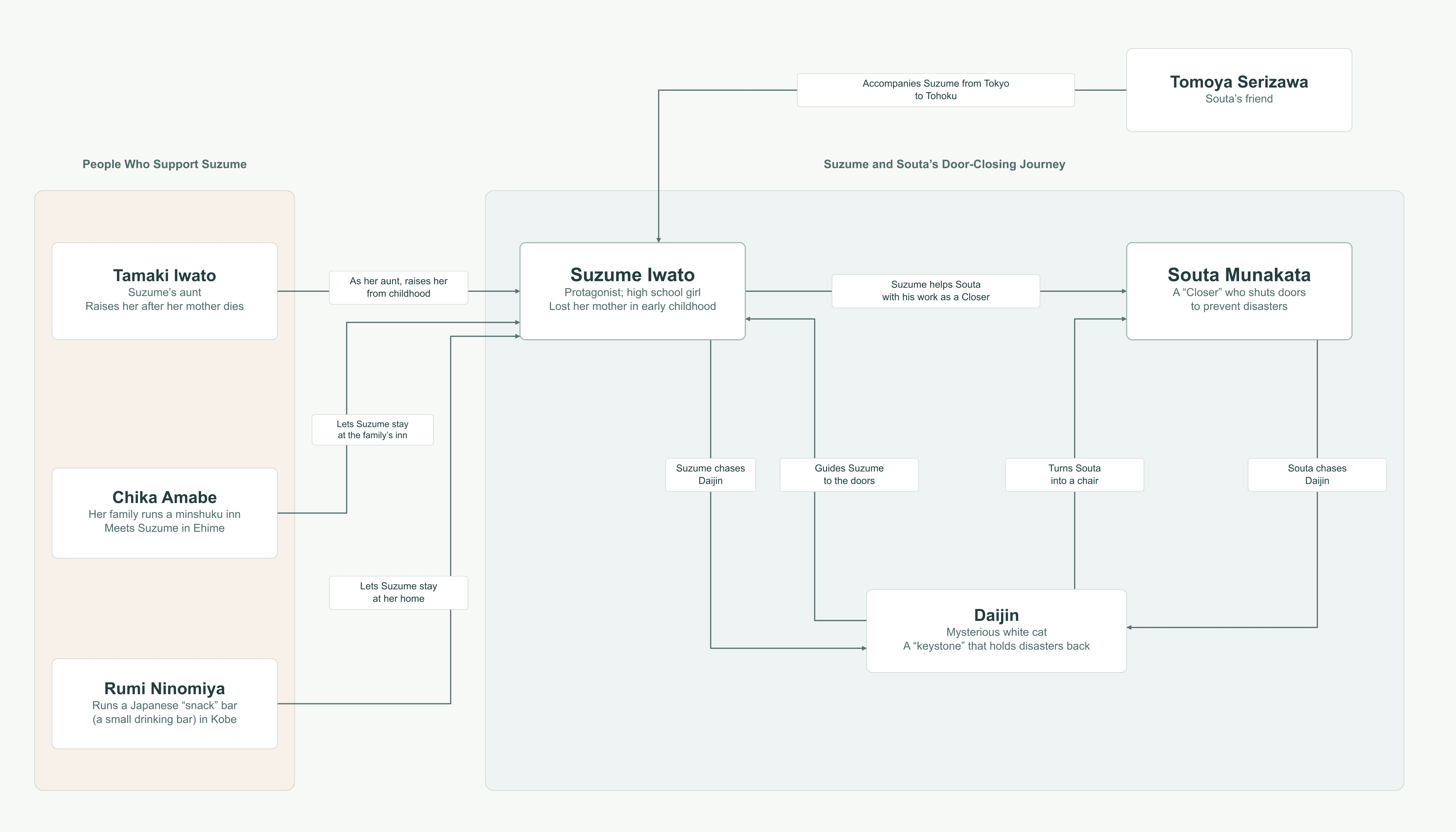
Suzume Iwato lost her mother in the Great East Japan Earthquake of March 11, 2011. At the beginning of the film, she lives with her aunt in Miyazaki Prefecture.
Suzume and Souta pursue Daijin as far as Tokyo. To bring the crisis there under control, Souta becomes trapped in the Ever-After, a world beyond this one.
Joined by her aunt and Souta’s friend Serizawa, Suzume heads for her childhood home in Iwate. She hopes to enter the Ever-After there and save him.
For the full story, see my synopsis and analysis of Suzume.
Suzume: Character Introductions and Analysis
The characters’ choices and relationships offer different perspectives on Suzume’s journey and the family bonds at its center.
Suzume Iwato | English Voices: Nichole Sakura, Bennet Hetrick (Young Suzume)
Character introduction and analysis: Suzume Iwato
Suzume Iwato: Introduction and Analysis
The protagonist is a 17-year-old high school student in a Miyazaki port town. On what should be an ordinary morning, she meets the beautiful Souta Munakata, and the story begins.
Suzume lives with her aunt, having lost her mother in the Great East Japan Earthquake. The film says nothing about her father. Since she seems to have lived with Tamaki from immediately after the disaster, I suspect he died before it. Or perhaps he was such a rotten man that Tamaki never considered entrusting Suzume to him. Either way, the film does not tell us what happened.
Suzume has grown into an admirable young woman, but Tamaki’s achievement in supporting her is just as remarkable. Could I have done such a thing? Still, living together seems to have left both with unspoken feelings. A bomb has smoldered for years, and it finally goes off in the second half.
From the outside, they look like an ordinary mother and daughter. Their awareness that they are not biological mother and daughter probably complicates the friction that any parent and child might feel. At its heart, Suzume is experiencing high school for the first time, while Tamaki is raising a high-school-age daughter for the first time. They are a very ordinary, admirable family.
Yet the loss of Suzume’s mother, and the earthquake itself, have become subjects neither can touch. Those feelings smolder within them like the Worm, then erupt in a world whose two keystones have come loose. Neatly done. For me, Suzume is a story of growing up, facing oneself, and recovering a mother. I thought it was a very good film.
Souta Munakata | English Voice: Josh Keaton
Character introduction and analysis: Souta Munakata
Souta Munakata: Introduction and Analysis
A beautiful young man, Souta keeps up his family’s inherited work as a Closer while studying education to pursue his main career as a teacher.
Speaking to Suzume at the beginning seals his fate. From there, he:
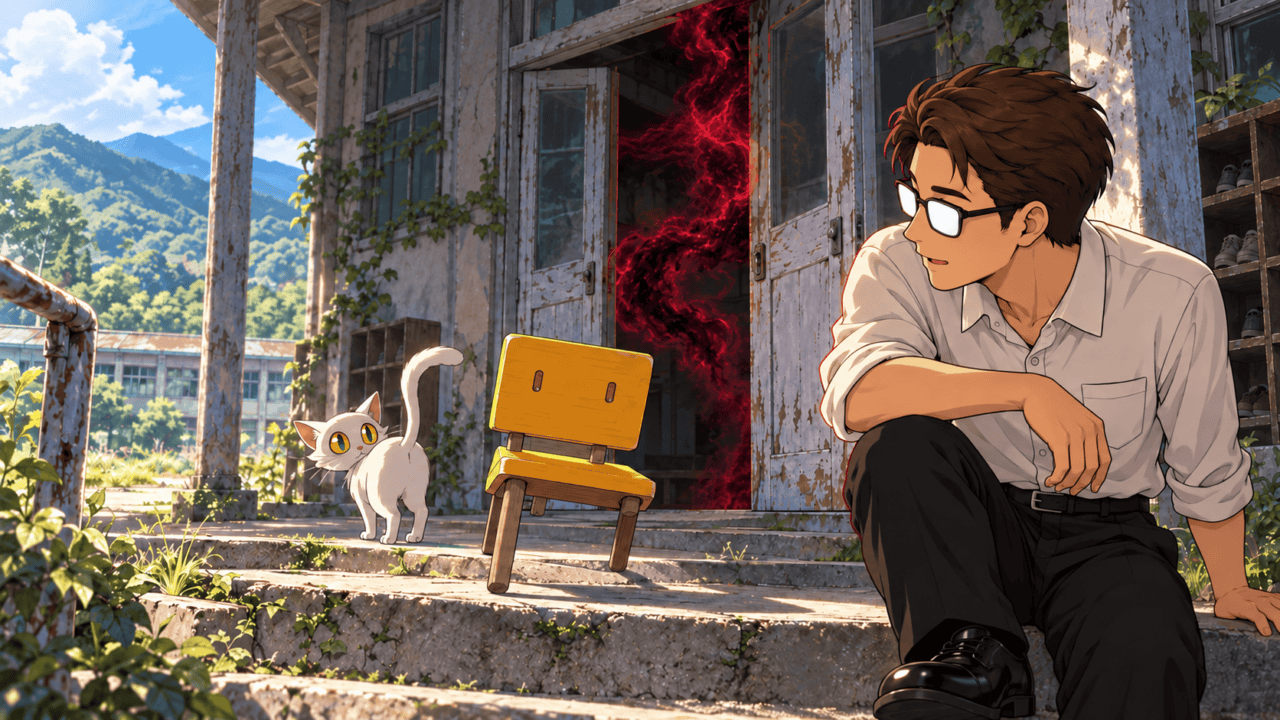
- is turned into a chair by Daijin,
- is given the role of a keystone,
- misses his teacher recruitment exam,
- and is made to hold down the Worm in the middle of Tokyo.
If only the girl he asked for directions had not been Suzume. Since The Place Promised in Our Early Days, Shinkai’s men have ended up on extraordinary journeys for women. Might this be the most extreme yet?
Daijin | English Voice: Lena Josephine Marano
Character introduction and analysis: Daijin
Daijin: Introduction and Analysis
Daijin has suppressed the Worm as a keystone at an abandoned hot-spring resort in Miyazaki. Suzume gives him the name because he looks like a daijin—a government minister. Pulling him out lets him regain his original form, but Japan loses the keystone that held the Worm down.
It happens in an instant, but Suzume has done something extraordinary: Japan is once again at risk of a terrible earthquake.
Yet, seeing Souta’s lonely existence as a keystone later in the film, I cannot simply blame Suzume. At first, Daijin seems a villain opening rear doors across Japan. In fact, he has been leading them to the doors that will open next, not causing them to open himself.
I can understand his wish to travel around Japan with the girl who gave him freedom for the first time in so long. Nor can I blame her for giving it to him. Every job needs a break.
Tamaki Iwato | English Voice: Jennifer Sun Bell
Character introduction and analysis: Tamaki Iwato
Tamaki Iwato: Introduction and Analysis
Suzume’s aunt raised her from the age of four, when the earthquake took her mother, through her high school years.
In the flashback, Tamaki finds Suzume wandering in search of her mother and embraces her, resolving to raise her as her own child. Her commitment makes any words of praise seem inadequate. The life from which this film begins is her extraordinary achievement.
Yet perhaps that great achievement makes us see Tamaki as a conventional mother for much of the film. In a paradoxical sense, the story shows that this is exactly what she has been all along.
Tamaki sees her frustrations and anxieties as signs that she is not Suzume’s birth mother. But I see them as feelings that every parent experiences, proof that she has continued to be Suzume’s parent. Her struggle to do her best has made that harder for her to see.
Someone like me can hardly say more about that… yet Suzume’s father still intrigues me. I understand Tamaki taking her in after her mother’s death, but why did she not go to her father? He does not even appear in her memories. Where did he go? I can think of three possibilities:
- He died when Suzume was very young.
- Her parents divorced when she was very young.
- Tsubame had her as a single mother from the beginning, so no one knows him.
I favor the third: it would make the film’s complete silence about him most natural. But the second is the most interesting. In that scenario, perhaps he was such a rotten bastard that Tamaki never even considered leaving Suzume with him. None of this is explained in Suzume, so we can only imagine. Isn’t thinking about these unseen family circumstances one of its greatest pleasures?
Tsubame Iwato | English Voice: Allegra Clark
Character introduction and analysis: Tsubame Iwato
Tsubame Iwato: Introduction and Analysis
Suzume’s mother died in the Great East Japan Earthquake.
We see very little of her in the film, but learn that:
- she seems to have worked in health care,
- and she was handy enough to make a chair for Suzume.
I suspect she raised Suzume as a single mother while working, which must have been a struggle. Perhaps she was working for someone else’s sake even when the earthquake struck.
Tomoya Serizawa | English Voice: Joe Zieja
Character introduction and analysis: Tomoya Serizawa
Tomoya Serizawa: Introduction and Analysis
Souta’s friend is also studying to become a teacher. His appearance is flashy and his language a little rough, but he is a good enough friend to come to Souta’s home out of concern when he has not seen Souta for a while.
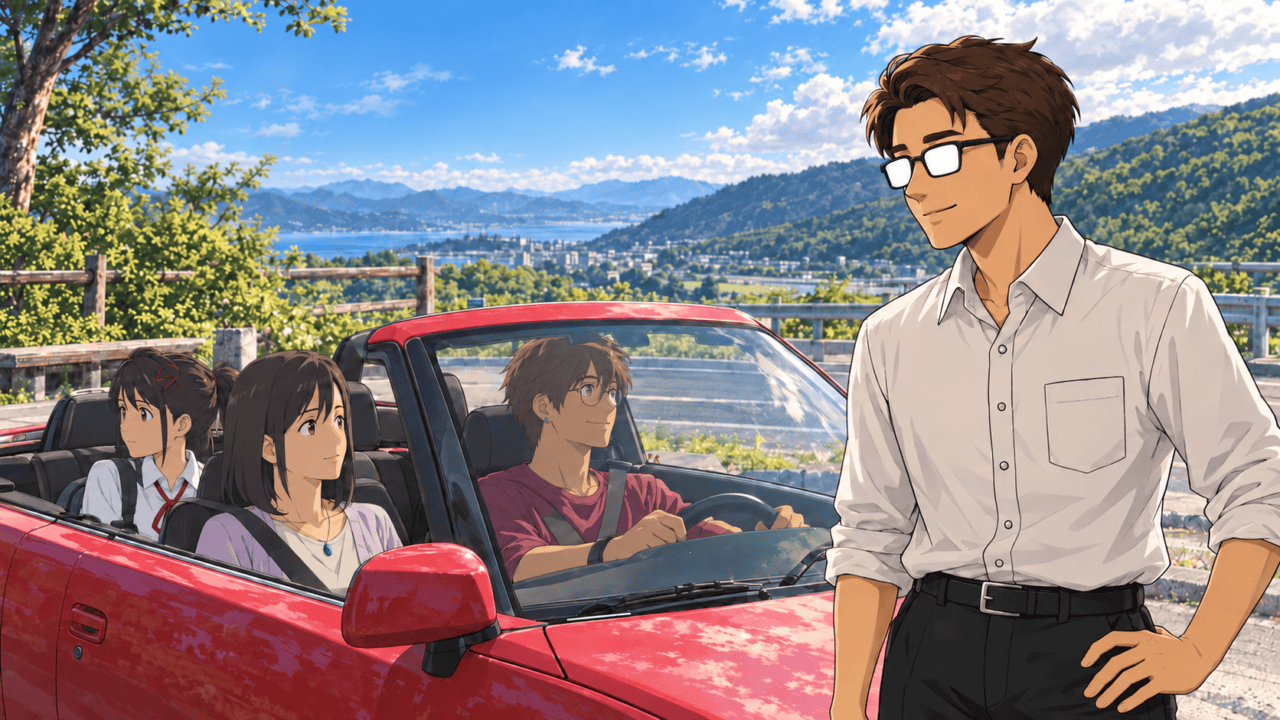
His red secondhand car, once a functioning convertible, helps make Suzume’s second journey possible.
More than that, he keeps driving without complaint while caught between Suzume and Tamaki’s difficult relationship. What a good guy. He seems to know his 1980s music, playing several old hits on the journey north. They offer a wonderfully warm interlude in an otherwise serious trip.
Chika Amabe | English Voice: Rosalie Chiang
Character introduction and analysis: Chika Amabe
Chika Amabe: Introduction and Analysis
Suzume meets Chika in Ehime while pursuing Daijin.
They are the same age. Chika lets Suzume stay at the guesthouse her parents run, and even gives her ordinary clothes because a school uniform makes her stand out.
She is the first person to sense that something is going on and support Suzume without prying.
Rumi Ninomiya | English Voice: Amanda C. Miller
Character introduction and analysis: Rumi Ninomiya
Rumi Ninomiya: Introduction and Analysis
Suzume meets Rumi at a bus stop in Ehime while chasing Daijin.
Rumi runs the Haabaa bar in Kobe. Suzume stays at her home while helping behind the scenes. Perhaps Rumi considered letting her stay for free, but thought that working would make her less self-conscious about accepting help. I see it as Rumi’s own form of consideration.
Miki | English Voice: Mela Lee
Character introduction and analysis: Miki
Miki: Introduction and Analysis
Miki works part-time at the Haabaa bar.
Like Rumi, she cares for Suzume with a big sister’s warmth.
Minoru Okabe | English Voice: Roger Craig Smith
Character introduction and analysis: Minoru Okabe
Minoru Okabe: Introduction and Analysis
Minoru is Tamaki’s coworker at the fisheries cooperative. He has feelings for her, and everyone around them seems to notice or know. Tamaki herself seems completely unaware.
He tries earnestly to get involved in the Iwato family’s difficulties, only for Tamaki to brush him off. You have to admire his persistence.
Hitsujiro Munakata | English Voice: Cam Clarke
Character introduction and analysis: Hitsujiro Munakata
Hitsujiro Munakata: Introduction and Analysis
Souta’s grandfather is also his mentor as a Closer. He is hospitalized in Tokyo, and his condition is not good.
He gives the impression of knowing a great deal. Near the end, he offers Suzume a clue to meeting Souta again beyond the rear door.
Many fields struggle to find successors these days; apparently the Closer business does too. Perhaps we should be surprised it has lasted this long. In any case, Souta’s return from keystone to human must have been good news for the trade.
Your Take: Suzume’s Journey
Suzume’s journey brings her closer to strangers, loved ones, and her own past. Which part stays with you most?
Reader poll




Reader Comments
Have a thought or interpretation? Leave a comment