
Rob Reiner’s Stand by Me came out in 1986. It’s based on Stephen King’s novella The Body.
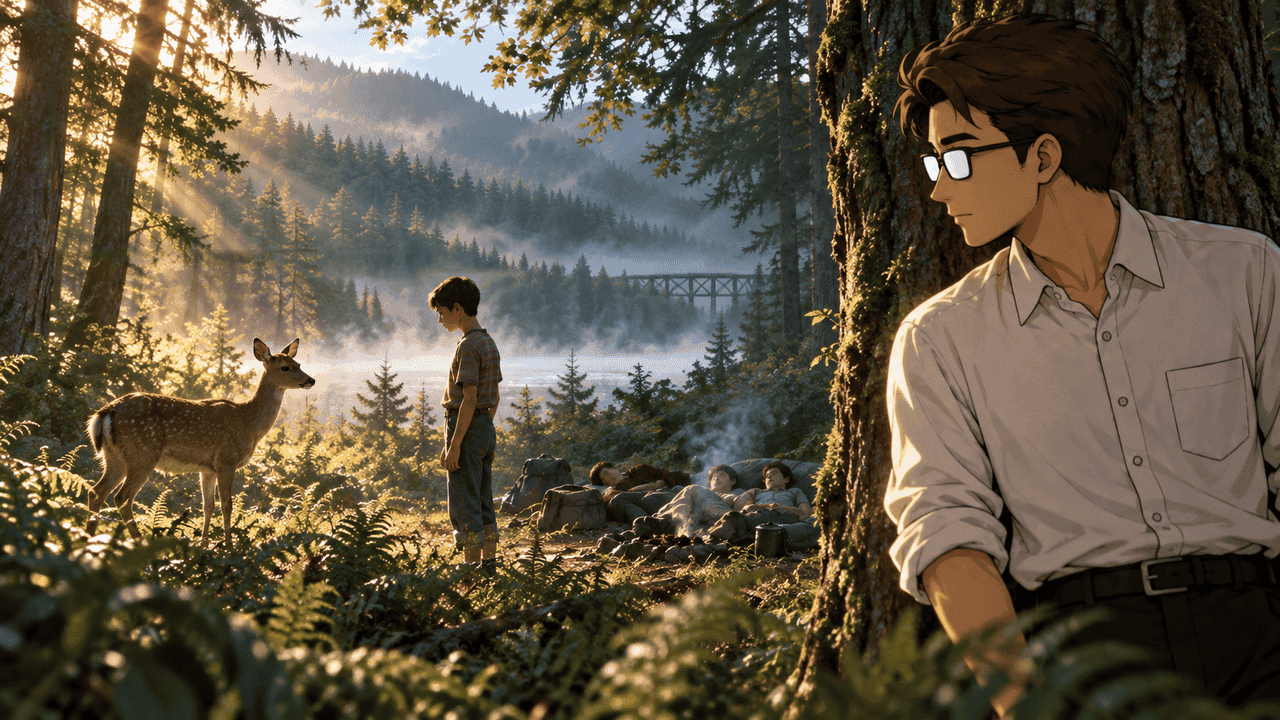
I’ve seen this movie more times than I can count since I was a kid. So many scenes stay with me, but there’s something about the moment Gordie meets the deer that I’ve never quite been able to shake. He doesn’t tell his friends he saw it, and the grown-up Gordie goes out of his way to say he didn’t. I would have blurted it out. “Hey! I saw a deer!” I’ve wondered since childhood why he kept quiet, even though some part of me always felt it was right that he did.
I want to put that feeling into words. There’s also a much bigger lie I suspect Gordie may have told once he grew up and started writing. Let’s go back through the story first.
*This is a translated version. The original (Japanese) is available here.
On this pageContents
Stand by Me Plot Without Spoilers
It’s 1959 in the small Oregon town of Castle Rock. Gordie, Chris, Teddy, and Vern spend most of their time together. Each boy has trouble of some kind at home. Then Vern overhears his older brother talking about a missing boy named Ray Brower, whose body they found in the woods.
The four boys follow the railroad tracks to find Ray Brower and come home as heroes. They lie to their families and set out on a two-day trip, their first real chance to get somewhere away from home. A dangerous crossing on a railroad bridge and a night in the woods bring them closer. They share things they’ve kept to themselves about their families and what they fear for the future.
The boys find themselves up against an older gang led by Ace Merrill, who wants to claim the body for himself. Will they make it home safely? And what will they take with them from those two days?
Stand by Me Plot With Spoilers
Vern overhears his brother talking about the body, and the four friends set out imagining how famous they’ll be. They talk about the things that hurt at home, and by the time they find Ray, all the excitement is gone. The boys keep Ace’s gang from taking the body, then go home without claiming credit. Eventually, they go their separate ways.
Plot at a Glance
- Vern finds out where Ray Brower is. He tells Gordie, Chris, and Teddy, and the four follow the tracks, hoping to come back as heroes.
- The boys open up along the way. At the junkyard and around the campfire, they show how much trouble they carry with them. Teddy is fiercely loyal to his father, and Chris worries that his family’s reputation will decide his future for him.
- They find Ray. The sight of his body ends the excitement. Gordie thinks about his dead brother, and Chris tries to comfort him. When Ace’s gang shows up, Gordie drives them away with a gun.
- The boys call in the discovery anonymously and give up their chance to be heroes. As the friends grow apart, Chris becomes a lawyer and is later killed trying to break up a fight. The adult Gordie writes about the friends he had that summer.
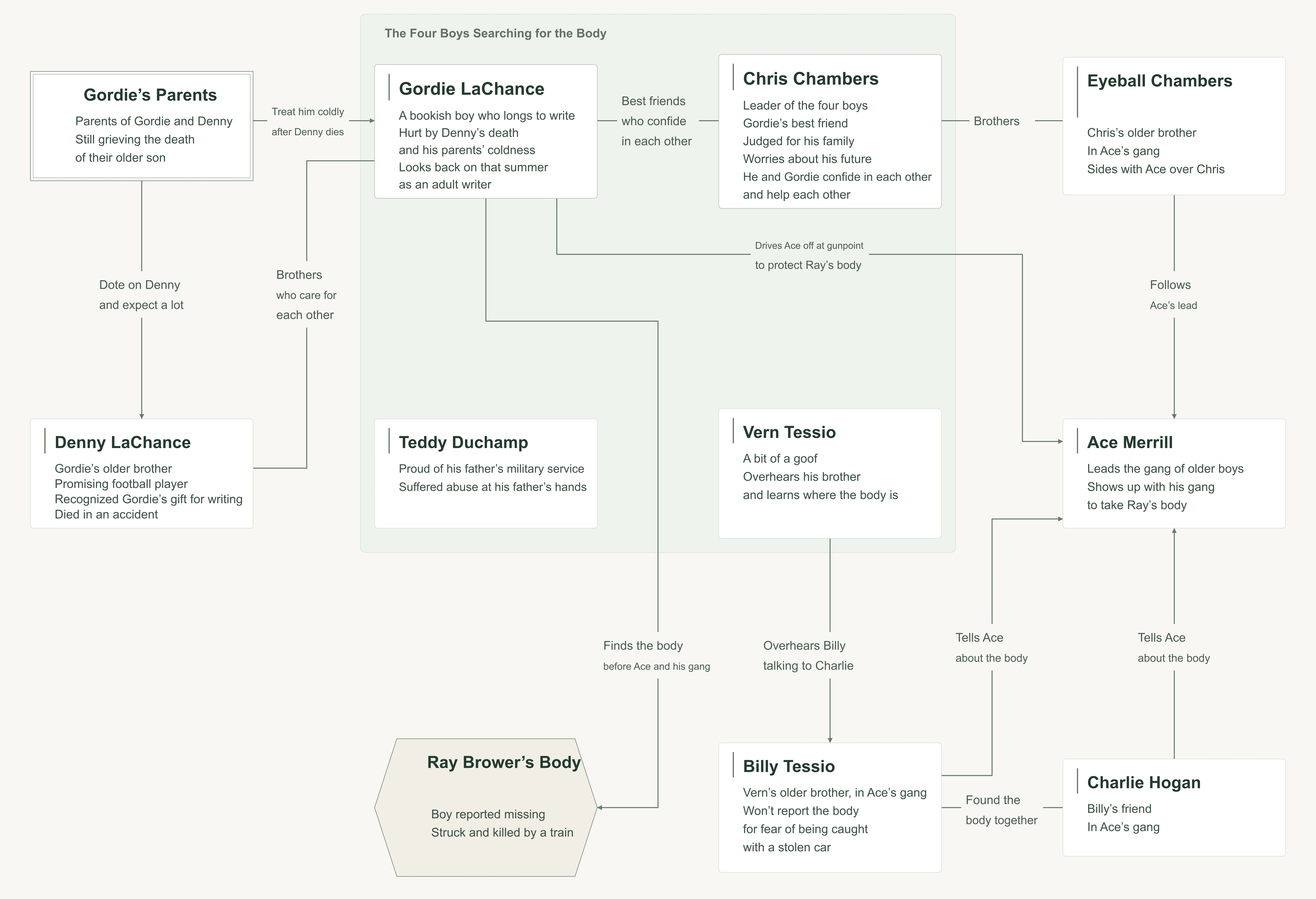
Character Map
Gordie and Chris trust each other with things they keep from the other boys. The map shows how that friendship fits into the search for Ray Brower, Gordie’s grief over Denny, and the conflict with Ace’s gang. The full summary follows.
Full Plot Summary
Setting Off to Find the Body
Vern Tessio has lost his stash of pennies. More precisely, his mother threw out the treasure map that showed where he’d buried them beneath the porch. He’s been digging for nine months when he overhears his brother and a friend talking about the body they found near Back Harlow Road. It belongs to Ray Brower, a boy about Vern’s age who’s been missing for three days. They decide to keep it quiet because they got there in a stolen car.
Vern tells Chris Chambers, Teddy Duchamp, and Gordie LaChance and suggests they go find Ray themselves. Imagine making the news and becoming the town’s heroes. They get their stories straight and decide to spend a night away. Gordie, alone among them, is thinking about his dead brother.
At the Junkyard
The next day, the four set off along the railroad tracks toward Back Harlow Road. Chris has taken his father’s gun for protection. Vern has brought a comb in case he’s on television.
They stop at a junkyard, where they’re having a good time until the man who runs it catches them. They get over the fence, but on the way out he insults Teddy’s father. A veteran struggling with his mental health, Teddy’s father once held his son’s ear to a stove and burned it. Teddy still looks up to him as a hero of Normandy. He flies into a rage and then breaks down in tears.
A Night by the Campfire
That night, the boys sit quietly around a fire. They take turns keeping watch, passing the gun from one to the next. Gordie dreams he’s at his brother’s funeral and his father coldly tells him he wishes Gordie had died instead.
Gordie wakes with a start and talks about school with Chris, who’s tending the fire. Chris says people judge him by his father and brother, and that he can’t see anyone letting him into the college-prep classes. He admits he stole the milk money. What he can hardly bear to tell Gordie is that he gave it back to a teacher, who kept it. She knew nobody would believe a boy like Chris if he told them. That’s the part that hurt him most.
Gordie does his best to comfort him. He’s now the only one who knows what Chris has been carrying around. Early the next morning, Gordie is reading alone when he comes face to face with a deer. He keeps it to himself.
Finding Ray Brower
After a few more scrapes, the four reach Back Harlow Road and find Ray. All their excitement disappears. The sight of Ray’s body brings back Denny’s death, and Gordie finally tells Chris he thinks his father hates him. He says it through tears. Chris says his father just doesn’t know him. He tells Gordie he’ll be a great writer someday and can always write about the four of them if he runs out of ideas.
Vern’s brother has told his friends after all. Ace’s gang shows up demanding the body, with Chris’s brother among them. Chris holds his ground, insisting the four of them got there first. Gordie fires into the air and points the gun at Ace. Ace and the others leave.
Ray’s body is theirs to report, and they make an anonymous call and give up the glory they came for. They walk back to Castle Rock through the night and head home.
Gordie the Writer
In time, Gordie drifts away from Teddy and Vern, as friends often do. Chris goes into the college-prep classes alongside Gordie. He makes it to college, and then, against the odds, he becomes a lawyer.
Last week, Chris tried to break up a fight at a fast-food restaurant. He was stabbed in the throat and died. Gordie writes that he hadn’t seen Chris in more than ten years and will miss him forever. He doubts he’ll ever have friends again like the ones he had at twelve. Then he gets up from his desk and goes to the kids.
That’s the story as I remember it, with plenty left out. Now we can come back to the deer.
What Stays With Me About Stand by Me
The boys have reasons of their own to want to get out of Castle Rock, and the trip gives Chris and Gordie the chance to tell each other things they can’t say at home. I think what Chris confides by the fire changes how Gordie sees their friendship and helps explain why he keeps the deer to himself. Years later, the novelist Gordie gives their friends Teddy and Vern roles that seem almost too well suited to telling the story of him and Chris. It’s worth asking what Gordie may have made up, including the scene in which Chris gives him permission to write about them.
The Boys Want to Get Away From Home
Going out to find a body and daydreaming about the glory sounds exactly like something boys that age would do. I wonder what else made them so eager to leave. Think about what each boy has going on at home.
- Gordie’s parents have barely taken notice of him since his older brother died.
- Chris has a father who drinks and a brother who runs with a gang.
- Teddy has been abused by his father.
- Vern has lost his pennies. His pennies!
I don’t know whether you’d call what happens to Gordie neglect, strictly speaking. It still has to hurt when your parents are so caught up in your dead brother that they barely see you. Loving Denny himself makes it that much harder. Chris suffers at home and has to live with a reputation he inherited, which makes it hard to imagine a future for himself. Teddy loves the man who hurt him and proudly calls him a hero of Normandy. Maybe that’s how he protects himself. As for Vern, well, there are the pennies.
Finding Ray’s body gives the four boys a reason to go somewhere beyond the lives they know. I can’t imagine they’d have been so keen to set off without that feeling of wanting to be somewhere else.
Why Doesn’t Gordie Tell His Friends About the Deer?
The night before Gordie sees the deer, Chris breaks down and tells him what happened with the milk money. I think that confession changes something for Gordie. To see why, it helps to look at who cries in the film and who gets to hear what they say.
Three Confessions
At least three of the boys break down and tell someone how they feel. Teddy goes first, right after the man at the junkyard insults his father. Everyone sees it. What comes out is how much he loves his dad. By the campfire, Chris tells Gordie what he did, how his teacher betrayed him, and why it leaves him with so little faith in other people or his own future. After they find Ray, Gordie tells Chris about the grief he feels for Denny and his fear that his father hates him.
All three cry. Teddy is defending the life and the family he has, and it hurts to see just how fiercely he does it. Chris and Gordie are pushing back against theirs. I think Teddy’s outburst helps make the other two possible. Gordie sees exactly how much Teddy loves his father, then dreams that his own father wishes he were dead. Chris has troubles with his own father and brother, and that night the despair he’s kept to himself comes spilling out. What changes for Gordie when he hears it?
The Pecking Order Among Friends
The four boys are friends. They also have something of a pecking order. I’d put Chris at the top, Teddy next, then Gordie, then Vern. You could put Teddy and Gordie on a level, too. I get that impression throughout the film, and the card game in the tree house gives it to me right from the start. Nobody has to lay down the rules or even think very hard about it. Friends can just fall into certain places. In this group, Chris is clearly the leader.
That’s what makes the night at the campfire different. For the first time, Gordie gets to stand on an equal footing with Chris. He finds out that the kid who leads the group has his own private trouble, something he’s never let his friends see.
The Secret Gordie Keeps
What would it have meant if Gordie had told everyone about the deer? He’d have taken something he experienced alone and shared it immediately. You could call that wanting to share your joy or surprise. After hearing Chris, though, I think it would also leave Gordie in the position of the kid who follows someone else’s lead. Chris can keep something to himself. Now Gordie can too.
By keeping the deer to himself, Gordie has a secret of his own and can stand as Chris’s equal. You could even say he’s pulled a little ahead. He knows what Chris has been hiding, and Chris knows nothing about the deer or what Gordie feels about his father. From then on, Gordie acts with a new force. He starts shaping what happens instead of letting it happen to him.
Maybe he keeps the secret to put himself on equal footing with Chris. Maybe keeping it is the film’s way of showing he’s already there. You could simply say he’s grown up a little. The pecking order helps me explain why keeping something to yourself can look like growing up.
Becoming Friends
The advantage Gordie has with the two secrets doesn’t last. Finding Ray brings him right back to Denny’s death, and he tells Chris what he’s been hiding all along. He thinks his father hates him. It’s a sad scene, and Chris’s care for him is so plain. I think it’s also the point when the two really become equals. Now each has trusted the other with something nobody else in the group knows. To me, that’s the friendship the whole film was made to show.
The ending puts it right in front of us. Gordie stops at his word processor after writing about Chris.
Although I hadn’t seen him in more than ten years, I know I’ll miss him forever.
I think that’s where the grown-up Gordie has written what he really wanted to say. His kids come into the room, bringing him back to the present, and he adds one more thought about all four of them.
I never had any friends later on like the ones I had when I was twelve. Jesus, does anyone?
When Gordie thinks of a friend he’ll never forget, I think he’s thinking of Chris alone.
Vern Is an Angel
That gets me to an answer about the deer, and Vern hasn’t once come into it. Teddy, Chris, and Gordie all carry some deep hurt from their families. Vern has lost his pennies. Come to think of it, he loses his comb on the trip too. He’s the one boy the film can make an unabashed goof.
Imagine a fourth boy with a wound like the others’. One boy loves a father who abused him, another can’t escape what people think of his family, and another feels his parents turn away from him while he’s grieving his brother. Add one more and it would be hard to watch. It would certainly be a different movie.
Vern brings enough laughter to stay with the boys through a story we might otherwise want to look away from. He’s like an angel who stays with Stand by Me from beginning to end. The more I think about what a perfect part he plays, though, the more I find myself wondering about something that might sound a little far-fetched.
The Big Lie Gordie the Novelist May Have Told
There’s the world where Gordie is a grown man who writes for a living. Inside it is the story he writes about that summer. We’re watching a story within the film, and it’s easy to take that inner story at face value. But how much of it happened the way he tells it?
How Convenient Teddy and Vern Are
Teddy cries just as Chris and Gordie do, and his fierce love for his father sets up the other two boys’ confessions. Meanwhile, Vern keeps the story moving and takes the edge off when things get hard to watch. Both boys have distinct parts to play, and they suit Gordie’s story almost a little too well.
The Strange Work of Being a Novelist
The film begins when the adult Gordie learns that Chris has died. I take that much to be true. What do most of us do when we learn someone dear to us has died? Think about their life, call their family, find out when the funeral is. There’s only so much we can do. There are people who take it further, or maybe can’t help taking it further. We tend to call them artists.
I think of Eric Clapton’s “Tears in Heaven.”
Loading video...
It’s a beautiful song, and it’s deeply moving as a way of mourning his four-year-old son, who died in an accident. And there’s still a small part of me that thinks, “You can make a song out of that?” Some people can turn grief into something the rest of us couldn’t make. I doubt I’d come out of losing a son with a song. Some people do, and I doubt they could stop themselves. I don’t see why they should.
Maybe that’s what happened to Gordie. When he heard Chris was dead, a story began taking shape in his head. It probably grew out of things that really happened, and he probably changed a fair amount. Chris’s death brought it into being, so of course it turned into a story about the two of them. Teddy and Vern became supporting characters, and the novelist in Gordie may have recast them to give the story the parts it needed.
The junkyard scene gives me another reason to wonder. The adult Gordie says the man told his dog, Chopper, “Sic him, boy,” while the boy heard “Chopper, sic balls.” As a kid running from the dog, how would Gordie have known what the man actually said? I can imagine a novelist adding that little distinction to make the scene funnier and more frightening.
Asking Chris to Forgive Him
Once Gordie starts writing, he can hardly help making up some of what we see. Creating fiction is his work and the thing he does best. That’s what makes it worth going back to what Chris says while Gordie is crying near the end.
You’re gonna be a great writer someday, Gordie.
You might even write about us guys if you ever get hard up for material.
Chris’s words get me every time. They land differently when I remember who wrote them down. Chris might really have said them. He might never have said anything of the sort. The novelist Gordie had to put the words in his mouth, and every piece of the story leads to that moment.
Maybe Gordie wrote the story to have Chris forgive him for turning their lives into fiction. A novelist can make a story out of anything. Even the death of the person who once told him he could write about them.
That’s what I make of Stand by Me, more than twenty years after I first saw it as a kid. A lot of my answer about the deer hinges on whether you can see a pecking order among the four boys. It doesn’t seem such a strange idea to me. What kind of story was Stand by Me for you?
Poll results
Voting closedWhy do you think Gordie kept his encounter with the deer to himself?
- He wanted to keep it as a memory of his own0%
- Having a secret of his own helped him feel like Chris’s equal0%
- The experience felt too special to put into words0%
- Several of these reasons fit0%
- I think there was another reason0%
- I’m still not sure0%
Sifr’s video on Stand by Me
Loading video...



Reader Comments
Have a thought or interpretation? Leave a comment