
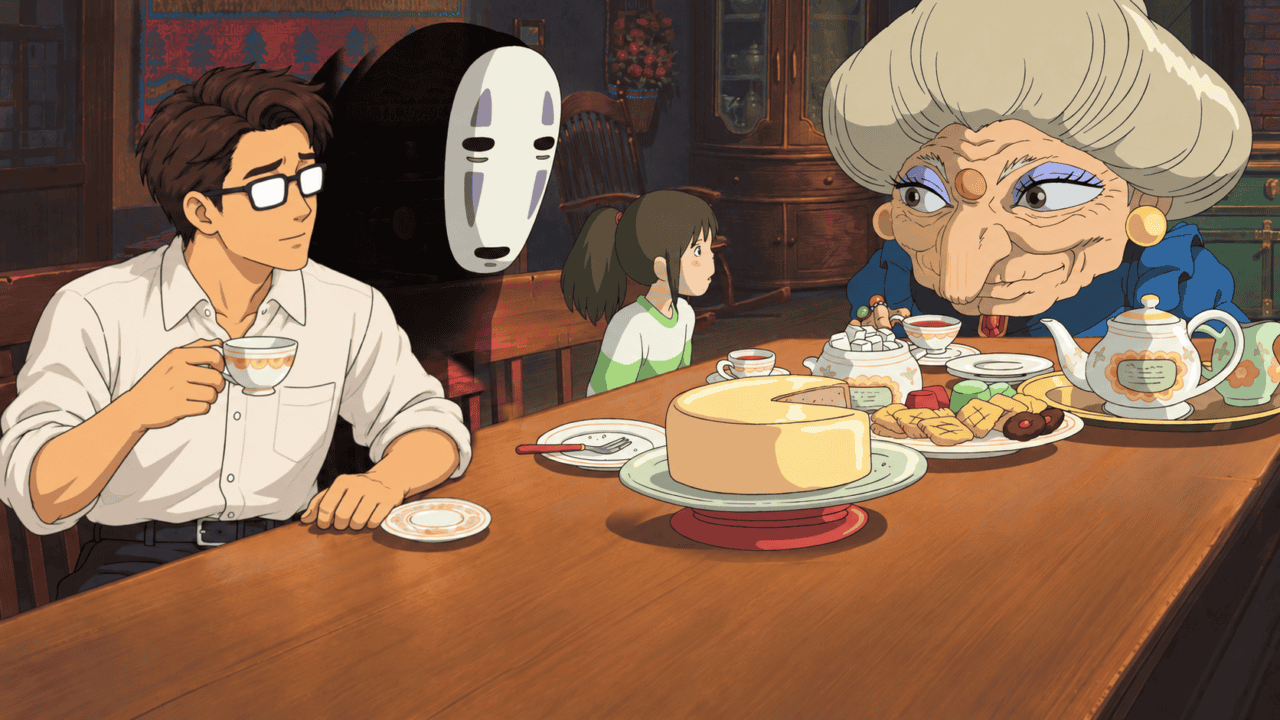
In my previous article, I considered why Yubaba takes people’s names in Spirited Away(Official Studio Ghibli).
Read the previous analysis: Why Does Yubaba Take People’s Names?
This time, I want to consider the sisters’ magic and their contracts. One of the film’s mysteries is why Yubaba sends Haku to steal Zeniba’s contract seal. To explore that question, I first need to think about the obligations of both sisters.
The film tells us about Yubaba’s obligation: she must give work to anyone who wants it. But what might Zeniba’s obligation be?
*This is a translated version. The original (Japanese) is available here.
- A Possible Contract for Zeniba
I suggest that Zeniba’s obligation is to complete the work she is given, as a counterpart to Yubaba’s duty to provide work. This might explain why she remains at Swamp Bottom. - Why Yubaba Might Want the Seal
Perhaps Yubaba wants to employ her capable sister and uses the seal to force a contract. Or perhaps it is an attempt to make amends for having sent Zeniba to the swamp. These are possibilities I explore, not backstory the film confirms. - The Two Sides of Miyazaki
I also read Yubaba as Miyazaki the manager and director, and Zeniba as Miyazaki the animator. From that perspective, stealing the seal might express a wish to employ the ideal animator: himself.
On this pageContents
What Might Zeniba’s Contract Be?
If we rely on the film itself, there are mainly two clues about Zeniba’s contract.
One is Yubaba’s promise to give work to anyone who wants it. The other is Zeniba’s statement that she and Yubaba are two halves of a whole.
From those two clues, I would expect Zeniba’s obligation to complement Yubaba’s. It is difficult to say exactly how, but my suggestion is: “Complete the work you are given.” In other words, employer and worker.
In this reading of Spirited Away, just as Yubaba is bound to give work, Zeniba is bound to do the work she is given.
Could that be why Zeniba cannot leave Swamp Bottom?
Yubaba is in a similar position. She goes out at night, but she cannot simply abandon the bathhouse and all its problems. As the Stink Spirit’s visit shows, she has to make the decisions when a major crisis arises. Yubaba rules the bathhouse, but she is also bound to it.
If the sisters form a pair, perhaps Zeniba is bound to her own place too. After all, she does not pursue Haku in person; her paper shikigami, or familiar, does. To me, that suggests she is unable to leave Swamp Bottom.
Now for the main question: why does Yubaba try to take Zeniba’s contract seal?
Why Does Yubaba Want Zeniba’s Seal?
I have two ways of thinking about the theft. To me, both feel plausible.
Theory One: Yubaba Wants Zeniba to Work for Her
If it is a contract seal, taking it might allow Yubaba to make Zeniba enter into a contract. Perhaps she wants her sister to work at the bathhouse.
One of the film’s most striking contradictions is that Yubaba is obliged to give work to anyone who wants it, yet tries desperately to stop Chihiro from saying, “Let me work here!”
It is the exclusionary side of an employer: she cannot hire absolutely everyone. Yet she wants the seal. Perhaps she is trying to make a particularly capable worker—Zeniba—sign a contract, even against her will.
Yubaba has many employees, but they probably seldom do exactly what she wants. At such moments, perhaps she thinks of her sister and how good she is at her work. That could explain the attempt to steal her seal and make her sign a contract.
Imagining an Earlier Quarrel: Let’s let our imaginations wander. Who gave Zeniba her work at Swamp Bottom? Perhaps it was Yubaba. During a quarrel, recently or long ago, she might have said, “Stay here and spin thread for the rest of your life!” Zeniba has remained there ever since.
Perhaps sending Haku to steal the seal was Yubaba’s way of making amends. After years of estrangement, she could not bring herself to say sorry. Of course, this is entirely imagined. But inventing possibilities like this is part of the pleasure of a film that leaves so much unexplained.
Next, I want to consider Yubaba’s actions from a different angle.
Theory Two: Yubaba and Zeniba as the Two Sides of Miyazaki
After watching many Miyazaki films, I find it hard not to see Yubaba as Miyazaki the manager—or Miyazaki the director giving instructions to animators.
Read that way, where she goes at night becomes obvious: Miyazaki’s house, of course. Within the story, she lives at the bathhouse. But from this perspective, her departure looks for all the world like someone going home.
If Yubaba is Miyazaki the manager and director, then perhaps Zeniba is Miyazaki the animator.
I read Zeniba’s place at Swamp Bottom, from which she cannot return, as a metaphor for days as an animator that are gone for good. Miyazaki may not want to return to those days, but perhaps he sometimes remembers the freedom of being one animator among others.
Animators are hardly free in every sense: they have to realize the director’s intentions. But they can say, “That’s wrong!” or “We should do it this way!” That freedom belongs to someone who is not the director. Miyazaki no longer has it. Everything is his responsibility; there is no one else to complain to.
Who, then, would Miyazaki most like to employ as an animator?
Himself, surely.
Let me make one thing clear: I am not suggesting that Ghibli’s animators are inadequate. To us viewers, all animators—not just those at Ghibli—are practically magicians. I have respect for them, not contempt.
But Miyazaki wants to realize Miyazaki’s world. In that context, the individuality and originality of his animators are sacrificed to his vision.
In documentaries about Miyazaki, I have repeatedly seen animators’ painstakingly drawn key frames rejected and redrawn, erased, or discarded. Watching from outside, I almost want to say, “Then why not draw it yourself in the first place?”
At least he redraws them himself. Still, to me it seems clear that the animator Miyazaki is looking for is Miyazaki.
I seem to have wandered away from the question of why Yubaba steals Zeniba’s seal. In this context, my answer would be:
It expresses Miyazaki’s selfish wish to employ himself.
That is my interpretation, drawn from my own assumptions and prejudices. Such private wishes are hardly things one would want to put on display. Perhaps part of the wonder of Miyazaki’s films lies in wrapping them in beautiful fantasy.
That is how I read the sisters here: a fantasy through which to imagine the tensions within one person.
Your Take
What is your view? Choose the answer that comes closest to your own response.
Poll results
How do you see Yubaba and Zeniba?
- As people with fundamentally opposite values.0%
- As different sides of the same kind of person.0%
- As people shaped by different surroundings.0%
- Several of these at once.0%
- I see them differently.0%
- I’m not sure.0%
The images used in this article are from Studio Ghibli Works Still Images.
Can you name the movie before the scene comes into focus?
Put your visual memory to the test with a blurred Studio Ghibli scene.





Reader Comments
Have a thought or interpretation? Leave a comment