
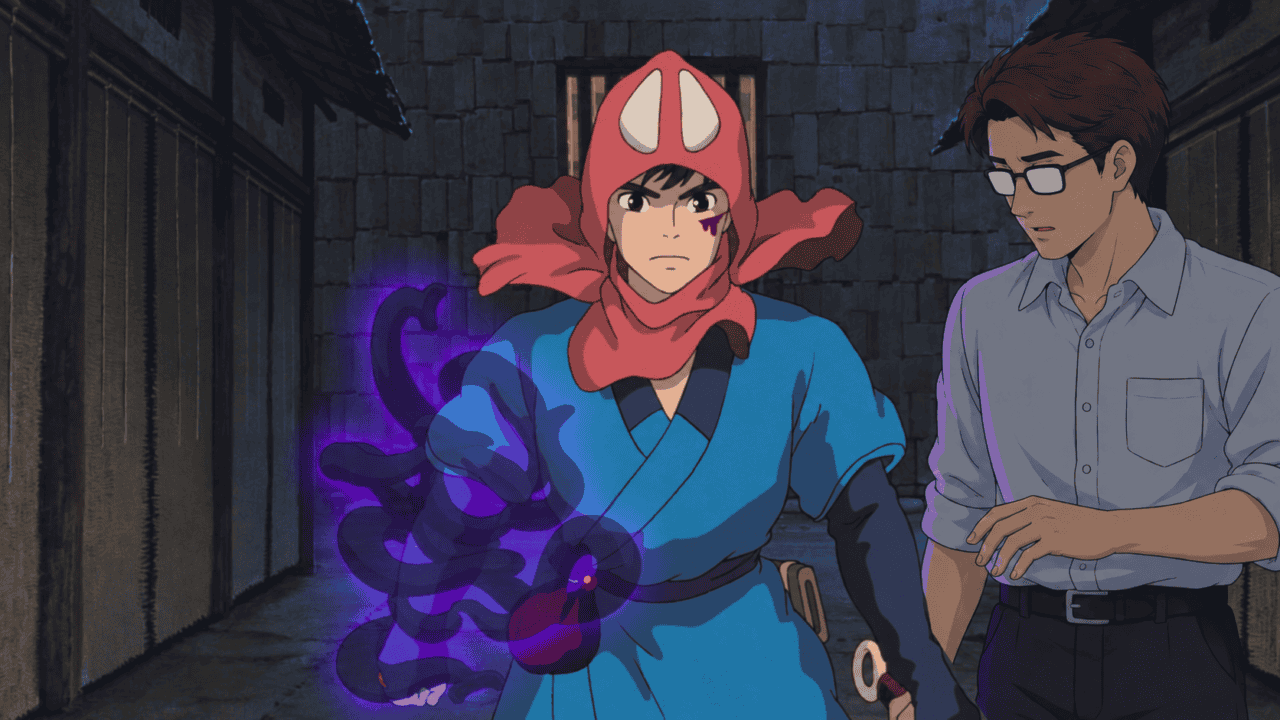
Hayao Miyazaki’s Princess Mononoke(Studio Ghibli Official) was released in 1997. Here I want to look at Ashitaka, particularly his role as the film’s protagonist. That raises a question on which opinions may differ: Who is the protagonist?
Personally, I think it is Ashitaka. Miyazaki’s proposed title, The Legend of Ashitaka (Ashitaka Sekki), points in that direction. But the way Ashitaka is portrayed in the film also reveals a clear difference between him and the other characters.
I’d like to explore that difference by comparing Ashitaka with the rest of the cast. First, let’s consider the people who hide their true feelings—a group that, at the beginning, includes Ashitaka himself.
*This is a translated version. The original (Japanese) is available here.
- People Who Hide Their True Feelings
Jiko-bō conceals his assignment, Eboshi does not speak of her past or ambitions, San denies her awareness of being human, and Moro cannot quite hate humanity outright. The women at the bellows endure their hard work with expressionless faces. - Ashitaka Initially Hides His Feelings Too
He leaves home smiling, concealing his grief at being exiled and his fear of the curse. At first, he too keeps his real feelings to himself. - Becoming the Protagonist
I see two turning points: Ashitaka learns to control his own hatred and can tell others not to be consumed by it; then, after the Forest Spirit fails to lift his curse, his tear marks a decision to live for others. - Speaking Bluntly and Unsettling Others
Ashitaka’s words touch the feelings others have kept hidden, stirring both anger and admiration. In making them reconsider their positions, he takes on the role of someone who can set them free. - The Importance of Not Reading the Room
His habit of voicing his ideals without considering other people’s circumstances moves the story and touches those around him. I think it also helps explain why San and Moro come to accept him.
On this pageContents
The Other Characters: People Who Hide Their True Feelings
Ashitaka’s role becomes clearer beside people whose words and actions pull in different directions. Their hidden feelings complicate the disputes he enters.
The Devious Monk, Jiko-bō
Jiko-bō may be the first character whose concealment of his real thoughts becomes clear.
When Ashitaka shows him the iron pellet, Jiko-bō must already understand what has happened. Yet he says nothing about the pellet itself. He responds only to Ashitaka’s mention of a “giant boar”, then tells him about the forest where the Forest Spirit lives.
If I try to imagine his thoughts at that moment, they might run like this:
- He saved my life, so I want to give him some information.
- But I don’t want to tell him anything connected with my work.
- And talking about the iron pellet would make me look bad.
Something like that, perhaps. Whatever the details, he is a man who does not tell us everything he knows.
Lady Eboshi and Her Harsh Past
Eboshi, one of the film’s central figures, also seems to keep the truth of her inner life hidden.
The film alone does not tell us that Eboshi was sold overseas and made the wife of a Wakō (Japanese pirate) chieftain (Reference: How Princess Mononoke Was Born (「もののけ姫」はこうして生まれた, in Japanese)). She rose to prominence in that harsh world, eventually took revenge on the chieftain, and returned to Japan with Gonza, who was already her subordinate.
None of this is apparent simply from watching the film, and Eboshi herself presumably does not go around telling people about it. I read her hidden feelings as a fierce desire for revenge against the world that forced such a life upon her—a world made by men.
She does not voice that desire in the film, but one of the sick people in her secret garden makes the following remark:
“Scary, scary. Lady Eboshi means to bring the country down.”
It is said jokingly, and the improved firearms seem, on the face of it, intended only to strengthen Irontown’s defenses. Yet I think the remark speaks for Eboshi’s real ambition. Her lack of response to the joke is one reason to read it that way.
In short, I see two things Eboshi keeps to herself:
- The suffering she endured in the past.
- Her ambition to overturn the world as it is.
San: Rejecting Herself
Compared with Jiko-bō and Eboshi, San may seem to have no hidden feelings. Her behavior is fairly consistent: she attacks the humans who destroy nature. Still, I think there is something she keeps inside.
We do not know the details of San’s origins, but Moro describes her as:
“The humans who violated the forest threw her in my path as they ran from me.”
Raised by Moro, San would naturally side with the forest against humans. Even so, her insistence that she is a wolf can seem excessive.
If people go to extremes to become what they wish to be precisely when they are not that person, then San may be more aware of her humanity than anyone. Her natural love for Moro, who raised her, and for the forest where she grew up leads her to seek an identity as a wolf—almost as a fundamentalist.
On this reading, the sad truth she keeps hidden is her awareness that she is human.
Seen that way, her cry of “I am a wolf!” to Ashitaka after the Forest Spirit runs wild is deeply moving. “Deeply moving” is a rather trite phrase, admittedly.
Moro: Unable to Hate Humans Completely
Moro, San’s adoptive mother, also seems to hide her true feelings.
My reason for thinking so is the simple fact that she raised San from infancy.
Had Moro hated humans from the bottom of her heart, she would not have raised a human child. She could have killed San—even, or especially, as a baby. But she didn’t. That suggests her conflict with humanity arises from necessity: the lives of the forest’s inhabitants clash with those of humans, particularly the people engaged in ironmaking.
Yet Moro shows little sign of reluctantly accepting an unavoidable conflict. Why? I think San may be the reason.
Moro fights humans because of that conflict, but her beloved daughter hates them independently of it. And Moro understands San’s desire to be a wolf more than anyone, despite having been born human. She really is San’s mother. Perhaps her uncompromising hostility toward humanity comes from standing beside her daughter’s fierce feelings.
A Possible Hope: This may be taking the reading too far, but perhaps Moro had a faint hope that San would grow up to stand between humans and the forest’s inhabitants. Instead, San made an extreme sense of belonging to the forest central to her identity. Then Ashitaka appeared: a man driven from his own community, with nowhere to live, who searched for a way for humans and the forest to coexist. Perhaps Moro thought him worth entrusting her daughter to.
The People of Irontown: Enduring Hard Work
The people of Irontown—or at least the women working its bellows—also keep their real feelings hidden.
In the documentary How Princess Mononoke Was Born, Miyazaki makes the following observation to the animator working on this scene:
“It’s far too simple to think that because it’s hard work, you should draw them looking as though they’re suffering. The difficulty is already a given, and beyond that… Think of a marathon runner: just before they collapse, do they make that face? They hold it in, don’t they? With work you can only keep doing by gritting your teeth and holding on, doing it for hours is painful. But when you become dazed, wouldn’t your face turn expressionless rather than look pained?”
The women keep working the bellows without showing how hard it is—or perhaps without being able to show it. The work is grueling, but their lives before Irontown were worse, and their gratitude for being able to make a living outweighs the hardship. Perhaps they also know they are not the only ones suffering; people everywhere endure something.
Seen this way, I think they welcome Ashitaka for two reasons: he saved their fellow ox drivers, and he came to a place like this alone. People who have been hurt accept another hurt person who finds his way to them. Surely that is what Eboshi did for them, too.
Ashitaka Initially Hides His Feelings Too
I have been setting Ashitaka against these people who hide their feelings. Yet he initially does the same. That may sound contradictory, but my argument is that he begins as one of them and then becomes the protagonist.
What does he hide? Surely his grief, pain, and frustration at being driven from home, and his despair at the curse.
He conceals all of it when he leaves the village, telling Kaya that he, too, will always think of her. He fears death from the curse and faces exile, with no idea what to do beyond heading west. Yet he gives her a broad smile in return for her kindness in coming to see him off.
The people in this film give others their finest smiles at the hardest moments of their lives.
Two Turning Points: How Ashitaka Becomes the Protagonist
Where others hide their feelings, Ashitaka speaks his mind with remarkable bluntness. At first, he may seem like nothing more than a nuisance. Yet I think that very quality makes him a protagonist who can set others free. First, let’s look back at how he reaches that point.
The Two Turning Points
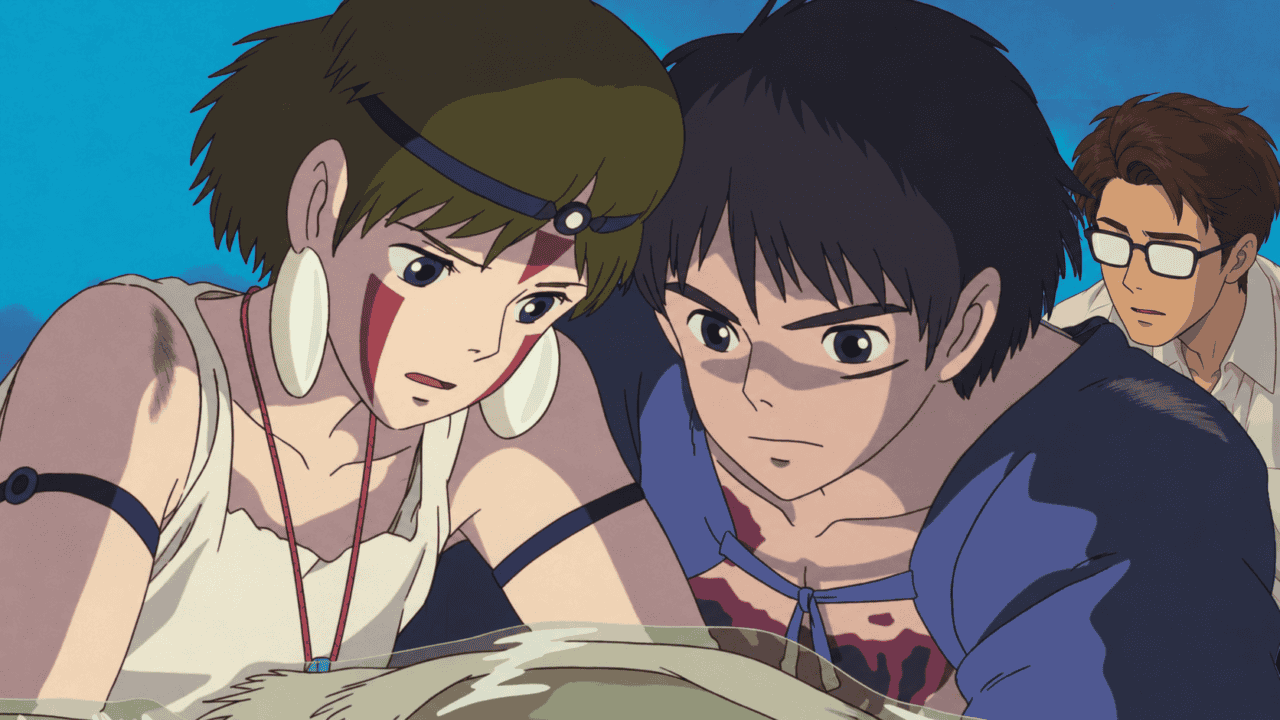
A film’s protagonist is usually settled from the outset. In Mononoke, though, the two main possibilities are Ashitaka and San. The title points to San, but the story begins with Ashitaka’s exile and unfolds largely through his perspective; Miyazaki also considered the title Ashitaka Sekki. Something else is needed to decide between them. Personally, I think Ashitaka becomes the protagonist through two turning points:
- His speech while standing between Eboshi and San during San’s attack on Irontown.
- His tear when he discovers that the Forest Spirit has not removed the mark of his curse.
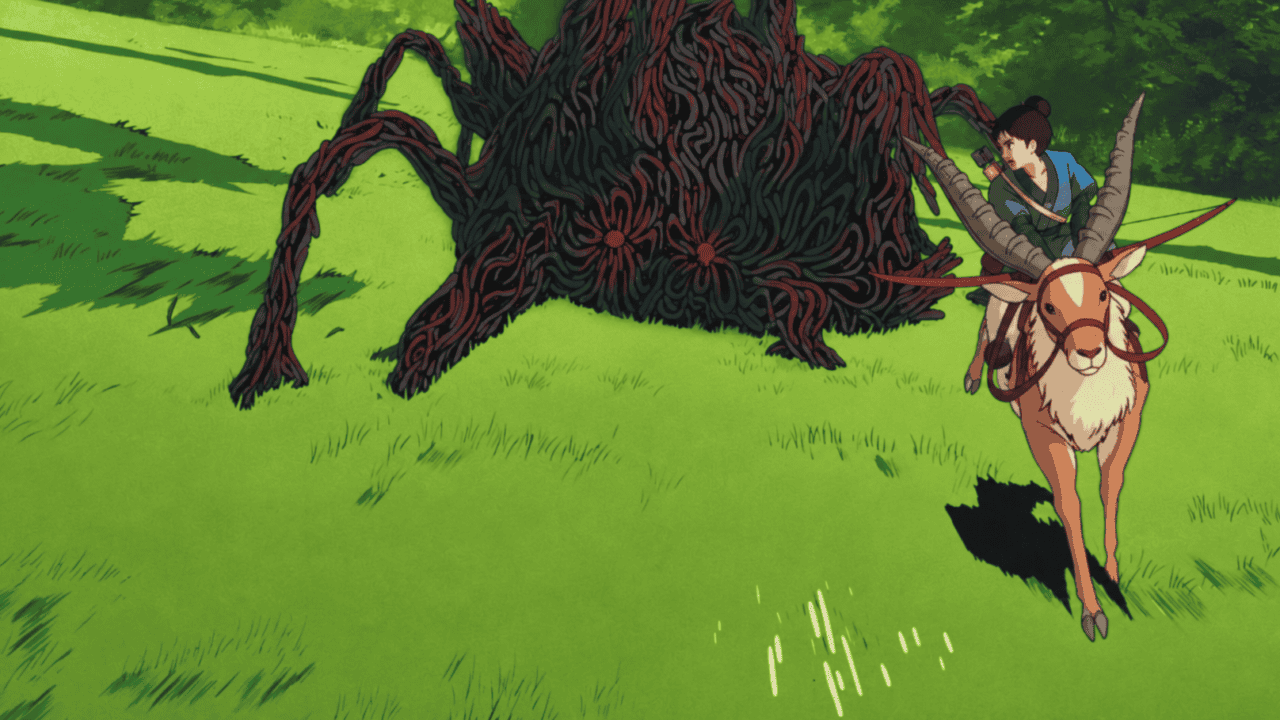
Before San’s attack, Ashitaka’s right arm moves against his will twice: during the attack that incidentally saves Jiko-bō, and during his visit to Eboshi’s secret garden. Yet by the time he makes his speech between San and Eboshi, his arm is no longer running wild.
I take this to mean that he has learned to control his own hatred.
Reading the Curse: The scene creates a subtle misdirection. Eboshi says, “Foolish boar. If you must curse someone, curse me,” and Ashitaka’s arm immediately runs wild. That makes it look as though Nago’s hatred is responsible. But I think we should read the outburst as an expression of Ashitaka’s own anger and hatred. Otherwise, how could he control it during San’s attack? What he has mastered is his own hatred, not Nago’s. That is why he can insist that others not be consumed by hatred.
That alone may qualify him as a protagonist. But during the speech at Irontown, he still carries a serious problem of his own: the curse on his arm. He must still have a slender hope that it can be lifted.
Later, when the Forest Spirit heals his wound but leaves the curse, I see him bringing his journey in search of a cure to an end.
His hope has been cut off, and in his sadness he sheds his one tear in the film. I read his guiding purpose as fundamentally different before and after that moment. Before it, he lives for himself; afterward, he lives for someone else, particularly San.
For me, Ashitaka becomes the protagonist when, despite despairing of his own future, he chooses to live for others.
The Protagonist’s Role: Speaking His Mind
What does it actually mean for Ashitaka to live for others?
Within Princess Mononoke, I think it means living to free people from hatred.
He readily voices such fresh, earnest appeals as “Do not be consumed by hatred!” and “Is there no way for the forest and humans to coexist?!”
Those he addresses already understand such things. But something they cannot resist holds them in place. Put another way, they live with the sense that they can no longer turn back.
They may want to dismiss his words as a young man’s foolish talk, yet those words touch something in them. I think the more strongly they reject Ashitaka, the more they reveal a kind of longing for what he says.
In other words, those who react to him also want to bring out the feelings they have hidden and shout them aloud, as he does.
I think Ashitaka’s role as protagonist is to unsettle people in this way, prompting them to look at themselves and ultimately freeing them from hatred. It is hard to say that he achieves that wish within the film. But I believe he will keep trying afterward, as Ashitaka and all those other protagonists have done for us.
The Protagonist’s Burden: Miyazaki has spoken about Ashitaka’s future, somewhat jokingly, in several places, including the making-of documentary. Ashitaka chooses to live in Irontown, while San remains in the forest. That leaves him caught between an ironmaking community and San: satisfying one side means disappointing the other. He will do his best in a situation like an endless hell. I feel a little sorry for him, but from the standpoint of hatred, it may not be so bad. Hatred is a one-sided feeling; the wavering within us is perhaps almost our only weapon against it. Ashitaka’s words and actions unsettle San and the people of Irontown. After the film ends, he will himself be thrown into a literal movement back and forth between the forest and Irontown. Embodying that wavering with his own life makes him all the more a protagonist.
An Aside: Ashitaka’s Failure to Read the Room
So far, I’ve focused on what makes Ashitaka admirable. Watch closely, though, and his troublesome side becomes apparent too. The film works very well in this respect: we can even see that troublesome quality as what makes him the protagonist. Let’s revisit it.
Youthful Presumption at the Bellows
His first troublesome moment may be his visit to the women working the bellows.
They have just invited him to see their workplace. Ordinarily, though, that sort of invitation is a social pleasantry, not a request that he actually turn up.
Ashitaka not only appears but insists on working the bellows himself. He may think he is helping, but for people following a strict routine in grueling conditions, he is a considerable nuisance—especially to whoever is in charge.
Toki, who is in charge, must be in a difficult position. She owes him for carrying her husband over a mountain, but she needs him to leave as soon as possible. I read her solution as letting him work the bellows quickly so that he will go away. The recording of her line required several retakes in the making-of documentary. Perhaps the performance sounded too kind to convey that delicate undertone: Ashitaka is actually in the way.
At any rate, he does not seem able to consider these things. Perhaps it is simply a matter of being young.
Innocence: Telling Moro “She Is Human!”
Another troublesome moment is his famous declaration to Moro.
“Set her free! She is human!” It is a memorable line, used in commercials and trailers, and surely one of Ashitaka’s big moments.
But imagine it from Moro’s perspective. I can almost hear her thinking: “What are you talking about? I know that. I’ve spent years wondering what to do for her, and whether I’m the one keeping her trapped. But she has feelings of her own, and we’ve lived together as a family. How can you, a complete stranger, tell me to ‘set her free’?”
I am impressed by Moro’s generosity in ending it with no more than “Silence, boy!” It is such a failure to read the room that she might reasonably have eaten him.
Yet that inability to read the room is crucial here. It cuts into people’s hearts and lets them begin again. Perhaps Moro becomes willing to entrust San to Ashitaka precisely because he can say “She is human!” so unhesitatingly.
Perhaps not reading the room is an important quality in a protagonist. Without it, you’re just an ordinary person. Me? I read the room. Yes, I do. Looking back, I feel that the film’s many elements fit together beautifully to make Ashitaka stand out as its protagonist.
What do you think about Ashitaka and the question of who the protagonist of Princess Mononoke is? Let me know!
Your Take
What is your view? Choose the answer that comes closest to your own response.
Poll results
What makes Ashitaka compelling to you?
- His compassion for people who disagree.0%
- His determination to keep living.0%
- His willingness to change through encounters.0%
- His own unresolved contradictions.0%
- Several of these equally.0%
- Something else.0%
The images used in this article are from Studio Ghibli Works Stills.
Can you name the movie before the scene comes into focus?
Put your visual memory to the test with a blurred Studio Ghibli scene.

Reader Comments
Have a thought or interpretation? Leave a comment