
When Hayao Miyazaki’s Ponyo(Official Studio Ghibli) came out in 2008, it struck me as very much a children’s film. I was already a university student, and it did not seem especially appealing. Still, I went, feeling a little embarrassed, because it was Miyazaki’s latest film. I cannot even remember whether I enjoyed it.
With those rather vague memories, I come to Part 3 of “The Melancholy of Men,” following Porco Rosso and Howl’s Moving Castle. This time, my subject is Gran Mamare. What sort of melancholy do I see in this film?
*This is a translated version. The original (Japanese) is available here.
- Gran Mamare and the Anglerfish
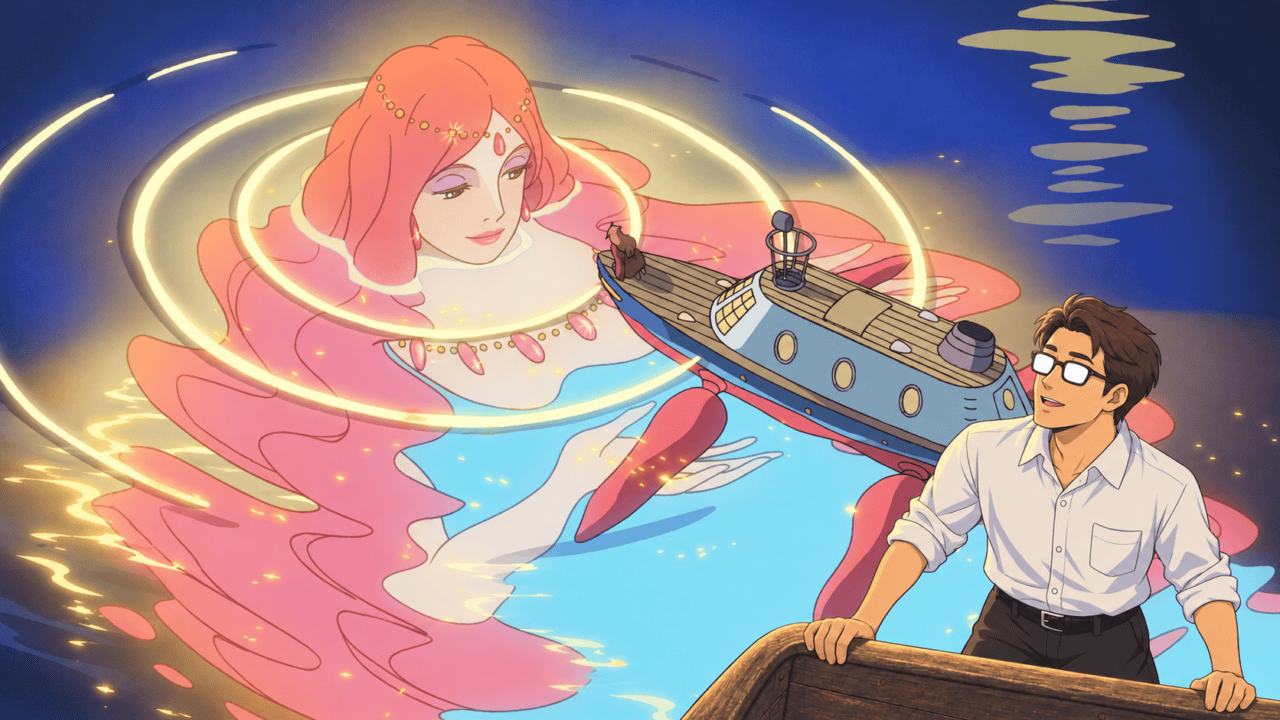
Gran Mamare is “the sea itself,” beyond human common sense. Miyazaki spoke of an idea discussed among the staff: her true form was a giant anglerfish. I connect that image with the fate of males that fuse with females, reading it as a metaphor for the melancholy of men. - Fujimoto and the Melancholy of Men
In this reading, Fujimoto has been absorbed by Gran Mamare in a spiritual sense. It continues a theme I see in Porco Rosso and Howl’s Moving Castle: a man falls for a woman and is caught by her. - A Future for Sōsuke
Sōsuke, however, need not share that fate. I read the ending as encouragement from Miyazaki to the next generation: freedom and hope still lie ahead.
On this pageContents
Ponyo: Gran Mamare, the Melancholy of Men, and What Comes Next
Sōsuke’s promise gives the ending its reassurance, while Gran Mamare’s presence invites questions about the future. The reading below considers both the hope and the weight of that promise.
The Strange Life of the Anglerfish
Gran Mamare’s True Form
In Ponyo, Gran Mamare seems to be the most powerful presence of all, beyond anyone’s reach.
Ponyo’s mother is “the sea itself.” She belongs to a world where human common sense does not apply, and her sense of time is fundamentally different from ours.
Near the end, the world is flooded. To Gran Mamare, the sea itself, a change on that scale may not be so significant.
There is also a story about her true form: she is an anglerfish. The interview collection The Place Where the Wind Returns, Continued (続・風の帰る場所, in Japanese) includes the following passage, translated here from the Japanese quoted below:
Miyazaki: “But Japan has plenty of tales of marriage between different species. We talked among the staff about things like that mother really being a giant anglerfish. But we wouldn’t know how to fit an anglerfish a kilometer across into the frame (laughs), so she can also take human form, with her size changing at will. Basically, it’s the world of Sun Wukong. There’s a story in which a goldfish from the heavenly realm escapes to earth for about three days and runs wild as a monster. Down on earth, that was something like three years. In the end, I think Guanyin takes it away (laughs). That’s the sort of story it is, basically.”
(Original Text in Japanese)
宮崎「でも異種婚礼っていうのは日本には数々あるからね。あのお母さんだって本当は巨大なアンコウなんだとかね。そういうことは、スタッフの中で話してたんですよ。でも差し渡し1キロのアンコウが出てきても画面の中にどう入れていいかわかんないから(笑)、ちゃんと人間の姿を取ることもできて、その代わり大きさは自由自在っていう。要するに孫悟空の世界ですね。孫悟空の中に、天界にいた金魚が3日間ほど地上に逃げて、化けものになって暴れるっていう話があるんですよ。それが地上では3年間だったとか。最後は観音様だったかに連れていかれちゃうんですけど(笑)。そういう話ですよ、要するに」
The natural question is, “So what?” To see why this matters to my reading, we need to consider what happens to some male anglerfish.
The Fate of the Male Deep-Sea Anglerfish
For us men—or rather, males—the relationship between female and male anglerfish is hard to forget.
A female can grow to around 40 centimeters, while her male mate may be only a tenth of that size. To put it bluntly, the male is a mere speck.
And a sad fate awaits him.
In some deep-sea anglerfish species, the male attaches to the female and fuses with her body. More than one male may attach to a single female. The male becomes little more than a number in the statistics.
I probably first learned this as a child watching Sekai Marumie! TV Tokusōbu. I think that episode also covered the sad mating fate of some squid. Either way, the story of the anglerfish struck me even then.
It is something I find myself thinking about more as I grow older. But a calmer look raises another question: why does the female not reject the male’s tissue?
If this were possible in humans, our immune system would recognize the other person’s tissue as foreign and reject it. We cannot simply fuse with a woman. Thank goodness.
In the anglerfish species that fuse, researchers have found changes or losses in important parts of adaptive immunity that help explain the absence of tissue rejection.
The immune-system changes are discussed by Science News in “An immune system quirk may help anglerfish fuse with mates during sex.”
For a moment, I think, “That works rather neatly.” But wait: if they are going to give up something as important as immune defenses, couldn’t they have kept those defenses and given the males some rights instead?
At any rate, we males cannot help feeling something for these little anglerfish.
Now let’s return to Ponyo.
If I treat Gran Mamare as one of these anglerfish, Fujimoto, one of her husbands, has already been absorbed by her. That is the melancholy of men in this reading: they are caught by the woman they love and spiritually fused with her—or, rather, absorbed.
That connects the different perspectives I have discussed in Porco Rosso and Howl’s Moving Castle.
It might seem to be the fate awaiting Sōsuke too, now that Ponyo has chosen him. But is it?
The Future Entrusted to Sōsuke
One thought after watching Ponyo might be, “Poor Sōsuke. Such a small child, and now he has Ponyo’s future to carry.”
But the anglerfish idea changes the way I see it.
After the private conversation between Gran Mamare and Sōsuke’s mother near the end, Ponyo becomes human.
As a human, she is now unable to fuse a male to herself.
The final test is also where Sōsuke delivers one of the film’s most important declarations of love. I examine that line in both Japanese and English in my Ponyo quotes guide.
Sōsuke still has an open future ahead of him. In the terms of this metaphor, he has not been absorbed by Ponyo.
I hear a message from Miyazaki in this: “Sōsuke! You can still fly! You can fly freely!” Perhaps we have returned to Porco Rosso. But “We are free!” and “You are free!” have different meanings.
It is encouragement for boys who are still children, like Sōsuke.
It is as if the film were saying, “We are liable to get caught, and eventually we do—but we are not anglerfish!”
Of course, as with the conclusion of Howl’s Moving Castle, all this is just a captured man boasting about being loved. Someone who has not been caught might well say, “I don’t care if it’s an anglerfish—somebody capture me!”
In any case, I find it interesting to read Porco Rosso, Howl’s Moving Castle, and Ponyo as a connected Melancholy of Men series.
That is how I see them, at least.
Your Take
What is your view? Choose the answer that comes closest to your own response.
Poll results
How does Sōsuke’s promise to Ponyo feel to you?
- Hopeful and reassuring.0%
- Like a very heavy promise for a child.0%
- Both hopeful and heavy.0%
- I see it differently.0%
- I’m not sure.0%
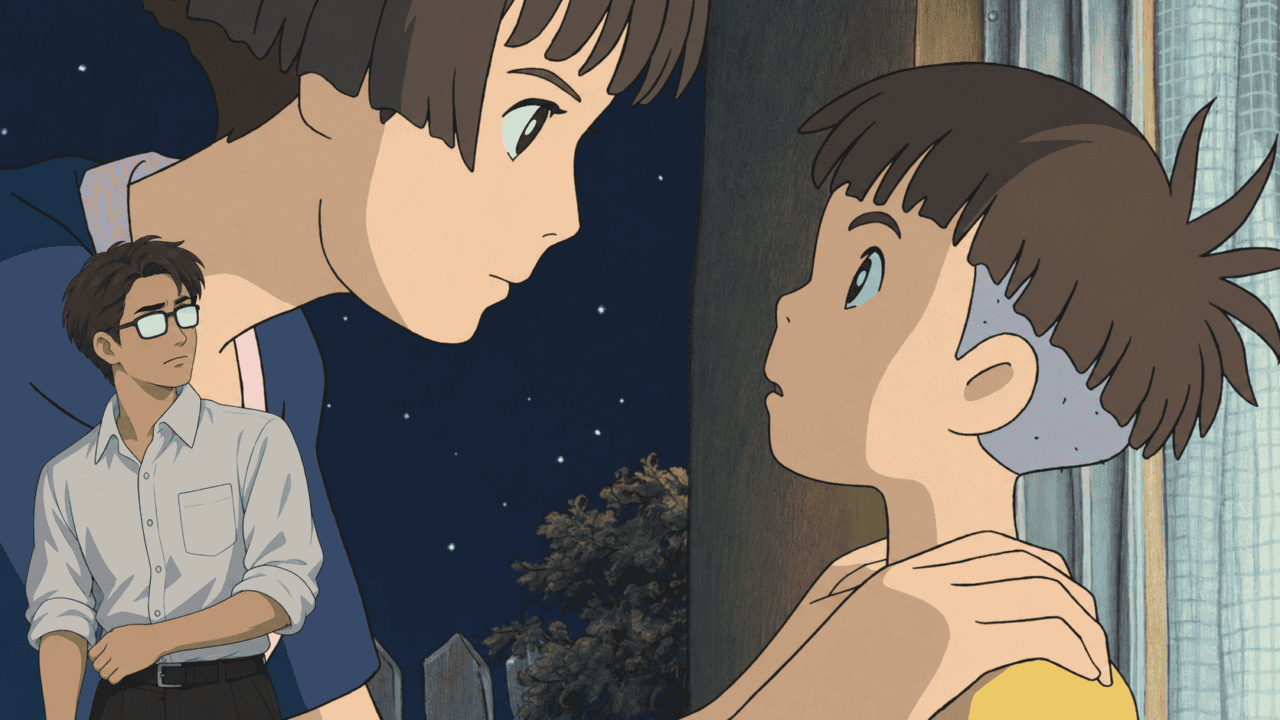
The images used in this article are from “Studio Ghibli Still Images“.
Can you name the movie before the scene comes into focus?
Put your visual memory to the test with a blurred Studio Ghibli scene.

Reader Comments
Have a thought or interpretation? Leave a comment