
In earlier articles, I considered why Jiji stops talking and why Kiki loses her magic. This time, I want to look at the senior witch who leaves us feeling distinctly uncomfortable near the beginning of Hayao Miyazaki’s Kiki’s Delivery Service(Studio Ghibli Official).
It is her offhand manner that unsettles us—coldness, even. More importantly, the film would hold together perfectly well without her. Why, then, does this unpleasant encounter need to happen? That is the question I want to explore.
*This is a translated version. The original (Japanese) is available here.
- The Hardships of Other Young Witches
My reading starts with a contrast: Kiki meets Osono, but surely most young witches never find anyone like her. The kindness Kiki encounters seems almost miraculous. - What Might Lie Behind Her Coldness
The senior witch’s manner may reflect hard years of her own rather than a desire to put Kiki down. Perhaps she is giving the younger girl a blunt glimpse of the world ahead. - An Excuse for the Story’s Convenience
I also read her as a way of acknowledging how conveniently things later work out for Kiki. She represents the difficulties other young witches may have faced, balancing the warmth of Kiki’s story.
On this pageContents
Kiki’s Encounter with the Senior Witch
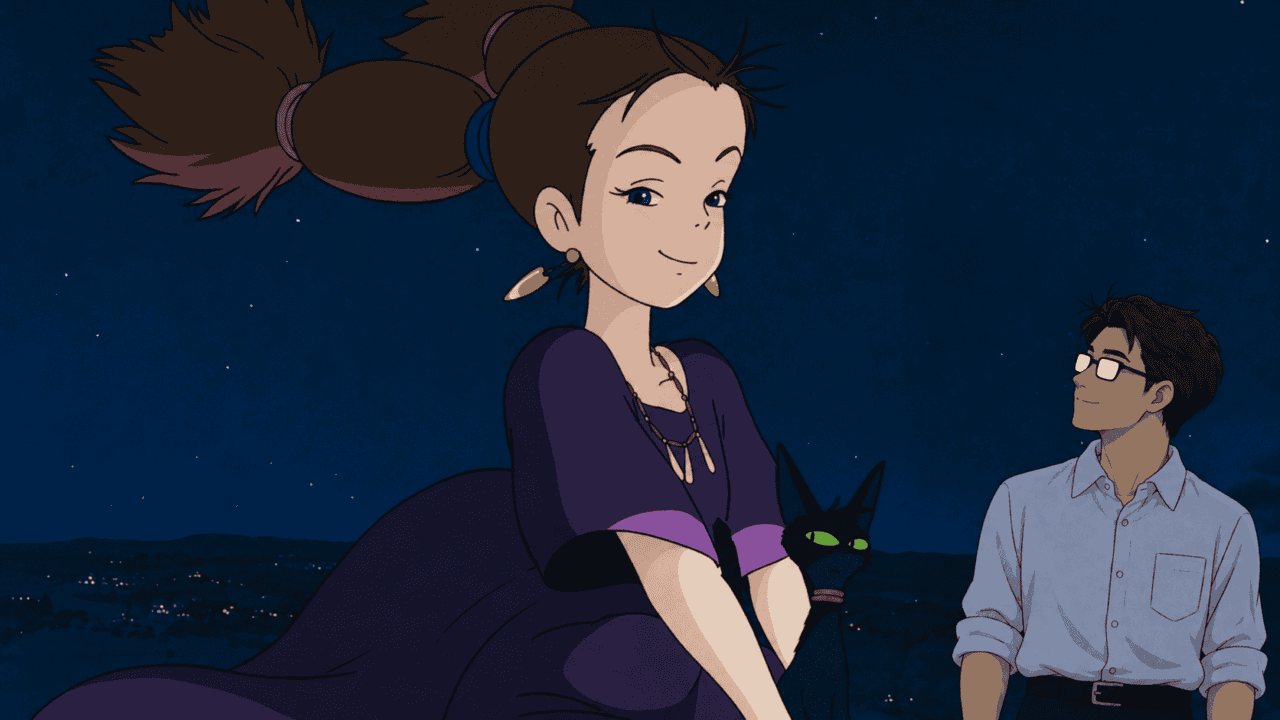
After leaving home, Kiki plays “Rouge no Dengon” on the radio to lift her spirits. She spots another witch flying on a broom and cheerfully calls out to her.
At first, the older witch seems friendly enough. But as soon as she discovers that Kiki is a newcomer, her manner changes: “Could you please turn off that radio?”
That is an unexpected first blow, but Kiki does as she is asked. The senior witch says she prefers to fly quietly. Even so, Kiki asks how hard it is to settle in a new town.
From there, the senior witch is spectacularly condescending: “Well, there were many things, but I had a special skill in fortune-telling, so I managed. Do you have any special skills?” Apparently, she is nearing the end of her training.
Soon, her town comes into view. “It’s a small town, but not bad. You do your best,” she says, then goes out of her way to fly over Kiki’s head before descending towards it.
Left behind, Kiki feels a little uneasy about what awaits her. Flying is the only skill she has.
Jiji is the only character who openly voices their reaction to the encounter, dismissing the other familiar as “What a stuck-up cat.” Compare the original Japanese, romanization, English subtitle, literal translation, and the dub’s use of “snob” in our analysis of Jiji’s memorable line.
I feel as though I have spent my life trying not to become that sort of senior colleague. But why does such an unpleasant older girl appear in this film? I think the answer involves its most important figure: Osono.
Kiki’s Good Fortune and the Senior Witch’s Experience
Kiki’s early good fortune and the senior witch’s established life offer different perspectives on independence. That contrast helps frame the older girl’s brief, unfriendly appearance.
The Hardships of Young Witches
There is a convenient turn of events in Kiki’s Delivery Service that we half-recognize but prefer to overlook: Osono’s presence. There is also the broom Kiki’s mother gave her, which I considered in an earlier article.
Osono is particularly important. When Kiki decides to make the town by the sea her home, she first encounters the townspeople’s cold stares. Of course, her expectations were naive. Still, we cannot help thinking: couldn’t they be a little kinder to her?
Perhaps that is precisely why a witch has to make this journey alone: to learn what such a world is like, and to develop the strength to survive in it all the same.
At this point, we ought to ask what life was like for witches other than Kiki.
Kiki has Osono, but not every young witch can meet someone like her. I would go further: almost all young witches must have gone without an Osono.
The Kiki we see just before Osono calls out to her gives us a picture of what those earlier witches may have faced: no one welcomes them, and they have no idea what to do. What happened to those girls after that? …
Perhaps they had no choice but to resort to the very possibilities we would rather not imagine. At any rate, the magic shown in this film is not especially powerful. There is very little a witch can do with it. Most of these girls may have found themselves in desperately difficult circumstances, yet struggled on as best they could.
Seen in that light, the senior witch’s cold, condescending manner begins to make a certain sense.
On this reading, she is not trying to assert her superiority over Kiki. She has genuinely been through hard times. She dismisses them with “Well, there were many things,” but perhaps that phrase contains the days we have just imagined.
Surely she, too, once set out as excited about a new home as Kiki is now. But the world she met was not so gentle. After struggling and struggling to get by, she finally established a place for herself through fortune-telling. She did not find that place. She established it.
If such a girl had said, “Oh, how nostalgic! I remember when I first left home. Wonderful things are waiting for you—good luck!”, that would have been a lie. Perhaps she did not know what to say to a young witch who seemed about to face the hardships she herself had endured. In that moment, this may have been the only attitude she could manage.
Kiki’s Good Fortune: An Excuse for Plot Convenience
Thinking about it this way makes the people Kiki meets in the town by the sea seem all the more remarkable. A thirteen-year-old girl needs a great deal of kindness to make a life in an unfamiliar town. We can call this a wonderful film full of that kindness. We can also call it convenient.
I think the senior witch is there to offer an excuse for that convenience. By taking the wind out of Kiki’s sails, she stands in for the hardships of all those earlier young witches.
Put more bluntly, it is almost as if the film were saying: “Kiki will grow through all sorts of difficulties, you know. Just turn a blind eye to the stage we’ve set for her to do it on, won’t you? We know it’s convenient!”
That makes the senior witch a hybrid figure in my reading: she carries the imagined history of the witches within the story while also supplying an excuse for the story itself.
Her offhand greeting may also prepare us for the townspeople’s unsurprising coldness when Kiki reaches the town by the sea.
Either way, it is cleverly done.
Your Take
What is your view? Choose the answer that comes closest to your own response.
Reader poll
The images used in this article are from Studio Ghibli Still Images.
Can you name the movie before the scene comes into focus?
Put your visual memory to the test with a blurred Studio Ghibli scene.
Reader Comments
Have a thought or interpretation? Leave a comment