
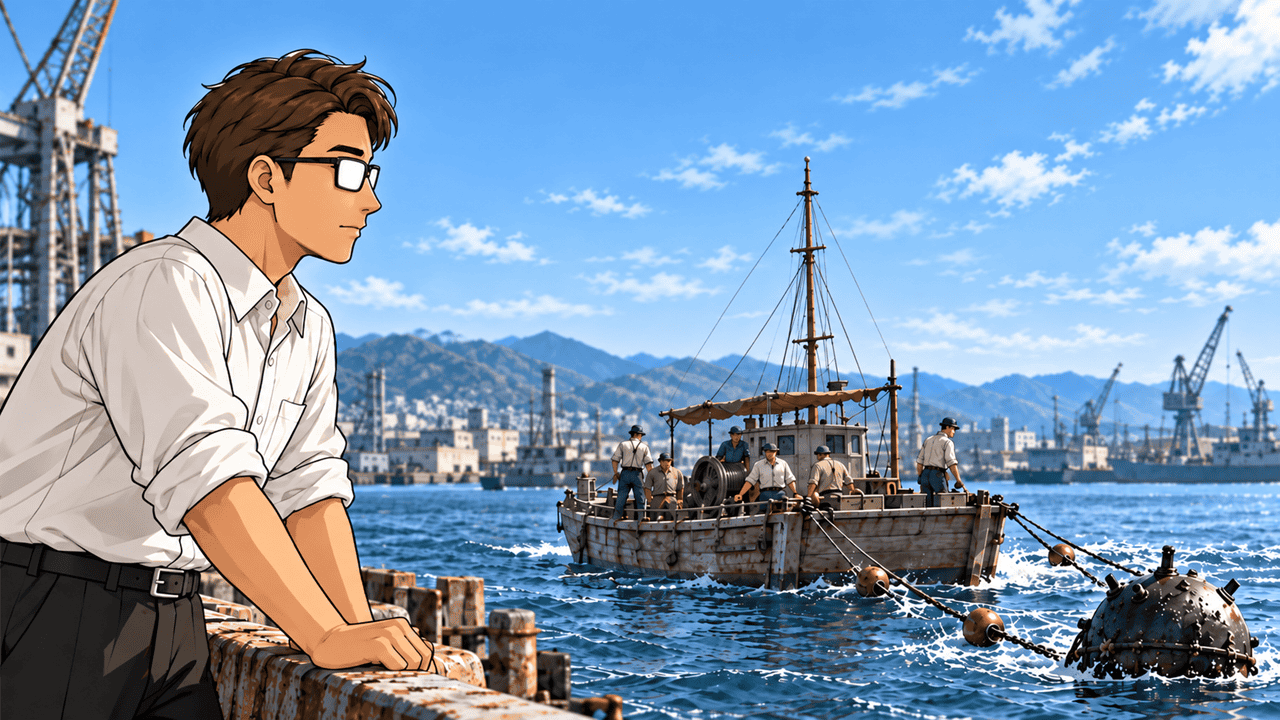
In Godzilla Minus One, Koichi Shikishima, a former kamikaze pilot, takes a job clearing naval mines. It is March 1946. The war has long since ended, yet mines still have to be removed from the sea. The work apparently pays well because it is dangerous. Shikishima says he has received an advance of 3,000 yen.
Watching this scene, you may have thought, “So that kind of work really existed,” while also wondering what it was actually like. At least, I did.
Contemporary records show that mine clearance really was a job, and that in March 1946 large numbers of former naval personnel were doing it under government supervision. I also found regulations setting allowances for dangerous work, and records of a special payment promised to seamen undertaking a particular assignment.
That led me to a further question: what other kinds of work supported demobilized servicemen like Shikishima? Taking March 1946 as a starting point, this article traces minesweeping, its pay, and the work people did immediately after Japan’s defeat through contemporary bulletins and government records.
*This is a translated version. The original (Japanese) is available here.
On this pageContents
Was the Minesweeping Job in Godzilla Minus One Real?
The mine clearance depicted in the film was real work carried out in Japanese waters, and it played an important part in sustaining society immediately after the war.
Large Numbers of Mines Remained Around Japan After the War
Naval mines are weapons placed in the sea to damage or sink ships. During the Pacific War, both the Japanese navy and US forces laid large numbers around Japan.
According to Kōro Keikaishi (History of Sea-Lane Clearance; 2012 revised PDF), compiled in 1961 by the Defense Department of the Maritime Staff Office, Japan Defense Agency, 55,347 moored mines laid by the Japanese navy and 6,546 influence mines laid by US forces remained in Japanese waters when the war ended in August 1945. The latter figure is not the total number laid by US forces: it counts those that remained at the end of the war, after losses through sweeping, explosions, and other causes.
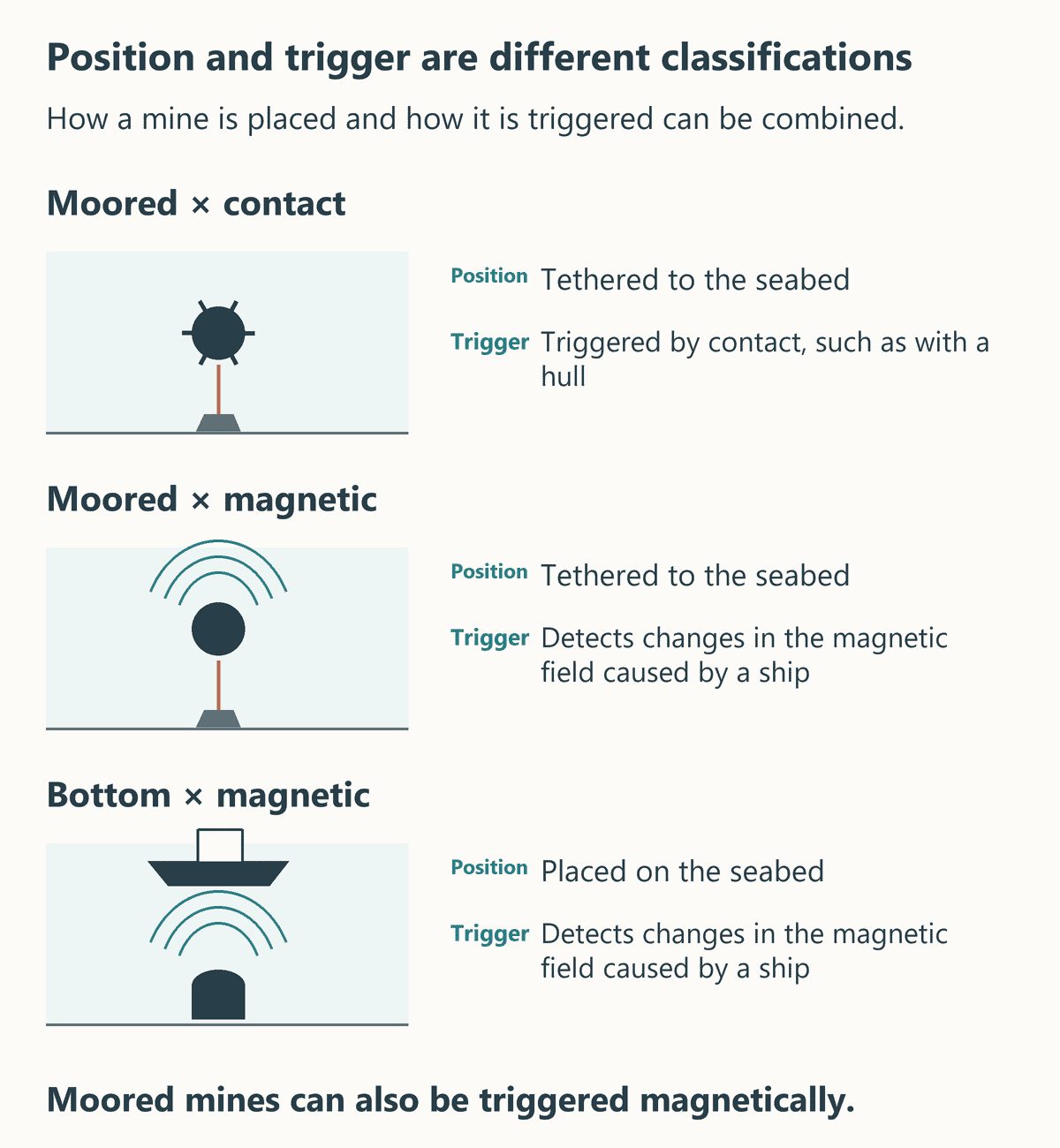
A moored mine floats underwater, tethered to a weight or similar anchor on the seabed. Some moored mines are triggered by contact with a hull; others respond to magnetic or other influences. “Moored” describes how a mine is positioned, while “magnetic” describes how it is triggered, so the two can be combined. With these unseen dangers still in place, the end of the war did not make shipping safe. Historical research by the National Institute for Defense Studies also notes the substantial losses and effort these mines imposed on postwar clearance operations.
Safe Sea Lanes Were Essential to Recovery
Where mines remained, ships carrying food, coal, and other supplies could not sail with confidence. Securing safe sea lanes was urgent for a defeated Japan whose production and transport systems were in disarray.
The task of removing mines to open navigable channels was known as kōro keikai, or sea-lane clearance. Under Allied direction and supervision, minesweeping continued using personnel and vessels from the former Japanese navy. The Japan Maritime Self-Defense Force’s history of its minesweeping units likewise records the start of sea-lane clearance duties in 1945.
History of Sea-Lane Clearance states that the sweeping of moored mines was completed on August 17, 1946, while work against influence mines continued for much longer. March 1946, when this part of the film takes place, was therefore a period of substantial ongoing operations, rather than a point when postwar mine clearance was nearly over.
Who Was Clearing Mines in March 1946?
Who was doing this work? In the film, Shikishima and a small crew board a boat. Historically, government organizations and former naval personnel were central to the operation.
The Second Demobilization Ministry Was Responsible
In March 1946, minesweeping came under the Second Demobilization Ministry. After the Navy Ministry was abolished in November 1945, the new ministry was established that December, taking over minesweeping alongside naval demobilization duties.
In June 1946, reorganization made it the Second Demobilization Bureau of the Demobilization Agency. Minesweeping subsequently passed to the Ministry of Transport. The Japan Coast Guard was not established until May 1, 1948. At the time depicted in the film, then, responsibility lay with the Second Demobilization Ministry under the occupation, rather than the Coast Guard or the Self-Defense Forces.
Thousands of Former Naval Personnel Took Part
History of Sea-Lane Clearance records the numbers engaged in postwar clearance duties.
| Date | Personnel |
|---|---|
| October 1945 | Approximately 10,000 |
| June 1946 | 8,390 |
| August 1946 | 4,469 |
Source: History of Sea-Lane Clearance, p. 29, table of changes in sea-lane clearance personnel. It gives no exact figure for March 1946. The June total of 8,390 is divided into 638 former naval officers and 7,752 other former naval servicemen.
The presence of more than 8,000 personnel in June 1946 suggests that a substantial minesweeping organization was also operating in March, when Shikishima starts work.
“Former naval servicemen” describes their previous background. It does not mean that they were still serving as members of a Japanese navy after the war. Minesweeping had become a government responsibility carried on after the armed forces were dismantled.
Some Men Joined Minesweeping After Demobilization
Personal testimony also survives. According to the account of former minesweeper crewman Shimada (嶋田好孝), published by the Kobe Shimbun on December 11, 2016, he left the navy and returned to his family home in Tottori Prefecture. In spring 1946, he learned that the Second Demobilization Ministry was recruiting and applied.
He wanted to work on demobilization, but was ordered aboard a minesweeper instead. Having learned steering at a naval navigation school, he went on to sweep the Seto Inland Sea from a base in Kobe. Here is a real example of a former naval serviceman taking up minesweeping after demobilization at almost exactly the time depicted in the film.
History of Sea-Lane Clearance also contains an interesting account of how previous experience aboard a vessel was considered. When crews were sought for special trial-sailing ships in early 1946, officials considered recruiting former naval servicemen or retaining the seamen already familiar with those ships. Because new crews would need time to learn how to operate them, the initial policy for three ships, including Tōa Maru, was to ask their existing crews to stay.
What Did Mine Clearance Actually Involve?
Mine clearance involved more than finding and removing mines floating on the surface. Methods differed according to the type of mine, and several kinds of vessel were used. Some assignments also involved sailing ships through an area to trigger mines or check the safety of a swept channel.
Different Mines Required Different Sweeping Methods
In the film, Shikishima’s crew and another boat tow a sweep cable between them, cutting the mooring cables that tether mines to weights on the seabed. Once released, the mines rise to the surface and are destroyed by machine-gun fire. Noda explains the danger of American magnetic mines and says they use wooden boats as a precaution, but also explains that they mainly deal with moored mines. The wires they cut in the film do not belong to magnetic mines resting on the seabed.
This method has a historical basis. The illustrated table of moored-mine sweeping gear on p. 47 of History of Sea-Lane Clearance includes gear operated by two vessels and methods that use a sweep cable to cut mines’ mooring cables. The film’s basic process of towing a cable between two boats to bring mines to the surface is consistent with minesweeping technology of the period.
Shooting surfaced mines was also explicitly permitted. According to p. 97 of History of Sea-Lane Clearance, on December 8, 1945, the commander of the US Fifth Fleet authorized Japanese minesweeping vessels to carry two machine guns or rifles for mine disposal, with 500 rounds for each weapon. The book states that Japanese crews continued disposal by gunfire until the sweeping of moored mines was completed in August 1946. In March 1946, when the film is set, cutting mooring cables and shooting the surfaced mines was therefore an established method.

There is testimony from someone who experienced this sequence. In the Kobe Shimbun’s December 16, 2016 article on an American vessel striking a mine and sinking ahead of him, Shimada recalled operations off Wonsan in October 1950. American minesweepers cut the mooring cables, and Japanese crews following behind shot the surfaced mines with automatic rifles. Although this is not an example from 1946, it is specific testimony that the same disposal sequence shown in the film was used in reality.
By contrast, in the Kobe Shimbun’s December 11, 2016 article on searching for mines after the war, Shimada describes sweeping magnetic mines lying on the seabed. Groups of two or three wooden boats towed electrical cables, passing a current through them to create a magnetic field that triggered the mines underwater. This was a different method from cutting a mooring cable and bringing a mine to the surface.
Section 8 of History of Sea-Lane Clearance, on sweeping influence mines, also records magnetic sweeping using equipment such as the electrically energized Type 5 sweep. The influence mines laid around Japan by US forces included acoustic mines and mines combining magnetic and pressure triggers, as well as magnetic mines. When comparing these operations with the film, it is important to distinguish between surfacing moored contact mines and triggering bottom magnetic mines where they lie.
These comparisons show that the film’s minesweeping was grounded in actual technology, rather than simply devised to look plausible.
Requisitioned Fishing Boats Served Alongside Former Naval Vessels
Postwar minesweeping used coastal-defense ships, auxiliary submarine chasers, auxiliary patrol boats, and other vessels. Requisitioned fishing boats and large landing craft, known as daihatsu, also served as auxiliaries.
History of Sea-Lane Clearance states that an Allied directive dated April 11, 1946 designated 328 minesweeping vessels. Although that is not an exact count for March, it illustrates the variety of ships involved at the time.
The wooden construction of the film’s Shinsei Maru also reflects these circumstances. Magnetic mines can react to disturbances in the Earth’s magnetic field caused by a steel hull. Wooden boats were therefore used to reduce their magnetic influence by minimizing the iron in their hulls. A wooden boat was not, however, completely safe from mines.
Shōgo Nose, a former naval officer who also took part in postwar sweeping, writes in his account of the Japanese Special Minesweeping Force deployed in the Korean War that wooden auxiliary patrol boats of about 230 tons and auxiliary submarine chasers of about 130 tons were converted for magnetic sweeping toward the end of the war. An account of sea-lane clearance duties by Himeno (姫野修) records that an electrically energized Type 5 sweep, towed by three wooden vessels, entered practical use in August 1944. Pages 30 and 57 of History of Sea-Lane Clearance also describe postwar magnetic sweeping based mainly on auxiliary submarine chasers and patrol boats, with requisitioned fishing boats among the other vessels used.
Page 15 of Niigata City’s Niigata as a Battlefield records the requisitioning of local wooden fishing boats for minesweeping in Niigata Port in 1945. This is not an example from Tokyo Bay in March 1946, the film’s setting. It nevertheless shows that mine clearance used civilian wooden fishing boats as well as wooden naval craft. These technical circumstances underpin the film’s explanation that wooden boats reduced the danger from magnetic mines.
Trial Sailings to Trigger Mines and Check Sea Lanes
One dangerous assignment associated with clearance was shikō, or trial sailing. According to History of Sea-Lane Clearance, p. 73, its original purpose was to use the passage of a real ship to trigger and dispose of mines responding to changes in water pressure. By the end of 1946, most pressure mines were found to have ceased functioning, and checking the results of magnetic sweeping became the main purpose. At the time depicted in the film, trial sailing did more than verify safety: it also used a ship’s passage to set mines off.
Early in 1946, ships including Tōa Maru and Sōei Maru were prepared for trial sailings and operated under US Navy guidance. History of Sea-Lane Clearance describes bedding mats and quilts fitted inside the ships to protect their crews by cushioning the shock of a mine explosion. This work involved confronting a known danger, rather than sailing only after every risk had been removed.
Trial sailing also matters when considering the pay offered at the time.
Was Mine Clearance Really Well Paid?
The film presents dangerous mine clearance as a well-paid job. How much did actual minesweepers receive? Although I could not establish their total basic pay, I found contemporary rules specifying an allowance based on hours worked.
The Minesweeping Allowance Was Set at Two Yen per Hour
Issue 5 of the Second Demobilization Ministry Bulletin, dated December 17, 1945, contains the ministry’s regulations for minesweeping allowances on printed pages 1906–1907.
Article 2 stipulates that the minesweeping allowance was two yen per hour. Another provision allowed captains to receive a twenty-percent increase.
- Basic rate: two yen for each hour spent sweeping dangerous waters
- Captains: a twenty-percent increase could be granted
- Qualifying time: time actually spent sweeping mines in dangerous waters
- Fractions of an hour: counted as a full hour
- Payment: normally made on the regular salary or wage payment date
- Effective date: remuneration from December 1, 1945 onward
Source: Second Demobilization Ministry Bulletin, No. 5, December 17, 1945, regulations on minesweeping allowances, Articles 1–5 and supplementary provision. Japan Center for Asian Historical Records reference C12070535300, PDF pages 28–29 (printed bulletin pages 1906–1907). Enter the reference code in the center’s search site to find the record.
If someone performed 100 qualifying hours in a month, the basic allowance rate would produce 200 yen. But not every hour spent aboard a ship necessarily qualified. I have also not confirmed an amendment history establishing that the rate remained unchanged through March 1946. What can be stated securely is that this hourly allowance was prescribed in December 1945.
Basic Pay and Actual Monthly Income Remain Unconfirmed
The minesweeping allowance supplemented ordinary salary or wages; it did not replace basic pay. Establishing a crewman’s monthly income would therefore require his basic salary, actual qualifying hours, and any other payments.
Unfortunately, this research did not establish an actual total monthly income, including basic pay and allowances, for an ordinary minesweeper crewman in March 1946. The two-yen hourly allowance alone cannot tell us whether the job was highly paid.
Can Shikishima’s 3,000-Yen Advance Be Verified Historically?
Shikishima says that he received a 3,000-yen advance when he took the job. Did actual minesweepers receive advances like that?
The allowance regulations I found contain no advance-payment scheme matching the film’s 3,000 yen. That does not rule out a separate contract or lump-sum payment, but I found no document that directly establishes a historical equivalent to Shikishima’s advance. An advance is not necessarily a monthly salary either, so the scene cannot establish that minesweepers earned 3,000 yen per month.
Dangerous Trial-Sailing Duties Carried a Promise of 10,000 Yen Each
Interestingly, records of a special assignment connected with minesweeping mention an even larger sum. According to History of Sea-Lane Clearance, pp. 34–35, seamen recruited to perform dangerous work aboard trial-sailing ships until the end of March 1946 were verbally promised a special payment of 10,000 yen each.
Officials at the Second Demobilization Ministry subsequently questioned the arrangement. They considered trial sailing less dangerous than first anticipated and wondered whether 10,000 yen per person after only about two months in service was disproportionate to payments for related duties. The crews protested, holding onboard meetings and making representations to the Kure Regional Demobilization Bureau in early March 1946. The payment was ultimately to be made as originally promised, but the crews of Tōa Maru and Sōei Maru left their ships at the end of that month.
This 10,000 yen was a special one-off payment promised to trial-ship crews, rather than an ordinary minesweeper crewman’s monthly salary. I have not examined individual payment vouchers proving that every man received it. Even so, the documented promise of 10,000 yen for hazardous trial-sailing duties in 1946, so soon after defeat, offers context for the film’s portrayal of dangerous but well-paid work.
Separate regulations on minesweeping gratuities were introduced in June 1946, but applied from April onward. They do not directly establish an ordinary crewman’s monthly salary in March.
How Much Was 3,000 Yen Worth in 1946?
Even without knowing a minesweeper’s monthly income, we can consider the scale of the film’s 3,000-yen advance. Wages and prices changed rapidly in Japan in 1946, however, so figures from different months should not be treated as though they shared a single stable basis.
Comparison with Factory Workers’ and Miners’ Wages
Specific wage figures survive in contemporary Japanese newspaper reports translated into English and preserved by the occupation’s General Headquarters, or GHQ. A January 1946 press translation made available by Dartmouth College reports monthly pay of 100–150 yen for male factory workers in Aichi Prefecture.
A December 1945 record of a Hokkaido coal-mining labor dispute gives a settlement of 18 yen per day for underground workers and 10 yen for surface workers. Another press translation from February 1946 reports that the Ministry of Health and Welfare was considering a standard monthly wage of 450 yen for male heads of households aged thirty to fifty.
| Date | Category | Amount |
|---|---|---|
| Reports from late 1945 to January 1946 | Male factory workers’ monthly pay in Aichi Prefecture | 100–150 yen |
| A December 1945 settlement | Coal miners’ daily pay: underground / surface | 18 yen / 10 yen |
| A February 1946 report | Proposed standard wage for male household heads considered by the Ministry of Health and Welfare | 450 yen per month |
| March 1946 policy benchmark | Standard household living costs | 500 yen per month |
These examples differ in region, occupation, date, and what the amounts represent. The 450 yen was a wage proposal under consideration, and the 500 yen a policy benchmark for living costs. Neither is an actual average salary. They cannot be combined into a single national average wage.
The gap between monthly factory wages of 100–150 yen and the film’s 3,000-yen advance is large. But the wage example is regional and several months earlier, while the 3,000 yen is an advance rather than a monthly salary. These figures cannot support a calculation claiming that minesweepers earned more than twenty times as much as factory workers.
The Government Set Standard Household Living Costs at 500 Yen a Month
According to an explanation by the Ohara Institute for Social Research at Hosei University, the government set standard household living costs at 500 yen per month in its March 1946 price controls. The film’s 3,000 yen is six times that policy figure.
But 500 yen was not the average amount people actually spent. The institute explains that it excluded black-market purchases and was held to about seventy percent of the living costs people really needed.
Receiving a 3,000-yen advance therefore did not mean that a family could live securely for six months. The benchmark helps convey the scale of the money, but shortages prevent it from telling us, on its own, how comfortably someone could live.
March 1946 Came Just After the Deposit Freeze and Currency Conversion
Another important consideration is the financial policy introduced shortly before Shikishima starts work. On February 17, 1946, the government promulgated and implemented emergency financial measures, freezing deposits and replacing the old currency with new yen. As explained by the National Archives of Japan and the Bank of Japan, old yen had to be deposited, while withdrawals of new yen for living expenses and other purposes were restricted.
At the outset, only up to 500 yen per month could be paid as wages in cash; amounts above that went into frozen deposits. A research response in the National Diet Library’s Collaborative Reference Database also explains this restriction.
Controlled Prices and Black-Market Prices Differed Sharply
Even withdrawing cash did not guarantee that goods were available. Severe shortages persisted after the war, creating large differences between official controlled prices and the amounts charged at street stalls and elsewhere.
A contemporary press translation reporting a Tokyo Finance Bureau survey of street-stall prices on January 21, 1946 gives a controlled price of 7.50 yen for cotton trousers, against a stall price of 200 yen. A sweater had a controlled price of 6 yen but a stall price of 800 yen.
The prices of a few garments cannot stand in for average living costs. They nevertheless show how far the prices on paper could differ from those encountered when buying something. In March 1946, livelihoods depended not just on wages, but on what people could obtain and how much cash they could use.
What Other Work Did Demobilized Servicemen Do?
Minesweeping was a real job. How, then, did other demobilized servicemen support themselves? Returning home after the war did not necessarily mean finding work immediately. Having work did not necessarily provide enough income to live on either.
Many Had Worked Elsewhere Before Enlistment
At the Imperial Diet on December 12, 1945, Toshio Saeki, director of the Ministry of Health and Welfare’s Labor Bureau, described the pre-enlistment occupations of approximately 3.96 million men demobilized from units within Japan. The proceedings give the following breakdown.
| Occupation | Number |
|---|---|
| Industry | Approximately 1,530,000 |
| Agriculture and forestry | Approximately 1,040,000 |
| Public service and the professions | Approximately 540,000 |
| Commerce | Approximately 290,000 |
| Transport | Approximately 280,000 |
| Mining | Approximately 130,000 |
| Fisheries | Approximately 70,000 |
These are approximate figures from the government’s answer, and their sum does not equal approximately 3.96 million. They describe occupations before enlistment, rather than where the men found work after demobilization.
The figures show that many men had worked in industry or agriculture before entering the forces. Once the war ended, however, the closure of military factories and stagnating production left some unable to return to their previous jobs.
In the same proceedings, Saeki said that the government did not yet have accurate national statistics showing who had returned to which occupations after demobilization. His answer cannot support a national ranking of demobilized men’s jobs in March 1946, with agriculture first and factory work second, for example.
A Nagano Survey Records Actual Employment
Local records do identify some actual post-demobilization employment. According to History of Nagano City, Volume 7: Modern History, a survey on April 19, 1946 recorded the employment circumstances of forty-three demobilized servicemen in Nagano City’s Kamitakada district.
| Employment or circumstances | Number |
|---|---|
| Factories | 15 |
| Agriculture | 10 |
| Railway | 3 |
| Postal services | 3 |
| Other employment | 10 |
| At home without employment | 2 |
Compiled from the city history’s figures of fifteen in factories, ten in agriculture, three on the railway, three in postal work, and others, with two staying at home without employment. The ten classified as “other” are obtained by subtraction; their occupations are not specified. This is one district’s experience about a month after the film’s March 1946 setting.
Of the forty-three men, forty-one had found a place of employment, including through reinstatement. Their jobs extended beyond factories and agriculture to the railway and postal services. The same city history notes, however, that repatriates without a previous workplace to return to had to find a new one and faced greater difficulties.
Farming, Coal Mining, and Public Works Offered Ways to Rebuild Lives
For men from farming households, returning home to agriculture was one practical option. Yet doing farm work did not mean that a family had enough land or cash income. Some people settled on newly opened land after the war.
The Nagano city history records that, of 154 households settled in nine reclamation areas in Nagano Prefecture by the end of November 1946, fifty-eight were associated with military personnel or civilian military employees. Although this is later than March, it is an example of people rebuilding their livelihoods through agricultural settlement after demobilization.
Coal mining was also essential to recovery. Without coal, factories, railways, and other activities could not be restored. Yet mines struggled to recruit workers. In the December 12, 1945 proceedings, the government explained that it was asking former miners to return, but too few were doing so.
The government also sought to create work through road and river repairs, port improvements, civil engineering and construction, and land reclamation, including drainage projects. Many schemes were still being planned in December 1945, however; they had not all materialized by March 1946. This is apparent in Health and Welfare Minister Hitoshi Ashida’s answer on December 4, 1945.
Even People with Jobs Could Struggle to Survive
In those same December 4 proceedings, Ashida described an apparent contradiction: unemployment was rising, yet employers in coal and other sectors could not find enough workers even when vacancies were advertised.
Low wages and food shortages lay behind this situation. Heavy labor did not necessarily secure enough food, while traveling to rural areas to buy provisions and selling surplus food on the black market could sometimes bring in more money. Ashida cited such circumstances as one reason factories and ports struggled to attract labor.
We do not know how many of those buying provisions or trading goods were demobilized servicemen. The film includes a conversation mentioning that Shikishima had previously transported rice. This too overlaps with one way people made a living at the time.
The employment and labor section of the government’s 1947 Economic Report, drawing on a population survey of April 26, 1946, states that 1.59 million people wanted work but had none. Another 1.96 million were employed but worked no more than one week per month, while 4.32 million worked at least eight but fewer than twenty days per month.
These figures cover society as a whole, rather than demobilized servicemen alone, about a month after the film’s March 1946 setting. They show that insufficient employment was a major problem alongside outright unemployment. Whether someone had a job was not enough to tell us whether they could make a living.
The World in Which Shikishima Chose Mine Clearance
Returning to the original question, the mine clearance Shikishima takes up in Godzilla Minus One really existed. In March 1946, operations staffed largely by former naval personnel continued under the Second Demobilization Ministry. Testimony also survives from someone who applied after demobilization and then went aboard a minesweeper.
I found regulations specifying an allowance of two yen per hour for hazardous sweeping work. There was also a promise of 10,000 yen each to trial-ship crewmen who continued their assignment until the end of March. But I could not establish ordinary minesweepers’ basic pay or actual total monthly income, nor find a payment record directly matching the film’s 3,000-yen advance. The institutions that really existed should be distinguished from the film’s specific choice of an amount.
The more I investigated this job, the more apparent the difficulties of demobilized men’s lives became. Some could not return to prewar factories; others resumed farming, sought work in mines or public projects, or supplemented regular employment by buying provisions and trading goods. Even a job did not guarantee a secure future amid inflation, food shortages, and frozen deposits.
For Shikishima, clearing mines is presented as a way to support life with Noriko and Akiko. Yet the work also brings him back into dangerous contact with weapons the war left behind. Seven months after the fighting ended, mines remained at sea, and people were still needed to deal with them. Even after the war was over, some people had to make their living by clearing up its aftermath. Knowing that history gives a different resonance to the scene in which Shikishima boards the minesweeper.
Principal Historical Sources
For personnel numbers, vessels, recruitment, changes in the purpose of trial sailing, and special payments to trial-ship crews, I chiefly used Kōro Keikaishi (History of Sea-Lane Clearance), compiled by the Defense Department of the Maritime Staff Office, Japan Defense Agency in 1961, in the 2012 revised PDF prepared by the organizing committee of a gathering of former minesweeping personnel. For the allowance, I examined images of the original Second Demobilization Ministry Bulletin, No. 5, December 17, 1945, held by the Japan Center for Asian Historical Records under reference C12070535300.
For demobilized servicemen’s work, I used the Imperial Diet proceedings of December 12, 1945, the proceedings of December 4 that year, History of Nagano City, Volume 7: Modern History, and the government’s 1947 Economic Report. For wages and prices, I referred to GHQ-related translations of contemporary Japanese newspapers, the explanation by Hosei University’s Ohara Institute for Social Research, and materials from the Bank of Japan and the National Archives, among other sources.



Reader Comments
Have a thought or interpretation? Leave a comment