
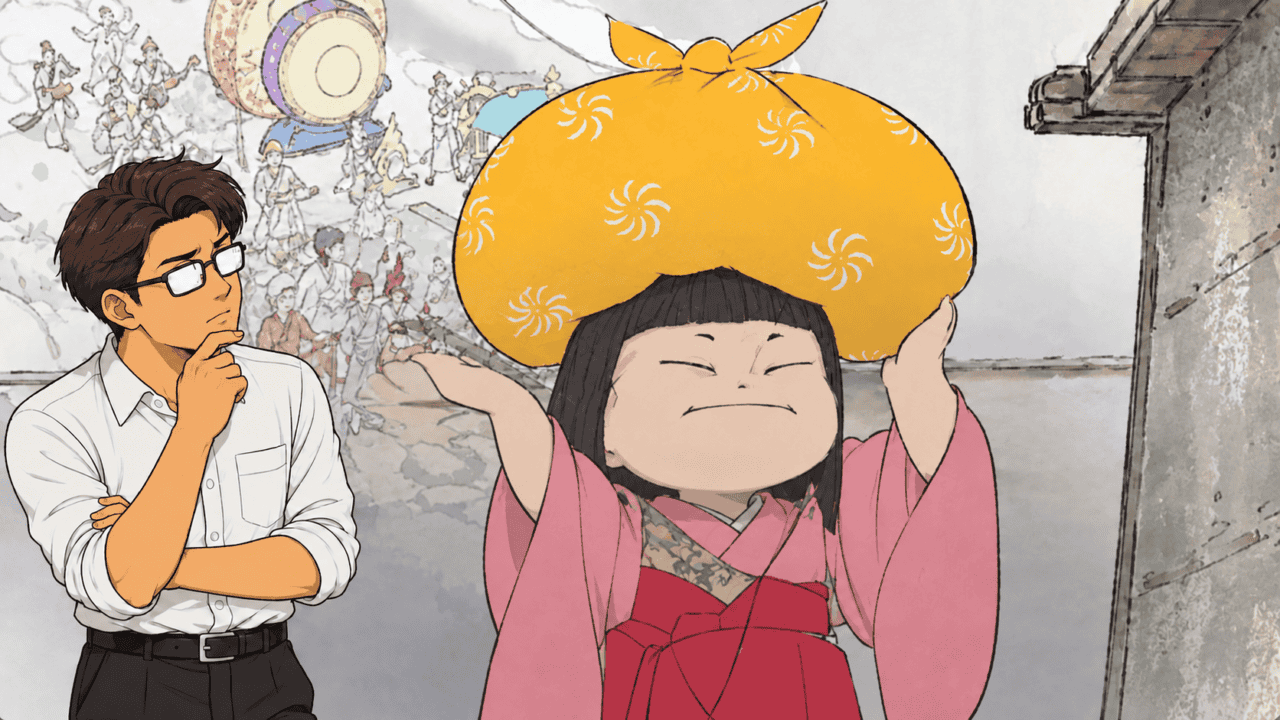
Isao Takahata’s The Tale of the Princess Kaguya (Official Studio Ghibli) is an animated feature released in 2013.
Based on The Tale of the Bamboo Cutter, it focuses on Kaguya’s inner life, making for an exceptionally painful story. I discuss that painful quality in the following article:

Amid all that pain, the young serving girl Menowarawa won our hearts. She devotedly looks after Kaguya after the move from the mountains to Kyoto. With Tomoko Tabata’s delightful performance in the Japanese version, she is a wonderfully comic presence and one of the few consolations in this difficult story.
Menowarawa seems the sort of person who would never leave Kaguya’s side. Yet at the end, she pulls off an astonishing “miracle move”, bringing the finale together almost alarmingly well.
I want to revisit that move and consider what made it possible. How did she manage it?
*This is a translated version. The original (Japanese) is available here.
- A Servant to a “Selfish Girl”
Kaguya may look selfish to Menowarawa: she rejects her naming ceremony, love letters, and the Emperor’s advances. Serving someone who refuses happiness she herself could never obtain may give the maid complicated feelings. - The Other Princess Kaguya
Menowarawa must live within the conventions Kaguya rejects. Supporting someone with access to happiness she cannot share makes her another, less visible Kaguya: oppressed in a different way. - A Disappearance—and a Return to Duty
I suggest that risking her life for Kaguya begins to seem absurd. But her “somewhat desperate” singing, as described in the storyboards, suggests that she returns to her duty as a maid and supports Kaguya through the song. - Another Perspective on the Story
Kaguya is not the only person subjected to oppression and exploitation. Looking at Menowarawa brings into view those who must live by the era’s conventions—and the worth of the people who support others.
On this pageContents
Menowarawa’s “Miracle Move” at the Ending
At the end, samurai gather at Kaguya’s mansion to repel the party arriving from the Moon.
Menowarawa, who has looked after Kaguya all this time, waits outside the room where the princess is hiding, holding a naginata, a traditional polearm.
But when the party arrives and its supernatural power sends the mansion’s occupants to sleep, Menowarawa, who should be guarding Kaguya, has disappeared.
The storyboards included in the commercially released Blu-ray read: “Menowarawa has disappeared for some reason, leaving her naginata and headband behind.”
That alone might mean she simply ran away. But now her miracle move begins.
Outside the mansion, she joins the children at play and begins singing with them: “Birds, bugs, beasts, grass, trees, flowers…” The song has been heard throughout the film.
Hearing it, Kaguya and the old couple regain consciousness. They can say a final goodbye before the Moon’s inhabitants, and Kaguya can give the speech of a lifetime.
While the people in the mansion fall asleep, Menowarawa somehow escapes that power and brings the film to its climax.
This raises a fascinating question.
Everyone else watches the arrivals from the Moon and is put to sleep. Why is Menowarawa able to do something different?
Let us consider why.
Why Does Menowarawa Disappear?
Menowarawa’s absence raises questions that the film does not directly settle. The possibilities below explore what that gap might mean within Kaguya’s story.
A Servant’s Perspective: Princess Kaguya as a “Selfish Girl”
The Tale of the Princess Kaguya focuses on Kaguya’s inner life, so we naturally sympathize with her. But it matters how she looks to other people too.
Looking back at what Menowarawa has seen may help explain her desertion.
To put it bluntly, the Princess Kaguya that Menowarawa observed in the capital was a girl who:
- Was reluctant to take part in the naming ceremony held in her honor,
- Showed no interest in the piles of love letters sent to her,
- Turned down five noblemen,
- Suggested a cherry-blossom outing without asking about anyone else’s plans,
- Then wanted to go home as soon as her mood turned sour,
- Grieved like a victim at the news of Isonokami no Chunagon’s death,
- Rejected the Emperor, and finally,
- Had the Emperor use his authority to defend her, though she herself had wished to return to the Moon.
Of course, all these actions have reasons we can sympathize with—or would simply take for granted today. But Menowarawa belongs to that era too.
In that world, receiving and celebrating a formal name, being courted by noblemen, and becoming the Emperor’s consort would all be wonderful prospects. If such a chance came your way, rejecting it would be unthinkable.
Might Kaguya therefore look to her like a terribly selfish girl who thinks only of herself?
The Tale of the Bamboo Cutter is generally dated to around the ninth century and has been retold for over a thousand years. At least today, I think there is a reading of Kaguya as a “selfish girl.”
Watching The Tale of the Princess Kaguya normally, we see a story in which nobody understands Kaguya, rather than a selfish protagonist. Through Menowarawa’s eyes, however, I think that familiar “selfish girl” interpretation becomes visible.
Menowarawa as Another Kaguya
Suppose Kaguya does look selfish to her. Thinking of the days she spends supporting the princess as her job, Menowarawa begins to seem even more oppressed than Kaguya.
The conventions of that era do not exist for Kaguya, or have no hold on her. For Menowarawa, they are a serious reality.
She has served someone who throws away every piece of good fortune she herself could probably never enjoy.
Inside, she must be thinking, “Why? You’ve got to be kidding!”
The Tale of the Princess Kaguya depicts women oppressed and exploited by social conventions—or, at least, it can be read that way. Kaguya’s wishes are crushed by the old man, the embodiment of those conventions. Something similar happens to Menowarawa, in a different form.
In other words, Menowarawa probably cannot obtain the social happiness available to Kaguya.
She must accept that as simply the way things are. She does not have Kaguya’s appeal.
Serving someone who rejects all the happiness she herself cannot have, Menowarawa may be the other Kaguya in this story.
And because she is not the protagonist, nobody pays her much attention.
The Reason for Her Disappearance
Seen this way, her disappearance in the final confrontation starts to make sense. The whole thing begins to seem ridiculous. It resembles Kaguya’s own flight from the naming ceremony.
Everyone has been thrown into turmoil by Kaguya’s actions; even the Emperor is doing everything he can to protect her. Why should Menowarawa tie on a headband, take up a naginata, and defend her too?
The more she thought about it, the more absurd it became.
Once the arrivals from the Moon stand before her, the battle is already over: they have passed through all the defenses. She has supported this difficult girl until now, but has no obligation to join a battle that might kill her. Pay the price for your own selfishness yourself.
I think this reading goes some way toward explaining her disappearance. What do you think?
Still, it would be too sad if Menowarawa, who brought some comfort to the painful world of The Tale of the Princess Kaguya, had merely abandoned her job for this reason.
Do not worry. There is good news.
One Last Consolation: “Somewhat Desperate”
Let’s look at Takahata’s storyboard notes one more time.
In the final scene, when she leads the children in singing “Birds, bugs, beasts, grass, trees, flowers,” the storyboards describe her as “somewhat desperate.”
What exactly does this desperation mean?
I believe her internal monologue went something like this:
“Something strange has come from the Moon. Everyone is being put to sleep, and who knows what will happen to me? So I’ve abandoned my post… But can’t I do something to protect her? Hmm… Oh, to hell with it—I’ll sing that song!”
That is how I imagine it.
As I suggested, she may have felt resentment while close to Kaguya. Yet once she steps away, she remembers her duty. Isn’t that a very human response?
Leaving that place, Menowarawa returns to her work as a maid. She becomes again the person who helped sustain us through this deeply painful story.
Kaguya, too, follows the old man’s wishes despite having wishes of her own. Responding to him may have been a kind of “job” for her. In that sense, perhaps she and Menowarawa occupy the same position.
I like this interpretation because the contrast between Kaguya and Menowarawa makes The Tale of the Princess Kaguya clearer to me. But we could also read the scene without assuming she abandoned her post.
“Somewhat desperate” might mean that she sees everyone falling asleep, realizes she cannot remain there, and reluctantly leaves while still wanting to do something. At this point, though, I think it becomes a matter of preference.
A Summary
Here is how I would bring the argument together.
The Tale of the Princess Kaguya is a story of oppression and exploitation centered on Kaguya. We identify with her, while Menowarawa stands for those left unnoticed.
Kaguya feels tormented by her situation. But to the maid beside her, she may look like someone who rejects opportunities the maid could never obtain, while acting without regard for anyone else’s circumstances.
I imagine Menowarawa becoming sick of a situation in which even the Emperor must defend Kaguya. Yet after leaving the mansion, she thinks she may still be able to do something, and leads the children in singing the song Kaguya loves.
The important point is that Kaguya alone does not share her era’s outlook. The old woman stays close to Kaguya’s feelings until the end, but she surely understands what the old man means. That is why her continued sympathy for Kaguya is so moving.
Menowarawa must share something of the outlook of that old man who irritates us so much. Isn’t it important to try to see her side too?
An Aside: Sutemaru as a Victim
I have considered Kaguya’s “selfishness” in this article. Perhaps Sutemaru is its greatest victim.
Among the children in Kaguya’s mountain home, Sutemaru is the eldest and the leader of the “Sutemaru gang.”
He tells the rapidly growing Takenoko, or Little Bamboo, “I feel like you’re going to go somewhere far away.” Her reply is: “Takenoko will always be with Sutemaru-niichan. I’ll be your underling forever and ever!”
From the outside, it looks as though Takenoko gives his indirect confession the wrong answer with a radiant smile. She is a child then, of course, so perhaps that is only natural.
If only it had ended there. Later, in the capital, she spots Sutemaru trying to escape after a theft. Calling out without thinking, she helps create the situation in which he is beaten up.
Then, after learning that she must return to the Moon, she goes back to the mountains with the old woman’s help and meets him again.
Without stopping to consider whether he has a wife and child, she shares a special moment with him.
As a result, Sutemaru must go on living with that moment tucked away as an illusory memory. Even though he has a wife and child.
Had they not met again, he might have lived an unremarkable life. Instead, I imagine that memory binding him forever.
In that sense, perhaps Sutemaru is the greatest victim.
So don’t call him “Family-Abandoning Sutemaru.”
The “Kazoku Sutemaru” Pun
“Kazoku Sutemaru,” or “Family-Abandoning Sutemaru,” is a Japanese pun on his name. Its character 捨 means to discard or abandon; kazoku o suteru means “to abandon one’s family.” The joke plays on his willingness to leave his wife and child for Kaguya.
Your Take
What is your view? Choose the answer that comes closest to your own response.
Reader poll
Can you name the movie before the scene comes into focus?
Put your visual memory to the test with a blurred Studio Ghibli scene.

Reader Comments
Have a thought or interpretation? Leave a comment