
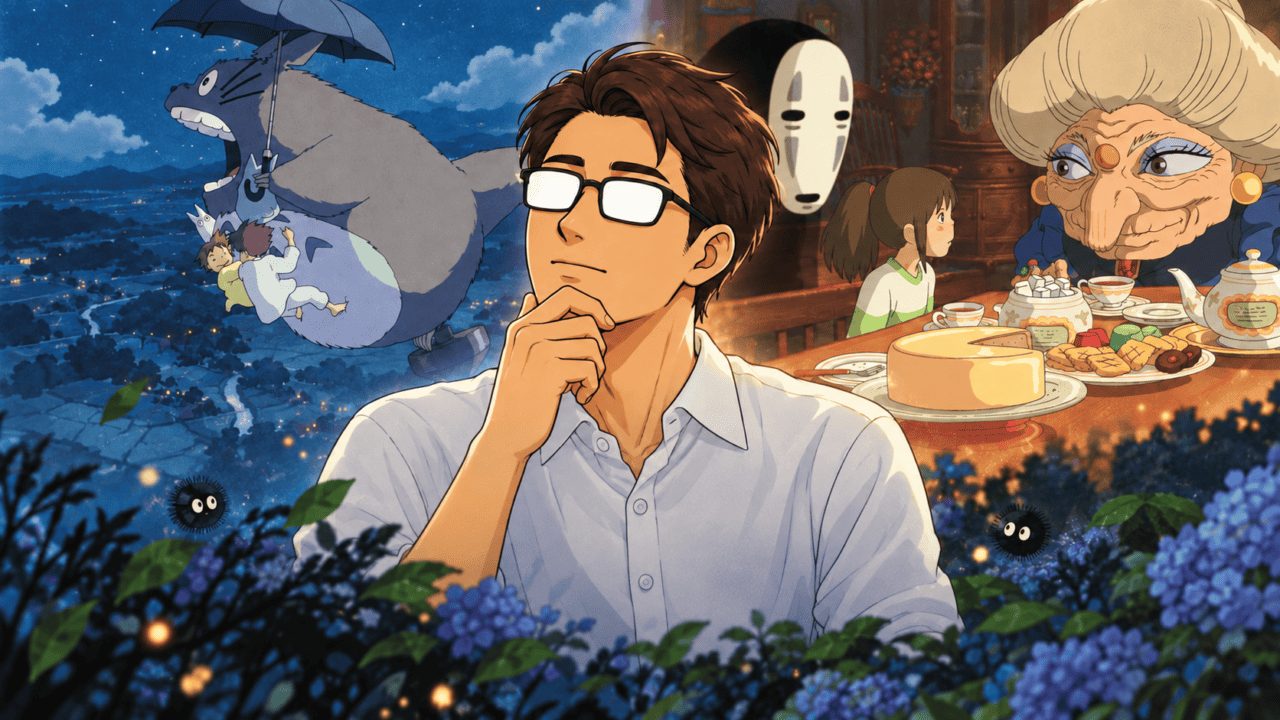
In Hayao Miyazaki’s films, memory seems to be more than an accumulation of information. It is nourishment that settles beneath consciousness, forming the soil in which a personality grows.
I think this is especially apparent in My Neighbor Totoro (Official Website) (1988) and Spirited Away (Official Website) (2001).
At first glance, the two films seem to inhabit different worlds. Yet they mirror each other in one respect: the strange experiences of childhood are destined to be forgotten as we grow up. Through two lines—“It was a dream, but it wasn’t a dream” and “Everything that happens stays inside you, even if you can’t remember it”—I want to explore the relationship between forgetting and growth that Miyazaki depicts.
*This is a translated version. The original (Japanese) is available here.
- Forgetting as an Imprint on the Soul, Rather Than a Loss
Chihiro loses her conscious memories of the world beyond the tunnel. Yet Zeniba’s words suggest that the experience settles beneath consciousness, nourishing her personality and her strength to live. - “It Was a Dream, but It Wasn’t a Dream”: Resistance to Logic
Satsuki and Mei may eventually dismiss Totoro as a childhood dream. This line resists the logical forgetting that comes with growing up, declaring the reality of their experience and impressing it on their souls. - Spirited Away as an Answer to Totoro
My Neighbor Totoro leaves us with the sadness of knowing that one day the experience may be forgotten. Thirteen years later, Spirited Away offers an answer: it remains, even if we cannot remember it. In this reading, forgetting becomes a positive part of growing up.
On this pageContents
The Certainty of Forgetting in Spirited Away
First, let us look at how memory is treated at the end of Spirited Away.
At the end, Chihiro keeps her promise to Haku and does not look back until she has passed through the tunnel. Back in the ordinary world, the glint of Zeniba’s hair tie suggests that something remains. Yet Chihiro shows no clear sign of remembering what happened in the mysterious town.
This is not my speculation; it is explicitly indicated in Miyazaki’s storyboards.
The storyboard direction for the scene reads: “She doesn’t remember anything…”


Her work at the bathhouse, her encounters with Haku, and her confrontation with No-Face have vanished from her conscious memory.
Zeniba’s Words and the “Imprint on the Soul”
Here, the words Zeniba gives Chihiro toward the end of the story become important:
“Everything that happens stays inside you, even if you can’t remember it.”
(Original Text in Japanese)
「一度あったことは忘れないものさ、想い出せないだけで。」
This is more than consolation. Might it be Miyazaki’s definition of memory itself?
For the original Japanese, romanization, English subtitle, and a closer translation analysis of this line, see our guide to memorable Spirited Away quotes.
Chihiro has indeed reached a state in which she cannot recall what happened. Yet, to borrow Zeniba’s words, being unable to remember is not the same as losing the experience. It has settled at the bottom of the vessel that is Chihiro and become part of her unconscious life.
At the beginning, Chihiro is a listless modern child lying in the back seat of a car. After she emerges from the tunnel, her expression is visibly different. Even without her memories, the strength to live and the self-esteem she has gained remain imprinted within her. That is where Spirited Away leaves her.
The Forgetting Still to Come in My Neighbor Totoro
Now let us turn to My Neighbor Totoro.
Totoro and the Catbus are not presented as things Satsuki and Mei merely imagine. Within the film, they are real. Yet the story also seems to place an almost cruel time limit on these encounters.
The Day Totoro Becomes Invisible
The film never directly shows Satsuki and Mei forgetting Totoro. Even in the end-credit illustrations of their later lives, they seem to remain in the afterglow of those strange experiences.
Viewed in terms of growing up, however, their eventual forgetting of Totoro seems inescapable.
- Older villagers, including Kanta’s grandmother, do not speak of Totoro in concrete terms. At most, these beings belong to the realm of remembered childhood folklore: “We could see them when we were children.”
- The Soot Sprites (Makkuro Kurosuke) are described as yokai and treated as a kind of folklore.
Taken together, these details suggest that, as adults, Satsuki and Mei may well reclassify that summer as a childhood dream. Or they may forget it altogether.
For another perspective on why Totoro appears, read our analysis:
Mirai and Totoro: Dreams, Loneliness, and Parents Looking Away
What “It Was a Dream, but It Wasn’t a Dream!” Means
This gives a particular resonance to the line Satsuki and Mei shout together: “It was a dream, but it wasn’t a dream!”
They say it when the seeds Totoro gave them have sprouted in the garden. The sprouts are physical evidence: a joyful confirmation that the previous night’s experience was not a dream.
Read in the context of forgetting, however, the line acquires a deeper meaning.
Eventually, they will probably come to regard that night as a dream: the logic of adulthood will reclassify the extraordinary. Yet the experience will remain at their core as something that was not a dream.
The time spent with Totoro, the awe of nature, the warmth that filled their loneliness—all may become fleeting, dreamlike memories. Still, as real experiences, they will continue to support the sisters throughout their lives. Perhaps the line is both a prophecy of forgetting and a declaration of resistance to it.
For the original Japanese, romanization, English subtitle, and a closer translation analysis of this defining line, see “It was a dream. But it wasn’t a dream.” in our guide to memorable My Neighbor Totoro quotes.
Spirited Away and the Consolation It Offers Totoro
Let us consider the two films together.
The future of Satsuki and Mei carries the unease that they may forget. Totoro is a vision particular to childhood, and a sadness hangs over My Neighbor Totoro, as though growing up must mean losing him.
Made thirteen years later, Spirited Away offers a clear answer to that unease.
Forgetting does not make the experience disappear.
Chihiro has lost her memories of the world beyond the tunnel. Satsuki and Mei may also lose their memories of Totoro. Yet Zeniba’s words and the changed Chihiro show that forgetting is not the same as loss.
Could we see the whole of Spirited Away as an expansive “answer song” to My Neighbor Totoro? In this reading, it gives a structural assurance to the intuitive conviction of “It was a dream, but it wasn’t a dream”: the memories remain, even when they cannot be recalled.
Satsuki and Mei Brought Together in One Girl
Finally, I want to consider the connection through the way the protagonists are conceived.
As is well known, in the early concept for My Neighbor Totoro, the protagonist was one girl, rather than the sisters Satsuki and Mei. The girl standing beside Totoro at the rainy bus stop in the poster combines features of both sisters.
What if that single girl had remained the protagonist?
In fact, might Chihiro in Spirited Away be that girl?
Chihiro seems to contain both Satsuki’s sense of responsibility—or the difficulties of being swept along by her parents’ decisions—and Mei’s freedom and innocence, or recklessness.
To explore growing up, Miyazaki divided these qualities between two sisters. Thirteen years later, he brought them together in one girl. Seen this way, Spirited Away might be Miyazaki’s updated reprise of My Neighbor Totoro.
Conclusion: Forgetting as a Sign of Growth
“It was a dream, but it wasn’t a dream.”
“Everything that happens stays inside you, even if you can’t remember it.”
These two lines are a hymn to the childhood Miyazaki has continued to portray. The strange events we experience as children, and our sense of oneness with the world, inevitably recede and are forgotten as we grow up.
That need not be cause for despair. Our ability to forget allows us to move on to the next stage of life. Even then, the warmth of sleeping on Totoro’s belly, or the sensation of flying with the spirit of the Kohaku River, never disappears. It continues to shape the soul.
We too have grown up forgetting many things. Yet the nostalgia that comes over us unexpectedly, or the inexplicable feeling that we can do anything, may be gifts from the “Totoros” and gods we once met and then forgot.
Can you name the movie before the scene comes into focus?
Put your visual memory to the test with a blurred Studio Ghibli scene.
Reader Comments
Have a thought or interpretation? Leave a comment