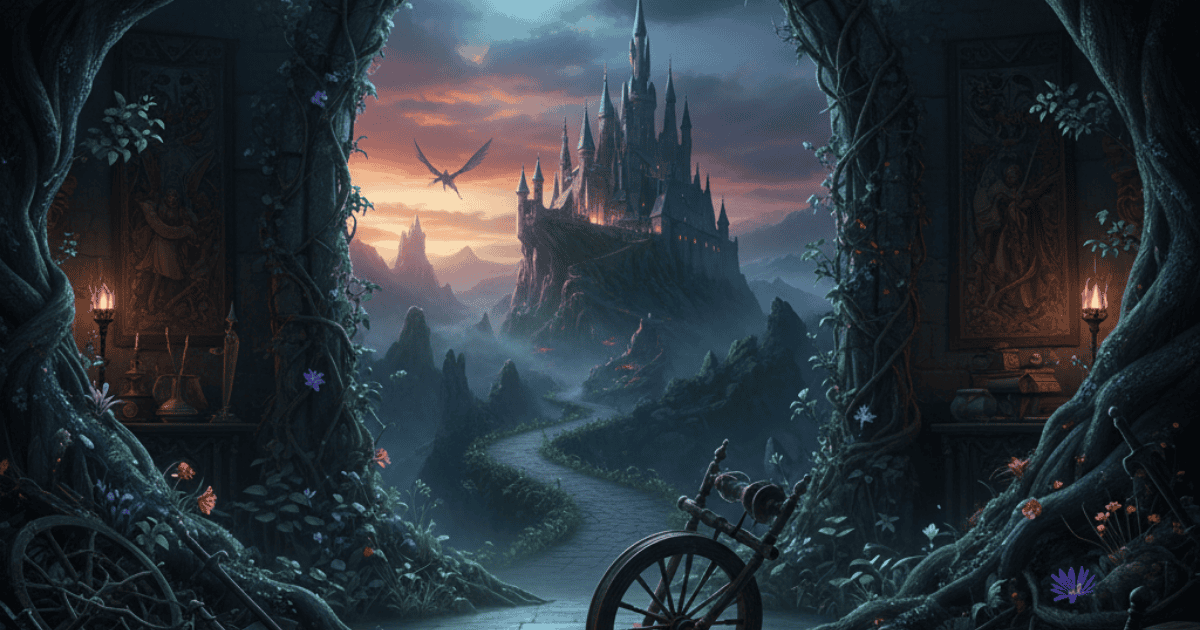
Maleficent: Mistress of Evil is a film directed by Joachim Rønning and released by Walt Disney Pictures on October 18, 2019.
Its predecessor, Maleficent (2014), substantially reworked Disney’s 1959 animated film Sleeping Beauty.
Opinions will differ, but I saw the first film as an interesting attempt to fill in and rework the questionable plot points in Sleeping Beauty. I enjoyed that aspect of it.
My discussion of the first film: Maleficent and Sleeping Beauty: Reworking the Fairy Tale
This sequel, Maleficent: Mistress of Evil, however, has none of the first film’s narrative consistency and is full of moments that make me want to ask, “Wait, why?”
A film is a film, of course, and no story is entirely free of questionable moments. Still, I find it frustrating that the coherence the first film achieved—even by changing the ending—is missing here.
To put it generously, this is a “return to the fairy tale.” In practice, though, important parts of the story are so convenient that I would call it an overuse of the fairy-tale excuse.
That is a lot of complaining already, but having watched Maleficent: Mistress of Evil, I would like to revisit its story and take a closer look at what bothered me.
*This is a translated version. The original (Japanese) is available here.
- The Convenient Cursed Spinning Wheel
Why does Ingrith possess the cursed spinning wheel, and why can a curse intended for Aurora also affect John? These questions go unexplained. The sequel relies on the fairy-tale convenience the first film seemed to have corrected. - The Unresolved Story of Ingrith’s Brother
The truth about her brother’s death—or disappearance—is never revealed. Since it is crucial to her hatred of fairies, leaving it unexplained makes her motivation feel incomplete. - A King and Prince Who Notice Nothing
The queen builds up the military and develops a weapon against fairies without John or Philip noticing. I find it difficult to accept that a conspiracy on this scale could proceed so easily. - Flittle’s Sad Return to Heroism
After the first film reduced the three fairies to fools, Flittle is given a heroic act of self-sacrifice. Yet to me her death feels like a way of moving the audience, far removed from the fairies’ achievements in the 1959 film.
On this pageContents
Maleficent: Mistress of Evil (2019) Full Synopsis (Spoilers Ahead)
Quick Summary, Character Map, and Narrative Explanation
-
The Engagement and the Queen’s Trap
Aurora and Philip become engaged. His mother, Queen Ingrith, hates fairies and frames Maleficent at a dinner, driving a wedge between her and Aurora. As Maleficent leaves the castle, she is shot down. -
The Dark Fae and the Queen’s Plot
Maleficent is rescued by the Dark Fae, winged beings of her own kind who have been driven into hiding by humans. Ingrith prepares a red powder that destroys fairies and plans to use the wedding to lure them into a trap. -
War and the Truth Revealed
Aurora discovers the queen’s plot. An attack on the fairies gathered for the wedding begins, and war breaks out between humans and fairies. Maleficent heads for the castle with the Dark Fae. -
A Miracle of Love and Peace Between the Realms
Maleficent dies, but returns as a phoenix after Aurora’s tears fall on her ashes. The queen is defeated, humans and fairies are reconciled, and Aurora and Philip marry with both peoples’ blessing.
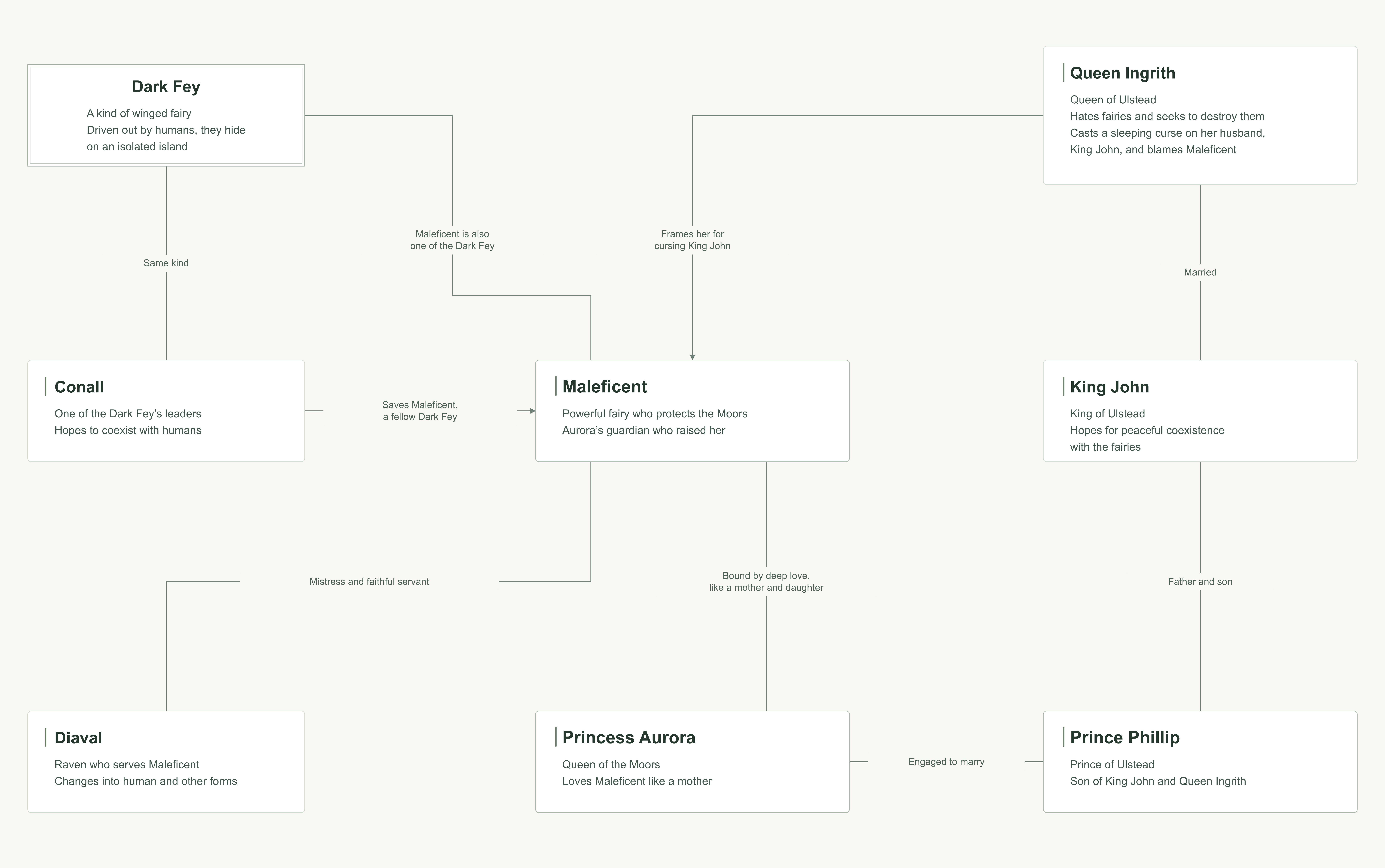
Character Map
Story Explanation: Missing the Mark
The first Maleficent boldly changed the story of the 1959 animated film Sleeping Beauty.
I think those changes clearly involved what is now often called “political correctness.” But they also filled in and reworked the fairy tale’s questionable or overly convenient plot points. That was what I liked about it.
Unfortunately, I find no comparable purpose in Maleficent: Mistress of Evil, and no moment that makes me think, “Nicely done!” The key seems to be the following:
- Maleficent presents itself as Aurora’s “true story.”
- That leaves a need to explain why the story was distorted.
- Ingrith was created as the person responsible for that distortion.
I do not find that a story worth going to such lengths to tell. Worse, the first film’s strength—filling in and reworking the old story—has disappeared, and questionable plot points return.
Calling it a “return to the fairy tale” might cover everything, but it leaves me with mixed feelings. If that is the answer, why did we need the first Maleficent at all?
I will explore those reservations later. First, here is the story in more detail.
Detailed Synopsis
Aurora’s Engagement and a Creeping Shadow
A happy day arrives for Aurora, the kind-hearted queen of the Moors. Prince Philip of neighboring Ulstead kneels and asks her to marry him. She gladly accepts.
Philip’s father, King John, welcomes the news: the marriage will bring the two realms together. His mother, Queen Ingrith, offers congratulations, but seems to have something else on her mind.
Aurora also tells Maleficent, who raised her. Maleficent is unhappy at the thought of Aurora marrying a human, but cannot refuse her daughter’s wish. Reluctantly, she accepts John’s invitation to dinner.
The Unwelcome Dinner and the Queen’s Scheme
At dinner, Ingrith brings up the curse Maleficent once placed on Aurora and quietly presses her. She then declares that Aurora will now be her daughter. The challenge angers Maleficent, who loves Aurora dearly, and her magic flares up.
As green light bursts from Maleficent, John collapses. Ingrith immediately accuses her of cursing him. Maleficent denies it, but Aurora believes the queen and begs her to wake the king.
Distraught that even Aurora suspects her, Maleficent flies away. Ingrith’s servant shoots her with iron, and she falls into the water below a waterfall. It is all part of the queen’s plot.
The Wounded Maleficent and the Dark Fae
Maleficent is rescued by a winged being who resembles her. He belongs to the Dark Fae, her own kind. Once spread across the world, they have been driven out by humans and now live in hiding on an isolated island where their people originated.
Some Dark Fae want war with humans. Conall, who rescued Maleficent, sees hope for coexistence in her relationship with Aurora. But Maleficent, betrayed by humans twice, closes her heart to the idea.
Aurora and Diaval search for Maleficent, hoping she will lift the king’s curse, but cannot find her.
A Wedding Trap and the Red Powder
Ingrith pretends to sympathize with Aurora and tries to draw her to her side. She announces that the wedding will take place in three days, inviting the Moors and neighboring realms. It is a trap to bring the fairies to the castle.
After years of research, the queen has prepared a red powder that turns fairies to dust. Making it requires tomb bloom flowers from the Moors. When Maleficent learns that soldiers are heading there, she flies off to protect her homeland.
She finds that the flowers have been uprooted. Soldiers ambush her, but Conall sacrifices himself to save her. His death leads the Dark Fae to decide on war with humans.
The Truth Revealed and the Battle Begins
On the wedding day, Aurora discovers Ingrith’s secret room. There she finds the red powder and the spinning wheel that once put her to sleep. She realizes that Ingrith used its spindle to curse John.
Ingrith appears and tells Aurora about her past. Her father, who wanted peace with the fairies, sent her brother to the Moors; he never returned, and she believes the fairies killed him. She describes her jealousy and hatred of the prosperous Moors, then locks Aurora away. The attack begins on the fairies who have gathered for the wedding.
A Miracle of Love and the Reconciliation of Two Kingdoms
Humans and fairies fight at the castle. The Dark Fae struggle against Ingrith’s preparations, but Maleficent’s arrival changes the battle. She corners the queen.
Aurora, who has escaped from her room, arrives and asks Maleficent to stop. During her moment of hesitation, Ingrith fires an arrow. Maleficent is struck and falls apart into black ash.
But the story is not over. Aurora’s tears fall on the ashes, which swirl into the air. Maleficent returns as a phoenix.
Maleficent transforms Ingrith into a goat. The fighting ends, and she destroys the cursed spindle, waking John.
Aurora and Philip’s wedding now takes place, celebrated by humans and fairies alike.
Maleficent: Mistress of Evil — Analysis of Its Questionable Plot Points
The Spinning Wheel Spindle Problem
Ingrith puts John under a sleeping curse using the spindle that once cursed Aurora. This raises two questions:
- Why does Ingrith have the spinning wheel?
- The curse was intended for Aurora. Why would pricking John with the same spindle curse him too?
Neither question is explained. Cursing John merely by pricking him with the spindle seems far too convenient.
If this were the first film, I might simply accept that this is how its world works. But these are just the sort of details I would have expected Maleficent to explain, which makes their absence more disappointing.
It feels as though the sequel is taking advantage of the fairy-tale logic that the first film so neatly rejected.
The Unresolved Plot Point: The Vanished Brother
Ingrith seems to have resented the fairies since childhood, but her brother’s supposed death sealed her hatred. More precisely, he went to the Moors as an envoy and never returned.
The belief that the fairies killed him matters. Afterward, the people removed her father from the throne, and she married John against her wishes. I think that chain of events made her hatred and anger enduring.
Yet the film never explains the brother’s supposed death, the event at the root of Ingrith’s hatred. I doubt that the fairies killed him—but what did happen? Did he really die? Did he simply go somewhere else? If so, why?
It leaves me feeling that something has not been resolved.
How Does John Fail to Notice Ingrith’s Plot?
There is another problem with Ingrith’s story: John is astonishingly oblivious.
The queen develops fairy-killing powder in a secret room, while preparations for war proceed underground.
John wants reconciliation with the Moors and does not appear to be contemplating war.
That means the military buildup is happening entirely without his knowledge. Is that really possible?
It might stay secret for a while, but one person letting something slip would expose it. And even if John is exceptionally foolish, Philip seems sensible enough.
I cannot quite accept that such a large operation, using the army—a major national resource—could proceed so perfectly without either of them knowing.
How did Ingrith manage it? As with her brother’s story, I feel there is too little explanation.
Flittle’s Tragedy
In the first Maleficent, the three fairies who raise Aurora are little more than fools.
That is a painful contrast with the 1959 Sleeping Beauty, in which they play essential, heroic roles. Perhaps giving them different names reflects that fundamental change in how they are portrayed.
They remain fairly inconspicuous in Maleficent: Mistress of Evil. Near the end, though, Flittle puts herself in the way of the red powder, giving her life to stop it from spreading.
It is a heroic act reminiscent of the fairies in Sleeping Beauty—but honestly, it just makes me sad.
There is a suggestion that she returns as a flower. But why not let the fairies succeed as plainly as they did in 1959? Couldn’t the three work together to turn things around? They eventually defeat the queen’s servant by poking her, so it hardly seems beyond them.
For a moment, Flittle seems to have become a hero again. Ultimately, though, she appears to have been used to move the audience by showing someone risk her life.
Those are my personal thoughts on Maleficent: Mistress of Evil. I wrote this because I had watched the film and wanted to share my impressions, but ended up with little except complaints.
Perhaps I have missed something important. Personally, though, I did not find it a particularly interesting film.
I was not enormously impressed by the first Maleficent either, but this sequel shows how carefully it was put together by comparison. What was the aim of Mistress of Evil? I find it a puzzling film—and a less accomplished one than its predecessor. That is only my view, of course.


Reader Comments