Directed by Robert Stromberg and released by Walt Disney Pictures on May 30, 2014, Maleficent was marketed as a live-action reimagining of the classic 1959 animated film Sleeping Beauty.
Although presented as a remake, it is not a faithful live-action adaptation. I think it is better approached as an entirely different film.
The original Sleeping Beauty comes from an old European fairy tale with no clear protagonist, even though Princess Aurora is at the center of the story. Maleficent also opens with a fairy-tale narrator, but its protagonist is clearly Maleficent, the witch who curses Aurora.
Here, I will compare Maleficent with the 1959 Sleeping Beauty and consider its appeal. For me, the key is how making Maleficent the protagonist fills in and reworks some of the original fairy tale’s more questionable plot points.
First, let’s revisit the story and the differences between the two films.
*This is a translated version. The original (Japanese) is available here.
- Answering the “Overreaction Problem”
In the 1959 Sleeping Beauty, cursing a newborn because you were not invited to a celebration seems excessive. This film gives Maleficent’s revenge a much more painful history: Stefan, her first love, betrays her and takes her wings. - A Different Kind of “True Love”
The original prince’s kiss feels an awkward fit for “true love” when he has only just met Aurora. Here, the love Maleficent develops while watching over the girl takes the place of romantic love. - The Three Fairies Sacrificed for the Story
The three fairies are heroes in the 1959 film, but become unreliable fools in this version. I read that change as a way of making Maleficent’s bond with Aurora unique. - Why Stefan Keeps the Wings
The wings can be understood as a symbol of Stefan’s heroic reputation. But I also wonder whether they remind him of his innocent youth and a first love he has never quite put behind him.
On this pageContents
Maleficent (2014) Full Synopsis (Spoilers Ahead)
Quick Summary, Character Map, and Differences from Sleeping Beauty
Here are the main events in Maleficent:
-
Betrayal and a Vengeful Curse
Stefan betrays Maleficent and takes her wings to win the throne. In revenge, she curses his newborn daughter, Aurora, to fall into a death-like sleep on her sixteenth birthday, from which only true love’s kiss can wake her. -
Maternal Love Born from Watching Over Aurora
Maleficent watches over the princess in hiding until the curse can take effect. As she sees Aurora grow, however, the girl’s innocence draws her in, and her hatred gives way to an affection resembling maternal love. -
A Different Kind of “True Love”
When Aurora falls asleep, the prince’s kiss does not wake her. Maleficent’s loving kiss on her forehead breaks the curse. The two are reconciled, the kingdoms are united, and peace returns.
Character Map
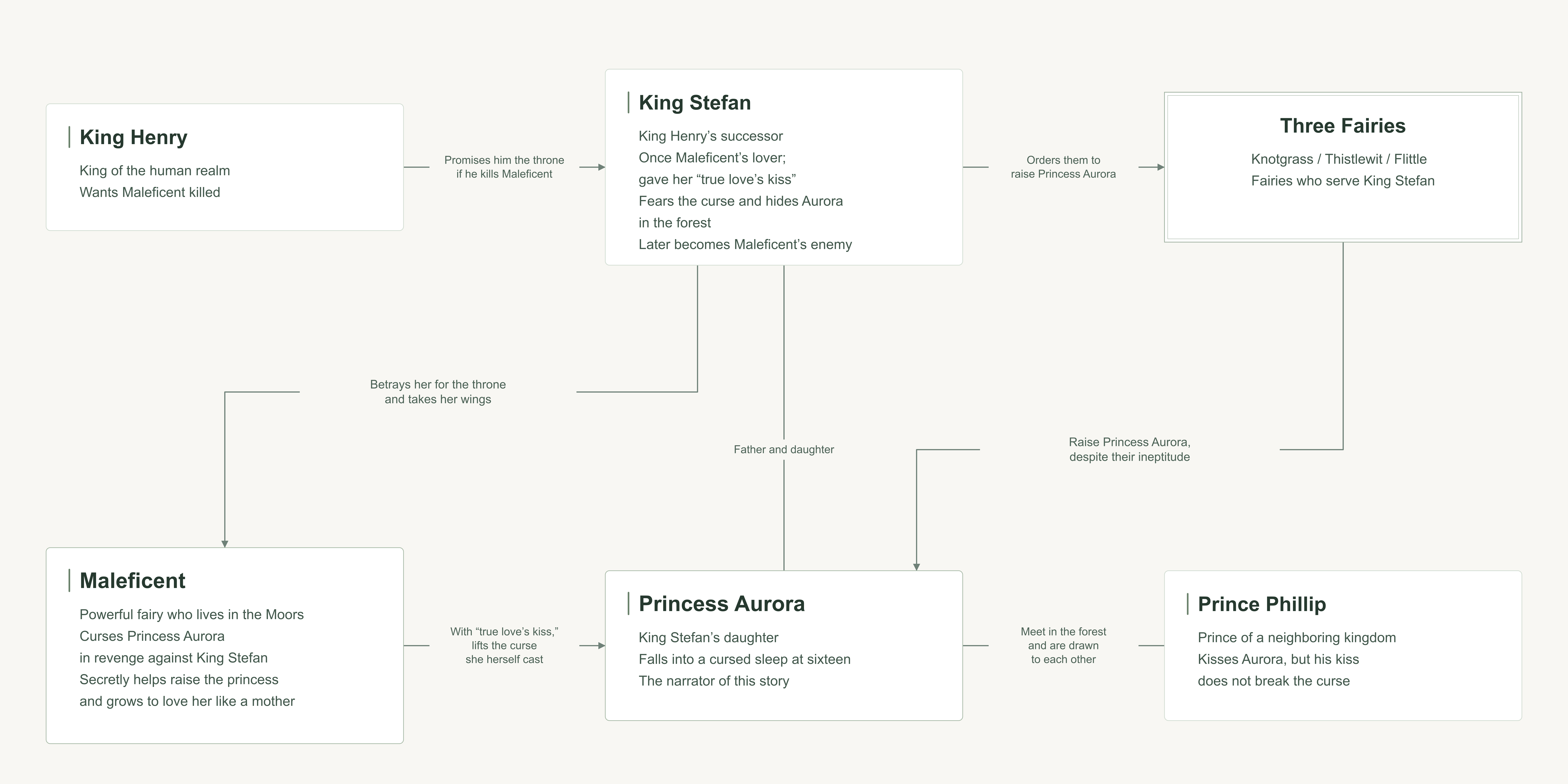
Comparing the Two Disney Films
Maleficent is a remake of the 1959 animated film Sleeping Beauty, rather than a straightforward live-action adaptation.
The main differences are as follows:
| Plot Point | Sleeping Beauty (1959) | Maleficent (2014) |
|---|---|---|
| Protagonist vs. Antagonist | Princess Aurora is at the center of the story. Maleficent is portrayed as an evil antagonist. | Maleficent is the protagonist. Her former lover, King Stefan, is her antagonist. |
| The Motive for the Curse | Anger at not being invited to Aurora’s birth celebration. | Hatred and revenge after Stefan betrays her and takes her wings. |
| Aurora’s Upbringing | Raised deep in the forest by three competent, loving fairies. | The three fairies are unreliable, and Maleficent protects and helps raise Aurora from the shadows. |
| True Love’s Kiss | Phillip, whom Aurora meets in the forest, breaks the curse with his kiss. | The prince’s kiss does not work. Maleficent’s kiss, expressing maternal love, wakes Aurora. |
| The Climax | Prince Phillip slays Maleficent after she transforms into a dragon. | Maleficent regains her stolen wings and overpowers King Stefan, who plunges to his death from the castle tower. |
| The Ending | The prince and princess are married, ensuring a traditional “happily ever after.” | The human and magical kingdoms are united, with Aurora crowned as Queen of both realms. Maleficent acts as her protector. |
These are substantial differences. Frankly, the two films are almost entirely different works.
Why make these changes? One reason, and probably the most important, is to challenge the traditional story in which happiness comes from marrying a prince.
Maleficent’s wings, the source of her power, are taken by a man. The image readily suggests a woman stripped of her power by a male-dominated society.
With that in mind, looking at the smaller changes in the plot reveals another way to read the film: it fills in and reworks the questionable details that come with the original fairy tale.
I will return to those changes in the analysis. First, here is the story of Maleficent in more detail.
Detailed Synopsis
Encounter and Betrayal
The film opens with a narrator offering to tell a familiar story anew. Two hostile realms lie side by side: a human kingdom and the Moors, home to magical creatures. Ruled by a greedy king, the humans envy the Moors’ beauty and abundance. The Moors have no king or queen; their creatures live peacefully, bound by trust. Among them is a young fairy with large wings: Maleficent.
One day, Maleficent meets Stefan, a human boy who has entered the Moors to steal a jewel. Both have lost their parents, and she feels an affinity with him. When he learns that his iron ring burns her, he throws it away without hesitation. Their friendship grows into love, and on her sixteenth birthday he gives her what he calls “true love’s kiss.”
As they grow older, Stefan’s innocent heart gives way to ambition. Maleficent, meanwhile, becomes the Moors’ powerful guardian. When King Henry invades, she defeats him, leaving him mortally wounded.
The king promises his throne and his daughter to whoever kills Maleficent. Hoping to become king, Stefan returns and drugs her. He cannot bring himself to kill the woman he once loved, but cuts off her great wings and presents them as proof of her defeat. Betrayed by someone she loves and deprived of her wings, Maleficent sinks into despair.
The Curse and a Strange Upbringing
Stefan becomes king, and a daughter, Aurora, is born. Three fairies from the Moors—Knotgrass, Thistlewit, and Flittle—attend the celebration of her birth. Two have given her the gifts of beauty and happiness when Maleficent, who was not invited, appears. Instead of a blessing, she pronounces a curse: by sunset on her sixteenth birthday, Aurora will prick her finger on a spinning wheel’s spindle and fall into a death-like sleep, from which only true love’s kiss can wake her.
Maleficent sets true love’s kiss as the condition for breaking the curse because she no longer believes such love exists.
Fearing the curse, Stefan orders the kingdom’s spinning wheels destroyed and tells the three fairies to hide Aurora in the forest until she is sixteen years and one day old. They take human form and begin raising her, but are hopelessly inept at it.
Maleficent soon finds the cottage and keeps watch until the curse can take effect. Yet the fairies are so poor at caring for Aurora that she begins helping from the shadows: the princess must at least stay alive long enough to be cursed. A strange sort of child-rearing begins.
Budding Affection and the Inescapable Fate
Aurora grows into a beautiful, kind-hearted girl. When she enters the Moors, she is enchanted by the place and comes to know Maleficent as the “fairy godmother” who has always watched over her. She grows fond of her, and Maleficent, after watching the girl for so many years, comes to love her too. She tries to lift her own curse, but it is too powerful to undo.
Shortly before her sixteenth birthday, Aurora meets Prince Phillip in the forest, and the two are attracted to each other. She decides to live with Maleficent in the Moors, but the three fairies reveal her origins—and tell her that Maleficent is the one who cursed her. The revelation leaves her devastated.
Aurora leaves for the castle to meet her father.
Back at the castle, Aurora meets King Stefan, who locks her in a room to keep her safe. The curse nevertheless draws her down to the dungeon, where the remains of the spinning wheels have been stored. She pricks her finger on a spindle and falls into a deep sleep.
Maleficent brings Prince Phillip to the castle, hoping he might be able to break the curse.
True Love’s Kiss and the Union of the Two Kingdoms
Phillip kisses the sleeping Aurora, but she does not wake. Overcome with sorrow and regret, Maleficent approaches her and gently kisses her forehead.
Aurora opens her eyes. It is Maleficent’s love, resembling that of a mother, that proves to be the true love needed to break the curse.
Aurora decides to return to the Moors with Maleficent. But Stefan and his soldiers stand in their way, trapping Maleficent in an iron net. Aurora finds her severed wings, which have been kept in the castle, and releases them from their glass case.
The wings return to Maleficent’s back. With her power restored, she overcomes the soldiers and defeats Stefan, but spares his life.
Stefan refuses to accept defeat and attacks her again. They fall from the tower; Maleficent flies free, and Stefan falls to his death.
The long conflict ends. Maleficent unites the two realms, and Aurora becomes their queen. The narrator who has been telling the story is revealed to be Aurora herself.
Maleficent: Analysis and Comparison with Sleeping Beauty
Solving the “Overreaction Problem”
An important feature of Maleficent is the detailed account of what happens before Aurora is born.
A modern film may need that sort of detail to sustain its story. But I also see it as an answer to the “overreaction problem” in the 1959 Sleeping Beauty.
The animated film begins with Aurora’s birth. The king and queen, who have long wanted a child, hold a grand celebration but do not invite Maleficent. Angered by the slight, she curses the princess to die after pricking her finger on a spindle by sunset on her sixteenth birthday.
That is not an especially outlandish turn of events in a fairy tale. Still, isn’t Maleficent rather too angry?
I can understand her displeasure, but it seems a small reason to curse a newborn baby. Then again, anyone who has ever been left out of a celebration they felt they should have been invited to may see things differently.
Maleficent, by contrast, shows the love between young Maleficent and Stefan, followed by Stefan’s appalling betrayal.
After such a cruel, selfish act, her revenge can almost seem mild by comparison.
By giving the curse this history, the film neatly avoids the original’s “overreaction problem.”
A More Convincing Place for Prince Phillip’s “True Love”
In the 1959 Sleeping Beauty, Aurora wakes through a kiss from Prince Phillip, whom she happens to meet in the forest at sixteen.
The revelation that they were already betrothed gives their meeting a sense of destiny. Even so, it seems a long way from what we usually mean by “true love.”
Phillip’s behavior makes Aurora seem like someone who briefly lets him forget the pressures of becoming king and his dissatisfaction with an arranged marriage to a woman he does not know.
In the original, the three fairies have lovingly raised Aurora for sixteen years, which makes Phillip feel rather like a late arrival. The fairies’ affection for her seems much closer to “true love” to me.
In Maleficent, Maleficent is the one who develops that affection.
Placing parental love at the center makes the idea of true love more convincing and gives Phillip a more natural role in the story.
Phillip and Aurora still seem attracted to each other. I hope they have time to discover their own true love.
But while these changes resolve some awkward points in Sleeping Beauty, they also leave the three fairies as casualties of the remake.
The Three Fairies: Heroes Turned into Fools
The three fairies do remarkable things in the 1959 Sleeping Beauty. They:
- Weaken the curse from death to sleep;
- Raise Aurora with care for sixteen years;
- Rescue Phillip from Maleficent’s prison.
They even bring about Aurora’s meeting with Phillip by sending her out to pick berries. It is no exaggeration to call Sleeping Beauty a heroic tale about the three fairies. Their affection for Aurora is genuinely moving.
In Maleficent, however, they are a bunch of fools. They do not notice Aurora meeting Maleficent, or the crow visiting her. They even seem to find looking after the girl something of a nuisance.
Frankly, the three fairies seem unnecessary here. If they are this inept and inattentive, human caretakers would do just as well. But humans who raised Aurora for sixteen years would surely grow fond of her, and Maleficent’s love would no longer be unique. One of them could give the true love’s kiss.
The film retains the original idea of the three fairies raising Aurora, but uses them as unusual beings who feel no particular affection for her.
I think it is fair to say that the fairies were sacrificed for the remake.
Perhaps changing their names from Flora, Fauna, and Merryweather to Knotgrass, Thistlewit, and Flittle betrays a guilty conscience about bringing the original heroes so low.
Why Didn’t Stefan Dispose of Maleficent’s Wings?
Finally, there is one question peculiar to this film: why didn’t Stefan simply dispose of Maleficent’s wings?
Keeping them leaves open the possibility that she might recover her power.
His decision can be rationalized to some extent. Stefan is a commoner who becomes king because he is hailed as the hero who defeated Maleficent. Her wings symbolize his heroic reputation. Even if he wanted to dispose of them, perhaps those around him would not have allowed it.
That would explain why he kept them. But watching the film, I also sense another possibility.
Perhaps, for Stefan too, his love for Maleficent is a beautiful memory of his innocent youth, and he sees those days in her wings.
He comes close to killing her but can only bring himself to take her wings. In that sense, he has never quite got over his ex.
There is something ridiculous and pathetic about that attachment, something he could hardly admit to anyone.
Perhaps this unbalanced attachment is why, at the end, he cannot accept defeat and loses his life.
Those are my thoughts on Maleficent. Reworking and filling in the older Sleeping Beauty story leads quite naturally, I think, to this new film.
How did you see Maleficent?



Reader Comments