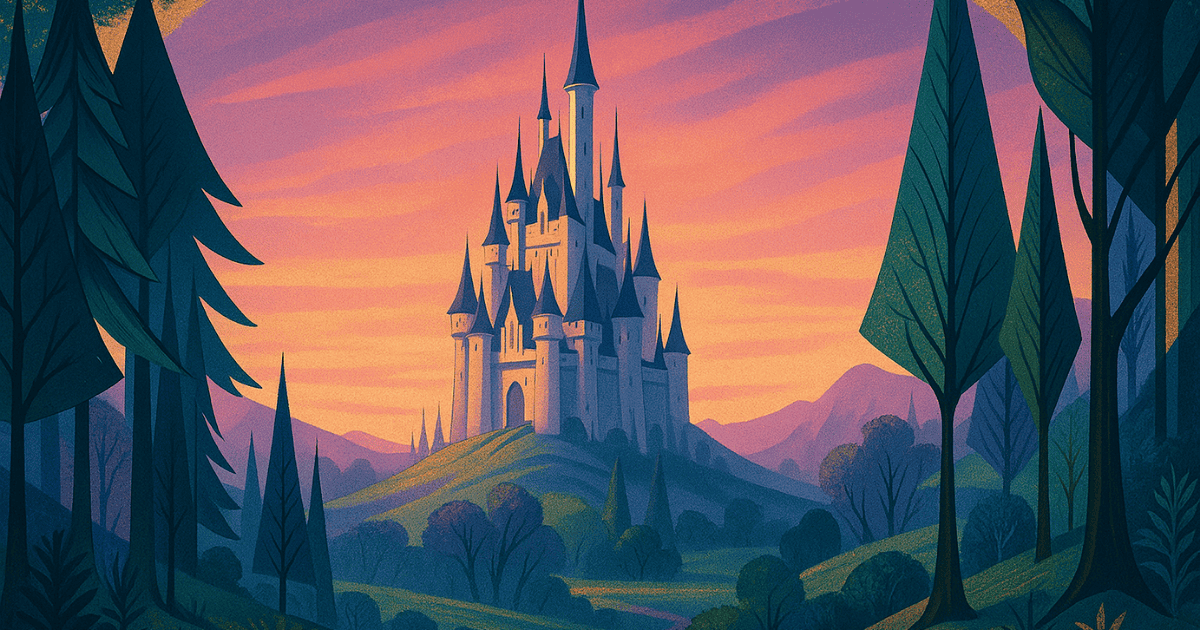
Walt Disney Productions’ Sleeping Beauty is an animated film released in the United States in 1959.
As indicated on Disney’s official page, the film is based on Charles Perrault’s La Belle au bois dormant (The Sleeping Beauty in the Woods), published in his 1697 fairy-tale collection. The story itself comes from an older European folktale. The Brothers Grimm’s Little Briar Rose is also familiar, but their collection’s first volume appeared in 1812, so Disney’s credited source predates it.
With so many changes and omissions, however, I find it more natural to think of the tale as a starting point. In some respects, the familiar Grimm version may make the film easier to understand.
Here, I will revisit the story of Sleeping Beauty and consider what makes it so enjoyable.
I do end up poking a little fun at it, but I believe that is one way of enjoying an older film.
*This is a translated version. The original (Japanese) is available here.
-
A Freely Adapted Fairy Tale
The story is based on Perrault, but Disney adds elements such as true love’s kiss and the dragon battle. A major difference is that the princess’s hundred-year sleep is omitted. -
Maleficent’s Excessive Anger and the Appeal of Magic
A death curse seems an excessive response to not being invited to a celebration. Yet that anger also makes the film’s striking magical scenes possible. I read it as a film that gives visual expression priority over narrative consistency. -
Convenient Love and Wonderful Images
The romance feels more like convenient love at first sight than “true love.” For me, though, the visual artistry more than makes up for that weakness. The film shows how much animation can achieve through images.
On this pageContents
Sleeping Beauty: Synopsis (Spoilers)
The Main Events, Character Map, and Fairy-Tale Differences
Here are the main events in Sleeping Beauty:
-
Aurora’s Birth and Maleficent’s Curse
Not invited to Princess Aurora’s birth celebration, Maleficent curses her to die after pricking her finger on a spindle by sunset on her sixteenth birthday. A good fairy weakens the curse: she will fall asleep instead and awaken through true love’s kiss. -
A Meeting in the Forest and the Curse Fulfilled
Raised in the forest to avoid the curse, Aurora falls in love with Prince Phillip on her sixteenth birthday. Back at the castle, Maleficent’s magic leads her to prick her finger on a spindle and fall asleep. Maleficent also captures Phillip, the prince who can save her. -
The Prince, the Dragon, and True Love’s Kiss
With help from the fairies, Phillip escapes and defeats Maleficent, who has turned into a dragon. At the castle, he kisses the sleeping Aurora and breaks the curse. The two are reunited, and peace returns to the kingdom.
Character Map
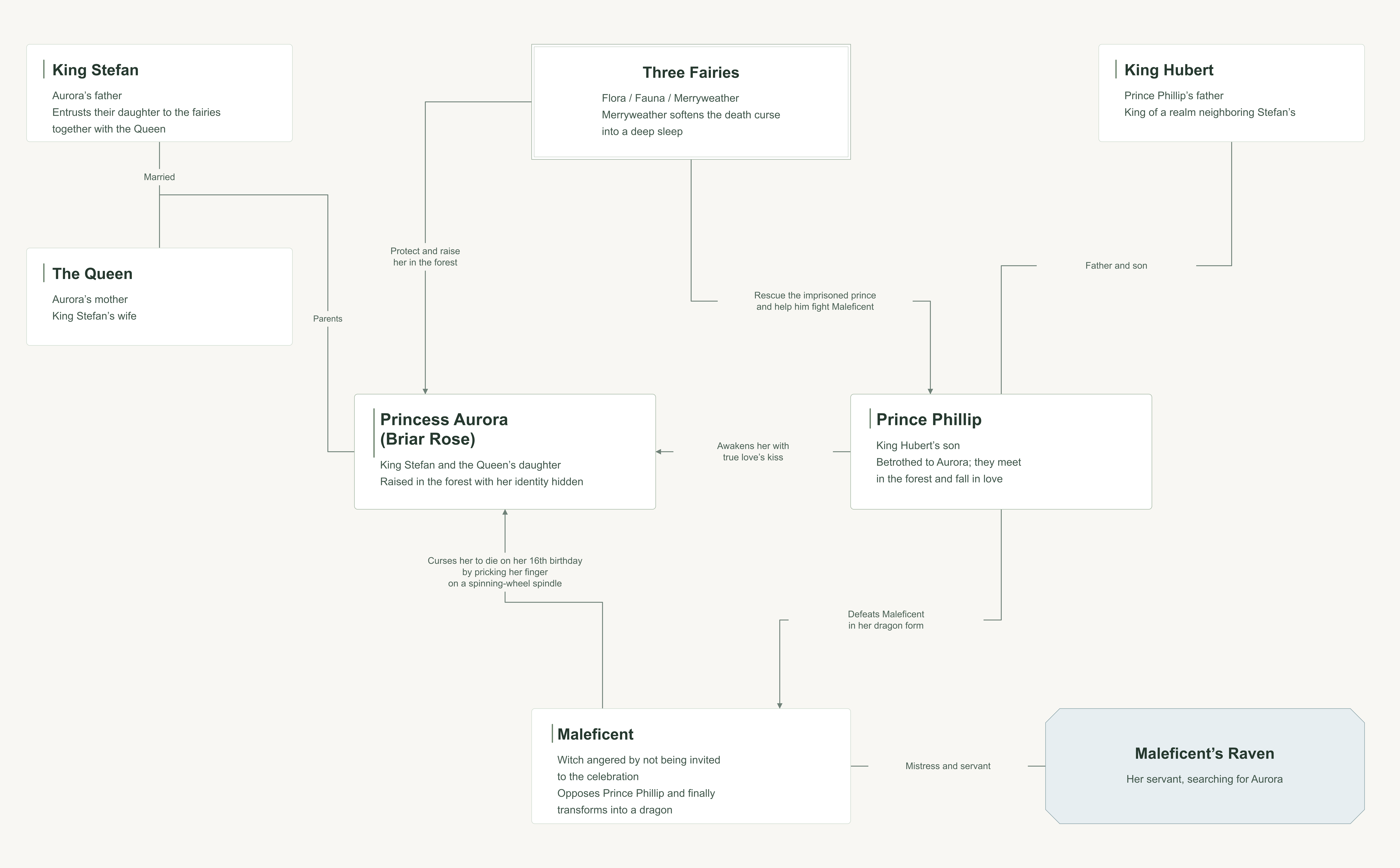
Next, let’s compare the film with the Perrault tale.
Disney and the Perrault Tale: Main Differences
The following table compares the film with the Perrault story in the Japanese translation used for the original article.
| Plot Point | Perrault Tale (Japanese Translation Used Here) | Disney’s Animated Version |
|---|---|---|
| The Fairies & The Villain | Seven fairy godmothers are invited. An old, forgotten fairy crashes the party and casts the curse. | Three good fairies (Flora, Fauna, and Merryweather) oppose Maleficent. |
| The Curse | She is cursed to “die by pricking her hand on a spindle.” A younger fairy softens it to a 100-year sleep (no kiss is mentioned). | She is cursed to “die before sunset on her 16th birthday.” Merryweather softens it to a sleep broken only by “true love’s kiss.” |
| The Upbringing | The princess is raised comfortably in the palace. There is no secret alias or forest exile. | The three fairies raise her in the forest under the name Briar Rose. |
| The Spinning Wheel Scene | She wanders into a tower, finds an old woman spinning, and pricks her finger purely out of naive curiosity. | Maleficent magically hypnotizes her with a floating green orb, forcing the princess to prick her finger against her will. |
| Scope of the Sleep | The castle’s people, animals, and even fires and spits are put to sleep, though the King and Queen are not. | The three fairies put the people in the castle to sleep. |
| The Prince’s Romance | They have not met or been betrothed beforehand. The prince arrives through the forest 100 years later. | Betrothed at birth, they accidentally cross paths in the woods and fall in love, unaware of their royal identities. |
| The Awakening | She wakes when the hundred years end and the prince arrives (no kiss is described). | She is explicitly awakened by the magical power of Prince Phillip’s kiss. |
| The Climax | No battle at the awakening: the prince arrives, and the princess wakes. | A spectacular, terrifying battle where Maleficent transforms into a dragon and is slain by the “Sword of Truth.” |
| The Timeline | The accident happens when she is around fifteen or sixteen, with no strict “sunset” deadline. | A highly dramatic, ticking clock: the curse activates “by sunset on her 16th birthday.” |
| Banning the Spindles | The king simply issues a royal decree forbidding spindles. | King Stefan orders all the spinning wheels in the kingdom burned. |
| The Prince’s Ordeal | The prince faces no major villainous resistance. | Maleficent captures and imprisons him; the fairies rescue him. |
One notable difference is that the Perrault version does not describe a kiss awakening the princess. That detail probably comes from the Grimm tale. Disney also omits the hundred-year sleep: Phillip’s kiss wakes Aurora relatively soon after she falls asleep.
Now, let’s return to the film and follow the story in more detail.
Detailed Synopsis
Princess Aurora’s Birth and Maleficent’s Curse
Long ago, King Stefan and his queen celebrate the birth of their long-awaited daughter, Aurora. King Hubert and his young son, Prince Phillip, are invited to the festivities. The kings plan to announce the children’s betrothal, hoping eventually to unite their kingdoms.
Three good fairies, Flora, Fauna, and Merryweather, arrive to give Aurora gifts. Flora grants beauty, and Fauna a beautiful singing voice. Before Merryweather can give hers, Maleficent appears, angry at not having been invited.
She curses Aurora to prick her finger on a spindle and die before sunset on her sixteenth birthday.
Merryweather cannot undo the curse, but she can soften it: Aurora will sleep rather than die, and true love’s kiss will awaken her.
A Secret Life in the Woods
To protect his daughter, Stefan orders every spinning wheel in the kingdom burned. The fairies propose raising Aurora deep in the forest until she turns sixteen.
With heavy hearts, the King and Queen agree to entrust their daughter to the fairies. To conceal her identity, she is raised under the name Briar Rose.
Meanwhile, Maleficent sends her servants to find Aurora, but they fail for sixteen years. Their foolish mistake is that they have been looking for a newborn baby all that time.
A Fateful Encounter and the Spindle’s Curse
On her sixteenth birthday, Briar Rose is singing in the forest when she meets Phillip. Neither knows the other’s identity. They fall in love at first sight and promise to meet again that evening.
When she returns home, the fairies reveal who she is and tell her she is already betrothed. Distressed at losing the young man she loves and having to marry a prince she does not know, Aurora reluctantly accompanies them to the castle.
But Maleficent’s raven has found the grown-up Aurora. Alone and unhappy at the castle, she is led by Maleficent’s magic to a spinning wheel formed from green light. Against her will, she pricks her finger and falls asleep.
The Prince and the Witch
To prevent Phillip from waking Aurora, Maleficent captures him and locks him in her dungeon. Her cruel plan is to keep him there for a hundred years and release him as an old man to kiss the princess, who will not have aged.
The three fairies come to rescue him. With their magical help, Phillip escapes and makes his way toward Aurora’s castle.
Maleficent turns into a huge dragon and blocks his path. After a fierce battle, Phillip defeats her with the Sword of Truth.
True Love’s Kiss
At the castle, Phillip gently kisses Aurora, breaking the curse and waking her.
The castle returns to life. The couple are celebrated by those around them and live happily ever after.
Sleeping Beauty: Visual Brilliance and Lovable Contrivances
The Irresistible Charm of the Forest Animals
It may be no exaggeration to call the woodland animals one of the greatest pleasures of Sleeping Beauty. They are wonderfully cute.
That is hardly unique to Sleeping Beauty—it is true of Disney animation more generally—but the animals really are adorable.
The unusual fluidity of Disney animation from this period suits them beautifully. They capture “animals as we wish they were.” I would happily live surrounded by creatures like these.
Real animals, of course, are not always that lovable or that eager to keep us company. Yet we seem to want them to be. Animation gives wonderful form to that curious wish.
The “Maleficent is Way Too Angry” Problem
Let me tease Sleeping Beauty a little now. Its biggest talking point may be that Maleficent gets far too angry.
She curses a newborn because she was not invited to the celebration. The reason is the same in Perrault and Grimm. I understand why she is annoyed, but it seems an excessive punishment to inflict on a baby.
In the fairy tale, the crucial situation is simply that a princess has been asleep for a hundred years. Perhaps it cannot be helped that the reason for it is a little hasty.
In Disney’s version, however, Aurora does not sleep for a hundred years: the prince kisses her awake soon after she falls asleep. Once that central device is removed, the imbalance between Maleficent’s anger and the curse becomes much more conspicuous.
But we could turn this around and ask whether Disney wanted to portray something else altogether.
This is only a guess, but might the film’s greatest priority have been “the depiction of magic itself”?
Look at the magic with that possibility in mind, and its appeal becomes clear. Even knowing modern animation—or perhaps because we know it—we can still find ourselves thinking, “That is amazing.”
The character animation is excellent, and the magic feels genuinely strange, powerful, and uncanny. The result is that Sleeping Beauty becomes “a film that stays enjoyable however many times you watch it, even when you know the story.”
Maleficent certainly seems too angry. But perhaps her anger serves the fairy tale’s hundred-year sleep in one version and the opportunity to depict lots of magic in the other.
Phillip’s Convenient “True Love”
The supposed beauty of Sleeping Beauty lies in a cursed princess awakening through true love’s kiss. But is this not a little too convenient to count as “true love”?
Having Phillip meet Aurora as a baby is a neat structural touch, presenting them as destined for each other. In practical terms, though, their meeting in the forest when she is sixteen is their first real encounter.
Phillip has fallen in love at first sight with the beautiful young woman Aurora has become.
Frankly, he falls for her because she looks beautiful. I think that is a little—no, quite a long way from what we usually mean by “true love.”
Phillip is also unhappy with the political marriage arranged for him. Perhaps he wants to escape his circumstances, including the prospect of becoming king. Meeting a beautiful young woman in the forest might have given him a convenient excuse to escape reality.
In the end, even the love story between Aurora and Phillip seems a relatively small part of this film.
As I suggested above, its real interest may lie in magic. Perhaps the ambition to express magic through animation left little need to develop the idea of true love.
And still, its excellence as animation makes it a pleasure to watch.
Perhaps Sleeping Beauty shows that the essence of an animated film can lie in visual expression rather than its script or story. In that sense, the narrative shortcomings inherited from a fairy tale are not necessarily a bad thing.
That is my own account of what makes Sleeping Beauty enjoyable. I think many of its contrivances arise from its fairy-tale source. Trying to iron them all out would probably make the film longer and longer—perhaps even three hours would not be enough.
I think the later Disney film Maleficent neatly addresses many of these problems. With Maleficent as the protagonist and substantial changes in interpretation, it is better regarded as a different work. Still, watching Maleficent as a film that tackles the contrivances in Sleeping Beauty one after another could be entertaining.
That’s all for now!

Reader Comments