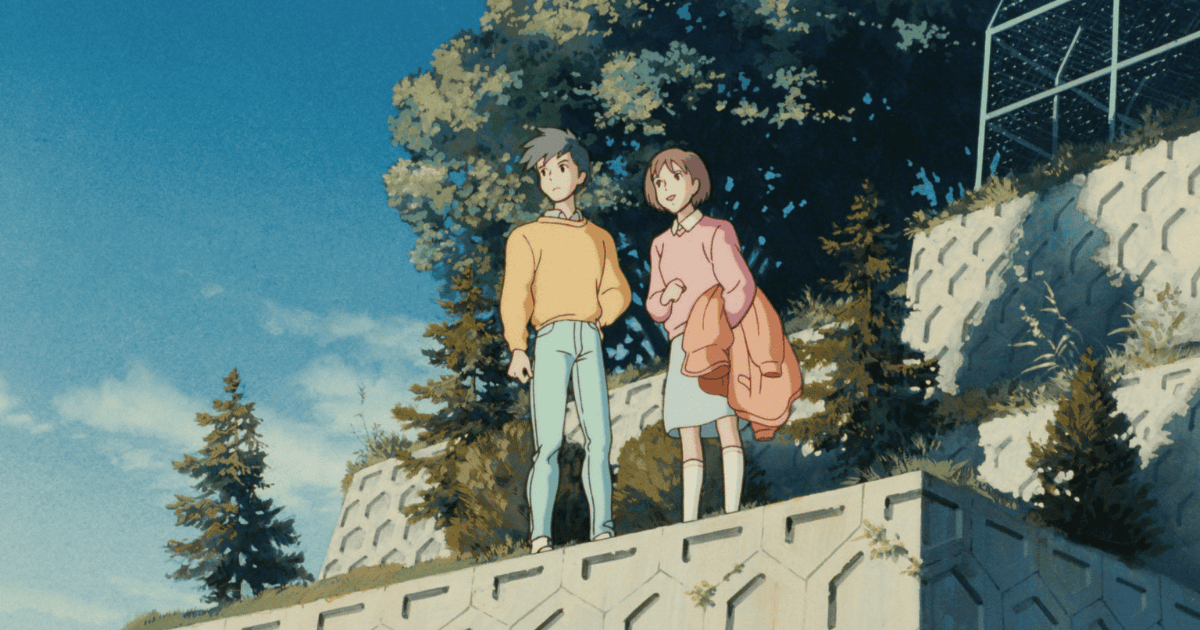
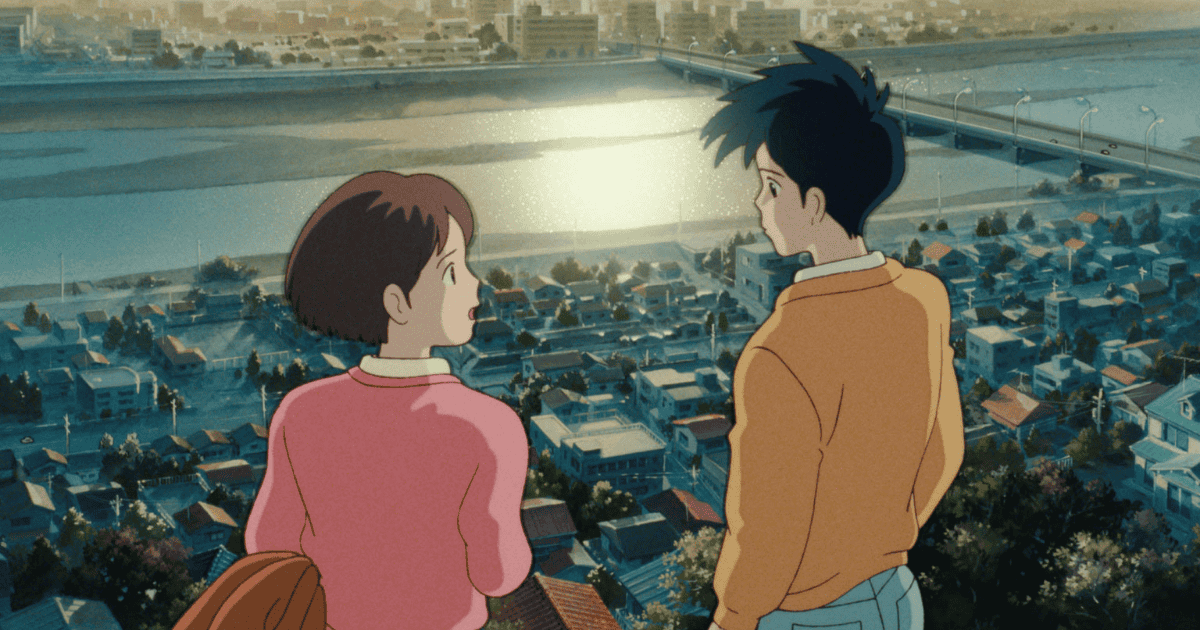
Last time, I considered Sugimura’s story in Whisper of the Heart(Studio Ghibli Official). I deliberately looked beyond the protagonists, but avoiding them altogether would feel like a cop-out. This time, I want to think properly about Seiji Amasawa and Shizuku Tsukishima.
My feelings about the two have changed with age. As a student, I watched Shizuku start writing a novel with her high school entrance exams approaching and thought, “This girl is trouble. Run, Seiji!” Watching now, I feel quite differently.
What matters to me is that both Seiji and Shizuku made promises to their parents.
*This is a translated version. The original (Japanese) is available here.
- A Story of Promises
I read Whisper of the Heart as a story in which Seiji and Shizuku face their parents seriously and make promises that help them move toward the future. The final promise of marriage belongs to that same pattern. - The Poster’s Sleight of Hand
A poster that puts the Baron and the film’s fantasy imagery up front invites a misleading impression while drawing us in. - Did the Old Man Tell a Lie?
His dramatic past seems almost too well matched to Shizuku’s story. I wonder whether some of it might have been invented or embellished.
On this pageContents
Whisper of the Heart (1995): The Promises Seiji and Shizuku Make
Seiji: Facing His Parents and Making a Promise
Seiji is, in a sense, presented as a “perfect” person. He has a dream, stands up to his parents, and wins permission to study violin-making in Italy. Perhaps few people in Japan can truly identify with him. I may think that only because I was nothing like him at that age, but his way of living is awfully cool. His grandfather helps, of course, yet without firm resolve of his own he could not live that way.
What do I mean by that way of living? Making a promise to his parents. He is not merely a boy who argues with adults who do not understand him and then complains about them. His grandfather may have helped enormously, but Seiji persuaded his parents and reached an agreement with them.
I hope with all my heart that Seiji makes it as a violin maker. Even if he does not, I think he will keep his promise, return to Japan, and press on toward another goal. I think he has the inner strength to do that.
Seiji could make even another man fall for him. Shizuku, who has fallen for him, also reaches an agreement with her parents.
Shizuku: Facing Her Parents in Her Own Way
As a student, I thought Shizuku was trouble. Now, what strikes me is that she, too, kept her promise to her parents.
The adults in Whisper of the Heart are all frighteningly understanding, above all Shizuku’s father. She is clearly someone they protect. And because she recognizes that protection, Seiji’s way of living makes her anxious to catch up.
Her novel begins as a secret project. But, conveniently enough, her grades slide, and her family realizes something unusual is going on.
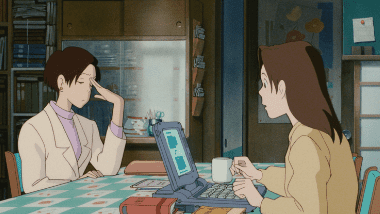
Her father’s decision is hardly an ordinary one—at least, I cannot imagine myself doing the same. Yet it proves an excellent move. I think the scene also shows how he has learned to navigate that household as its only man.
Shizuku keeps her promise and returns to being an ordinary student preparing for entrance exams.
Now I cannot remember why I once thought she was so alarming. She is an eminently sensible protagonist.
What Happens to the Two Afterward?
The moment in Whisper of the Heart that makes me squirm is the final promise of marriage.
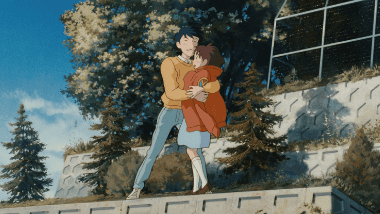
Seiji embraces Shizuku with his right leg stuck straight out: it is wonderfully awkward and young. Yet plenty of viewers may find it difficult to watch without thoughts like these:
- “I can’t watch this.”
- “What idiots. They’re bound to break up anyway.”
- “As if that would ever happen. Both of you, drop dead.”
I think those negative reactions reveal admiration for the two. Perhaps the person who seems most scornful is the one who most wants to embrace the scene, expressing that wish in a contrary way.
Of course, it would be natural for their story to become one of a special time shared before their paths diverge, as in Roman Holiday, Breath of Fire, La La Land, or 5 Centimeters per Second.
But as I have argued, Whisper of the Heart is a story of promises. So, in my reading, the two do marry afterward. They promised, after all. They might split up later, though.
The scene ends with an even simpler line: “Shizuku… I love you!” In Japanese, Seiji says daisuki da, an expression whose force depends heavily on context. See the original Japanese, romanization, English subtitle, literal translation, and my comparison with Ocean Waves in our detailed analysis of Seiji’s final declaration.
Whisper of the Heart (1995) Trivia: The Poster That Deceived Japan
What comes to mind when you picture the poster for Whisper of the Heart? Seiji and Shizuku sharing a bicycle? The first one I remember uses the image below.
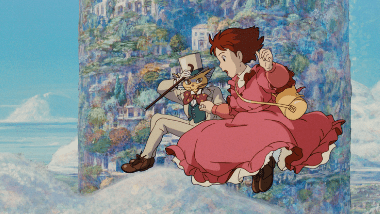
Having missed the theatrical release, I spent years misunderstanding the film because of that poster. I also remember the television trailers putting the Baron front and center. When I finally saw the film, I was surprised by how different it was from what I had imagined.
How to advertise a film with even less fantasy than Pom Poko must have been an important question. I have no material that tells me whose idea the poster was. But perhaps, through it, the advertisers were trying to fool all of Japan that summer into expecting a different sort of Whisper of the Heart.
Perhaps that poster is my favorite thing about the film.
Whisper of the Heart (1995) Theory: Did the Grandfather Lie?
For some reason, Shizuku gives her first novel to the old man at Chikyuya to read. The scene in which they eat nabeyaki udon together is rather lovely.
Yet Toshio Suzuki apparently saw something else in it: to him, it looked like an “erotic scene.” In his reading, that came not from director Kondo but from Miyazaki’s storyboards. Once someone points it out, it certainly starts to feel like an odd scene.
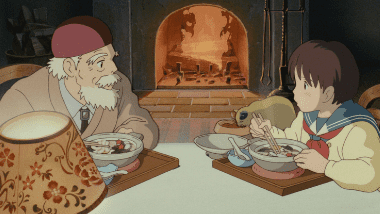
Looked at that way, another question arises: Was the story the old man told Shizuku about his past really true?
His dramatic past fits Shizuku’s story a little too conveniently. It makes me suspicious. He did live abroad, and perhaps there was a woman he loved. But the beautiful story he tells might have been nothing more than an unrequited attachment.
Ultimately, we do not know. But surely it is the sort of story that should make us ask, “Can things really work out that conveniently?”
Then again, I am not sure this is a particularly good way to watch a film.
The images used in this article are from the “Studio Ghibli Still Images” collection.
Can you name the movie before the scene comes into focus?
Put your visual memory to the test with a blurred Studio Ghibli scene.


Reader Comments