
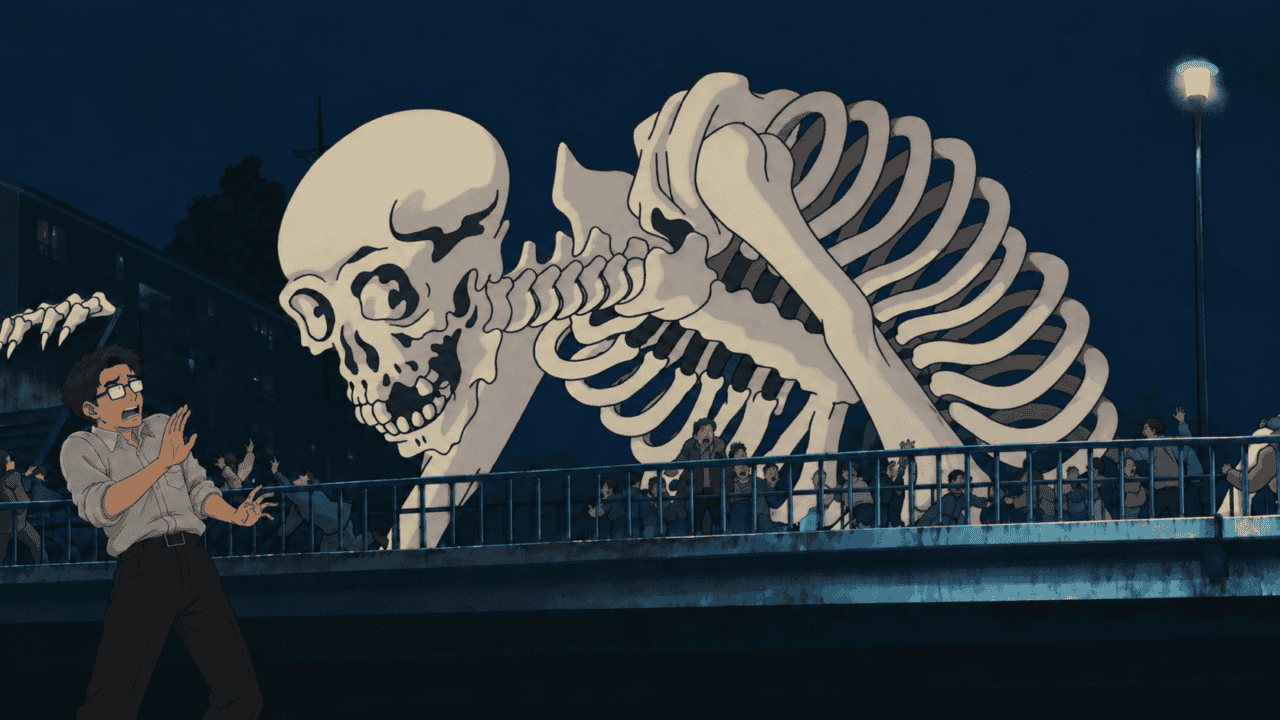
In my previous article, I considered Oroku’s words and offered a bawdy theory about her secret art. This time, I want to discuss Pom Poko(Official Studio Ghibli) and its Operation Specter, also known as the Yokai Grand Operation.
I imagine most viewers have thought, Operation Specter is not going to work. Gyobu’s sudden death cuts it short, but how was it meant to end? Even if the tanuki had completed it, I doubt the outcome would have been different.
Yet those useless elders from Shikoku are delighted: “Now things will take a turn for the better!”
It is tempting to feel frustrated by all that effort going nowhere. But I think that reaction can miss something fundamental about how to watch Pom Poko. Let us begin there.
*This is a translated version. The original (Japanese) is available here.
- Pom Poko Is a Comedy
The tanuki’s struggle is a tragedy, yet their frantic efforts can look comically futile from outside. Operation Specter is a highlight of that overlap between tragedy and comedy. - Operation Specter as Animation
I read the transforming tanuki as animators and the parade as animation itself. The cameos and the human spectators’ reactions bring the distance between makers and viewers into focus. - The Names in the End Credits
I hear the ending song, Itsudemo Dareka ga, as a small request to remember the people whose names appear in the credits and the work they have done. - Entering and Leaving the Fantasy
A tanuki looks at us at the beginning; a human boy looks at us near the end. I read their matching gazes as an entrance into the fantasy and a way back to reality.
On this pageContents
Operation Specter as a Comic Highlight
A Film You Are Allowed to Laugh At
Because Pom Poko depicts the struggle between humans and tanuki, we tend to sit up straight and take it seriously: “How cruel and foolish humans are! How pitiful the tanuki!” That is a valid response, but it is not how I remember watching it as a child, nor how my father watched it. We simply enjoyed its rakugo-like humor.
To me, Pom Poko is a comedy we are allowed to laugh at. Perhaps Takahata chose rakugo storytellers as voices and narrators because otherwise we would not recognize it as comedy. He may also have felt that using comedians known for double acts or sketches would be too obvious. Traditional rakugo offers another approach to such a fierce subject as the struggle between humans and tanuki.
Rakugo is traditional Japanese comic storytelling. A seated performer uses a fan, a cloth, and changes of voice and posture to play several characters. Stories often build toward a punchline, known as an ochi.
The important point can be summed up in the phrase: “Comedy is tragedy, and tragedy is comedy.”
For the tanuki, Pom Poko is plainly a tragedy. They are desperately fighting humanity. Yet however serious their situation and however hard they try, from the outside their efforts can look rather futile. That is how tragedy can be shown as comedy, and this film does it quite openly.
Operation Specter as the Comedic Climax
The comedy is there from the outset of Operation Specter. Look, for example, at how those useless elders from Shikoku arrive in Tama:
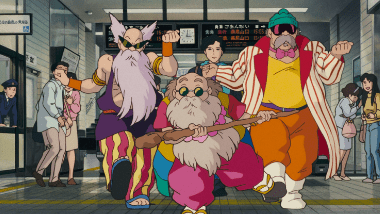
Presumably they have dressed up for their trip to Tokyo. But visually, the moment they appear, I cannot help thinking, “This is hopeless.” There is no way things will go well if they are left in charge.
As we know, following the elders’ advice does nothing to improve the situation. What matters, though, is that both the tanuki who invited them and the elders themselves are completely serious.
Operation Specter is the comic highlight of all that misplaced effort. At the last moment, they spin their wheels on the grandest possible scale.
After that, the story changes rapidly, and tanuki die one after another in suicidal attacks and acts of self-destruction. Surely nobody could laugh at that—though you are allowed to, of course.
Operation Specter is more than a symbol of the tanuki’s futile efforts. Characters from other Ghibli films famously appear in it. Why?
Operation Specter as Animation Itself
Ghibli Cameos and Takahata’s Critique
Operation Specter includes four familiar characters across the three scenes shown below.
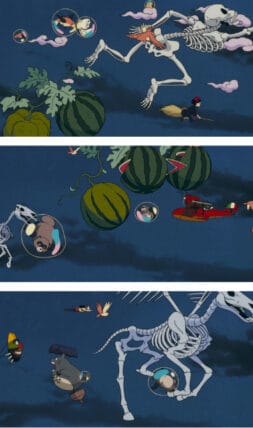
Kiki from Kiki’s Delivery Service moves from left to right in the first; Porco Rosso moves from right to left in the second. In the third, Totoro travels right to left, while Taeko from Only Yesterday moves left to right.
Perhaps these appearances are a kind of fan service. But I also read them as Takahata’s commentary on Miyazaki’s films. Taeko travels in the same direction as the parade itself, as though to say, “This is the direction our animation should take!”
As I argued in my article on Oroku’s words and secret art, perhaps a similar feeling lay behind Takahata’s rejection of the proposed Happyakuya-danuki adaptation.
With animated characters appearing within it, could Operation Specter represent animation itself for Takahata?
The Tanuki Are the Animators
The film calls transformation “the greatest marvel of the natural world.” But the work of animators drawing the images that move before our eyes is a marvel, too. We are so used to animation that we no longer stop to be astonished when drawings move naturally. Yet that should be astonishing.
Operation Specter, the symbol of the tanuki’s fruitless efforts, is itself the product of animators’ sweat and tears. We consume it without giving that much thought.
The men drinking at a food stall explain the apparitions away as their nerves making them see things. To me, they stand for the careless remarks we make while watching animation. I hear Takahata scolding us: “Don’t just stare blankly! This is not a trick of your nerves. What you are watching is the result of animators’ sweat and tears!“
After the operation, children say how much fun it was, and their mother remarks that it makes her want to believe in UFOs. She puts a miracle achieved through the tanuki’s desperate training in the same category as the occult. Structurally, I read her comment like the men’s at the stall: it reflects viewers who never think about the work that makes animation possible.
The tanuki’s lament after the operation sounds to me like the creators’ own: “We are wearing ourselves out making this—why don’t they understand?” It also carries an angry demand that we look properly. Tsurukame’s cry of “We were the ones who did it!” sounds like the makers’ cry, too.
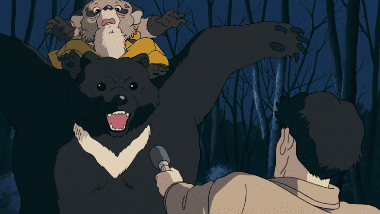
Tsurukame Oshō’s actual proposal is even more striking than this summary suggests: he argues that their only remaining choice is to reveal that the tanuki themselves created Operation Specter. Compare the original Japanese, romanization, English subtitle’s “Operation Goblin,” literal translation, and the dub’s “Operation Specter” in our detailed analysis of his declaration.
Animation does not make itself, nor is it easy to make. It is the product of many people’s sweat and tears, from the director to the animators. Yet we usually think only of the director and perhaps the lead character’s voice actor. No wonder everyone else might want to shout, “We made it!” We ought to spare them a thought.
Again and again, Pom Poko feels like a story in which Takahata scolds us. I can still love it because I find myself agreeing with him. We should watch more seriously—and also avoid becoming trapped in fiction. Being a consumer is not easy, either.
Seen in that light, the end credits become quite moving.
Remembering Their Wonderful Names
The ending song is Shang Shang Typhoon’s Itsudemo Dareka ga (Someone Is Always There). As I wrote in Memories of Pom Poko, my first thought when I heard it in the cinema as a child was of Yonige-ya Honpo.
Yonige-ya Honpo (The Night Movers) is a Japanese comedy-drama film series from the 1990s about a team that helps people burdened with debt move away under cover of night.
Itsudemo Dareka ga was also used as the theme song of the 1993 film Yonige-ya Honpo 2. That explains my childhood association; in Pom Poko, I now hear a different message.
Watching the film now, though, I respond differently. The ending song tells us that someone will be beside us and asks us to remember their wonderful names.
I take “their wonderful names” to mean all the people listed in the credits. After scolding us through Operation Specter, Takahata seems to be asking, “At least try to remember their names.”
There are so many names that remembering them all is hardly possible. Still, while the credits run, we might at least think about the sweat and tears of the people who helped make the animation and films we watch.
I think Pom Poko has this further dimension: through the tanuki’s transformations, it depicts animation and the act of making it. That is another part of its appeal.
An Aside: The Tanuki and the Boy Who Look at Us
Late in the film, the tanuki show people the old landscape as a diversion. Ponkichi and the others cannot bear it and rush out; a boy spots them.
The boy then looks toward us and asks, “Can tanuki really transform?” It is one of the film’s memorable moments.
Why is that scene there? We would have to ask Takahata to know his intention. But it certainly has the effect of returning us to reality for a moment.
Pom Poko has been described as a critique of fantasy. Perhaps Takahata was especially conscious of the original sin of making animation—that is, creating fiction—and felt that somewhere the film needed a device to bring its viewers back to reality.
On the other hand, remember the ordinary-looking tanuki that gazes toward us at the very beginning. Its look draws us into the world of animation or fantasy; the boy’s look takes us out. The entrance and exit match.
That sort of deftness is another reason I find Pom Poko so interesting.
The images used in this article are from Still Images from Studio Ghibli Works.
Can you name the movie before the scene comes into focus?
Put your visual memory to the test with a blurred Studio Ghibli scene.

Reader Comments
Have a thought or interpretation? Leave a comment