
Hayao Miyazaki’s 1988 film, My Neighbor Totoro(Official Studio Ghibli), has become one of Studio Ghibli’s defining works. Many of us watched it again and again as children. I certainly did, and even now, on a windy night, I feel as though Totoro might be out there.
As I have grown older, I have become curious about what went on behind the scenes. Hirokatsu Kihara, who worked on the production desk, recounts the making of the film in Our Totoro (ふたりのトトロ, in Japanese). The book is a treasure trove of information, and I recommend it to anyone who loves Totoro.
Here, I want to consider not whether the urban legend is true, but why the My Neighbor Totoro urban legend arose in the first place. First, let’s look at what the legend claims.
*This is a translated version. The original (Japanese) is available here.
- An Urban Legend Born from the “Scent of Death”
Could the theory that Mei and Satsuki are dead reflect the danger surrounding children—and the unease we feel when they disappear? This is my reading of why the legend took hold. - The Danger Surrounding Children
Children seem drawn to danger. Perhaps Miyazaki portrays their vulnerability so well that, beneath the film’s warmth, we sense how easily something could go wrong. - Miyazaki’s Insistence on a “Fun Film”
From the outset, Miyazaki asked the staff to make a fun film in a fun way. A more cynical reading might suggest that this emphasis was needed to keep the story’s darker possibilities at bay. - The Connection to Matasaburo of the Wind
I also see a connection with Kenji Miyazawa’s Matasaburo of the Wind (風の又三郎): both works bring children close to danger, and both give the wind a powerful presence.
On this pageContents
My Neighbor Totoro (1988) Analysis: Breaking Down the Urban Legend
The urban legend surrounding My Neighbor Totoro has several versions. Its main claims seem to run along these lines:
- The sandal found floating in the pond actually belonged to Mei, meaning she drowned.
- Satsuki, realizing that her sister is dead, asks Totoro—a God of Death—to take her to the underworld so that she can find Mei. “Mei” is said to be a pun on “Meikai,” the Japanese word for the underworld. Satsuki, too, is dead.
- At the hospital, the mother cannot see Mei and Satsuki in the tree because both girls are already dead.
- Alternatively, the whole story is a fantasy imagined by a father who has lost his daughters. The absence of the girls’ shadows in some scenes is offered as evidence that they are dead.
- Another claim links the story to the Sayama Incident (Wiki), a real-life murder case from the 1960s, and takes this as evidence that Mei is dead.
Taken together, these claims almost make you wonder whether someone has a grudge against Mei and Satsuki. Still, I can see why the legend is compelling: its details have a certain plausibility.
There are reasons to reject it, of course. The sandal in the pond is a different design; at noon, shadows fall directly beneath their subjects; and the story originally had only one girl, with the sisters introduced later. That last point makes the proposed connection to the Sayama Incident particularly doubtful. As an urban legend, though, it is an interesting one.
Why, then, did such a dark reading of the film emerge? I think it may be because My Neighbor Totoro is almost too good at portraying children. To explain what I mean, let’s consider what children are like.
My Neighbor Totoro (1988) Psychology: The Fragile Nature of Childhood
The girls’ everyday circumstances offer a way to consider how childhood vulnerability might shape an adult viewer’s response to the film.
Children Are Always Close to Death
Watching children, I sometimes think their defining quality is that they love danger. They touch things they have been told not to touch and venture into places they have been told not to go.
Adults stop them because they are worried. Children head towards danger without knowing how to protect themselves, and watching them can be nerve-racking. Sometimes all it takes is a moment’s inattention for a child to cross the line between safety and danger.
I think there is truth in the idea that children cannot grow without encountering danger. Even so, adults cannot simply stand by and watch. Childhood involves a constant tension between children heading towards danger and adults trying to keep them safe. We can only hope that they remain just on the safe side of the line.
In that sense, I think there is some truth in the claim that children are always close to death.
If that is part of what being a child means, then portraying children convincingly may also make them seem close to death. Mei and Satsuki’s circumstances add to that impression.
Mei and Satsuki’s Situation
Mei and Satsuki are children, and Mei is still very young. At her age, a moment without supervision can be dangerous. Their mother is in hospital, while their father works at home and becomes absorbed in his research. He cannot always keep an eye on Mei.
Mei goes missing twice in the film. Fortunately, she is found safe both times. Yet watching these scenes as an adult, I find that they reek of the “scent of death.” Perhaps this is because Miyazaki portrays Mei and Satsuki so convincingly as children that their vulnerability becomes impossible to ignore.
Had the children been less convincingly drawn, perhaps the urban legend would never have arisen. Because they feel so real, however, we may find ourselves thinking that their deaths would be all too plausible. That thought could have developed into the claim that Mei and Satsuki are already dead. (The Sayama Incident may also have played a part in the legend’s development.)
My Neighbor Totoro (1988): Why the Urban Legend Arose
To sum up my argument:
If children are always close to danger and death, then portraying them well may also give a story the scent of death.
Mei and Satsuki’s mother is in hospital, and their father becomes absorbed in his research. The children can easily slip beyond adult supervision. Those circumstances intensify the scent of death; perhaps the urban legend arose from that unease.
And perhaps the reason we find the legend so plausible is that we have sensed the same danger ourselves.
Of course, this is only my reading. The legend may have begun as a much simpler joke. Still, the idea that My Neighbor Totoro gives off a scent of death precisely because it portrays children so well seems to me to have some truth in it.
My Neighbor Totoro (1988) Appendix 1: Miyazaki on Making a “Fun Film”
In Our Totoro (ふたりのトトロ, in Japanese), Hirokatsu Kihara recalls Miyazaki addressing the production staff as follows:
“Listen, let me be clear from the start. This is a fun film. Please make it in a fun way. That’s all I have to say to the production team.”
Miyazaki also asked Kihara to arrange the desks so that the light and breeze from the windows would make the workplace pleasant. He was thorough about making a fun film in a fun way. Reading this, I wonder whether the scent of death is simply something I have imagined. Perhaps I should just enjoy the film.
On the other hand, a cynical reader might ask why Miyazaki needed to emphasize the fun so strongly. Perhaps, without that effort, the danger surrounding children—and the scent of death—would have been too apparent.
Or perhaps I am the one who has become trapped by the scent of death. Getting old is not a good thing.
My Neighbor Totoro (1988) Appendix 2: The Kenji Miyazawa Connection
Mei wanders off twice in My Neighbor Totoro. Another work that places children in danger on two occasions is Kenji Miyazawa’s Matasaburo of the Wind (風の又三郎). Consider these scenes:
- Kasuke chases a runaway horse into the mountains. Lost in thick fog, he grows tired and falls asleep. In a dream, he sees Matasaburo wearing a glass cloak and rising into the sky. When he wakes, he finds the horse, and a search party comes to his rescue. His grandfather makes the danger clear: “That was close. That was close. If you had gone down the other way, both horse and man would have been lost.”
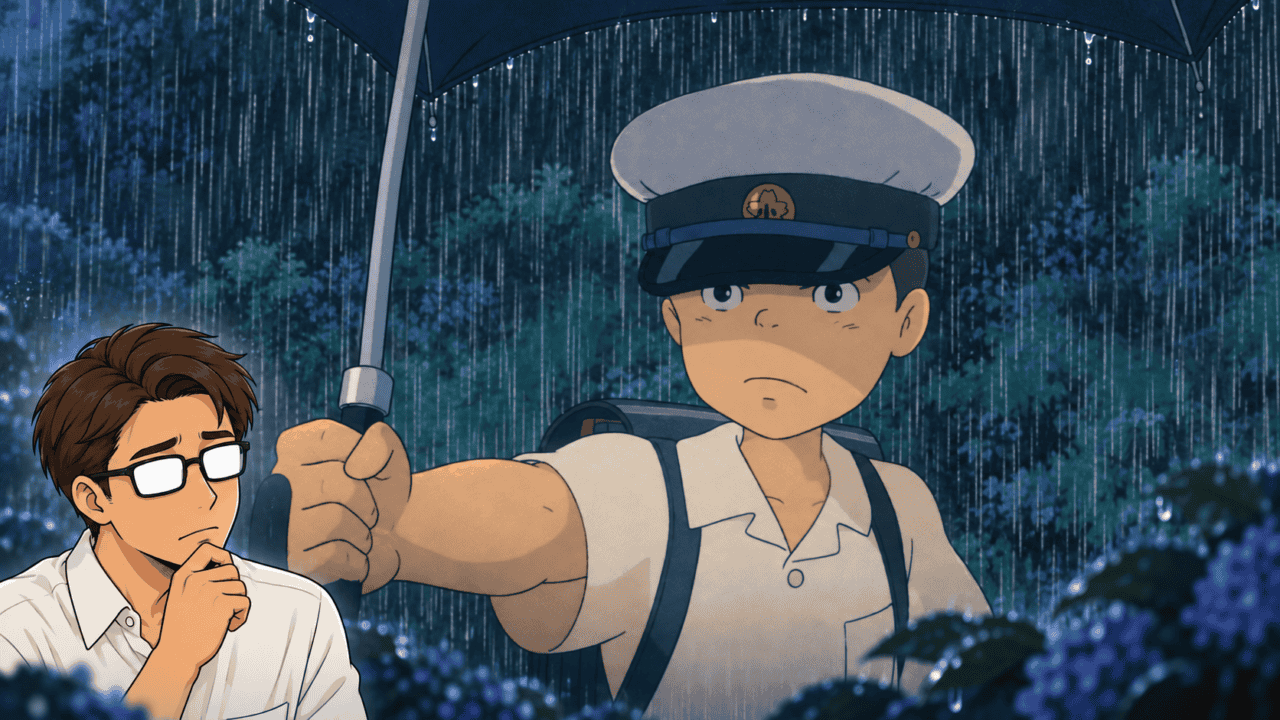
- In another scene, the children are playing by the river after school when a sudden, violent rainstorm hits. While the local children seem completely unbothered by the heavy winds, Matasaburo stands there, violently trembling.
The grandfather’s words make the danger in the first scene explicit. The second is less obvious, but heavy rain by a river can be dangerous. The local children are used to the place and seem unconcerned, while Matasaburo trembles. I think his fear is the appropriate response: he seems to sense the danger approaching.
Matasaburo of the Wind (風の又三郎) seems to me to portray the danger surrounding children, and to suggest that growing up involves encounters with it. In that respect, I see a connection between this work and My Neighbor Totoro.
There is also the wind: the gust that frightens Satsuki while she is fetching firewood, and Totoro and the Catbus moving like the wind itself. I think these works are connected at a fundamental level. My Neighbor Totoro feels almost like Miyazaki’s way of saying, “I would do it like this,” in response to Matasaburo of the Wind (風の又三郎).
Your Take: The Mood of Totoro
The film brings wonder and comfort alongside moments of worry for Satsuki and Mei. What mood stays with you most?
Reader poll
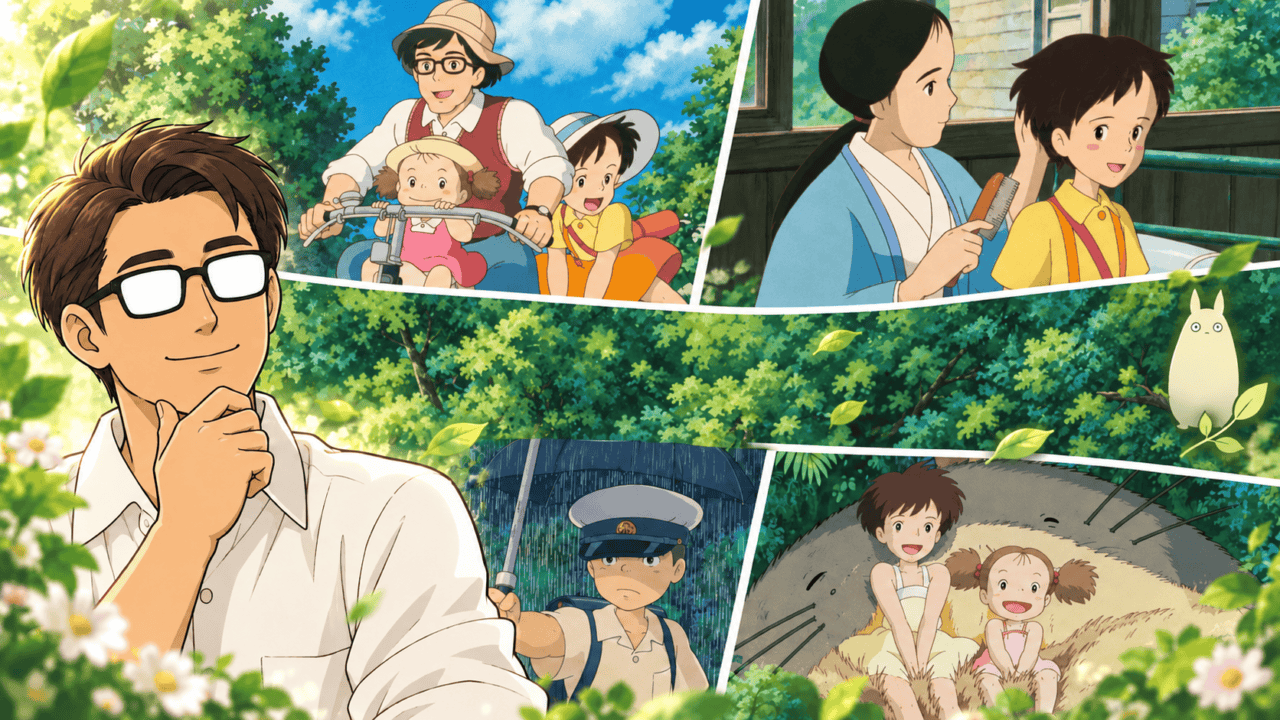
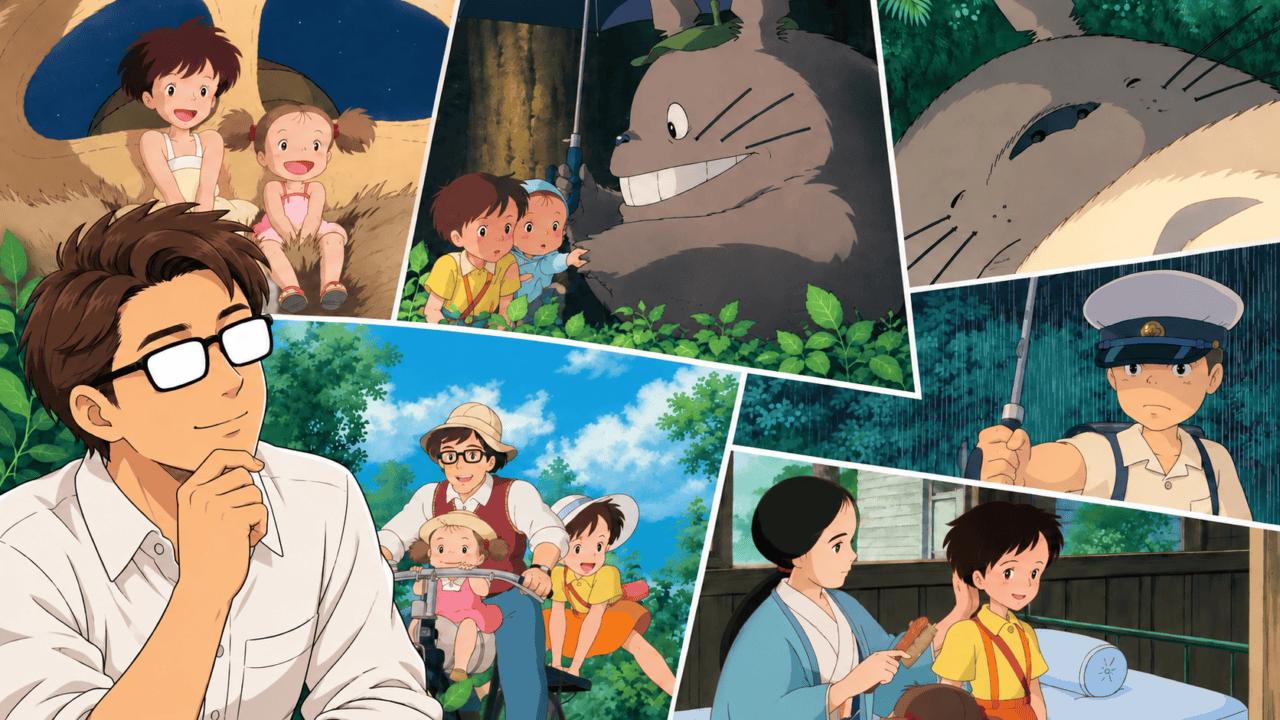
The images used in this article are from the “Studio Ghibli Still Images” collection.
Can you name the movie before the scene comes into focus?
Put your visual memory to the test with a blurred Studio Ghibli scene.


Reader Comments
Have a thought or interpretation? Leave a comment