
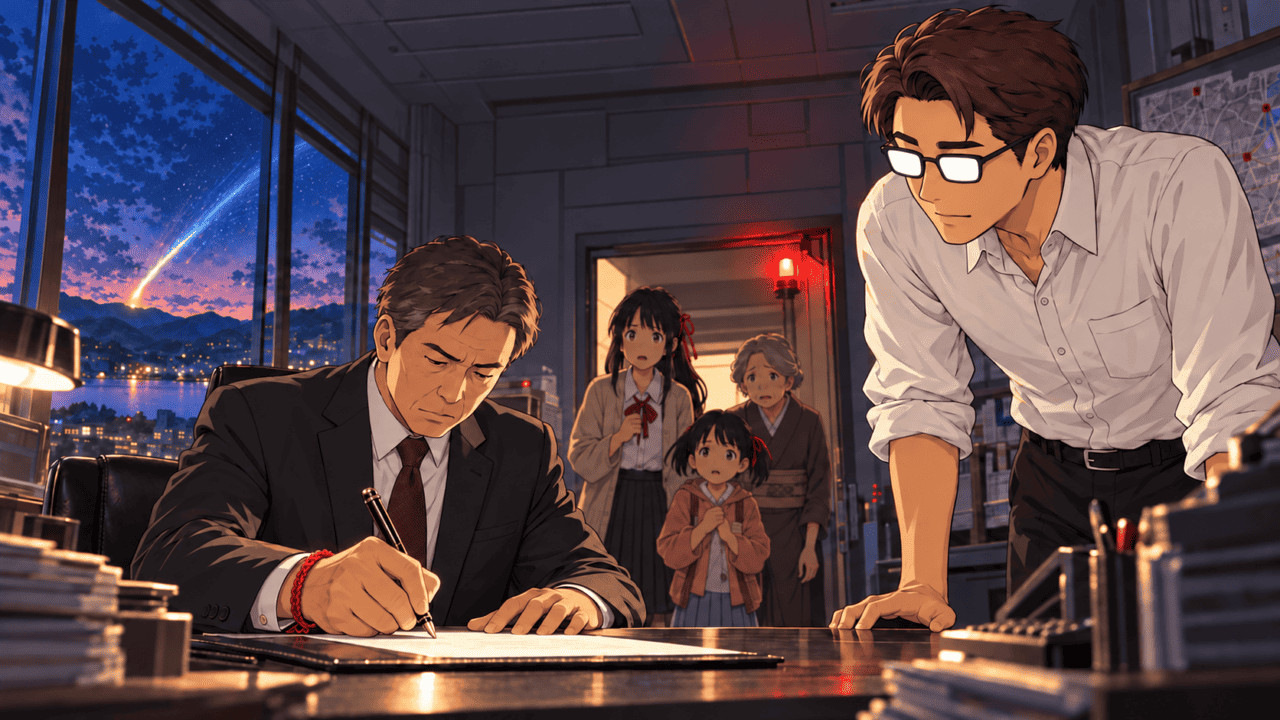
Makoto Shinkai’s Your Name (Official) was released in 2016, three years after The Garden of Words. I remember looking forward to it enormously.
I could not see it on opening day. Before I knew it, it had become a huge hit, and my contrarian streak began to assert itself. I think it was more than a month after release when I finally saw it. I avoided all information in the meantime, and that effort paid off: I thoroughly enjoyed the film.
Here I want to consider why Mitsuha’s father, the mayor, issues the evacuation order at the end. Personally, I have never quite been able to accept that he gives the order. Perhaps others feel the same way.
To make sense of that ending, I think we need to unearth another Your Name hidden within the film.
First, though, let us review the ordinary explanation.
*This is a translated version. The original (Japanese) is available here.
- The Evacuation Order and a Swap with Futaba
On the surface, the mayor appears to yield to his family. My reading is that he has swapped bodies with Futaba, and that Mitsuha’s account of the body swaps and the approaching comet prompts the decision. - The Past Suggested by the Mayor’s Puzzling Words
His remarks about the Miyamizu family’s ‘delusions’ and his failure to save Futaba may suggest that he once heard the future Futaba’s seemingly delusional words and regrets not helping her. - The Miyamizu Women Together
In this interpretation, the office scene brings Mitsuha, Yotsuha, Hitoha, and Futaba—within the mayor’s body—together. It becomes a crucial moment in this reading of Your Name. - The Bicycle and a Change of Worldline
Teshigawara’s failure to recognize the bicycle incident leads me to read the miracle as a move to another worldline, rather than a change to a single future. - Not Making Real Tragedy ‘Never Happen’
Against the memory of the Great East Japan Earthquake, I see Your Name balancing its miraculous escape from tragedy with a branching worldline in which the deaths are not erased.
On this pageContents
Your Name: The Ordinary Explanation for the Mayor’s Order
The following scene gives us a general sense of how the mayor comes to order the evacuation.
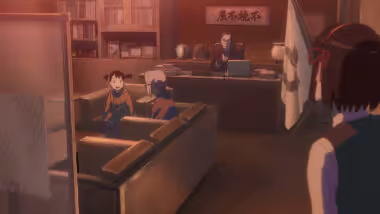
In other words:
- Mitsuha, with Taki in her body, tries to persuade the mayor.
- Hitoha and Yotsuha initially disbelieve the warning about the comet, but eventually ask the mayor to order an evacuation.
- After receiving Taki’s warning, Mitsuha tells the mayor that the comet will strike.
- After four requests from his family, the reluctant mayor finally issues the order.
That seems to be the sequence. Mitsuha’s rush into his office makes a ‘good scene’: a family that has been scattered comes together again.
But is that enough to convince us? It was not enough for me.
To find a slightly more convincing explanation, I think we need to follow the puzzling lines the mayor speaks. Once their meaning becomes clear, another hidden Your Name may emerge.
The Mayor’s Puzzling Words and Another Your Name
The mayor’s wording leaves room for a reading beyond the ordinary explanation of persuasion. The following hypothesis explores that possibility without treating it as confirmed plot.
‘Are Delusions in the Miyamizu Blood?’
When the mayor speaks to Mitsuha with Taki inside her, he asks, ‘Are delusions in the Miyamizu blood?’
This suggests that he has heard someone else’s ‘delusions’ before hearing Mitsuha’s. Whose, and what were they? His next line, ‘Who are you?’, offers a clue.
Taki is, of course, the first to use ‘Who are you?’ In my reading, the mayor’s use of the same words links him in some way to the body swaps.
The repeated question is striking. I also discuss Toshiki’s ‘Who are you?’ and other dialogue in my guide to quotes from Your Name in Japanese and English.
The natural assumption is that the mayor has swapped bodies with someone. But I think that is half right and half wrong. To explain why, let us look at another puzzling line.
‘I Couldn’t Save Her’
When Taki drinks the kuchikamizake to try to swap with Mitsuha again, he travels through memories handed down by the Miyamizu family. He sees the mayor, then a shrine priest, at what appears to be the moment just after Futaba’s death.
There the mayor says, in anguish, ‘I couldn’t save her.’
For a moment, that seems understandable. Yet it is an odd thing to say. The mayor is not a doctor: saving Futaba was not something he could have done in the first place.
From here, we have to let our imaginations take flight.
Perhaps he means ‘I did not do what I ought to have done.’
Perhaps, shortly before her death, Futaba swapped bodies with the future mayor. Faced with her strange words and behavior, her husband may have been at a loss. She then had to be hospitalized—because of an illness, perhaps—and died.
Might his ‘I couldn’t save her’ express regret that he could have done more for Futaba when she was speaking incomprehensible ‘delusions’?
My Reading of Why the Mayor Gives the Order
If we follow this line of thought, the meaning of the scene changes.
Here is how I read it:
The mayor in this scene has swapped bodies with Futaba. I imagine Mitsuha tells him not only that the comet will strike, but also that she learned this by swapping with someone whose name she has forgotten. This extraordinary convergence prompts Futaba, in the mayor’s body, to issue the evacuation order.
On that reading, the scene does more than reunite a scattered family: it brings the four Miyamizu women together.
That brings me to the first conclusion of this article:
‘The mayor orders the evacuation because he has swapped bodies with Futaba.’ That is the explanation I am proposing.
Can I end the article there? I do not think I should.
A serious question remains: did the order really save the people of Itomori?
That may sound puzzling. It concerns a kind of ‘meta-structure’ in Your Name, and I think it matters greatly to what the film means.
The clue is Teshigawara’s puzzling reaction.
A Changed Worldline Rather Than a Changed Future
Changing how the worldlines connect also changes what it means for the future to be saved. This distinction helps clarify the hypothesis developed above.
Why Doesn’t Teshigawara Recognize the Bicycle Incident?
Near the end, Taki faces the mayor in Mitsuha’s body and fails spectacularly to persuade him. He borrows Teshigawara’s bicycle and heads for the mountaintop. The bike is wrecked along the way, but he reaches the summit and reunites with Mitsuha, who has been wandering in the otherworld. He tells her the comet will strike, and they part. Later, Mitsuha apologizes for the bicycle, but Teshigawara, riding a moped, has no idea what she means. Why?
I think there are two ways to understand stories that change the world across time and space. One is the Back to the Future model: changing the past changes the future. The other is the Steins;Gate model: changing the past changes the worldline.
The first model does not explain Teshigawara’s reaction in Your Name.
The decisive change in the film occurs when Mitsuha and Taki meet on the summit, after the bicycle has been borrowed. If the future changes at that point, it is strange that Teshigawara does not recognize the incident. (To be honest, it is also strange that Mitsuha knows about the bicycle.) This leads me to think that what changes in Your Name is the worldline, rather than the future.
That might simply reflect Shinkai’s tastes: The Place Promised in Our Early Days also depicts parallel worlds.
But I think it means something more in Your Name.
We Must Not Make Real Disasters ‘Never Happen’
Going back into the past to change the world is a human dream. Perhaps it also expresses the regret we cannot help feeling over tragedies we were powerless to prevent.
To my mind, Your Name clearly has the Great East Japan Earthquake in view.
Perhaps Mitsuha and Taki’s miracle gives form to the wishes of those of us who have experienced disasters and tragedies. That may be one reason the film is so enjoyable and moving—only one of the reasons, of course.
But we must not forget that their miracle is a lie: it is fiction.
Tragedies have occurred in the world we live in. They are facts, and we cannot change them. That is why human life is precious, and why we must not live carelessly. Surely the same should hold within Your Name.
Within the film, the comet strikes Itomori and many lives are lost. That event should not simply be erasable.
Movies and animation can offer a brief dream, healing, or comfort amid a reality we cannot change—though not every work does so. But that comfort is fiction: a lie.
Perhaps one of a creator’s struggles is deciding how much of a lie to offer the audience. Animation, in principle, can do anything. There must be countless tricks for giving viewers a sweet dream.
Yet I see Your Name striking a delicate balance by choosing a changed worldline rather than a changed future.
Mitsuha and Taki have indeed made a miracle happen, but, in this reading, the fact that many people died has not disappeared.
If real tragedies cannot be made ‘never to have happened,’ neither should tragedies within a fiction be made ‘never to have happened.’
One of the things I find wonderful about Your Name is that I can glimpse a creator struggling against this original sin of film and animation.
Your Name: Final Thoughts
I seem to have taken a rather neat detour. Let me sum up:
The mayor’s evacuation order still feels unconvincing to me on an ordinary reading. But his puzzling words allow me to imagine that he and Futaba have swapped bodies at the end. On that basis, his decision seems somewhat more natural.
Teshigawara’s reaction also suggests to me that Mitsuha and Taki change the worldline rather than the future. This may reflect Shinkai’s preferences, but it might also express a wish not to make something that happened ‘never have happened.’
Perhaps we glimpse the effort of creators making their work while wrestling with film and animation’s original sin: earning money by offering audiences lies.
That is where my thinking stands. For the full story and other questions, including why the two protagonists meet again, see my synopsis and analysis of Your Name. My reading is still provisional and has contradictions. I hear that many people dislike their eventual reunion; personally, I think they have to meet again. I will consider that in another article.
Your Take
What is your view? Choose the answer that comes closest to your own response.
Reader poll


Reader Comments
Have a thought or interpretation? Leave a comment